
As an Amazon Associate, 456 AutoFix earns from qualifying purchases. Product links below go to Amazon, where you can confirm the right part for your vehicle.
The dashboard tire light usually wakes up on the first frosty morning of fall, and the gas station air hose rarely has a gauge you can trust. The best tire pressure gauge is simply one you can read easily, that stays accurate, and that you actually keep within reach.
This guide explains the four common gauge styles, where your correct number really comes from, and then five gauges worth owning. If you also want to know how much rubber is left, see our guide to the best tire tread depth gauge.
Quick answer
Which tire pressure gauge should most drivers buy?
For most drivers, a backlit digital gauge such as the AstroAI 150 PSI is the easiest to read. If you would rather skip batteries, a dial gauge like the JACO ElitePro holds its reading and has a bleeder valve. Own an air compressor? An inflator gauge checks and fills in one step.
Our Quick Picks
Three starting points: a backlit digital gauge for most drivers, a battery-free dial gauge with a bleeder valve, and an inflator gauge for anyone with a compressor. All five picks are covered below.
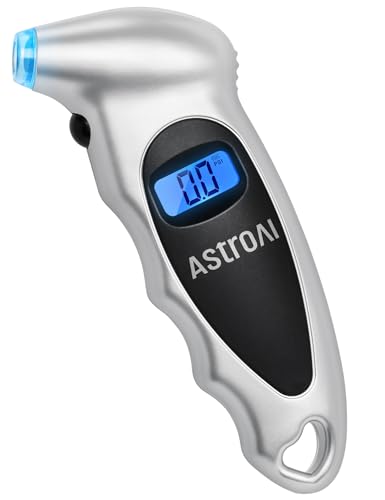
AstroAI Digital 150 PSI
A simple press-on gauge that is easy to read in a dark driveway.
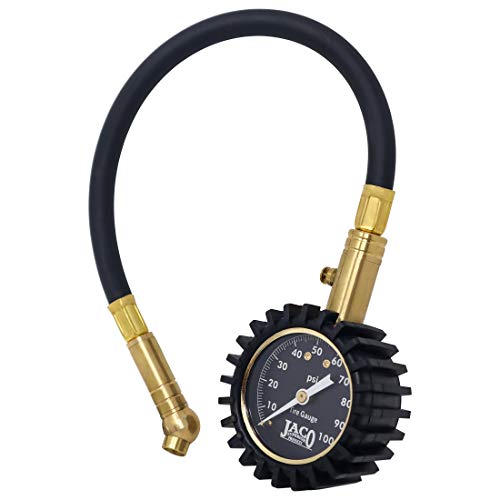
JACO ElitePro 100 PSI
A solid brass dial gauge that locks the reading and lets air out.

AstroAI Digital Inflator
Fills, bleeds and reads tire pressure in a single tool.
Digital, Dial, Pencil or Inflator: Picking a Gauge Type
Every gauge does the same basic job: it presses onto the valve stem and reports the air pressure inside the tire. How it shows that number, and what else it can do, is where the four styles split apart.
- Digital: a numeric screen, often backlit, that is easy to read at night. It runs on a small battery, and a cold glovebox can sap a weak one.
- Dial: a round analog face on a short hose. No battery, a sturdy feel, and many hold the reading until you press a reset button.
- Pencil: a slim metal stick with a sliding scale. It is the smallest and simplest option, though the markings are harder to see in poor light.
- Inflator gauge: a trigger handle that connects to a shop or garage air compressor, so you can add or release air while you watch the reading.
Shoppers asking for the best tire pressure gauge brand will see the same names again and again: AstroAI, JACO, Rhino USA and Milton. Brand matters less than a stated accuracy rating, a range that suits your tires and a chuck that seals cleanly on the valve. For a best home tire pressure gauge kept in the garage, a dial or inflator style makes sense; for the car, a compact digital or pencil gauge fits better.
What Pressure Should the Gauge Read?
The target is not the number molded into the tire sidewall. That figure is the maximum the tire can hold, not what your vehicle needs. The right setting is on the placard inside the driver’s door jamb, and sometimes on the glovebox door or in the owner’s manual.
The government’s fuel economy maintenance tips say the same thing and add that proper inflation improves mileage by 0.6% on average. They estimate that average pressure falling by 1 psi costs roughly 0.2% in mileage. Some vehicles list different front and rear pressures, so read the placard closely.
Best Tire Pressure Gauge Options, Reviewed One by One
The five picks cover each gauge style, starting with the one that suits the widest range of drivers. All of them fit the standard Schrader valves used on cars, SUVs and light trucks.
1. AstroAI Digital Tire Pressure Gauge: 0-150 PSI with Backlit LCD and Lit Nozzle
- Listed accuracy of plus or minus 1 PSI
- Backlit screen and illuminated nozzle
- Reads PSI, Bar, kgf/cm2 and kPa
- Shuts off after 30 seconds idle
The AstroAI digital gauge is a compact, press-and-read tool built around a backlit LCD. The listing gives its accuracy as plus or minus 1 PSI across a 0 to 150 PSI range, which comfortably covers passenger car, SUV and compact spare tires. A light in the nozzle helps you find the valve stem at night, and the screen stays readable in a dim garage.
One button turns it on and cycles through four units: PSI, Bar, kgf/cm2 and kPa. Most drivers will leave it on PSI to match the door placard, but the other scales help if you own a European vehicle or follow a manual that lists metric figures. The gauge powers itself down after 30 seconds without use, and it fits standard Schrader valves.
The body is small enough for a glovebox or door pocket, which makes it a natural everyday choice. The trade-off is the battery. The maker suggests replacing it when a low warning appears and removing it during long storage to avoid leaks, so pack a spare if the gauge lives in a cold car all winter. It cannot add air, so pair it with a pump or compressor.
View AstroAI Digital 150 PSI on Amazon
2. JACO ElitePro Tire Pressure Gauge: 100 PSI Glow Dial with Bleeder Valve
- ANSI-rated accuracy within 1.5 percent
- No batteries needed
- Built-in air bleeder valve
- Reading holds until you press reset
The JACO ElitePro is an analog dial gauge for drivers who would rather not think about batteries. The listing says each unit is calibrated within ANSI standards to plus or minus 1.5 percent. The 2 inch face carries a 100 PSI scale in single-pound steps and glows in the dark, so it stays readable at dusk.
Two features make it practical. The needle holds its position after you pull the chuck away, so you can read it at a comfortable angle, then press the reset button on the brass neck to zero it. A built-in bleeder valve lets you release air from an overfilled tire without a separate tool, which is handy after topping up at a gas station.
The gauge is solid brass inside a shock-resistant guard, with a flexible hose and a 360-degree swivel chuck that reaches awkward valve stems. JACO backs it with a lifetime warranty. It is bulkier than a pencil gauge, so it suits a garage shelf or trunk organizer better than a pocket. Anyone searching for the best JACO tire pressure gauge for battery-free use will find this model a sensible fit.
View JACO ElitePro 100 PSI on Amazon

3. Rhino USA Heavy Duty Tire Pressure Gauge: 0-75 PSI Glow Dial with Braided Hose

- 0 to 75 PSI range
- ANSI B40.1 certified accuracy
- 2 inch glow-in-the-dark dial
- Solid brass 360-degree swivel chuck
Rhino USA’s heavy-duty gauge is another battery-free dial design, scaled from 0 to 75 PSI. That range suits passenger cars, crossovers, motorcycles and light trucks running ordinary tire pressures, and a narrower scale can make each pound easier to read on the face. The listing states that it is certified to ANSI B40.1 accuracy.
The 2 inch dial glows in the dark, and the hose is braided to resist leaks and kinks. The brass chuck swivels a full 360 degrees, which helps on wheels where the valve stem sits close to the brake caliper or a deep spoke. The company describes itself as a small family business in California and offers a lifetime warranty on the gauge.
Compared with the JACO, this one has no bleeder valve, so you will need to let air out by pressing the valve core if a tire is overfilled. The 75 PSI ceiling also rules out heavy-duty truck tires and trailers with higher ratings. For a sturdy, simple gauge to keep in the garage or truck, it is a straightforward choice that needs no batteries on a cold morning.
View Rhino USA Glow Dial on Amazon
4. Milton S-921 Pencil Tire Pressure Gauge: 5-50 PSI with Built-in Deflator

- Reads 5 to 50 PSI in 1 lb steps
- Also marked 40 to 350 kPa
- Built-in deflator valve
- Machined plated brass, made in the USA
The Milton S-921 is the classic pencil-style gauge: a slim plated brass tube with a white nylon indicator bar that slides out when you press the chuck onto the valve. Milton points out that it uses machined parts and is made in the USA. The scale reads 5 to 50 PSI in 1 pound increments, with a kilopascal scale from 40 to 350 on the other side.
That range is aimed squarely at passenger cars, which is how the maker positions it. A built-in deflator valve lets you trim pressure if a tire comes out a little high. With no screen or battery, Milton notes it is handy in cold weather, and it takes up almost no room in a door pocket, console or tool roll.
The compromise is readability. The small printed markings are harder to see in dim light than a glow dial or backlit screen, and you need a steady hand to read the bar precisely. The 50 PSI top also means it will not cover many light truck tires or compact spares with higher ratings. It works well as a second gauge for another car or as a glovebox backup.

5. AstroAI Digital Tire Inflator Gauge: 3-250 PSI with Lock-On Chuck and Backlit LCD
- Inflate, deflate and read in one tool
- Listed accuracy of 1 percent, 0.1 PSI display
- Lock-on brass chuck and 19.7 in hose
- Backlit screen with LED light
AstroAI’s inflator gauge combines a pressure reader with an air chuck and trigger handle. It connects to an air compressor through a quick-connect coupler, so it is the right answer for anyone looking for a tire pressure gauge and pump setup at home rather than a standalone gauge. Squeeze the trigger to add air, press a button to release it, and watch the backlit screen.
The listing gives accuracy as plus or minus 1 percent across a 3 to 250 PSI range, with readings in 0.1 PSI steps. AstroAI notes that differences of about 2 PSI between readings fall within normal tolerance. The brass chuck locks onto the valve stem with a lever, and the 19.7 inch rubber hose is built to resist kinks. A small LED helps locate the valve stem in a dark parking spot.
The screen switches on when it senses airflow and turns off after 15 seconds idle. The main limit is obvious: without a compressor it is only a large gauge, so it makes little sense for a glovebox. Paired with a garage compressor, though, it turns a monthly check and top-up into one quick job instead of two.
View AstroAI Digital Inflator on Amazon
Quick Comparison of the Five Gauges
Here is how the picks line up. Ranges and accuracy figures are taken from each Amazon listing.
| Gauge | Style | Range as listed | Good fit |
|---|---|---|---|
| AstroAI 150 PSI | Digital | 0-150 PSI | Most drivers, night checks |
| JACO ElitePro | Dial with bleeder | 0-100 PSI | Battery-free home use |
| Rhino USA | Glow dial | 0-75 PSI | Cars and light trucks |
| Milton S-921 | Pencil | 5-50 PSI | Glovebox backup |
| AstroAI Inflator | Digital inflator | 3-250 PSI | Garages with a compressor |
If you only buy one, the best tire pressure gauge for a beginner is usually a digital model, since the number is hard to misread. If you already own a compressor, the inflator gauge is the best value tire pressure gauge in practice, because it replaces two tools. The pencil gauge is the one to keep as a spare for a second car.

How to Use a Tire Pressure Gauge Correctly
A good gauge still gives a misleading number if the reading is taken at the wrong time. These steps keep it honest:
- Check cold: measure before driving or after the car has sat for a few hours, since driving warms the air and raises the reading.
- Remove the valve cap: set it somewhere it cannot roll away.
- Press straight and firm: push the chuck squarely onto the stem. A hiss means a poor seal, so reseat it and read again.
- Compare to the placard: add air if the number is low, or use the bleeder or deflator to let some out if it is high.
- Do all four, then the spare: a compact spare often needs a higher pressure, which is printed on the placard or the spare itself.
Check monthly and before long trips. Taking two readings and keeping the second is a simple way to catch a bad seal.

Michigan Cold Snaps, Potholes and Your Tires
Air contracts as it cools, so tires that were fine in a warm September often read low after the first hard freeze. That is why the warning light tends to appear on cold mornings. Even the best tire pressure gauge only helps if you use it, so add a monthly check to the steps in our winter car maintenance checklist and recheck after big temperature swings.
Underinflated tires also give the wheel less cushion when it drops into a pothole, which West Michigan roads supply in quantity each spring. If you notice a pull, a crooked steering wheel or a new clunk after a hard hit, compare those symptoms with our list of pothole damage signs.

A tire that keeps losing air, or uneven wear on the inner or outer edge, can point to a leak or to bent steering and suspension parts. Our shop handles the steering and suspension side through suspension repair in Grand Rapids.
More Buying Guides
Frequently Asked Questions
What type of tire pressure gauge is most accurate?
Accuracy depends more on the individual gauge than the style. Look for a stated rating, such as an ANSI B40.1 or B40.7 grade or a plus or minus figure in PSI, and treat unrated bargain gauges with caution. Comparing a new gauge against a second one is a quick sanity check.
Should I trust the gauge on a gas station air pump?
Use it as a rough guide only. Station gauges take a lot of abuse and are rarely checked, so confirm the final reading with your own gauge before you drive off.
Is there a best Presta tire pressure gauge for cars?
Car tires use Schrader valves, and every gauge in this guide is made for those. Presta valves are found on many bicycles. Checking one of those calls for an adapter or a gauge whose listing specifically names Presta support.
How often should I check tire pressure?
At least once a month and before long drives, with the tires cold. In a Michigan winter, a check after a sudden temperature drop is also worthwhile, since cold air lowers the reading.
Tires keep losing air or wearing unevenly even with the gauge in hand? Give 456 AutoFix a call at 616-279-3832, Monday through Friday from 8am to 5pm, or book a time through our contact page.
If your workday overlaps our hours, the after-hours drop-off at 456 Carrier St NE, Grand Rapids, lets you leave the car and keys with us outside business hours.