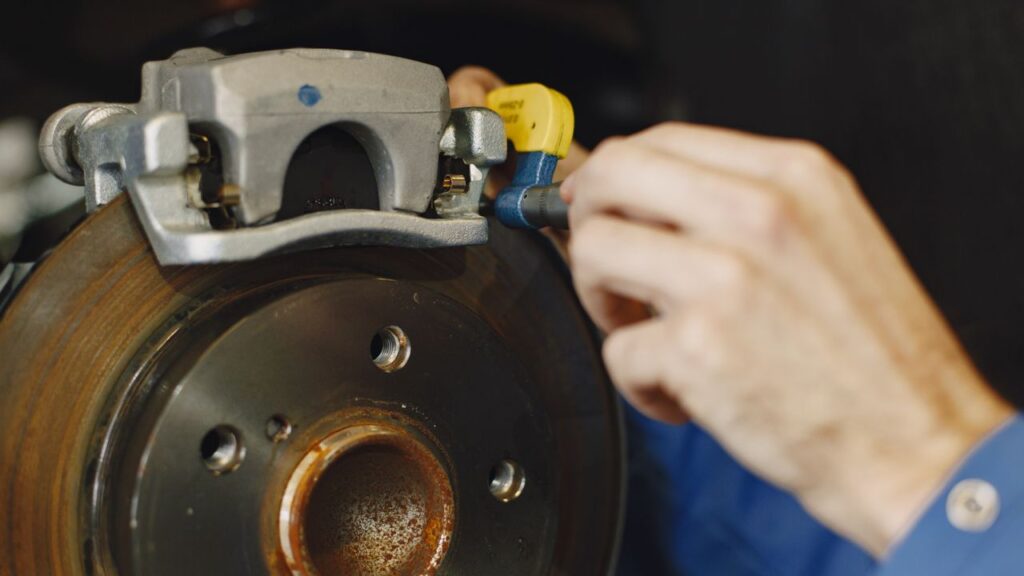
Your brakes usually warn you before they fail. A squeal, a grinding noise or a pedal that feels different are all signs worth acting on. At 456 AutoFix in Creston, we handle brake repair in Grand Rapids, MI on foreign and domestic vehicles, from pad replacement to rusted brake lines.
Quick answer
What are the signs my brakes need repair?
Squealing usually means your pads are getting thin, and grinding often means they are worn to metal. A soft pedal or a red brake warning light can point to a fluid leak, often from a rusted brake line in Michigan. For brake repair in Grand Rapids, MI, call 456 AutoFix at 616-279-3832.
A brake system is simple in principle. Your foot pushes fluid through steel lines and rubber hoses to the calipers, which squeeze pads against the rotors. When any part of that chain wears, leaks or sticks, you feel it, hear it or see a light on the dash.

Signs you need brake repair
Use this table to judge how soon your car should be looked at. When in doubt, have it checked.
| Symptom | Likely cause | How urgent |
|---|---|---|
| High-pitched squeal when braking | Pad wear indicator touching the rotor, or glazed pads | Soon Book within a few weeks |
| Grinding or scraping | Pads worn to the backing plate, metal on metal | High Stop driving as soon as you can safely |
| Pulsing or shaking pedal | Uneven rotor thickness, often called warped rotors | Moderate Have it checked soon |
| Soft, spongy or sinking pedal | Fluid leak, air or moisture in the fluid, failing master cylinder | High Don’t drive until inspected |
| Car pulls to one side when braking | Sticking caliper, collapsed hose or uneven pad wear | High Have it checked promptly |
| Red brake warning light | Low fluid or a hydraulic fault (check the parking brake is off) | High Have it checked before driving far |
| Amber ABS light | Wheel speed sensor, wiring or ABS module fault | Moderate Normal braking works, but ABS may not |
A light grinding after the car sits through a wet night is often surface rust on the rotors, and it usually clears after a few stops. If it stays, it’s the pads. A humming or growling that changes with speed rather than braking is more often a bearing, so see our page on wheel bearing replacement in Grand Rapids.
ABS lights usually trace back to a sensor or wiring fault. We diagnose those as part of our auto electrical repair and diagnosis work.

Brake repair in Grand Rapids, MI: what a brake job includes
“Brake job” can mean a lot of things. Here is what we inspect and what may need replacing.
| Part | What it does | When it’s replaced |
|---|---|---|
| Brake pads | Friction material that grips the rotor | When worn near the minimum, or squealing or grinding |
| Rotors | Metal discs the pads squeeze | When below minimum thickness, deeply grooved, cracked or causing pulsation |
| Calipers and slide pins | Clamp the pads onto the rotor | When seized, leaking or causing uneven wear |
| Rubber brake hoses | Flexible link to each wheel | When cracked, swollen or leaking |
| Steel brake lines | Carry fluid along the underbody | When rusted, pitted or leaking |
| Brake fluid | Transfers pedal pressure | At the owner’s manual interval, or after hydraulic repairs |
Some cars only need pads. Others need a caliper or a line as well.
Brake pad replacement: resurface or replace the rotors?
Not every pad replacement needs new rotors. Every rotor has a minimum thickness stamped or cast into it, and resurfacing removes metal. If a rotor would end up under that limit, it gets replaced.
| Condition | Resurface | Replace |
|---|---|---|
| Thickness | Stays above minimum after the cut | At or near minimum |
| Surface | Light scoring | Deep grooves, cracks or hard spots |
| Pulsation | Mild, with enough metal left | Severe, or returns after resurfacing |
| Rust | Light surface rust | Heavy rust or flaking edges |
Many modern rotors are thinner from the factory, so replacement is common. Rotors are done in pairs on the same axle so both sides brake evenly.

Michigan road salt and brake line repair
Most cars run steel brake lines along the underbody, right where salty slush sprays all winter. Over several Michigan winters, those lines can rust from the outside until they pit and leak. The first sign is often a pedal that slowly gets softer, a damp spot near a wheel, or the brake warning light.
This is a real salt-belt problem. Several automakers have run recalls and service campaigns for brake line corrosion on vehicles in high-salt states. You can enter your VIN at the Check To Protect VIN recall lookup to see if your car has an open recall.
- Rinse the underbody during thaws to wash off salt.
- Ask for a look at the brake lines whenever your car is on a lift.
- Never ignore a sinking pedal. A rusted line can let go under hard braking.
When a line is rusted, we replace the damaged section or the full run, then bleed the system. Our Michigan winter car maintenance guide covers more ways to protect your car from salt and cold.

Brake fluid basics
Most cars use glycol-based fluid, labeled DOT 3, DOT 4 or DOT 5.1. It absorbs moisture from the air over time, which lowers its boiling point and can corrode parts inside the calipers and ABS unit. That’s why fluid is changed by time as well as miles.
Intervals vary by make, so check your owner’s manual. Use only the fluid type listed on your reservoir cap. A low level can mean a leak or very worn pads. Fluid changes fit well with your factory scheduled maintenance in Grand Rapids.
Audi and European brake repair
Many Audis and other European cars use an electronic parking brake. The rear calipers have motors, and they must be put into service mode with a scan tool before the pistons can be retracted. Forcing them back by hand can damage the caliper.
These cars also often use electronic pad wear sensors that trigger a dash warning. The sensor is usually replaced along with the pads. Hendrick Hoffman, our owner, is Audi factory trained, and you can read more on our Audi repair service in Grand Rapids page.
We also work on brakes for other foreign and European vehicles in Grand Rapids. If your Audi is under factory coverage, our guide to using an independent shop without voiding your Audi warranty explains your options.
Why bring your brakes to 456 AutoFix
- Hendrick Hoffman has worked in automotive service since 2005 and is a Universal Technical Institute graduate.
- He is ASE and State of Michigan certified in brakes, and in steering and suspension. Meet our certified Grand Rapids mechanic.
- We work on foreign and domestic vehicles, with a focus on Audi and European cars.
- We tell you what we found before any parts go on.
Pulling can also come from worn tie rods or struts, covered by our suspension and steering repair. See everything else we do on our auto repair services in Grand Rapids page, and find our CARFAX and BBB ratings on the 456 AutoFix homepage.

Related guides
Frequently Asked Questions
Is it safe to drive with grinding brakes?
Not for long. Grinding usually means the pads are worn to metal, which damages the rotors and makes stopping distances longer. Get it inspected as soon as you safely can.
Do I need new rotors every time I replace brake pads?
Not always. If the rotors are above minimum thickness and free of deep grooves, cracks or pulsation, they may be resurfaced or reused. If not, they are replaced in pairs.
Why does my brake pedal feel soft?
A soft or sinking pedal usually means air or moisture in the fluid, a fluid leak or a failing master cylinder. In Michigan, a rusted steel brake line is a common cause. Have it checked before you drive further.
How often should brake fluid be changed?
It depends on the make, so follow your owner’s manual. Brake fluid absorbs moisture over time, so it’s changed by age as well as mileage.
Need brake repair in Grand Rapids? Call 456 AutoFix at 616-279-3832, Monday to Friday 8am to 5pm, or book through our contact page.
Can’t make it during the day? Use our after-hours drop-off. We’re at 456 Carrier St NE in Creston.