
As an Amazon Associate, 456 AutoFix earns from qualifying purchases. Product links below go to Amazon, where you can confirm the right part for your vehicle.
A tire pressure light rarely comes on when you are parked next to an air hose with a gauge in hand. The best tire pressure gauge to keep in car storage is the one that is still accurate, readable and working after months in a glove box that swings from freezing to sweltering.
This guide focuses on that one job: a gauge that lives in the vehicle full time. For gauges for the garage bench and every other use, see our main guide to the best tire pressure gauge.
Quick answer
What kind of tire gauge should live in your glove box?
A battery-free gauge is the safest bet for a car that sits out in heat and cold. A glow dial such as the AstroAI A1 is the easiest to read, while a brass pencil gauge like the Milton S-920 takes almost no space. Choose digital only if you will replace the batteries every year.
Our Quick Picks
Three easy places to start: a battery-free glow dial, a slim brass pencil gauge and a backlit digital gauge for drivers who prefer a number on a screen. All six options are covered below.
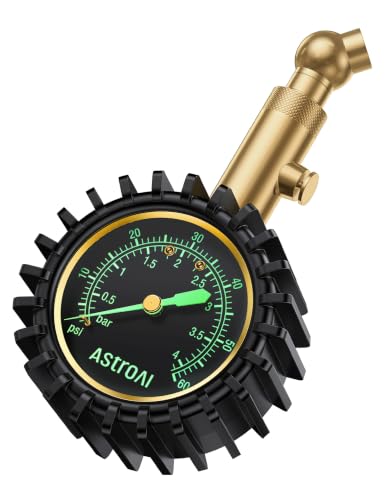
AstroAI A1
A glow dial that reads the same in a frozen or sun-baked car.

Milton S-920
A slim brass gauge that slips into a door pocket or console.

AstroAI Digital
A clear number on a lit screen, even in a dark lot.
What a Gauge Stored in the Car Has to Survive
A gauge that rides in the car lives with temperature swings, vibration and being tossed around in the glove box. Look at these points before you buy:
- Power source: pencil and dial gauges need no batteries. Digital gauges do, and cold weather saps batteries just when you need the reading.
- Range that fits your tires: most cars and crossovers run roughly 30 to 40 psi cold. A gauge whose scale tops out near 60 psi spreads those numbers out and makes them easier to read.
- Bleed valve: a button that lets air out helps you trim an overfilled tire down to the right number.
- Readability in the dark: a glow dial or a backlit screen saves fumbling for a light on a winter evening.
Pencil, Dial or Digital for the Glove Box?
Pencil gauges are the smallest and simplest. A bar slides out of the barrel when you press the head onto the valve, and you read the pressure where the bar stops. They need no battery, but the markings are small and the slide can stick if dirt gets inside.
Dial gauges show the pressure with a needle, which most people find quicker to read. Better ones carry a rubber shell and a glow-in-the-dark face. Digital gauges give an exact number on a screen, often backlit, but they rely on batteries that weaken in the cold and can leak if forgotten for years.
Best Tire Pressure Gauge to Keep in Car: Six Glove Box Options
The list starts with mechanical gauges that need no batteries and ends with one compact digital option. Every pick fits the standard Schrader valves found on passenger cars.
1. AstroAI A1: 2-60 PSI Battery-Free Gauge with 2 in Glow Dial
- 2-60 psi range with PSI and BAR scales
- Calibrated to ANSI B40.1 (plus or minus 1%)
- No batteries or electronics
- Rubber armor over a brass body
The AstroAI A1 is a mechanical dial gauge built for the range most passenger tires actually use. Its scale runs from 2 to 60 psi, so the markings are spread wide enough to read a 33 or 35 psi target at a glance instead of squinting at tiny tick marks. AstroAI lists it as calibrated to ANSI B40.1 with plus or minus 1% accuracy, and the 2 inch face carries PSI and BAR on the same dial.
What makes it a good glove box companion is what it leaves out. There are no batteries or electronics inside, so a week of subzero mornings or a parked car in July does not leave you with a blank screen. The pointer glows in the dark, which helps when a low tire light comes on after sunset, and a rubber shell wraps the brass body to soak up the knocks it will take rattling around with registration papers and napkins.
The chuck rotates to meet the valve stem at an awkward angle, and the listing says it fits standard Schrader valves on cars, SUVs, motorcycles and pickups. The trade-off is the 60 psi ceiling: it is the wrong tool for a heavy-duty truck or trailer tire set much higher than that. It is also a bit bulkier than a pencil gauge.
2. Milton S-920: 10-70 PSI Brass Pencil Gauge with Tread Depth Gauge
- 10-70 psi in 2 lb steps, plus kPa
- Built-in deflator valve
- Tread depth scale in 1/16 in steps
- Plated brass with machined parts
The Milton S-920 is a classic pencil gauge, and this version is aimed at higher-pressure car tires. The sliding bar reads 10 to 70 psi in 2 lb increments, with a kPa scale on the other side for anyone following a metric placard. The body is plated brass, and Milton points out that its pencil gauges use machined parts rather than the stamped pieces found in many low-cost copies.
Two extras earn it a spot in the car. A deflator valve lets you let air out when a gas station hose overfills a tire, so you can trim down to the door jamb number without guessing. The other end doubles as a tread depth gauge marked in 1/16 inch steps, which gives you a quick way to watch how your tires are wearing as winter approaches.
The S-920 is about as thin as a ballpoint pen, so it fits a door pocket, sun visor clip area or center console where a dial gauge would not. The maker describes it as handy in cold weather, and with no battery there is nothing to drain. Reading a sliding bar takes a little more care than a dial or screen, and the 2 lb steps are coarser than a digital readout.

3. DEWALT DXCM032-0163: 10-70 PSI Pencil Gauge with Tread Depth and Clip

- 10-70 psi slide indicator
- Tread depth gauge in 1/16 in steps
- Metal pocket clip
- Deflator button on the back of the head
DEWALT’s dual-function pencil gauge covers the same everyday 10 to 70 psi range as most car pencil gauges, with a slide indicator that pops out of the barrel when you press the head onto the valve. Like the Milton, it combines a pressure gauge and a tread depth gauge in one tool, with the depth scale marked in 1/16 inch increments.
The detail that sets it apart for in-car storage is the metal clip. You can clip it to a sun visor strap, a seat-back pocket or the edge of a console bin so it stays put instead of sliding under a seat after a hard stop. A deflator button on the back of the head releases air in small bursts, which is useful after topping up at a station with an unreliable hose gauge.
Pencil gauges need no power, so this one is ready whether the car sat in a cold driveway all week or baked in a summer parking lot. It suits drivers who already use DEWALT tools and want a gauge that matches the rest of their kit. As with any slide gauge, read it straight on and close to eye level, and keep it in a pocket or pouch so grit does not get into the barrel.
View DEWALT DXCM032-0163 on Amazon
4. ETENWOLF Pencil Gauge 2 Pack: 10-50 and 20-120 PSI with Storage Cases

- Two gauges: 10-50 psi and 20-120 psi
- ANSI B40.1 Grade B calibration
- Stainless body, zinc alloy head
- Two cases and 16 valve caps included
ETENWOLF sells this set as two separate pencil gauges with different ranges: one reads 10 to 50 psi and the other 20 to 120 psi. That split is practical for a household with a sedan and a pickup, or a car plus a utility trailer, because each vehicle can carry the gauge that suits its tires. Both are calibrated to ANSI B40.1 Grade B, and each has its own calibration number printed on the barrel.
The bodies are stainless steel with a zinc alloy head, so there is no plastic to crack in a cold glove box. Each gauge comes with a storage case, which is a sensible habit for any pencil gauge because it keeps lint and dirt away from the slide. The pack also includes 16 valve stem caps, handy since caps tend to go missing after a few seasons of road salt and slush.
Both gauges can also be used to let air out when a tire has been overfilled. The lower-range gauge spreads its markings across a narrower span, which makes typical car pressures a little easier to read. The higher-range one is the right choice for light truck tires, but it is not meant for high-pressure bicycle tires with Presta valves.
View ETENWOLF Pencil 2 Pack on Amazon

5. Slime 20049: 5-60 PSI Large Face Dial Gauge with Pressure Release

- 5-60 psi range
- 56 mm large face dial
- Pressure release button
- Fits standard Schrader valves
Slime is better known for tire sealant, but its 20049 is a straightforward analog gauge with a large 56 mm face. The scale runs from 5 to 60 psi, which covers sedans, minivans, crossovers and most SUVs, and the needle is easier for many people to read than the sliding bar on a pencil gauge.
It fits standard Schrader valve stems, the kind found on nearly every passenger car, and it has a pressure release button. That means you can press the chuck on, read the needle, and bleed off a little air until the dial matches the number on your door jamb placard. Slime notes that keeping tires at the right pressure helps fuel use and tire life, which lines up with what government fuel economy guidance says.
As a mechanical gauge it needs no batteries, so it is ready when you open the glove box on a frosty morning. The dial housing takes more room than a pencil gauge, so check that your glove box or door pocket has space for it alongside the owner’s manual. For checks after dark, a phone light on the dial does the job. It tops out at 60 psi, which rules out most heavy truck tires.
6. AstroAI Digital Gauge: 0-150 PSI with Backlit LCD and Lighted Nozzle
- 0-150 psi with four units
- Plus or minus 1 psi accuracy
- Backlit LCD and lighted nozzle
- 2 AAA batteries, auto-off after 30 s
AstroAI’s compact digital gauge is the pick for drivers who would rather read a number than a needle or slide. It measures 0 to 150 psi and switches between PSI, BAR, kgf/cm2 and kPa with one button. AstroAI lists accuracy as plus or minus 1 psi and states that each unit is calibrated with professional tools.
Two lighting features help on dark winter evenings: a backlit LCD and an illuminated nozzle that makes the valve stem easier to find. The listing describes the shape as ergonomic and small enough for a glove box or door compartment. It runs on two AAA batteries, which are included and can be replaced, and it shuts itself off after 30 seconds to save power.
The batteries are the one thing to manage when this gauge lives in a car. Cold weakens batteries, so a gauge that sat in a frozen car overnight may be slow to wake up, and old batteries left in for years can leak. Swap in fresh AAAs each fall, keep a spare pair in the console and test the gauge when you change your clocks. If you would rather not think about batteries at all, one of the mechanical gauges above is the simpler choice.
View AstroAI Digital on Amazon
Glove Box Gauges at a Glance
Here is how the six gauges line up on the details that matter most for a tool that stays in the vehicle.
| Gauge | Type | Range as listed | Needs batteries? |
|---|---|---|---|
| AstroAI A1 | Glow dial | 2-60 psi | No |
| Milton S-920 | Pencil with tread depth | 10-70 psi | No |
| DEWALT DXCM032-0163 | Pencil with tread depth and clip | 10-70 psi | No |
| ETENWOLF 2 Pack | Two pencil gauges | 10-50 and 20-120 psi | No |
| Slime 20049 | Large face dial | 5-60 psi | No |
| AstroAI Digital | Backlit digital | 0-150 psi | Yes, 2 AAA |
Sharing the car with someone who rarely checks the tires? A dial gauge is the easiest to hand over, and the best tire pressure gauge to keep in car door pockets is usually a pencil model.

How to Get an Accurate Reading on the Road
The number to aim for is on the tire placard in the driver’s door jamb or in the owner’s manual. The figure molded into the tire sidewall is the maximum the tire can hold, not the pressure your car should run. The U.S. Department of Energy’s fuel economy maintenance tips make the same point and note that under-inflated tires cost you mileage.
- Check cold: take the reading before driving or after the car has sat for a few hours. Warm tires read higher.
- Press straight and firm: a short hiss means the chuck is not seated. Reseat it and read again.
- Check all four, plus the spare: if your car carries a spare, it has its own pressure listed on the placard or in the manual.
- Trim with the bleed valve: station air hoses often overfill. Let out small bursts until the gauge matches the placard.
- Put the caps back: valve caps keep salty slush and grit out of the valve core.

A gauge works hand in hand with your car’s tire pressure monitoring system. The warning light tells you something is low; the gauge tells you which tire and by how much, so you know whether to top up or look for a nail.
Cold Snaps, Potholes and When to Call a Mechanic
West Michigan’s first cold mornings of fall are when tire lights start popping on, because cold air inside the tire takes up less room and the pressure drops. Checking more often from October on, and adding air as needed, belongs on any winter car maintenance checklist.

Freeze-thaw season also brings potholes. After a hard hit, check that tire’s pressure that day and over the next week, since a slow leak from a bent rim may not show at first. Our guide to pothole damage signs covers bulges, bent wheels and steering changes to watch for.
If one tire keeps losing air, the car pulls to one side, or a tire shows uneven wear at the right pressure, the problem may be in the suspension or alignment rather than the tire. Our suspension repair in Grand Rapids starts with an inspection to find the cause.
More Buying Guides
Frequently Asked Questions
Is it okay to leave a digital tire gauge in a cold car?
Yes, but expect the batteries to suffer. Cold can make a digital gauge slow to switch on or show a low-battery warning. Replace the batteries each fall and keep a spare set, or carry a pencil or dial gauge that needs no power.
Are pencil tire gauges accurate enough?
A good one is accurate enough for checking car tires, and several are calibrated to the ANSI B40.1 standard. Keep it in a case so dirt does not get into the slide, and compare it against a second gauge now and then.
How often should I check my tire pressure?
Many tire makers suggest once a month and before long trips. Check more often when temperatures drop quickly in fall and after hitting a deep pothole.
Do I need a gauge if my car has TPMS?
Yes. Many systems only warn when a tire is well below the recommended pressure, and some do not show which tire is low. A gauge gives you the exact reading for each tire so you can fill to the placard number.
Tires still losing air or wearing unevenly after you fix the pressure? Reach 456 AutoFix by phone at 616-279-3832, weekdays from 8am to 5pm, or request an appointment online.
Can’t get away from work during our hours? Drop the car off after hours at our shop on Carrier St NE in Creston, Grand Rapids.