
As an Amazon Associate, 456 AutoFix earns from qualifying purchases. Product links below go to Amazon, where you can confirm the right part for your vehicle.
A slow leak rarely announces itself at a convenient time. The best tire inflator for home garage use is one that sits on a shelf, plugs into a wall outlet or takes a battery you already own, and fills a tire to the right number without the car running in the driveway.
This page sorts five inflators by how they get power at home. If you mostly want something for the trunk, our broader tire inflator buying guide covers 12V clamp-on and portable units in more depth.
Quick answer
What kind of tire inflator works well in a home garage?
Look for one that runs from a 120V wall outlet, with a digital gauge and auto shut-off, so you can set the door-jamb pressure and walk away. The Kensun AC/DC and AstroAI MC3 plug straight in. If you already own Makita or WORX batteries, their bare-tool inflators make sense.
Our Quick Picks
Three garage picks by power source: a plug-in AC/DC unit, a three-way unit with its own battery pack and a bare tool for Makita owners. All five are reviewed below.
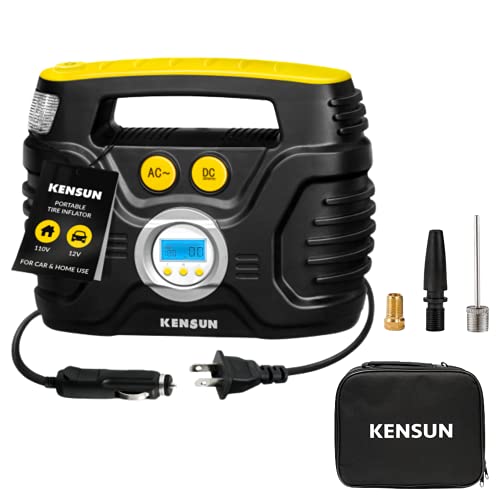
Kensun AC/DC Swift Performance 2.0
A corded inflator that never waits on a battery charge.

AstroAI MC3
Three power sources without buying into a tool platform.

Makita DMP180ZX
A light, cordless top-up tool for Makita battery owners.
What a Garage Inflator Should Do That a Glovebox Pump Doesn’t
A garage unit gets used for routine top-ups on every car in the household, plus bikes, the lawn tractor and the odd air mattress. That changes the priorities compared with a pump that only comes out at the roadside.
- Unlimited run time: a 120V cord means you are never waiting on a charge between the second and fourth tire.
- A preset gauge: you dial in the target, start it and let the auto shut-off stop at that number.
- Hose reach: a longer hose lets the unit stay on the floor while you work around the wheel.
- Storage: onboard slots for nozzles keep the needle and Presta adapter from vanishing into a drawer.
An inflator is not a shop compressor. It will not run an impact wrench or a blow gun, but for keeping tires at the right pressure it is quieter, smaller and needs no tank draining.
Wall Plug, Tool Battery or Car Socket?
The power source decides how a unit fits into your garage more than any other spec. Units with a 110V or 120V AC input plug into any outlet and run as long as you need. Battery-only tools are quick to grab and cordless, but they tie you to one brand’s packs.
A 12V car-socket plug is still handy as a backup, since several picks here offer all three. Pressure ratings matter less than you might think for passenger cars: most need well under 50 PSI. For trucks and large SUVs, check each maker’s stated limits before relying on one.
Best Tire Inflator for Home Garage: Five Units Up Close
The first three can run from a wall outlet; the last two are bare tools for owners of a battery platform. Specs come from each listing or maker page.
1. CRAFTSMAN V20 CMCE520B: Corded and Cordless Tire Inflator with Digital PSI Gauge

- V20 battery, AC wall plug or 12V car plug
- Set the PSI and it shuts off on its own
- Easy-read digital pressure display
- Battery and charger sold separately
The CRAFTSMAN CMCE520B belongs to the brand’s V20 cordless family, but it does not depend on a battery. CRAFTSMAN lists three power sources: a V20 20V MAX battery, an AC wall plug and a 12V car adapter plug. In a home garage that combination is practical. You can leave it plugged in on the bench for routine checks, then slide in a battery and carry it out to a car parked on the driveway.
Operation is set and forget. You enter the PSI you want on the digital display, start the pump, and the automatic shutoff stops it when the tire reaches that pressure. The display is designed to be easy to read, which helps in a dim corner of the garage. CRAFTSMAN describes it as a high-volume unit suited to jobs that range from car tires to an air mattress, so it can also look after the household’s bikes, balls and camping gear.
The battery and charger are not included, so this makes the most sense for someone who already has V20 tools on the shelf. The listing does not state a duty cycle or maximum pressure, so check the manual before using it for long runs on large tires. For a typical sedan or small SUV kept at the door-jamb pressure, it handles everyday top-ups.
View CRAFTSMAN V20 CMCE520B on Amazon
2. Kensun AC/DC Swift Performance 2.0: 110V and 12V Tire Inflator with Dual Metal Motors
- 110V wall plug and 12V car plug
- Dual solid metal motors
- Back-lit LCD in PSI, Bar or kPa
- Auto shut-off at the preset pressure
The Kensun Swift Performance 2.0 is a corded inflator made for people who mostly fill tires at home. It carries two plugs: a 110V plug for a household outlet and a 12V plug for the car’s accessory socket. Kensun describes its AC/DC switching as the feature that lets the same unit work in the garage and on the road. There is no battery to charge or replace, which suits a tool that may sit on a shelf for weeks between uses.
Inside are two solid metal motors, which Kensun says speed up inflation compared with a single-motor design. You set the target pressure, and the unit shuts off when it gets there. The large back-lit LCD shows the reading in PSI, Bar or kPa, so it is easy to match the number on your door-jamb placard even in poor light.
Kensun lists it for the tires of cars, bikes, sedans and midsize SUVs, with adapters for balls and inflatables in the box. A Presta valve adapter is not included, so cyclists with road bikes will need to buy one. Because the listing is aimed at cars and midsize SUVs, a full-size truck on large tires is better served by a unit rated for that size. For a two-car household, it is simple and dependable.
View Kensun AC/DC Swift Performance 2.0 on Amazon

3. AstroAI MC3: 160 PSI Tire Inflator with Battery Pack, 110V AC and 12V DC Power
- Battery pack and charger included
- Also runs on 110V AC or 12V DC
- 160 PSI high-pressure and 350 L/min large-volume modes
- Up to 20 minutes of continuous use
The AstroAI MC3 suits a garage that wants cordless freedom without committing to a power tool brand. Unlike the bare tools in this list, it comes with its own rechargeable battery pack and charger. It also runs from a 110V household outlet or a 12V car socket, and AstroAI says it detects which input is connected and adjusts on its own. The power cord stores in the base, with a compartment for nozzles and hoses.
Two modes are switched with one button. High-pressure mode reaches up to 160 PSI for car, bike and motorcycle tires and sports gear, and AstroAI states it can take a flat car tire from 0 to 36 PSI in about five minutes. Large-volume mode moves up to 350 liters per minute for rafts and air mattresses, and can also deflate them. Dual metal motors and a metal cylinder allow up to 20 minutes of continuous running.
AstroAI lists it for sedans, midsize SUVs, bikes and cars, and says plainly that it is not suited to heavy-duty trucks. The box includes three standard nozzles, a needle adapter, three large-volume nozzles and a spare fuse. Keep the pack charged between uses, especially through the winter months. For a household with mixed inflating jobs, it is a versatile, self-contained option.
4. Makita DMP180ZX: 18V LXT Cordless Inflator, 120 PSI with Auto-Stop
- Up to 120 PSI from the 18V LXT platform
- Auto-stop at the preset pressure
- Backlit gauge and built-in LED light
- 25-1/2 inch hose, 2.3 lb without battery
The Makita DMP180ZX is a bare-tool inflator for the 18V LXT battery platform, so it makes sense mainly for someone who already has Makita packs and a charger on the bench. Makita’s DMP180ZX product page lists a motor that delivers up to 120 PSI and describes it as a tool for topping off car and light truck tires, bike tires and sports balls.
You set the pressure, and the auto-stop function ends inflation at that point to prevent overfilling. The gauge is backlit for easy reading, and a built-in LED lights the valve stem, which helps in a dim garage or after dark. The hose is 25-1/2 inches long, enough to reach a valve from the floor. Without a battery the tool weighs 2.3 pounds, and Makita’s Star Protection controls guard against overloading, over-discharging and overheating.
In the box are a Presta valve adapter, a sports ball needle and a tapered adapter, but no battery or charger. Makita backs it with a 3-year limited warranty. Makita pitches it at topping off tires, so think of it as a quick check-and-fill tool. With no cord at all, it is easy to grab for a car parked in the driveway.
View Makita DMP180ZX on Amazon
5. WORX WX092L.9: 20V Cordless Tire Inflator, 150 PSI with Digital Gauge and Work Light

- Up to 150 PSI on WORX 20V PowerShare
- Preset digital gauge with auto stop
- LED work light plus emergency lights
- Onboard storage for 3 adapters
The WORX WX092L.9 is a bare-tool cordless inflator for the WORX 20V PowerShare battery system. If your garage already has WORX packs for a leaf blower, trimmer or drill, this adds a tire pump without another charger. WORX rates it at up to 150 PSI, which is far more than a passenger car tire needs, and lists it for car tires, sports balls and other small inflatables.
The digital gauge displays the current tire pressure and lets you preset the pressure you want. When the reading gets there, the automatic stop shuts the pump off to avoid overinflating. A built-in LED work light helps at the wheel, and two extra modes give red and yellow emergency lights if you carry it in the car. Three adapters store inside the body, so the needle and Presta adapter stay with the tool.
The kit includes a 20-inch high-pressure hose, a sport ball needle, a tapered adapter and a Presta valve adapter. The battery and charger are sold separately, and there is no cord option, so plan on keeping a charged pack nearby. The listing gives no duty cycle, so for a fully flat large tire let the tool rest between fills. For WORX owners topping up two cars, it is a tidy add-on.
Power Sources Side by Side
Use this table to match a power type to how you work. Many garages end up with a plug-in unit on the shelf and a cordless one for the driveway.
| Power source | Strength at home | Away from home | Watch out for |
|---|---|---|---|
| 120V wall outlet | Runs as long as needed | Not usable without an outlet | Cord length to the far wheels |
| Tool battery (18V or 20V) | Grab and go, no cord | Works anywhere with a charged pack | Battery and charger often sold separately |
| Included rechargeable pack | Cordless without a tool platform | Good for a trunk too | Pack needs charging before use |
| 12V car socket | Useful backup | Standard roadside option | Engine running in a closed garage is unsafe |
That last row matters. Never run the engine in a closed garage to power a 12V pump: pull the car out first, or use the wall outlet instead. It is one of the main reasons an AC input earns its place on a garage unit.

Keeping Air in Tires Through a Grand Rapids Winter
Tire pressure falls as the air cools, so the first hard freeze of the fall often brings on the low-pressure light. In West Michigan that swing happens again and again through freeze-thaw cycles. A garage inflator makes a weekly check a two-minute job rather than a trip to a gas station air machine.
- Check cold: measure before driving, as warm tires read high.
- Use the placard: fill to the pressure on the driver’s door jamb, not the maximum printed on the sidewall.
- Mind the gauge: confirm the inflator’s reading against a separate digital tire pressure gauge now and then.
- Store it sensibly: check the maker’s temperature range for storing and charging batteries in an unheated garage.

Tire pressure is one item on a longer list. Our winter car maintenance checklist covers the battery, wipers, coolant and the rest before the snow arrives.
Signs the Problem Is More Than Low Pressure
If one tire needs air every few days, an inflator is hiding a problem rather than fixing it. A nail, a leaking valve stem or a bead that no longer seals on a corroded rim are all common after a salty winter. A pothole hit can also bend a rim or knock the wheels out of line.

Watch for a pull to one side, a steering wheel that sits off center, a new vibration or wear on one edge of the tread. Our guide to pothole damage signs walks through what to look for. When those signs show up, our suspension repair in Grand Rapids covers the steering and suspension checks a bent part calls for.
More Buying Guides
Frequently Asked Questions
Is a tire inflator enough for a home garage, or do I need an air compressor?
For keeping tires, bikes and sports gear at the right pressure, an inflator is enough. A tank compressor makes sense only if you also want to run air tools such as an impact wrench or a blow gun.
Can a tire inflator plug into a wall outlet?
Only if it has an AC input. The CRAFTSMAN CMCE520B, Kensun AC/DC and AstroAI MC3 all list a household plug. Battery-only tools such as the Makita DMP180ZX and WORX WX092L.9 do not.
What is the best tire inflator for home garage use with more than one car?
A plug-in unit with a preset digital gauge suits a multi-car household, because it never runs out of charge partway through. Set each car to its own door-jamb pressure, since a sedan and an SUV often differ.
Can I keep an inflator in an unheated garage over the winter?
The inflator itself usually stores fine, but check the manual for its temperature range. Lithium packs are a different matter: many makers give a charging temperature range, so charge them indoors and bring them out when needed.
Topping up the same tire every week in Grand Rapids? Ring 456 AutoFix on 616-279-3832 between 8am and 5pm, Monday to Friday, or request a suspension and steering check through our contact page.
Working the same hours we do? Leave the car at our after-hours drop-off, 456 Carrier St NE in Grand Rapids, and we’ll handle it from there.