
As an Amazon Associate, 456 AutoFix earns from qualifying purchases. Product links below go to Amazon, where you can confirm the right part for your vehicle.
A front wheel drive car pulls itself through snow with the same two tires that steer it, so those tires carry every bit of grip you have. The best snow chains for front wheel drive are the ones that fit those front tires without touching the strut, brake lines or fender liner, and that you can mount by the roadside with cold hands.
Below we explain why clearance matters so much on a front-driven car, how to size chains from the tire sidewall, and which five designs from SCC, KONIG and MICHELIN suit sedans, hatchbacks and small crossovers.
Quick answer
Which snow chains work on a front wheel drive car?
Mount one pair on the front tires and choose a low-clearance design. The SCC Super Z6 cable chain needs very little room inside the tire, the KONIG K-Summit fits from the outside with no space needed behind the wheel, and the MICHELIN Easy Grip composite chain is gentle on alloy rims.
Our Quick Picks
Three starting points for front-drive cars: a thin cable chain for tight wheel wells, a front-mounted chain for cars with no room behind the tire and a composite chain that is gentle on alloy rims. All five picks are reviewed below.
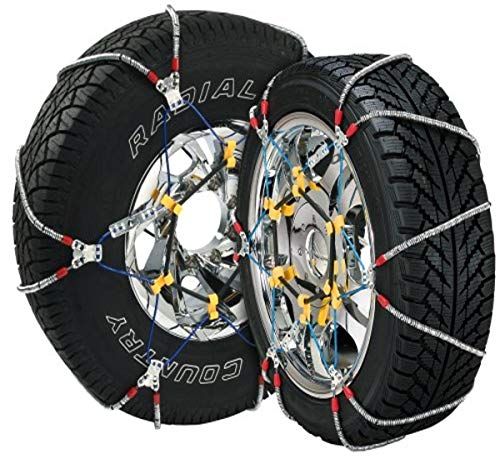
SCC Super Z6 SZ133
A thin cable chain built for cars with very little room around the drive tire.

KONIG K-Summit K33
Fits from the outside of the wheel, so nothing has to reach behind the tire.

MICHELIN Easy Grip Evolution 7
A light, flexible chain that stretches over the tire.
Why Front-Drive Cars Need Low-Clearance Chains
Chains always go on the drive wheels, which on a front wheel drive car means the front pair. That is also the busiest corner of the car: the strut, the brake caliper, the ABS sensor wire and the inner fender liner all sit a short distance from the tire. When the wheel turns to full lock, that gap gets smaller still.
Traditional ladder chains with thick links can slap against those parts. That is why many owner’s manuals for compact cars call for SAE Class S chains, a clearance class meant for vehicles with limited room around the tire. Cable chains, thin alloy link chains and front-mounted designs all aim at that tight space.
- Cable chains: steel cables with rollers or alloy cross members. Light, low profile and quick to fit.
- Low-profile link chains: small links in a ladder or diamond pattern, often with a manual or self-tensioning closure.
- Front-mounted chains: attach to a hub fitting on a wheel nut and fold over the tread from the outside, with nothing tucked behind the tire.
- Composite chains: a fabric or polymer structure with steel elements, gentle on rims and easy to stretch over the tire.
Sizing, Fit and the Owner’s Manual Check
Chains are sold by tire size, not by vehicle. Read the size off the sidewall, such as 205/55R16, and match it to the chart for the exact part number. Two cars of the same model can wear different tire sizes depending on trim, so never assume.
Next, open the owner’s manual and find the section on traction devices. Some carmakers restrict chains to certain tire sizes, require Class S products, or advise against chains on low-profile performance tires. Chain makers repeat that warning in their fitting guides and recommend a test fit before you need the chains on the road.
Tire pressure matters too. An underinflated tire changes shape and can make a set feel loose. Set pressure to the figure on the driver’s door label, which the U.S. Tire Manufacturers Association’s tire care guide also points to, and check it when the tires are cold.
Best Snow Chains for Front Wheel Drive: Five Low-Clearance Picks
All five suit the tight front wheel wells of most compact and midsize front-drive cars. Clearance figures and certifications come from the Amazon listings and makers’ pages.
1. SCC Super Z6 SZ133: Low-Clearance Cable Tire Chain with Built-In Rubber Tightener
- Needs about 6.3 mm (1/4 inch) inside sidewall space
- Rubber tightener, no stop to retighten
- Fits without moving the vehicle
- Listed as ABS, traction control and AWD compatible
The SCC Super Z6 is a cable traction chain aimed at cars, small pickups and SUVs that have very limited room around the drive tires, like the front corners of most compact front-drive cars. SZ133 is one part number in a range of sizes, so match the number to the tire size on your sidewall before ordering. The maker’s spec page lists the Super Z6 family as meeting Class S clearance.
The key figure on the listing is clearance. The Super Z6 needs only about 6.3 mm, or 1/4 inch, of operating space in the critical area along the inside sidewall, where the listing notes typical Class S products need 15 mm. That small footprint helps keep the chain away from the strut, brake hose and ABS sensor wire. A designed-in rubber tightener takes up slack as you drive, so the listing says you need not stop to retighten.
You fit it with the car parked, without rolling forward onto the chain. The listing also describes better compatibility with anti-lock brakes, traction control and all-wheel drive systems than conventional chains. This is a light road chain for plowed and packed snow, not a heavy link chain for deep, rutted back roads, so keep speeds low and remove it once you reach clear pavement.
View SCC Super Z6 SZ133 on Amazon
2. KONIG K-Summit K33: Front-Mounted Snow Chains with No Clearance Needed Behind the Wheel
- No clearance needed behind the wheel
- Mounts on an original wheel nut or bolt
- No contact with alloy rims
- Ö-Norm 5117, UNI 11313 and TÜV certified
The KONIG K-Summit takes a different approach from a cable chain. Instead of wrapping around the whole tire, it attaches to a fitting on the wheel’s face and folds a chain net over the tread from the outside. The listing states that it needs no clearance behind the wheel, which makes it a strong match for front-drive cars whose struts or liners sit very close to the tire.
The K33 size covers a long list of common tire sizes, including 205/60-16, 225/55-16, 205/55-17, 225/50-17 and 215/45-18, among many others shown on the listing. The fitting goes on one of the car’s original wheel nuts or bolts, and the listing is clear that it does not attach to an anti-theft locking bolt. It also states that the chain makes no contact with alloy rims. The set carries Ö-Norm 5117, UNI 11313 and TÜV certifications.
The trade-off is setup. The first fitting takes some care, and you need a free original wheel bolt on each front wheel, so check your wheels before buying. The listing says the K-Summit is not for off-road use. It suits owners who want a quick, clean fit on paved winter roads and who would rather not reach behind a tire in the snow.
View KONIG K-Summit K33 on Amazon

3. SCC Whitestar WS1604: Alloy Link Tire Traction Chain Meeting Class S Clearance

- Alloy link construction
- Meets Class S clearance
- Fits without moving the vehicle
- Smoother ride than the original Whitestar
The SCC Whitestar WS1604 is an alloy link traction chain, which puts it between a thin cable chain and a heavy ladder chain. Link chains tend to bite harder into packed snow and ice than plain cable, and the Whitestar keeps that link design while meeting Class S clearance requirements. The listing notes that it meets Class S even in light truck sizes. WS1604 is one size, so check it against your sidewall first.
For a front-drive car, Class S clearance is the detail that makes a link chain workable at all, since standard link chains often crowd the strut and inner liner. The listing describes the WS1604 as more durable than any other link-style chain in the range, including the original Whitestar, and says it gives an even smoother ride than that earlier design. Installation is done without moving the vehicle.
This is a sensible pick for drivers who face steep driveways or hilly side streets and want more grip than a light cable chain offers. Link chains are heavier to carry and handle than cable, so practice fitting it once at home. Like every chain here, it belongs on snow and ice at low speed and should come off once the road is clear.
View SCC Whitestar WS1604 on Amazon
4. KONIG CB-12 090: 12 mm Clearance Snow Chains with Manual Tensioning
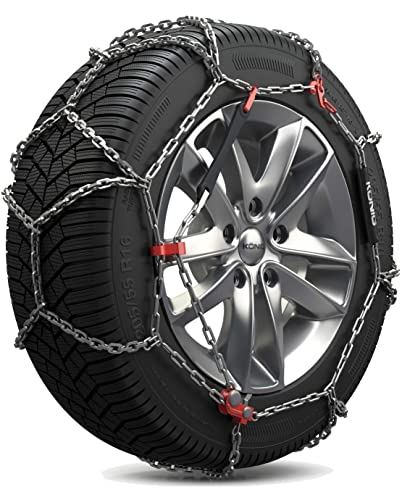
- 12 mm inside and on-the-tread clearance
- Simple manual tensioning
- Fits sizes such as 205/55-16 and 215/60-15
- Ö-Norm 5117, UNI 11313 and TÜV certified
The KONIG CB-12 is a traditional link snow chain built for passenger cars, with a low profile that suits the front wheels of many sedans and hatchbacks. The 090 size covers tire sizes listed on Amazon as including 195/65-16, 205/55-16, 215/50-16, 205/65-15, 215/60-15 and 215/45-17, among others. Read your sidewall and check it against the full list before ordering.
The listing gives the chain 12 mm of clearance on the inside and on the tread, which keeps it slimmer than heavier ladder chains. KONIG describes it as a simple and sturdy chain with manual tensioning, so you pull the chain snug by hand when fitting it. It carries Ö-Norm 5117, UNI 11313 and TÜV certifications, which are European standards and test marks for snow chains.
Manual tensioning means a little more work than a self-tightening design. Plan to stop after a short distance and take up any slack, since a loose link chain can strike the strut or wheel. Steel links also bite well on packed snow and ice. It suits a driver who wants a durable, conventional chain for occasional winter use and who has the 12 mm of room that the listing calls for.
View KONIG CB-12 090 on Amazon

5. MICHELIN Easy Grip Evolution 7: Composite Snow Chains for Reduced Wheel Arches
- Composite structure with steel clip mesh
- Extendable fastening for easy fitting
- Suited to vehicles with reduced wheel arches
- Hand-washable with clean water
The MICHELIN Easy Grip Evolution is not a steel chain in the usual sense. It uses a structure made of composite materials with a steel clip mesh across the tread, and the listing describes it as a high-performance snow chain approved for special winter equipment. Size n°7 is one of several, and the listing points to a table of matching tire sizes, so confirm yours there first.
For front-drive cars, the most useful line on the listing is that it is particularly suitable for vehicles with reduced wheel arches. The composite build is thin and flexible, which helps where a heavy link chain would crowd the strut or liner. An extendable fastening system is designed to make fitting and removal easier, and the steel clips give the tread surface its bite on snow and ice.
After use, the listing says it can be washed by hand with clean water, which is handy for rinsing off road salt. Composite chains are light and quick to handle, but treat them as an on-road winter device and take them off once you reach clear pavement. This pick suits drivers who rarely fit chains and want something friendly to alloy rims and simple to put on in the cold.
View MICHELIN Easy Grip Evolution 7 on Amazon
Matching a Chain to Your Front-Wheel-Drive Car
Start with the space behind the tire, then consider your wheels and how often you will fit chains.
| Your situation | Chain type | Picks from this list | Keep in mind |
|---|---|---|---|
| Very little room between tire and strut | Thin cable, Class S | SCC Super Z6 | Test fit at full steering lock |
| No usable room behind the wheel | Front-mounted | KONIG K-Summit K33 | Mounts on an original wheel bolt, not a locking one |
| Alloy wheels you want to protect | Composite or front-mounted | MICHELIN Easy Grip, KONIG K-Summit K33 | Still check the size chart closely |
| Hills and steep driveways | Low-profile link | SCC Whitestar, KONIG CB-12 | Heavier to carry; re-check tension after a short drive |
If you are still weighing chains against fabric covers, our guide to snow socks for tires covers that lighter option. For trucks and bigger tires, the main tire chains buying guide looks at heavier ladder and link designs.

Fitting and Driving on Chains in West Michigan
Practice once in a dry driveway. Lay the chains out flat, fit them to the front tires and roll forward if the instructions say so. Then turn the steering wheel lock to lock and look for any contact with the strut or liner.
In Grand Rapids, most main roads are plowed and salted quickly, so chains earn their keep on unplowed side streets, steep driveways and the first hours of a heavy lake-effect storm. Take them off once you reach clear pavement. Running chains on bare, salty asphalt wears them fast and puts extra shock through the front suspension.

Keep speed low and follow the maker’s stated limit, which is often 30 mph or less. Avoid hard acceleration and wheel spin. After the season, rinse off the road salt, dry the chains completely and store them in their bag with a pair of gloves and a small mat, alongside the rest of your winter car maintenance checklist items.
When the Front End Needs a Professional Look
A chain that comes loose can strike a fender liner, brake hose or ABS wire before you hear it. If you notice a new clunk, a pull to one side or a shake through the steering wheel after a chain day, have the front end inspected. Winter potholes do similar damage, and our list of pothole damage signs explains what to watch for.

Struts, control arms and tie rods take the brunt of a rough winter. Our ASE and State of Michigan certified team handles suspension repair in Grand Rapids when a bent part or worn joint turns up.
In short, the best snow chains for front wheel drive cars match the front tire size exactly and clear the strut at full steering lock. Check the owner’s manual first.
More Buying Guides
Frequently Asked Questions
Do snow chains go on the front or back of a front wheel drive car?
They go on the front tires, because those are the wheels that drive the car. Some owner’s manuals also allow a second set on the rear for stability, so read the traction device section for your model.
What does SAE Class S clearance mean?
It is a clearance class for traction devices meant for vehicles with limited space around the tire. Many compact and midsize cars call for Class S chains, and several picks on this list are listed as meeting it.
Will snow chains damage alloy wheels or ABS sensors?
A correctly sized, properly tightened set should not, but a loose chain can. Front-mounted chains and composite chains reduce rim contact, and you should remove chains as soon as the road is clear.
How fast can I drive with snow chains on?
Follow the limit printed in the chain’s instructions, which is commonly 30 mph or lower. Drive gently, avoid wheel spin and stop to check the fit after the first short stretch.
Did a chain day leave the steering feeling off, or is there a new knock from the front end? Phone 456 AutoFix at 616-279-3832 on any weekday from 8am to 5pm, or reach us through the contact page to set up a visit.
If your schedule keeps you at work until evening, our after-hours drop-off at 456 Carrier St NE lets you bring the car by when it suits you.