
As an Amazon Associate, 456 AutoFix earns from qualifying purchases. Product links below go to Amazon, where you can confirm the right part for your vehicle.
A cheap pencil gauge that tops out at 60 PSI is fine for a sedan, but it can’t read a loaded three-quarter-ton or reach the inner valve on a dually. The best tire pressure gauge for trucks reads well past your placard pressure, reaches awkward valves and survives life in a cab or toolbox.
This guide explains what to look for, then walks through six gauges, from straight-foot stick gauges built for big rigs to digital dial units for pickups. For a broader look that includes car gauges, see our main tire pressure gauge guide.
Quick answer
Which tire gauge should a truck owner buy?
Pick a gauge that reads to at least 150 PSI and has a chuck that reaches your valves. A Milton S-986 dual-foot stick gauge suits semis and duallies, the JACO EliteProPlus adds a dually chuck to an easy dial, and the AstroAI digital gauge covers pickups with a backlit screen.
Our Quick Picks
Three strong starting points: a dual-foot stick gauge for semis and duallies, a dial gauge that ships with a dually chuck and a high-range digital gauge for pickups. All six gauges are covered below.
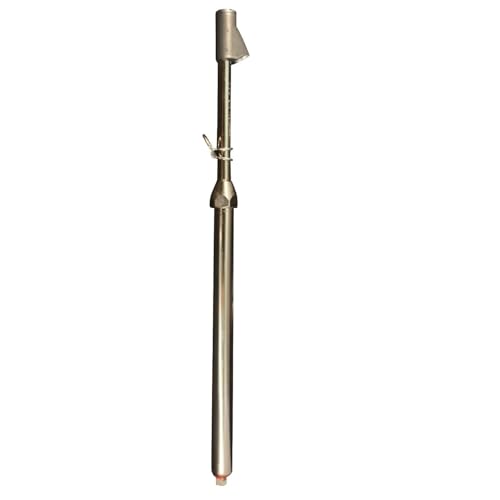
Milton S-986
A long brass service gauge that reaches inner dual valves.
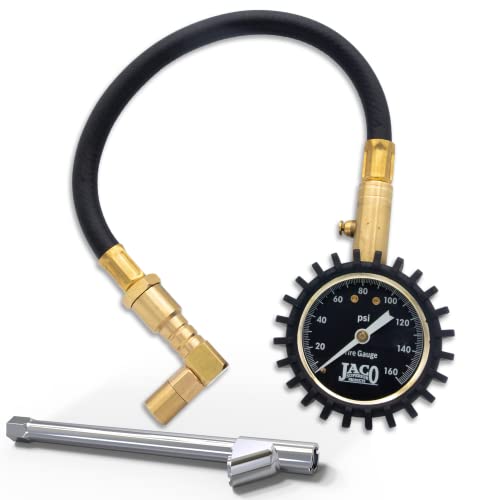
JACO EliteProPlus
An easy-to-read dial with an extended chuck for inner duals.

AstroAI Heavy Duty Digital
A high-range digital gauge that reads clearly in low light.
Range, Reach and Readability: What a Truck Gauge Needs
Truck tires ask more of a gauge than car tires do. Three things on the listing tell you whether a gauge is up to the job.
- Pressure range: many light-truck tires on heavy-duty pickups run well above car pressures, and commercial tires go higher still. A gauge reads most precisely in the middle of its scale, so choose one whose top end sits comfortably above your placard number.
- Chuck shape: a straight foot or dual-foot chuck pushes onto a valve stem from the front, which is how you reach the inner tire on dual rear wheels. A 30 or 90 degree chuck is easier on single wheels and outer duals.
- Readout: a dial or digital screen you can read while kneeling beats squinting at a small bar in the dark.
Matching the Gauge to Your Truck
A half-ton pickup on passenger or light-truck tires is the easy case: any accurate gauge that reads to about 100 PSI works, and a digital unit is quickest. Heavy-duty pickups on load range E tires usually call for higher pressures in the rear, especially when towing, so a gauge that reads to 150 PSI or more makes sense.
If you’re shopping for the best tire pressure gauge for dually trucks, reach matters more than range. The inner rear valve sits behind the outer wheel, and only a long straight-foot or dual-foot chuck gets onto it cleanly. Semi trucks and tractor-trailers combine both problems, which is why drivers tend to carry a heavy stick gauge with a dual-head chuck.
Best Tire Pressure Gauge for Trucks: Six Gauges in Detail
The list starts with the gauges that reach inner duals and moves on to digital and inflator-style options. Each section notes which kind of truck it suits.
1. Milton S-986: 10-160 PSI Straight-Foot Dual Head Truck Tire Gauge
- 10-160 PSI in 2 lb increments
- Straight-foot dual-head chuck
- Plated brass tube, 13 1/4 in long
- Four-sided nylon indicator bar with kPa
The Milton S-986 is a stick-style service gauge, the kind with a sliding bar that pops out of the tube to show pressure. It reads from 10 to 160 PSI in 2 lb steps, with a kilopascal scale on another face of the four-sided nylon bar. The tube is plated brass and the whole gauge measures 13 1/4 inches, which gives you useful reach around big wheels.
The defining feature is the straight-foot dual-head chuck. One head pushes straight onto a valve, the other is angled, so the same gauge handles the inner and outer tires on a dual rear axle. That is why Milton lists it for semi trucks, tractor-trailers, duallies and RVs, and why it turns up in so many truck cabs and fleet shops.
A stick gauge needs no batteries, so cold mornings and long storage do not affect it, and there is little inside to break if it gets dropped. The trade-off is readability: the bar markings are small, so you may want a flashlight for checks in the dark. It also only measures pressure, so you will still need a separate inflator or air hose to add air. For pickups that never go above 80 PSI, a simpler dial or digital gauge is easier to read day to day.
2. JACO EliteProPlus: 160 PSI Dial Tire Gauge with Dually Air Chuck
- 2 in glow-in-the-dark 160 PSI dial
- 90 degree chuck plus extended dually chuck
- Built-in air bleeder valve
- Holds reading until reset
The JACO EliteProPlus is an analog dial gauge with a 2 inch face that glows in the dark and reads up to 160 PSI. JACO states it is calibrated within ANSI standards to plus or minus 1.5 percent, and because it is mechanical, it does not rely on batteries. The reading holds on the dial until you press the reset button on the neck.
What sets this version apart for trucks is the second chuck. Alongside a 90 degree chuck for cars, motorcycles and outer wheels, it comes with an extended dual-foot chuck meant for dually wheels on semi trucks, RVs and trailers. The chuck sits on a 360 degree swivel, so you can approach the valve from whatever angle the wheel allows.
A built-in bleeder valve lets you let air out of an overinflated tire without taking the gauge off, which is handy after filling at a station air pump. The brass internals sit inside a rubberized protective guard that helps the gauge survive drops. The 160 PSI scale makes low-pressure readings, such as a spare or trailer tire around 30 PSI, a little harder to read precisely than on a digital screen. As with any dial gauge, swapping between the two chucks takes a moment before each check.
View JACO EliteProPlus on Amazon

3. AstroAI Heavy Duty Digital: 0-230 PSI Tire Gauge with Backlit LCD and Flashlight
- 0-230 PSI in 0.1 increments
- Green backlit LCD and flashlight
- Stainless steel body
- PSI, Bar, kg/cm2 and kPa units
AstroAI’s Heavy Duty Digital gauge covers 0 to 230 PSI, which leaves plenty of headroom for load range E pickup tires and RV tires. Readings appear in 0.1 increments on a green backlit LCD, and the listing title cites calibration to ANSI B40.7 Grade 2A. You can switch between PSI, Bar, kg/cm2 and kPa with the single power button.
The body is stainless steel and AstroAI describes the gauge as built for RV and truck use. A flashlight is built into the end, so you can find the valve stem and read the screen in a dark driveway or at a dim fuel stop. The nozzle is designed to seal quickly against the valve, and the gauge shuts itself off after 30 to 40 seconds to save the included batteries.
This is a straightforward pick for pickup owners who want a quick, precise number on every tire. The nozzle is a single head, so it is better suited to single rear wheels and the outer tires on a dually than to inner duals. Like any digital gauge, it depends on batteries, which can lose strength in a truck parked outside through a hard winter, so keeping spares in the glovebox is a sensible habit.
View AstroAI Heavy Duty Digital on Amazon
4. PUIBERS Semi Truck Digital: 0-200 PSI Dual Head Tire Gauge with Backlight

- 0-200 PSI, plus or minus 1 percent
- Straight-foot and 30 degree reverse chuck
- Zinc alloy long handle, brass core
- Backlit LCD with four units
The PUIBERS Semi Truck gauge pairs a digital readout with the long dual-head chuck that commercial tires call for. It reads from 0 to 200 PSI with a listed accuracy of plus or minus 1 percent and a resolution of 0.5 PSI. The screen switches between PSI, Bar, kPa and kgf/cm2 and has a green backlight plus a battery status indicator.
The handle is zinc alloy and the chuck has a solid brass core. One end is a straight-foot chuck for inner wheels and hard-to-reach valves, and the other is a 30 degree reverse chuck for outer wheels. The listing says the gauge switches on when it is connected to a tire, turns the backlight off after 60 seconds and shuts down completely after 150 seconds.
For semi drivers and dually owners who find stick gauges hard to read, this design offers both reach and a clear number. PUIBERS lists it for passenger cars and SUVs too, but the long handle is most useful on big wheels and dual axles. It is a newer brand than Milton or JACO, so there is less long-term history behind it. Keep a spare battery on hand, since a dead cell turns any digital gauge into dead weight on a cold morning.
View PUIBERS Semi Truck on Amazon

5. JACO ElitePro Digital: 200 PSI Tire Gauge with Hose and Bleeder Valve

- Reads to 200 PSI in 0.1 PSI steps
- Dual sensors, ANSI 2A plus or minus 0.50%
- 10 in hose with 360 degree swivel chuck
- 2.5 in backlit LCD, 2x AAA included
JACO’s ElitePro Digital is a hose-style gauge with a 2.5 inch backlit LCD that reads up to 200 PSI in 0.10 PSI steps. JACO says it uses dual pressure sensors certified to ANSI 2A, plus or minus 0.50 percent of full scale. The readout locks on the screen until you press the button again, so you can take the reading at the wheel and look at it once you stand up.
A 10 inch flexible hose ends in a 360 degree swivel chuck, and JACO notes the chuck can be swapped for any 1/4 inch NPT chuck. That means you could fit a dual-foot chuck later for inner duals. A built-in bleeder valve releases air in real time without resetting the display, which makes it easy to trim a tire down to the placard figure.
The body is brass and steel inside a gear-style protective guard, and it runs on two AAA batteries, which are included. The gauge powers down after 150 seconds of inactivity. It suits heavy-duty pickup owners who check pressures at home before towing, though the hose and guard make it bulkier than a stick gauge for a door pocket. Out of the box it has a single angled chuck, so duallies need the extra chuck.
View JACO ElitePro Digital on Amazon
6. Milton 553: 10-160 PSI Truck Tire Inflator Gauge with 5 ft Hose

- 10-160 PSI in 2 lb increments
- Dual-head lock-on chuck, full swivel
- 5 ft air hose
- Replaceable gauge and valve cartridges
The Milton 553 is a different kind of tool from the others here: an inflator with a gauge built in. You connect it to a shop air compressor, clip the chuck onto the valve and squeeze the handle to add air while watching the pressure. It reads 10 to 160 PSI in 2 lb increments, and Milton states it is made in the USA.
The dual-head lock-on chuck stays on the valve without being held, which frees a hand and makes it easier to reach inner and outer duals. A 5 foot hose lets you work around a wheel without dragging the compressor along, and the full-swivel chuck helps with awkward valve angles. A magnifying lens over the gauge window makes the scale easier to read.
Both the gauge and the valve cartridges can be replaced, so a worn part does not mean replacing the whole tool. This is a good fit for anyone who services their own truck or trailer at home with a compressor, or for a small fleet yard. It is not a pocket gauge and it does nothing without an air supply, so pair it with a stick or digital gauge in the cab for checks on the road.
Six Truck Tire Gauges Compared
Choosing the best tire pressure gauge for trucks comes down to range, chuck style and power source. All figures below come from the Amazon listings.
| Gauge | Range as listed | Chuck | Good fit |
|---|---|---|---|
| Milton S-986 | 10-160 PSI stick | Straight-foot dual head | Semis, duallies, fleets |
| JACO EliteProPlus | Up to 160 PSI dial | 90 degree plus dually chuck | Duallies, RVs, trailers |
| AstroAI Heavy Duty | 0-230 PSI digital | Single head | Pickups and RVs |
| PUIBERS Semi Truck | 0-200 PSI digital | Straight foot plus 30 degree reverse | Semis and box trucks |
| JACO ElitePro Digital | Up to 200 PSI digital | Swivel chuck on hose | HD pickups, home garage |
| Milton 553 | 10-160 PSI inflator | Dual-head lock-on, 5 ft hose | Trucks with a shop compressor |

Getting an Accurate Reading Every Time
Even a precise gauge gives a misleading number if you check at the wrong time or against the wrong target. The U.S. Tire Manufacturers Association’s tire care essentials recommend checking at least once a month with the tires cold, meaning parked for at least three hours. They also suggest checking before long trips, heavy loads or towing.
- Use the door placard: the recommended pressure is on the label in the driver’s door jamb or in the owner’s manual. The number molded on the sidewall is the tire’s maximum, not the target.
- Check front and rear separately: many trucks list different front and rear pressures, and some list a higher rear figure for heavy loads.
- Press straight and firm: a hiss means the chuck is not sealed, so reseat it and read again.
- Recheck after adding air: inflator chucks read while connected, but a second check with the gauge confirms the result.

West Michigan weather makes this matter. USTMA notes that pressure drops one to two PSI for every 10 degrees of temperature change, so a truck set on a mild October afternoon can be noticeably low on a January morning. Your tire pressure warning light is not a substitute either, since USTMA says these systems warn at around 25 percent under-inflation. Add tire checks to the steps in our winter car maintenance checklist.
When Low Pressure Points to a Bigger Problem
A tire that keeps losing air after you top it up may have a puncture, a leaking valve or a bent rim. Freeze-thaw potholes are hard on trucks, and our guide to pothole damage signs covers what to look for after a hard hit.

Uneven tread wear, a steering wheel that sits off-center or a clunk over bumps can mean the problem is underneath the truck, not in the tire. Our suspension repair in Grand Rapids covers ball joints, tie rods and shocks that wear faster under heavy loads.
More Buying Guides
Frequently Asked Questions
What is the best tire pressure gauge for semi trucks?
Look for a heavy stick or digital gauge that reads well above your tire pressure and has a straight-foot or dual-head chuck for inner duals. The Milton S-986 and the PUIBERS Semi Truck gauge are both built for that job.
How do you check the inner tire on a dually?
Use a gauge with a long straight-foot or dual-foot chuck and push it straight onto the inner valve through the opening in the outer wheel. Some owners also fit valve stem extensions, which make each check quicker.
Should I inflate my truck tires to the number on the sidewall?
No. The sidewall shows the maximum pressure the tire can hold. Inflate to the pressures on the door-jamb placard or in the owner’s manual, which may differ front to rear and for heavy loads.
Is a digital or analog gauge better for trucks?
Both work. Digital gauges are easier to read and often have backlights, but they need batteries, which can weaken in deep cold. Stick and dial gauges need no power and tend to shrug off rough handling.
Truck pulling, wandering or wearing tires unevenly even with the pressures set right? Ring 456 AutoFix at 616-279-3832, open 8am to 5pm Monday to Friday, or request an appointment online.
If daytime hours don’t work, use our after-hours drop-off at the shop, 456 Carrier St NE in Grand Rapids, and we’ll take it from there.