
As an Amazon Associate, 456 AutoFix earns from qualifying purchases. Product links below go to Amazon, where you can confirm the right part for your vehicle.
A new set of rims looks great until the dash shows a tire pressure warning on the drive home. The best TPMS sensors for aftermarket wheels are the ones that seat properly in the new valve holes, speak your car’s protocol and can be programmed with a tool you or your tire shop can actually reach.
Below are the fitment checks new rims add, then six programmable sensors. For factory wheels, see our TPMS sensor buying guide.
Quick answer
What sensor should go in a set of aftermarket rims?
Pick a programmable universal sensor with a metal clamp-in or adjustable-angle valve, because aftermarket valve holes often sit at angles a fixed OE stem does not match. The Schrader 33700 and LAUNCH LTR-03 handle odd angles, and the Autel MX-Sensor suits owners with an Autel tool. Every one needs programming before it goes in.
Our Quick Picks
Three sensors that cover most aftermarket wheel jobs: an adjustable aluminum stem for odd valve angles, a reusable adjustable metal stem, and a metal-valve set for owners with an Autel tool. All six are reviewed below.

Schrader 33700 EZ-sensor
Adjustable stem that lines up with angled aftermarket valve holes.
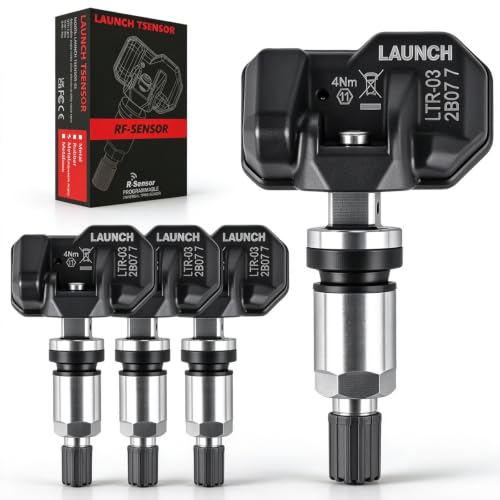
LAUNCH LTR-03
Adjustable metal stem and unlimited reprogramming.

Autel MX-Sensor Metal
Light sensor that clones factory IDs with an Autel tool.
Why New Rims Change the Sensor Question
Most cars and light trucks sold in the US carry direct TPMS: a battery-powered sensor inside each wheel that radios pressure to the car. The federal rule behind it, FMVSS No. 138 on the eCFR, requires a low-pressure warning within 20 minutes once a tire falls 25 percent below the recommended cold pressure. It also requires a malfunction warning when something stops the sensor signals from reaching the car.
That second rule is why bare aftermarket wheels trigger a light. With no sensors in the new rims, the car hears nothing and flags a fault, and you lose the low-pressure alert that matters most on a cold morning. You have three ways forward: move the factory sensors over, program universal sensors with the old IDs, or program universal sensors with new IDs and run a relearn.
Moving the old sensors works only if they are healthy and their stems suit the new valve holes. Many factory sensors use a fixed-angle stem shaped for the original rim, which is where a universal sensor earns its place.
Fitment Checks Before You Order Sensors
Aftermarket wheels vary far more than factory ones, so check these points against the wheel maker’s specs before you buy:
- Valve hole angle and shape: many aftermarket rims put the valve hole at a different angle than the factory wheel. An adjustable-angle stem lets the sensor body sit flat against the inside of the rim.
- Valve type: metal clamp-in stems seal with a nut and grommet and suit thicker valve holes and higher speeds. Rubber snap-in stems are simpler but suit a narrower range of wheels.
- Clearance: the sensor body must clear the rim’s inner barrel and the tire bead during mounting. Some wheel makers state whether a design accepts TPMS sensors, so read the spec sheet.
- Frequency and protocol: US vehicles use 315 MHz or 433 MHz. The universal sensors below cover both, and the programming tool loads your car’s year, make and model protocol.
- Programming tool: Autel and XTOOL sensors program only with their own brand’s tools, while Schrader, Bosch and BH SENS list support across several tool brands.
Best TPMS Sensors for Aftermarket Wheels: Six Sensors Reviewed
Every pick here ships blank and covers both 315 MHz and 433 MHz once programmed. Confirm coverage for your exact year, make and model with the sensor maker or your tool before ordering.
1. Schrader 33700 EZ-sensor: Programmable High Speed Sensor with Adjustable Aluminum Valve
- 314.9, 315 and 433 MHz once programmed
- Adjustable-angle aluminum valve
- Rated to 200 mph and 115 psi
- Listed nut torque 53 in-lbs, core 3.5 in-lbs
The Schrader 33700 is the high speed member of the EZ-sensor family, sold here as a four-pack with adjustable aluminum valves. It ships blank and is programmed with a compatible tool to your vehicle’s year, make and model protocol, covering 314.9, 315 and 433 MHz systems. Schrader states it can be set up for about 99 percent of vehicles in North America.
The adjustable stem is the reason it suits aftermarket rims. The valve can pivot to follow the angle of the valve hole while the sensor body sits against the inside of the wheel, which a fixed-angle snap-in stem cannot do. The listing rates it to 200 mph and 115 psi, and gives a nut torque of 53 in-lbs and a valve core torque of 3.5 in-lbs, figures worth handing to whoever mounts the tires.
Schrader says the sensor replicates OE behavior, including auto-locate, and that keeping your tool’s software current widens coverage. It is clear that this is not a DIY part: programming and installation belong with a trained technician who has the right tool. For an owner fitting wider or custom wheels through a tire shop, it is a sensible set to bring along.
View Schrader 33700 EZ-sensor on Amazon
2. LAUNCH LTR-03: Dual Frequency 315/433 MHz Sensor with Adjustable Metal Valve, 4 Pack
- 315 MHz and 433 MHz in one sensor
- Screw-in metal valve with adjustable angle
- Can copy the original sensor's data
- Reprogrammable for another wheel or vehicle
The LAUNCH LTR-03 is the newer version of the LTR-01, sold as a set of four blank sensors with screw-in metal valves. Each sensor works on both 315 MHz and 433 MHz, and LAUNCH states the range covers most vehicles on the market. It can copy the data from an original sensor, and it reports ID, voltage and temperature to the car.
The upgrade that matters for aftermarket wheels is the adjustable angle. LAUNCH explains that the sensor angle can be set to match the space inside the wheel, which helps on rims where a fixed stem would leave the body tilted. The listing also describes unlimited read and write, so a sensor can be reprogrammed and moved to another tire or vehicle later.
LAUNCH lists an FXTH87E chip, readings to 0.1 bar, and testing to SAE J1205 and J1206, with an expected battery life of five to eight years. After programming and installation, a relearn may be needed, though some vehicles that learn sensors while parked do not need one. LAUNCH itself suggests individual buyers let a shop with proper equipment handle the job.

3. Autel MX-Sensor 1-Sensor: 315/433 MHz Press-In Sensors with Metal Valves, Set of 4
- Both frequencies in one press-in sensor
- Interchangeable metal or rubber valve
- ID cloning when used with Autel tools
- 11 g sensor body, SAE J1205/J1206 tested
The Autel MX-Sensor 1-Sensor combines 315 MHz and 433 MHz in one press-in body, and this set of four comes with metal valves. Autel designed it as a single part that replaces most factory sensors, which is handy when a car’s original part number is hard to track down after a wheel change. The valve is interchangeable between metal and rubber types.
The catch is programming. Autel states these sensors can only be programmed by its own MaxiTPMS tools, such as the TS408S, TS508WF, TS601, TS900, ITS600 and MS906TS, so a tire shop running another brand of tool may not be able to set them up. With an Autel tool, they can be programmed wirelessly, even when already mounted, and up to 20 at a time.
Autel says the sensors can clone an existing ID, so the car accepts them without a relearn. The sensor body weighs 11 grams, it is tested to SAE J1205 and J1206, and Autel covers manufacturing defects for 24 months or 24,000 miles. Autel also notes the sensors are not universal for every vehicle and asks buyers to confirm compatibility before ordering.
View Autel MX-Sensor Metal on Amazon
4. Bosch QF0470 Quick Fit: Universal 315/433 MHz TPMS Sensor with Metal Stem

- Dual band 315/433 MHz
- Metal valve stem for all wheel types
- Unlimited reprogramming
- Works with ATEQ, Schrader, Snap-on and other tools
The Bosch QF0470 is a Quick Fit universal sensor that works on vehicles with either 315 MHz or 433 MHz systems. It is sold as a single sensor with a metal valve stem, and Bosch describes that stem as suitable for all wheel types, which is a useful point when you are fitting rims that differ from the factory design. A rubber stem version is sold separately as the QF0471.
Like the other universal sensors here, it must be programmed to your vehicle’s year, make and model before installation, or it will not communicate with the car. Bosch states it can be reprogrammed without limit, so the sensor can follow a wheel set to another vehicle later. The main selling point is tool support: Bosch lists compatibility with tools from ATEQ, Bosch, Echlin, OTC, Schrader, Snap-on, Topdon and others.
The list of exceptions matters just as much. Bosch says the QF0470 does not work with Autel, Bartec or Foxwell tools, nor with some locked tools. Before you order, ask the shop that will mount your wheels which TPMS tool it uses, then buy four sensors to suit it.

5. BH SENS UVS7050 IntelliSens: Dual Band 315/433 MHz Universal Sensor with Metal Valve

- Huf Baolong Electronics sensor
- Dual band 315/433 MHz
- Metal valve included
- Supported by ATEQ, Bartec, Snap-on and more
The UVS7050 comes from Huf Baolong Electronics, sold under the BH SENS name, a company that also makes direct-fit OE sensors. This IntelliSens universal sensor covers both 315 MHz and 433 MHz systems and ships with a metal valve, so it suits clamp-in valve holes on many aftermarket wheels. It is sold as a single sensor, so plan on four for a set of rims.
It must be programmed before installation, and the maker states that configuring it for a specific application takes about three seconds with a supported tool. BH SENS lists support from a wide range of tool brands, including ATEQ, Matco, Snap-on, Mac Tools, Monster Tools, KTool, NAPA, Bartec and OTC. That breadth makes it a good fit if your tire shop runs a Bartec tool, which some other universal sensors do not support.
The maker says the sensor works like the OE part it replaces and that its coverage can be updated through the TPMS tool as new vehicles arrive. The listing does not name a speed rating or torque values, so ask your installer to use the specs that come with the sensor. Confirm your vehicle is covered before you buy.
View BH SENS UVS7050 on Amazon
6. XTOOL TS100 Pro: 315/433 MHz TPMS Sensors with Metal Valves, Set of 4

- 315/433 MHz dual frequency
- Rotatable valve stem and sensor body
- Reads 0 to 900 kPa, 12 g weight
- Programs only with XTOOL TPMS tools
The XTOOL TS100 Pro is a four-pack of dual frequency sensors with metal valves, an upgrade of the earlier TS100. XTOOL states they suit about 98 percent of vehicles, including domestic, European and Asian makes, as long as the vehicle runs a 12V system with an OBD2 port. They arrive unprogrammed.
Programming is brand locked. XTOOL says the sensors work only with its own tools, such as the TP150 or IP819TP, and that other brands’ tools cannot set them up. Once programmed, the same XTOOL tool handles activation, relearn and diagnosis, so the whole job runs on one device. For an owner who already has a TP150 in the garage, that makes the set easy to work with.
For aftermarket wheels, the useful detail is the rotatable valve stem and sensor body, which XTOOL says makes installation easier when the valve hole angle differs. Each sensor weighs 12 grams, reads from 0 to 900 kPa, is rated from -40°C to 125°C and has a battery the maker rates for up to five years. XTOOL also says a sensor can be reprogrammed and moved to another car if it is still intact.
View XTOOL TS100 Pro Metal on Amazon
Reuse, Clone or Start Fresh?
Cloning copies the old sensor IDs onto the new ones, so the car sees no change and often needs no relearn. A fresh ID needs a relearn, which can be a driving routine, a key-and-pedal sequence, or a tool connected to the OBD2 port, depending on the vehicle.
| Route | When it fits | What you need |
|---|---|---|
| Move factory sensors | Sensors are healthy and stems suit the new valve holes | New service kits and a careful tire mount |
| Clone old IDs to new sensors | Keeping the factory wheels as a second set, or skipping a relearn | A tool that reads the old sensors and supports the new brand |
| New IDs plus relearn | Old sensors are dead, missing or staying in the winter set | A tool or the maker’s relearn routine for your car |

Follow the relearn steps your sensor or tool maker lists for your model rather than guessing. If you already own a capable scanner, our OBD2 scanner guide for DIY mechanics notes which kinds of tools include TPMS functions.
Salt, Potholes and Aluminum Stems in West Michigan
Grand Rapids winters are hard on wheel hardware. Road salt works into the joint between an aluminum valve stem, its nut and its cap, and a stem that sat untouched for three winters can crack or seize when a tire tech finally loosens it. Fit a fresh service kit (nut, grommet, core and cap) every time the tire comes off the rim, and torque the nut and core to the values the sensor maker lists.

Many owners run a second set of wheels for snow tires, which doubles the sensor count. Cloning the summer set’s IDs onto the winter set, where your tool and car allow it, saves a relearn at every seasonal swap. Freeze-thaw potholes are the other hazard: a hard hit can bend a rim lip, crack a sensor or knock the car out of alignment, and our list of signs of pothole damage shows what to look for afterward.
When New Wheels Point to a Bigger Problem
A TPMS light that stays on after programming and a relearn usually means a sensor damaged during mounting, a missed relearn step or a receiver fault. A tool that reads sensor IDs and battery status narrows it down quickly.

Larger or wider aftermarket wheels can also expose worn parts that the old setup hid, such as a clunk over bumps, a pull to one side or uneven tire wear. Those are steering and suspension questions, and our suspension and steering repair in Grand Rapids covers the inspection and the repair.
More Buying Guides
Frequently Asked Questions
Do I need new TPMS sensors for aftermarket wheels?
Not always. If your factory sensors are healthy and their stems fit the new valve holes, a tire shop can move them over with fresh service kits. If the stems do not suit the new rims, or you want to keep the old wheels as a winter set, new programmable sensors are the cleaner route.
Are metal or rubber valve stems better for aftermarket rims?
Metal clamp-in stems suit a wider range of aftermarket valve holes and higher speeds, and adjustable-angle versions sit flush in rims that a fixed stem does not match. Rubber snap-in stems are fine when the wheel maker lists them, but check the valve hole spec first.
Can I program universal TPMS sensors myself?
Yes, if you own a TPMS tool that supports the sensor brand. Autel and XTOOL sensors need their own brand’s tools, while Schrader, Bosch and BH SENS list support across several tool makers. Program the sensor before it goes into the wheel, then follow your car’s relearn steps.
Which are the best TPMS sensors for aftermarket wheels with odd valve angles?
Look for an adjustable-angle stem, such as the Schrader 33700 or the LAUNCH LTR-03. Both let the sensor body sit against the rim while the stem follows the valve hole, which is the usual problem with off-road and custom wheels.
New wheels on the car and something still feels off? Ring 456 AutoFix at 616-279-3832 between 8am and 5pm, Monday to Friday, or set up a suspension and steering check online.
Our after-hours drop-off means you can bring the car by when your workday ends. You’ll find us on Carrier St NE in Creston, at number 456.