
As an Amazon Associate, 456 AutoFix earns from qualifying purchases. Product links below go to Amazon, where you can confirm the right part for your vehicle.
A ratchet is built to spin fasteners quickly, not to fight them. When a lug nut has sat through a few winters or a crank bolt was installed with thread locker, you need a long, solid handle with no ratchet mechanism to strip. Choosing the best breaker bar comes down to three things: the drive size, the length and the head design.
This guide explains the main types and sizes, then looks at six bars that cover everything from a first toolbox to truck work. If you are still building out the basics, our mechanic tool set guide is a good place to start.
Quick answer
What size breaker bar should you buy first?
For most cars and small SUVs, start with a 1/2-inch drive bar around 24 inches long, such as the TEKTON SBH00224. It handles lug nuts, caliper brackets and suspension bolts. Add a 3/8-inch bar for smaller fasteners, or a 3/4-inch drive 40-inch bar for trucks and seized axle nuts.
Our Quick Picks
Three starting points: a 24-inch all-rounder, a two-bar set for engine and wheel work, and a 40-inch bar for heavy jobs. All six are reviewed below.

TEKTON SBH00224
A stiff, simple handle sized for most passenger-car jobs.

TEKTON SBH99201 2-Piece Set
Covers both common socket sizes for engine bay and wheel jobs.

MAXPOWER 40-Inch 3/4 Drive
Long reach and a bigger drive for the toughest fasteners.
Types of Breaker Bars You Will See
Nearly every bar sold for car work is a flex handle: a straight steel shaft with a drive tang on a pivoting head. The head lets you put the socket on at an angle and then swing the handle to wherever there is room to pull. The differences are in the details.
- Fixed length: the classic one-piece bar, usually 1/2-inch drive.
- Extended leverage: longer than standard for its drive, such as 30 inches on a 1/2-inch tang.
- Extendable: the handle slides out, so it stores short and works long.
- Dual drive: one 3/8-inch and one 1/2-inch tang on the same head.
- Heavy drive: 3/4-inch bars, often 40 inches long, for trucks and axle nuts.
Head travel varies from about 180 degrees to a full 360. A head that holds its angle under spring tension is easier to use one-handed than one that flops loose.
Best Breaker Bar Size for Car Work
Start with the drive size, because it has to match your sockets. A 1/2-inch drive bar suits most passenger-car jobs, and most impact socket sets are 1/2-inch drive too. If you need sockets to go with the bar, our impact socket set guide covers the six-point sets that grip a stuck nut without rounding it.
Length is leverage. Doubling the handle length roughly doubles the turning force for the same pull, but a 40-inch bar is awkward inside a wheel well and can overload a small fastener before you feel it give.
As a rule of thumb, 3/8-inch drive bars of 15 to 18 inches suit interior and engine bolts, 1/2-inch bars of 18 to 30 inches suit wheels and suspension, and 3/4-inch bars of 36 to 40 inches suit trucks and seized hardware. That is why the best breaker bar set for many home garages is a simple pair of 3/8-inch and 1/2-inch bars.
Best Breaker Bar Picks: Six Handles Reviewed
These six cover the common sizes and styles. Lengths, angles and ratings come from each Amazon listing.
1. TEKTON SBH00224: 1/2 Inch Drive x 24 Inch Breaker Bar with 230-Degree Pivoting Head
- 1/2-inch drive, 24 inches long
- 230-degree pivoting head
- Internal spring holds the head angle
- Heat-treated AISI 4140 steel head
The TEKTON SBH00224 is a single 1/2-inch drive flex handle, 24 inches long, which is the size most people reach for when a lug nut or suspension bolt will not move with a ratchet.
TEKTON lists a head that pivots through a 230-degree arc and an internal spring that controls its tension. In practice that means the head stays at the angle you set while you line up the socket, rather than dropping as soon as you let go. The head itself is AISI 4140 steel, heat-treated to be stronger and more ductile than the handle, and TEKTON uses an external head design that it says resists spreading and twisting better than an internal one. The handle has a finger groove for grip.
For everyday car work, such as wheel changes, brake caliper brackets and strut or control arm bolts, a 24-inch handle gives plenty of leverage while still fitting in a wheel well. It is a plain, smooth handle with no cushioned grip, so gloves help on long pulls. Owners of full-size trucks or anyone facing seized axle nuts may want a longer 3/4-inch drive bar alongside it.
View TEKTON SBH00224 on Amazon
2. Capri Tools Breaker Bar: 1/2 Inch Drive, 30 Inch Extended Leverage with 230-Degree Head
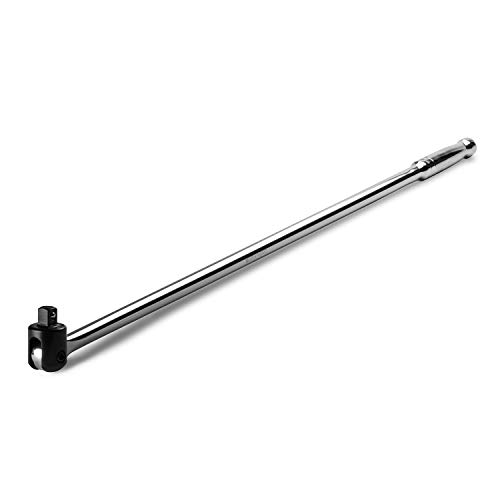
- 1/2-inch drive, 30 inches long
- Chrome vanadium body, chrome molybdenum head
- Spring-loaded ball holds sockets
- Head rotates 230 degrees
Capri Tools builds this 1/2-inch drive breaker bar longer than usual. The listing gives an extended length of 30 inches, which Capri describes as 25 percent longer than standard, and the extra handle is the whole point: more leverage on the same 1/2-inch sockets you already own.
The body is chrome vanadium steel and the head is chrome molybdenum, a common pairing where the head takes the shock and the handle takes the bending load. A spring-loaded ball bearing holds the socket on the tang. The head rotates through 230 degrees, so you can set the socket on a bolt at an awkward angle and still swing the handle to a clear spot.
This bar fits someone who keeps meeting fasteners that a 24-inch handle will not shift, such as sway bar links or lower control arm bolts that have rusted in place. The trade-off is size. At 30 inches it can be harder to swing inside a wheel well or under the hood, and the extra force is easier to overdo on smaller bolts, so match the bar to the fastener rather than reaching for it every time.
View Capri Tools 30-Inch Extended Leverage on Amazon

3. TEKTON SBH99201: 3/8 and 1/2 Inch Drive Breaker Bar Set, 18 and 24 Inch, Comfort Grip
- 3/8-inch x 18-inch and 1/2-inch x 24-inch bars
- 230-degree pivoting heads
- Internal spring holds head position
- Rounded oval comfort grip
The SBH99201 pairs two TEKTON breaker bars: a 3/8-inch drive bar at 18 inches and a 1/2-inch drive bar at 24 inches. Together the two bars cover small engine and interior bolts as well as wheel and suspension hardware, the range most home garages see.
Both bars share the features of TEKTON’s single bars, with a 230-degree pivoting head, an internal spring that controls head tension and heads made from heat-treated AISI 4140 steel in an external design. The difference is the handle. This version uses TEKTON’s comfort grip, which the listing describes as a rounded oval shape that fills the hand without being bulky, a help on long pulls or in cold weather.
The 3/8-inch bar earns its place on jobs where a 1/2-inch handle is overkill, such as exhaust hangers, valve cover bolts or crank pulley work on smaller engines, where you want leverage but less chance of snapping a small fastener. The 1/2-inch bar handles lug nuts and brake brackets. If you already own a 1/2-inch breaker bar, the single 3/8-inch bar on its own may make more sense than the pair.
View TEKTON SBH99201 2-Piece Set on Amazon
4. GEARWRENCH 87852: 1/2 Inch Drive Extendable Flex Handle Breaker Bar, 18 to 24 Inch

- 1/2-inch drive with 180-degree flex tang
- Extends from 18 inches to 24 inches
- Ball detent holds sockets
- Knurled, full polish chrome handle
The GEARWRENCH 87852 is a 1/2-inch drive flex handle with an extendable shaft. The handle extends the overall length from 18 inches up to 24 inches, so it can sit in a drawer or a trunk organizer at the shorter length and stretch out when a fastener needs more leverage.
That adjustability is useful in two ways. In a tight wheel well or along a subframe, the short setting gives you room to swing, and when the nut is out in the open, the long setting adds pull. GEARWRENCH’s product page for the 87852 lists a 180-degree flex tang, a ball detent to hold the socket, a knurled handle and a full polish chrome finish that wipes clean and resists corrosion. The maker also states it meets or exceeds ASME specifications.
An extendable bar has a sliding joint that a one-piece bar does not, so for repeated heavy pulls on seized hardware a fixed handle is the simpler tool. As a bar that rides along in the car for a roadside wheel change, or lives in a small garage where drawer space is tight, it fits well, and the 24-inch setting matches a standard bar for lug nuts.
View GEARWRENCH 87852 Extendable on Amazon
5. MAXPOWER Breaker Bar: 3/4 Inch Drive x 40 Inch Flex Handle with Cr-Mo 180-Degree Head
- 3/4-inch drive, 40-inch overall (37-inch working)
- Listed up to 1,041 lb-ft break-loose force
- 180-degree Cr-Mo flex head
- Forged Cr-V steel, knurled grip
MAXPOWER’s 40-inch bar steps up to a 3/4-inch drive, the size used for heavy truck lug nuts, axle nuts and large suspension fasteners. The listing gives a 40-inch overall length and a 37-inch working length, and states it delivers up to 1,412 N.m, or 1,041 lb-ft, of break-loose force.
The head is chrome molybdenum and flexes through 180 degrees, with a spring-loaded ball bearing to keep the socket in place. The shaft is forged chrome vanadium with a polished finish and a knurled section for grip. MAXPOWER also prints a clear warning on the listing: never add a cheater pipe or extension to the handle, and pull the bar toward your body instead of pushing, for safer, more controlled force.
You will need 3/4-inch drive sockets, or an adapter, to use it, and most passenger cars never call for this much bar. Where it earns its keep is on pickups, vans and older vehicles whose hardware has rusted solid, and on axle nuts that are tightened to high specs from the factory. Plan your footing and the direction of pull before you lean on it.
View MAXPOWER 40-Inch 3/4 Drive on Amazon
6. WORKPRO Dual Drive Breaker Bar: 3/8 and 1/2 Inch Drive, 24 Inch, 360-Degree Flex Head

- 3/8-inch and 1/2-inch drive ends
- 360-degree rotatable head
- Cr-Mo head, chrome vanadium handle
- Black phosphate finish
WORKPRO’s 24-inch bar has a drive at each end of the head, one 3/8-inch and one 1/2-inch, so a single handle works with both of the socket sizes most home mechanics own. If your sockets are split between two drive sizes, it saves carrying a separate bar or an adapter for each.
The listing describes a chrome molybdenum head on a chrome vanadium steel handle with a black phosphate coating for corrosion resistance. The head rotates through 360 degrees, which gives more angles than many single-drive bars, and a spring-loaded ball bearing holds the socket in place. The handle has a smooth, round profile.
Keep in mind that the 3/8-inch end shares a 24-inch handle with the 1/2-inch end. That is a lot of leverage on a 3/8-inch drive, and it is easy to overload a small socket or bolt if you pull as hard as you would on a lug nut. Use the smaller end for moderate fasteners and switch to the 1/2-inch side for wheels and suspension work. For a rack of 1/2-inch impact sockets alone, a single-drive bar is the simpler option.
View WORKPRO 24-Inch Dual Drive on Amazon
Six Bars Side by Side
Match a bar to the jobs you do most.
| Bar | Drive and length | Head | Good fit for |
|---|---|---|---|
| TEKTON SBH00224 | 1/2-inch drive, 24 inches | 230-degree, spring tension | A first breaker bar for cars |
| Capri Tools Extended Leverage | 1/2-inch drive, 30 inches | 230-degree | Extra pull on 1/2-inch sockets |
| TEKTON SBH99201 set | 3/8-inch x 18-inch and 1/2-inch x 24-inch | 230-degree, spring tension | Engine bay plus wheel work |
| GEARWRENCH 87852 | 1/2-inch drive, 18 to 24 inches | 180-degree flex tang | Small toolboxes and trunks |
| MAXPOWER 40-inch | 3/4-inch drive, 40 inches | 180-degree | Trucks and seized hardware |
| WORKPRO Dual Drive | 3/8-inch and 1/2-inch drive, 24 inches | 360-degree | One bar for two socket sizes |
If you only buy one, a 1/2-inch drive bar around 24 inches long is the safe middle choice.

Using a Breaker Bar Safely on Salted, Rusty Hardware
Road salt and freeze-thaw cycles in West Michigan rust lug nuts, caliper bolts and sway bar links in place, so soak them with penetrating oil and wait before you pull. Our guide to penetrating oil for rusted bolts compares the common choices.
- Pull, do not push: pull the handle toward you with a steady motion, so a sudden release does not send your knuckles into metal.
- Seat the socket fully: use a six-point socket and make sure it sits square on the nut before you load the bar.
- Skip the cheater pipe: sliding a pipe over the handle can bend the bar or snap the socket. Several listings warn against it.
- Wear eye protection: rust scale and broken pieces can fly when a fastener lets go.
For lug nuts, crack them loose while the tire is still on the ground, then lift the car. Once it is up, support it on stands rather than the jack, and a solid floor jack that gives good value makes the lifting part easier.
When you put the wheel back on, a breaker bar is not a tightening tool. Snug the nuts in a star pattern, then finish with a torque wrench set to the value in your owner’s manual.

When the Bolt Wins: Bring It to Our Shop
Even the best breaker bar cannot save a fastener that is rounding off or a part that is cracked or badly corroded. More leverage at that point can turn a one-hour job into a drilled-out stud, so stop and let a technician handle it.
Seized hardware often shows up during bigger jobs such as control arms, struts and hubs, which we handle through our suspension repair service in Grand Rapids. If you would rather leave the routine work to someone else, our factory scheduled maintenance in Grand Rapids covers the service items your owner’s manual lists for your mileage.

A wheel bearing that hums after the hub has been apart is another reason to call. Our wheel bearing replacement service handles that job, axle nut included.
More Buying Guides
Frequently Asked Questions
Do breaker bars work on really stuck bolts?
Yes, that is their job. The long handle multiplies the force of a steady pull, and with no ratchet inside there is nothing to slip or strip. Very rusty bolts still benefit from penetrating oil and some patience first.
Is a breaker bar or an impact wrench better for lug nuts?
An impact wrench is faster, especially when you rotate tires often. A breaker bar costs less, needs no battery or air supply and gives you more feel as the nut lets go. Many home mechanics keep a bar even after buying an impact wrench.
What is the largest breaker bar I would need for car work?
For cars, light trucks and SUVs, a 3/4-inch drive bar around 40 inches long covers the toughest jobs, such as seized axle nuts. Larger 1-inch drive bars exist for heavy trucks and equipment, but they are oversized for most home garages.
What is the best breaker bar brand?
No single brand wins every job. TEKTON, GEARWRENCH, Capri Tools, MAXPOWER and WORKPRO all make bars covered here, so compare drive size, length and head design on each listing rather than buying on the name alone.
If a fastener will not budge, we can help. Ring 456 AutoFix at 616-279-3832 on a weekday between 8am and 5pm, or reach us through the contact page to arrange a visit.
Short on time during business hours? Our after-hours drop-off lets you leave the vehicle at 456 Carrier St NE, Grand Rapids, and we will take it from there.