
As an Amazon Associate, 456 AutoFix earns from qualifying purchases. Product links below go to Amazon, where you can confirm the right part for your vehicle.
Hard braking at the end of a straight sends a lot of heat into the hub, and the grease inside a wheel bearing has to take that heat lap after lap. The best wheel bearing grease for performance driving keeps its structure at high temperature, carries heavy cornering loads and stays put when the car cools down and sits.
Below we cover whether your car can be regreased at all, what to read on the label, then five greases that suit track days, autocross and drag strip use. For everyday street driving, our guide to wheel bearing grease for regular cars and trucks covers a wider range.
Quick answer
Which wheel bearing grease handles track heat?
Pick an NLGI #2 grease rated NLGI GC-LB with a high dropping point. Red Line CV-2 is a synthetic built for high-performance wheel bearings, Timken GR224C is a lithium complex grease from the bearing maker, and Royal Purple UPG adds strong water resistance. Sealed hub units cannot be regreased at all.
Our Quick Picks
Three quick picks: Red Line CV-2 for track heat, Timken GR224C for street cars that run the odd event, and Royal Purple UPG as a synthetic that resists water washout. All five greases are reviewed below.

Red Line CV-2
A synthetic made for high-performance wheel bearings and CV joints.
Timken GR224C
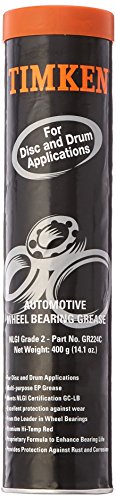
Timken's own automotive wheel bearing grease for disc and drum brakes.

Royal Purple UPG
One synthetic tube for bearings, U-joints and chassis points.
First Check: Can Your Bearings Be Repacked?
Most cars built in the last twenty-odd years use sealed hub bearing units. The bearing is filled with grease at the factory and sealed for life, so there is no way to add or change it. When one wears out, the whole hub or bearing is replaced.
Repackable bearings are the tapered roller type, with an inner and outer bearing, a grease seal and a dust cap held by a castle nut and cotter pin. You find them on many older muscle and sports cars, rear-drive trucks, trailers and a lot of purpose-built race and drag cars. If you pull the dust cap and see a nut and cotter pin, you have bearings you can clean and repack.
Not sure which kind you have? Your service manual or a parts catalog will show it, and it is worth knowing before you buy any grease.
Reading a Grease Label for Heat and Load
The most useful mark on the tube is the NLGI certification. “GC” is the top wheel bearing category and covers the heat that disc brakes put into a hub, while “LB” covers chassis points. A grease marked GC-LB does both jobs. NLGI #2 is the normal consistency for wheel bearings.
Dropping point is the temperature at which the grease turns liquid in a lab test. It is not a safe running temperature, so treat a high figure as headroom rather than a target. Red Line’s CV-2 data sheet is a good example of what a full spec sheet shows, from dropping point to water washout and four-ball weld load.
Thickener type matters when you switch brands. Lithium complex is the common choice, while some synthetics use a non-soap thickener that should not be mixed with it. When you change greases, clean every bit of the old one out of the bearings and hub before you pack.
Best Wheel Bearing Grease for Performance Driving: Five Greases Reviewed
Each grease below is a specific listing with its maker’s stated grade and temperature figures. Check the label against your bearing or vehicle maker’s recommendation, and buy enough to pack both sides of an axle at once.
1. Red Line 80402 CV-2: Synthetic Moly Grease Rated -100°F to 500°F, 14 oz Tube
- NLGI #2 with NLGI GC-LB service rating
- Synthetic base with organic moly
- Listed range of -100°F to 500°F
- 14 oz tube fits a standard grease gun
Red Line CV-2 is a fully synthetic grease that its maker describes for high-performance wheel bearings, U-joints and high-angle CV joints. Red Line’s data sheet lists it as an NLGI #2 grease with the GC-LB service rating, a non-soap thickener and a useful temperature range of -100°F to 500°F. This listing is the 14-ounce tube, part 80402, which loads into a standard grease gun; the 80401 jar holds the same grease for hand packing.
The key figures are about heat and pressure. Red Line quotes a dropping point above 800°F, a 400 kg four-ball weld load and 1 percent water washout at 105°F, plus low evaporation and oil separation at 350°F. An organic moly adds film strength under shock loads. The maker also notes the grease darkens after high-temperature use and says this does not affect how it performs.
This grease suits a car that sees track days, autocross or repeated hard stops, where brake heat soaks into the hub between sessions. Because the thickener is non-soap, clean every trace of old lithium grease out of the hub and bearings before you pack, rather than topping up. It is more than a stock commuter needs, and it cannot help a sealed hub unit that has no way to take fresh grease.
2. Timken GR224C: NLGI No. 2 Lithium Complex Wheel Bearing Grease, 14 oz Cartridge
- Made for automotive wheel bearings
- NLGI No. 2 with lithium complex thickener
- Dropping point of 280°C (536°F) minimum
- 400 g (14 oz) grease gun cartridge
Timken makes many of the tapered roller bearings found in car and truck hubs, and GR224C is its automotive wheel bearing grease in a 14-ounce cartridge. Timken’s data sheet lists it as a red NLGI No. 2 grease with a lithium complex thickener, a minimum dropping point of 280°C (536°F) and a four-ball weld point of at least 400 kgf. The same grease comes in a 1-pound tub as GR224T if you prefer to pack bearings by hand.
Timken’s literature describes it for disc and drum brake applications and lists NLGI GC-LB certification, the wheel bearing category meant for the heat disc brakes put into a hub. Timken also notes it is generally compatible with lithium, lithium complex and several calcium-based greases. Even so, the company recommends removing the old grease before you change products, which is good practice with any switch.
This is a sensible choice for a street car that runs a few autocross events or hard drives each summer, and for owners who like using grease from the company that made the bearing. It is not sold as a synthetic, so a full road racing schedule with very hot brakes may call for something with a wider temperature range. Like every grease here, it only applies to serviceable bearings, not sealed hub assemblies.

3. Royal Purple Ultra-Performance Grease UBP2-T: Synthetic, 500°F Max, 14.5 oz Tube
- Synthetic grease composition
- Maximum operating temperature of 500°F
- Extreme pressure and washout resistance
- 14.5 oz tube for bearings and U-joints
Royal Purple Ultra-Performance Grease, sold as UPG, is a synthetic grease in a 14.5-ounce tube with the part number UBP2-T. The Amazon listing positions it for bearings, U-joints and general-purpose lubrication, and it gives a maximum operating temperature of 500°F. That lets one tube cover the wheel bearings, driveshaft joints and chassis fittings on a car that gets driven hard.
Royal Purple’s description stresses extreme pressure capability and resistance to water, both to emulsifying and to washing out. Those two traits matter on a performance car. Cornering and braking loads press hard on the bearing rollers, and a car that also drives through rain or spring slush needs grease that stays where it was packed. The listing also describes the grease as stable at high temperatures.
UPG makes sense for an owner who wants a synthetic for a weekend car and would rather keep one grease in the garage than several. The listing does not state an NLGI service category, so read the tube or ask Royal Purple about GC-LB status if your bearing or vehicle maker calls for it. As with any change of grease, clean out the old product first, and remember that a sealed hub assembly cannot take any of it.
View Royal Purple UPG on Amazon
4. Liqui Moly LM 50 Litho HT 20248: Lithium Complex High-Temp Bearing Grease, 400 g

- Lithium complex soap thickener
- Made for heavily loaded wheel bearings
- Rated -30°C to +140°C, briefly 180°C
- Water and corrosion resistant
LM 50 Litho HT is a lithium complex grease from German maker Liqui Moly, part number 20248, sold here in a 400-gram cartridge. Liqui Moly describes it as a non-liquefying, water-resistant grease for heavily loaded plain and roller bearings, and it names wheel bearings as a main use. It carries the DIN 51502 code KP2N-30, which marks an NLGI 2 rolling bearing grease with extreme pressure additives.
Liqui Moly lists a service range of -30°C to +140°C (-22°F to 284°F), with short peaks up to 180°C (356°F). That continuous rating is lower than the synthetic greases above, which places this grease in fast road and heavy-duty street use rather than racing. It also resists oxidation and corrosion, a help for a car that sits for weeks between drives.
This grease suits older European and domestic sports cars with serviceable tapered bearings, plus spirited road driving where brake temperatures stay within normal limits. Given the lower continuous rating, keep it off a car that runs long track sessions on hot brakes. The listing does not quote an NLGI service category, so if your manual or bearing maker asks for GC-LB, check the cartridge label before you buy it.
View Liqui Moly LM 50 Litho HT on Amazon
5. Castrol Pyroplex Blue #2: Lithium Complex Grease with Hydro-Activation, 1 Tube

- Lithium complex thickener
- NLGI #2 consistency
- Hydro-Activation for tack when wet
- Single grease gun tube
Castrol Pyroplex Blue is a blue lithium complex grease, and this listing is a single tube of the NLGI #2 grade. Castrol builds it around what it calls Hydro-Activation technology, which the company says helps the grease keep its tack and adhesion when water gets in. It is sold for wheel bearings, chassis points and heavy equipment, so one tube can serve several jobs on the same car.
Castrol’s product literature claims roughly double the anti-wear protection of standard extreme pressure greases. Lithium complex thickeners hold together at higher temperatures than plain lithium, which is why they are the usual base for disc brake wheel bearing greases. Castrol’s data sheet ties its GC-LB note to a specific grade, so confirm the rating for the #2 tube on its label before you rely on it for disc brake hubs.
Pyroplex Blue suits a performance car that is also driven through rain, car washes and salted winter roads, where water resistance matters as much as heat. The Amazon listing itself is thin on detail, so treat the tube label and Castrol’s current data sheet as the final word. It is a heavy-duty multipurpose grease rather than a race product, and like the others it only applies to bearings that can be repacked.
View Castrol Pyroplex Blue on Amazon
Matching a Grease to How You Drive
How hot your hubs get depends far more on brake use than on top speed. A drag car makes one hard stop per pass, while a road course car can brake from high speed a dozen times a lap. Use this table as a starting point.
| Driving style | Grease to consider | Why |
|---|---|---|
| Road course and track days | Red Line CV-2 | GC-LB synthetic with a -100°F to 500°F listed range |
| Autocross and spirited street use | Timken GR224C or Royal Purple UPG | GC-LB lithium complex, or a synthetic with strong water washout resistance |
| Drag strip, street-driven | Timken GR224C or Red Line CV-2 | One hard stop per pass, then normal road use |
| Fast road car driven in all weather | Castrol Pyroplex Blue or Liqui Moly LM 50 | Lithium complex greases with water and corrosion resistance |

Drag cars with skinny front tires and low-drag spindles are a special case. Some race bearing and spindle makers specify their own lubricant, and their instructions override any general advice here. Hot brakes also cook brake fluid, so pair a good grease with fresh, high-boiling fluid from our roundup of brake fluid for performance driving.
Repacking Bearings Before a Track Day
A fresh repack before the season, and a look after any event that cooked the brakes, keeps a serviceable bearing healthy:
- Clean it out: wash the old grease from both bearings and the hub with solvent, then let everything dry.
- Inspect the races: look for pitting, blue heat marks or flaking on the rollers and cups. Any of those means new bearings, not more grease.
- Pack fully: work grease through the rollers by hand or with a packer until it comes out the other side.
- Fit a new seal: a reused seal lets grease out and water in.
- Set preload by the book: follow the manual’s nut procedure and use a new cotter pin.

A West Michigan car often runs events in summer and then drives on salted, slushy roads through winter. If yours does both, look closely at water washout figures and check the seals each spring, since brine that gets past a lip seal breaks down any grease. Darkened grease after a hot weekend can be normal; grease that looks milky or gritty means water or dirt got in.
When It Is the Bearing, Not the Grease
Even the best wheel bearing grease for performance driving will not quiet a bearing that is already damaged. A growl that changes with speed or gets louder in a turn is the classic sign, and our guide to wheel bearing noise symptoms explains how to narrow down which corner it is. Track use shortens bearing life, and how long wheel bearings last covers what wears them out.

Pressed-in bearings on front-drive and many modern cars need a press to swap, and our review of the wheel bearing press kits worth owning covers the tools. If you would rather hand it off, our wheel bearing replacement service in Grand Rapids handles sealed hubs and repackable bearings alike. Hendrick Hoffman, owner and head mechanic, carries ASE and State of Michigan certification covering brake work along with suspension and steering.
More Buying Guides
Frequently Asked Questions
Is synthetic grease worth it for track days?
Often, yes. Synthetic greases such as Red Line CV-2 list wider temperature ranges than most conventional greases, which gives more margin when brake heat soaks into the hub. A GC-LB lithium complex grease is still a sound choice for lighter use.
Can I mix two different wheel bearing greases?
It is better not to. Some thickeners do not get along, and a mix can soften or separate under heat. Clean out the old grease completely before packing with a new product.
How often should I repack bearings on a track car?
Many owners repack once a season and inspect after any event with very hot brakes. Follow your vehicle or bearing maker’s interval if it gives one.
Does my modern car need wheel bearing grease?
Probably not. Most recent cars use sealed hub units that are greased for life and replaced as a unit when they wear out.
Picking up a hum or growl from one corner after a weekend of hard driving? Call 456 AutoFix at 616-279-3832, Monday to Friday 8am to 5pm, or set up a wheel bearing inspection through our contact page.
If our weekday hours clash with yours, the after-hours drop-off lets you leave the car at 456 Carrier St NE in Creston on your own schedule.