
As an Amazon Associate, 456 AutoFix earns from qualifying purchases. Product links below go to Amazon, where you can confirm the right part for your vehicle.
The squat tank with a hand pump built into its lid shows up in almost every thread about changing oil without crawling under the car. This mityvac 7201 review explains what the Fluid Evacuator Plus does, the limits its own manual spells out, and four other extractors worth weighing against it before you order.
If you are still deciding between a hand pump, shop air and a 12V pump, our guide to fluid extractors for oil changes covers each type, and the 7201 also appears in that roundup. Here the focus stays on one tool and the people it suits.
Quick answer
Is the Mityvac 7201 worth buying for home oil changes?
For most cars and light trucks with a dipstick tube that takes its probe, yes. The 7201 holds 2.3 gallons, needs no power or air, and can refill as well as extract. Skip it for oil over 175 degrees F, any fuel, or sumps much larger than 8 liters.
Our Quick Picks
Three quick picks: the 7201 this review is built around, a dual-mode tank that also runs on shop air, and Mityvac's own compressed-air evacuator. All five extractors are covered below.
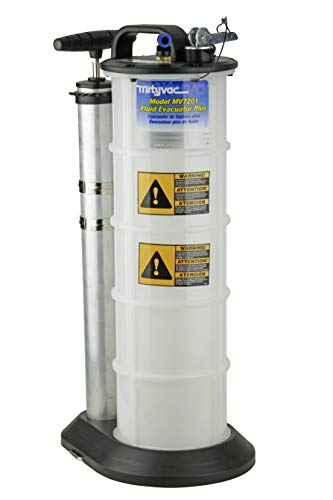
Mityvac 7201
Hand-pumped evacuator that also refills through the same tube.

VEVOR 6.5L Dual-Mode
One tank that switches between hand pumping and air.

Mityvac MV7110
Air-powered extractor that also pressure-fills and bleeds.
How the Fluid Evacuator Plus Pulls Oil Out the Top
The 7201 is a vacuum tank. You slide a thin probe down the dipstick tube until it touches the bottom of the oil pan, connect it to the main suction tube on the lid, and pump the handle to lower the pressure inside the reservoir. Atmospheric pressure then pushes the oil up the tube and into the tank.
The Mityvac MV7201 user manual hosted by SKF, the group that owns the brand, lays out a short routine. Idle the engine to normal operating temperature, shut it off, then pull the dipstick and insert the smallest dipstick tube. Set the selector valve on the pump to evacuate, lift the handle to its top stop and give it about ten strokes.
To empty it, pull the rubber plug and pour the old oil into a sealed jug. To refill, rinse and dry the tank, add fresh fluid, flip the valve to dispense and pump it back in.
Will Your Engine Work With a Topside Extractor?
Mityvac admits that differences in engine blocks and dipstick tubes make the tool unusable on some vehicles. If the smaller of the two probes doesn’t slide in freely, the manual says not to force it. Any honest mityvac 7201 review has to start there.
- Oil capacity: you may need to empty the tank and restart once a crankcase holds more than 8 liters (2.11 gallons).
- Oil temperature: the limit is 175 degrees F (80 degrees C).
- Fluids: never gasoline, diesel, kerosene or two-stroke mix.
- Filter access: extraction only replaces the drain plug. If the filter sits underneath, you still need to get under the car.
Topside changes suit engines with a top-mounted cartridge filter, a layout common on many European cars. Our pages on the oil extractor for Audi engines and the fluid extractor for Volkswagen owners go into those cars in more detail.
Mityvac 7201 Review: The Evacuator and Four Alternatives in Detail
The 7201 comes first, followed by another Mityvac and three rival extractors. Every spec below is taken from the maker or the Amazon listing, so compare capacities and tube sizes with your own engine.
1. Mityvac 7201: 2.3 Gallon Manual Fluid Evacuator with Push-Button Dispensing
- 2.3 gallon (8.8 liter) polyethylene reservoir
- Evacuates and dispenses with one hand pump
- Float-type automatic overflow prevention
- Quick-drain spout and wide, stable base
The 7201, sold by Mityvac as the Fluid Evacuator Plus, is a hand-operated tank that pulls fluid out through a tube and can push fresh fluid back in. The reservoir holds 2.3 gallons, or 8.8 liters, and is molded from chemical-resistant polyethylene, so it won’t rust in a damp garage. Mityvac lists engine oil, gear and transmission oils, power steering fluid, coolant and brake fluid among the fluids it handles.
A selector valve on the side of the pump chooses between evacuate and dispense. In evacuate mode, the manual has you raise the handle fully and give it about ten strokes, then the vacuum keeps drawing oil while you get on with the filter. A float shuts off the flow as the tank fills, although the manual says to keep the unit level and not to treat the shut-off as a guarantee. Once you’re done, the quick-drain spout lets the old oil pour into a recycling jug.
This suits a home mechanic who changes oil on one or two cars with a dipstick tube that accepts the supplied probes. It doesn’t suit oil hotter than 175 degrees F, fuel of any kind, or sumps over about 8 liters, where you would need to empty the tank partway through.
2. Mityvac MV7110: 2.5 Gallon Compressed-Air Fluid Extractor and Dispenser
- 2.5 gallon (10 liter) reservoir
- Runs on up to 120 psi of shop air
- Vacuum or positive pressure from one venturi lid
- Gauge for keeping output pressure under 30 psi
The MV7110 is Mityvac’s answer for owners who already run a compressor. Instead of a hand pump, its venturi lid uses up to 120 psi of shop air, and a slide valve and throttle decide whether the tank pulls a vacuum or builds positive pressure. That means one tool can empty a reservoir, top it up or refill it, and the listing also names pressure bleeding of hydraulic brake and clutch systems.
The reservoir holds 2.5 gallons, or 10 liters, which is a little more than the 7201. Separate pressure and vacuum switch valves control the flow, and a gauge helps you keep output pressure below 30 psi while dispensing. In the box are the reservoir, the venturi lid, an MVA575 flex hose, an evacuation wand, the gauge, a hook and a manual, and Mityvac backs materials and workmanship for one year.
Mityvac pitches it at agricultural, commercial and industrial vehicles, with brake fluid, power steering fluid, transmission fluid, engine oil and coolant on its list. The listing rules out solvents, liquid fuels and DEF. It is the wrong choice for anyone without a compressor, and it is more tool than a single-car driveway needs, but it suits a busy home shop that services trucks, tractors or several vehicles.

3. EWK 6L Manual Fluid Extractor: Hand Pump with 59 Inch Hose and 42 Inch Metal Probe

- 6 liter tank, no power or air needed
- 59 inch clear hose and 42 inch metal probe
- Step-on base and clear level gauge
- Sealing cap and angled pouring spout
EWK’s 6 liter extractor works on the same principle as the 7201: pump the handle, build vacuum and let the tank draw oil up the dipstick tube. It needs no electricity or compressor, so it works in a driveway, at a cabin or on a jobsite. The tank is smaller than the Mityvac’s, which makes it easier to store but means it holds less before you have to stop and pour it out.
The suction side is a 59 inch clear hose joined to a 42 inch flexible metal probe meant to reach the bottom of the pan. Because the hose is clear, you can watch the color of the oil as it comes up. A wide step-on base lets you pin the tank with your foot while pumping, a clear level gauge shows how much has come out, and a sealing cap and angled spout help with carrying and pouring. EWK sells a replacement hose under SKU EB0406.
The listing names cars, motorcycles, jet skis, generators and lawn equipment, with engine oil, ATF, coolant and power steering fluid on the list. EWK says it is not for gasoline, fluids above 175 degrees F, or the Mercedes W212 E350 and C218 CLS350. It suits small and midsize engines rather than large truck sumps.
View EWK 6L Manual Extractor on Amazon
4. VEVOR 6.5L Pneumatic/Manual Oil Extractor: Dual-Mode Tank with Four Suction Tubes
- 6.5 liter (1.74 gallon) tank
- Works by hand pump or compressed air
- Main tube, two extension tubes and a suction hose
- Dipstick and two sealing rings included
VEVOR’s 6.5 liter extractor gives you a choice the 7201 doesn’t: pump it by hand, or hook up compressed air for faster suction. The listing describes the pneumatic mode as the quicker option and the manual mode as the one to use when no extra equipment is around. The tank holds 1.74 gallons, so it sits between the 6 liter EWK and the larger Mityvac reservoirs.
The kit comes with a main tube, a dipstick, two extension tubes, a liquid suction hose, two sealing rings and a manual. VEVOR prints the tube sizes: extension tubes of 7 mm and 6 mm, each 1200 mm long, and a suction hose of 8 mm by 1480 mm. Having more than one diameter helps when a dipstick tube is narrow or curved, though you should still stop if a tube won’t slide in freely.
VEVOR lists engine oil, gear oil, power steering fluid and brake fluid, and names cars, motorcycles, boats, lawnmowers and tractors. It suits a home mechanic who has a compressor for some jobs but wants a hand-pump fallback. It is not a dispenser for refilling, and like any tank this size it may need emptying before a large engine is fully drained.
View VEVOR 6.5L Dual-Mode on Amazon
5. OMT 2.6 Gallon Vacuum Fluid Evacuator and Filler: Pneumatic Set with 15 ATF Adapters

- 10 liter (2.6 gallon) reservoir
- Extracts on up to 170 psi of shop air
- Two-way rotary valve and trigger lock
- 15 ATF refill adapters in a tool case
Orion Motor Tech’s 2.6 gallon set is built around transmission work as much as oil changes. It runs on compressed air, rated up to 170 psi for extraction and 36 psi for dispensing, and a two-way rotary valve switches between the two. A trigger lock allows hands-free continuous operation, and a safety valve pops up automatically if pressure climbs too high.
The reservoir holds 10 liters, the largest here alongside the MV7110. What sets it apart is a set of 15 ATF refill adapters, packed in a tool case with the hoses. A 1/4 NPT air inlet connects to a standard compressor, transparent hoses let you see the fluid, a built-in gauge shows pressure, hangers keep the lines tidy and gloves are included. OMT lists polyurethane and nylon hoses, a polyethylene reservoir and 6061 aluminum adapters, chosen for heat and chemical resistance.
This suits a home shop that handles transmission fluid service as well as engine oil, and already owns a compressor. It is overkill for someone who only changes engine oil twice a year, and it won’t work without shop air. Check your transmission maker’s fill procedure before using any adapter.
View OMT 2.6 Gallon Evacuator on Amazon
Our Mityvac 7201 Review Verdict: Strengths and Weak Spots
- Pros: no compressor or outlet needed; a 2.3 gallon tank for most car engines; evacuate and dispense from one pump; a polyethylene body that won’t rust; float shut-off and a quick-drain spout.
- Cons: the shut-off is not guaranteed; a 175 degree F ceiling; larger sumps mean emptying partway; no help when the dipstick tube rejects the probe.

The right buyer has one or two gasoline cars with a reachable filter and no wish to jack the car up. Anyone with a compressor may prefer the MV7110 or the OMT set, and owners who mostly bleed brakes should read our Motive Power Bleeder vs Mityvac instead.
The Five Extractors Side by Side
| Extractor | Capacity | Power | Good fit for |
|---|---|---|---|
| Mityvac 7201 | 2.3 gal (8.8 L) | Hand pump | Topside oil changes, refilling too |
| Mityvac MV7110 | 2.5 gal (10 L) | Shop air up to 120 psi | Trucks, farm and fleet fluids |
| EWK 6L | 6 L | Hand pump | Small and midsize engines |
| VEVOR 6.5L | 6.5 L | Hand pump or shop air | Owners who want both modes |
| OMT 2.6 gal | 10 L | Shop air up to 170 psi | Transmission fluid work |
An engine holding around 5 quarts fits in any of the five. Above 6 liters, the smaller tanks need an extra pour, while the 7201 and the two pneumatic units keep going. Only the 7201 is listed for refilling by hand, which helps with differentials that fill through a small plug.

Extracting Oil in a Cold Grand Rapids Garage
Cold oil is thick, and thick oil crawls through a narrow probe. After a January night in an unheated West Michigan garage, an engine gives up its oil far more slowly than one that has just idled to temperature, which is why Mityvac’s routine starts with warming it up. Let it idle, shut it off, and make sure the oil is below the 175 degree limit before you start pumping.

The oil you pour back in matters as much as how the old oil leaves. Our guide to motor oil for cold weather starts explains what the first number on the bottle means when the temperature drops. Keep the old oil sealed in a jug and take it to a used oil collection point, never a storm drain.
When the Drain Plug, or a Shop, Makes More Sense
If the probe won’t go in, the filter is underneath, or you want to inspect the drain plug threads, draining from below is the better route. Stretching changes because extraction feels easy is a mistake too, so read up on how long you can go without an oil change and follow the interval in your owner’s manual.
When you would rather hand the job over, our oil change service in Creston covers foreign and domestic vehicles, so you can skip the jack stands and the used oil run. Hendrick Hoffman has worked in automotive service since 2005, so odd filter housings and tight dipstick tubes are familiar ground.
More Buying Guides
Frequently Asked Questions
Should the oil be warm when I use the Mityvac 7201?
Yes, warm but not hot. Mityvac’s manual says to idle the engine to normal operating temperature and shut it off first, and not to extract oil above 175 degrees F (80 degrees C). Warm oil flows up the probe much faster than cold oil.
Can the Mityvac 7201 handle transmission fluid, coolant and brake fluid?
Mityvac lists engine oil, gear and transmission oils, power steering fluid, coolant and brake fluid. Let the engine cool before opening a radiator or expansion tank cap. It must never be used with gasoline, diesel, kerosene or two-stroke mix.
Is the 7201 big enough for a pickup truck engine?
It holds 2.3 gallons, or 8.8 liters. Mityvac says you may need to empty the tank and restart when a crankcase holds more than 8 liters, so check your owner’s manual for the oil capacity first.
What does a mityvac 7201 review leave out about fit?
Usually the dipstick tube. Some engines’ tubes won’t accept the probe, and Mityvac says never to force it. Try the smaller of the two dipstick tubes, and if it binds, drain from the plug instead.
Finished reading this mityvac 7201 review and decided to skip the mess altogether? Give our shop a call at 616-279-3832 on any weekday from 8am to 5pm, or request an oil change appointment online.
Tied up during business hours? Leave your car at 456 Carrier St NE using our after-hours drop-off, add a note with your mileage, and we will take it from there.