As an Amazon Associate, 456 AutoFix earns from qualifying purchases. Product links below go to Amazon, where you can confirm the right part for your vehicle.
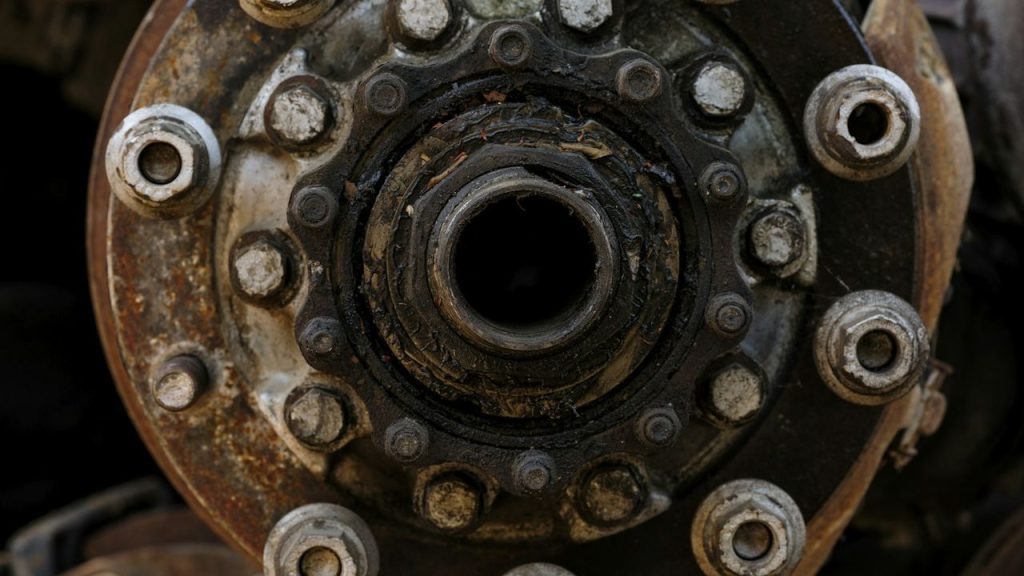
Pull a wheel off after a Grand Rapids winter and you will usually find orange crust on the caliper bracket, the hub and the edge of the rotor. Searching for the best brake cleaner for rust makes sense, but there is a catch: brake cleaner is a solvent that strips grease, brake fluid and dust, and it does not dissolve rust.
What works is a short sequence: loosen seized hardware with a penetrant, scrub the rust off by hand or with a hub tool, flush everything with brake cleaner, then protect the contact points with brake lubricant. Below are six products that cover each step. For a full comparison of cleaners on their own, see our guide to the best brake cleaner spray.
Quick answer
Does brake cleaner remove rust from brake parts?
Not on its own. Brake cleaner washes away grease, fluid, dust and loose rust flakes, but it can’t dissolve rust. Brush or pad the rust off first, use a penetrant such as CRC Freeze-Off on seized bolts, then flush with a 50-state formula like CRC Brakleen Pro Series and lubricate the contact points.
Our Quick Picks
Three quick picks: a 50-state brake cleaner for the final flush, a penetrant for seized bolts and a hub cleaning kit for scale. All six are reviewed below.

CRC Brakleen Pro Series
Blasts off grease, dust and loose rust flakes.

CRC Freeze-Off
Chills and penetrates rusted threads.
Titan 51798 Hub Cleaning Kit
Strips scale from the hub face.
What Brake Cleaner Does and Doesn’t Do on Rust
Brake cleaner is made to evaporate fast and leave nothing behind, which is exactly what you want on a rotor face or pad. CRC’s Brakleen Pro Series page describes it as a degreaser that removes oils, grease, dirt and other contaminants and leaves no residue. Nothing in that description says it converts or dissolves iron oxide, and no brake cleaner we know of makes that claim.
That still makes it useful on a rusty brake job. The best brake cleaner for rust work knocks loose rust dust out of corners and removes the oily film a penetrant leaves on threads.
- Brake cleaner: removes grease, dust and loose flakes before reassembly.
- Penetrant: frees rusted bolts and stuck rotors. Never on friction surfaces.
- Wire brush, file or hub pads: physically remove bonded rust and scale.
- Brake lubricant: a thin coat on clean contact points slows new rust.
- Rust converter: cosmetic use on brackets and backing plates only, never on abutments, hubs, pistons or rotors.
The Right Order for Rusty Brake Parts
Order matters more than any single product. Spraying brake cleaner first just rinses the surface, and putting a penetrant on last leaves oil where pads and rotors sit.
- Soak: spray penetrant on bracket bolts, lug studs and the rotor-to-hub joint.
- Scrub: brush the bracket, file the pad abutments and clean the hub face with an abrasive pad.
- Flush: spray brake cleaner over the bracket, hub and caliper, away from rubber boots and paint.
- Protect: put a thin film of brake lubricant on the abutments, clips and pad ears.
- Reassemble: torque to your service manual’s specs.
Every product here is flammable or needs care, so work outdoors or with the door open, wear gloves and eye protection, and never spray onto a hot brake. If you are replacing pads at the same time, our picks for daily-driving brake pads cover the friction side.
Best Brake Cleaner for Rust: The Picks in Detail
The list starts with one brake cleaner, then two penetrants, two tools that take rust off and a lubricant that slows it coming back. Descriptions use the makers’ and listings’ own claims, so read each label before you start.
1. CRC Brakleen BPC Pro Series 05050PS: 20 oz Non-Chlorinated 50-State Brake Cleaner
- Non-chlorinated, low VOC formula
- Meets all state and federal VOC rules
- PowerJet spray nozzle
- 20 oz aerosol can
CRC Brakleen is one of the most familiar brake cleaners in American garages, and the Pro Series 05050PS is its larger 20 oz can with a non-chlorinated, low VOC formula. CRC says this version meets all state and federal VOC regulations. That matters in Michigan, because CRC lists some of its higher-VOC Brakleen formulas as restricted from sale here.
CRC describes it as a fast degreaser that leaves no residue and says its PowerJet nozzle sprays with enough force to blast contaminants off brake parts. The listed applications include disc and drum brakes, calipers, brake linings, shoes, pads and clutch discs. On a rusty brake job, that force is what clears brushed-off rust dust, old pad material and penetrant oil from the bracket and hub before parts go back together.
Be clear about what it can’t do: it removes grime and loose flakes, not rust bonded to the metal. It is extremely flammable and CRC rates it as not plastic safe, so spray it with good ventilation, away from sparks, and keep it off painted surfaces and rubber where you can. For a side-by-side look at other cleaners, our brake cleaner spray guide compares formulas in more detail.
View CRC Brakleen Pro Series on Amazon
2. CRC Freeze-Off Super Penetrant 05002: 11.5 oz Freeze Shock Rust Penetrant
- Freeze shock action cracks rust
- Dissolves rust, gum and corrosion
- Leaves a water-displacing oil film
- Low VOC, 11.5 oz aerosol
Freeze-Off is CRC’s penetrant for rusted, seized fasteners, sold here in an 11.5 oz aerosol. It is the product to reach for before you put a wrench on a caliper bracket bolt that has sat through several Michigan winters. It is also useful on lug studs and on a rotor that has rusted itself to the hub.
According to CRC’s Freeze-Off product page, the spray first drops the temperature of the treated surface, which creates microscopic cracks in the rust. The penetrating liquid then soaks into those cracks, and CRC says seized parts begin to loosen within a few seconds. The page also says it dissolves rust, gum and corrosion and leaves a lubricating, non-drying oil film that displaces water.
That oil film is the reason to keep it off pads and rotor faces, and to flush the area with brake cleaner once the parts are apart. CRC lists it as extremely flammable and not plastic safe, with a pine-like odor and a low VOC formula. Give badly rusted bolts time and a second application rather than forcing them, because a snapped bracket bolt turns a simple job into a repair.
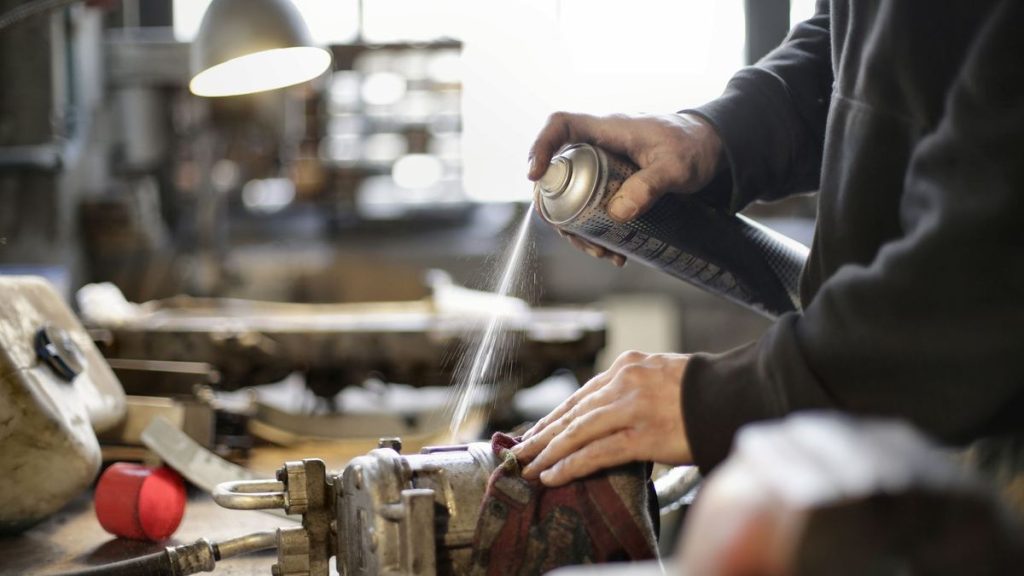
3. PB Blaster Penetrating Oil 13.2 oz: Penetrating Catalyst with ProStraw Flow Control

- Penetrating catalyst for rusted parts
- Low surface tension creeps into threads
- ProStraw with dual spray patterns
- 50-state VOC compliant
PB Blaster is a long-standing name in rust penetrants, and this listing is the 13.2 oz aerosol of its Penetrating Catalyst. It does the same job as Freeze-Off by a different route. Rather than chilling the rust, it relies on a low surface tension formula that the listing says creeps deep into threads and tight spaces to loosen rusted nuts, bolts and seized hardware.
The listing describes a ProStraw with flow control, which gives adjustable volume and two spray patterns. That helps on brakes, where you want the penetrant on a bracket bolt or the hub joint and not drifting onto the rotor face. It also says the spray leaves a protective film that helps block moisture, and that the formula is 50-state VOC compliant.
Many owners soak hardware the night before a brake job and spray again before starting, which suits a slow-creeping penetrant like this one. Like any oil-based product, it has no place on pads or friction surfaces, so clean everything with brake cleaner afterward. It frees stuck parts but doesn’t remove the rust itself, so you will still need a brush or hub pad before reassembly.
View PB Blaster Penetrating Oil on Amazon
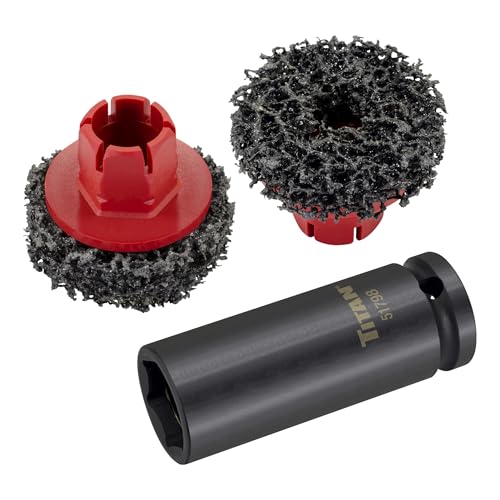
4. Titan 51798 Wheel Hub Cleaning Kit: 1/2-Inch Drive Tool with Two Abrasive Pads
- 1/2 in. drive hub cleaning tool
- Two 2 in. abrasive cleaning pads
- Cleans hubs, studs and mounting faces
- Pads lock in with a locking ring
Rust and scale on the hub face are easy to miss and cause real trouble. A thin layer between the hub and a new rotor can hold the rotor slightly out of true, which can show up later as a pulsing brake pedal. The Titan 51798 kit is a simple way to clean that face properly instead of scraping at it by hand.
The listing says the set includes one 1/2-inch drive hub cleaning tool and two 2-inch abrasive cleaning pads. The pads are made for brake hubs, wheel studs and wheel mounting surfaces, and each one snaps in place with a locking ring. Titan sells a separate five-pad set, the 51799, for replacements when the included pads wear down.
The tool fits 1/2-inch drive impact wrench power tools, so you need one to use it, and it suits owners who already work on their own brakes. Work around the studs with steady, light pressure until you see clean metal, then blow off the dust and wipe the face with brake cleaner. It is meant for the hub and studs, not for grinding the friction surface of a rotor.
View Titan 51798 Hub Cleaning Kit on Amazon
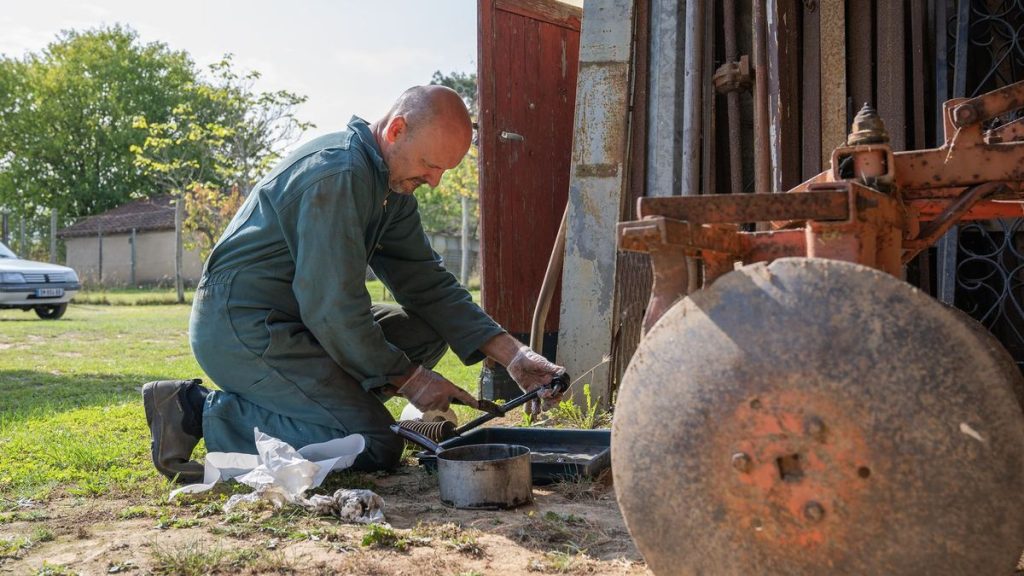
5. Lisle 13410 Disc Brake Caliper Brush: Angled Steel Wire Brush for Tight Spaces

- Heavy-duty steel wire bristles
- Angled head for tight places
- Molded handle grip
- 10.5 in. tall overall
Plenty of rust on brakes comes off with nothing more than a stiff brush and some effort. The Lisle 13410 is a hand brush built for that job, with heavy-duty steel wire bristles on an angled head. The listing says it removes brake dust, rust and other debris from brake caliper castings and is angled to fit into tight places.
That shape is what sets it apart from a general wire brush. It reaches into the caliper bracket where the pad clips sit, around the caliper body and along the backing plate behind the rotor. The molded handle gives a firm grip, and the listing puts the brush at about 4.25 inches wide by 10.5 inches high.
Use it after any seized hardware is free and the pads are out, then follow with brake cleaner to wash away the loosened rust. Forum advice for the pad abutments under the clips is to finish with a file if the brush only polishes the rust, because those surfaces need to be flat and clean for pads to slide. Keep the bristles away from piston boots and slide pin boots, which tear easily.
View Lisle 13410 Caliper Brush on Amazon
6. Permatex 24125 Ceramic Extreme Brake Parts Lubricant: 8 oz Synthetic with Ceramic Solids

- 100% synthetic with ceramic solids
- Resists moisture and corrosion
- Will not wash out
- 8 oz container
Once the rust is off and the parts are clean, something has to keep it from coming straight back. Permatex Ceramic Extreme is a brake parts lubricant made for that last step. The listing describes it as a 100% synthetic formula with ceramic solids, resistant to moisture, corrosion and contaminants, and says it will not wash out.
Permatex lists disc brake caliper hardware, pistons, bushings, rubber sleeves and seals among the suggested applications. In practice, a thin film on the bracket abutments, pad clips and the ears of the pad backing plates keeps salty water from reaching bare metal and helps the pads slide freely. The listing also says it silences brake noise across a wide temperature range.
A little goes a long way, and more is not better. Keep it off pad friction material and the rotor face, wipe away any excess, and check your pad maker’s directions, since some pads come with their own lubricant or shims. On a Michigan car, relubing the hardware each time the wheels come off for a tire swap helps the brakes stay free all winter.
View Permatex Ceramic Extreme on Amazon
Which Product for Which Rust Problem
Most rusty brake jobs need two or three of these products, and the best brake cleaner for rust is only one of them. Match each product to what you see.
| Rust problem | What to use | Brake cleaner’s role | Watch out for |
|---|---|---|---|
| Orange film on rotors after rain or a car wash | Usually nothing; a few gentle stops clear it | None needed | Pitting or a ridge that doesn’t wipe away |
| Seized caliper bolts, lug studs or a stuck rotor | Penetrant, time, then the right tools | Flush penetrant off threads and the hub | Rounded bolt heads and snapped studs |
| Scale on the hub face | Hub cleaning pads on an impact or drill | Final wipe before the rotor goes on | Missing a spot, which can cause runout |
| Rust under pad clips on the bracket | Caliper brush or file, then brake lubricant | Clean the abutments before lubricating | Pads that bind and wear unevenly |
| Flaky caliper body or backing plate | Brush, then a rust converter or caliper paint for looks | Degrease before any coating | Coating pistons, boots or friction surfaces |
If the rust is on the rotors themselves and keeps coming back between brake jobs, a cleaner won’t solve it. Our guide to the best coated brake rotors for rust explains which coatings protect the hat and vanes on salted roads.
Road Salt and Brake Rust in West Michigan
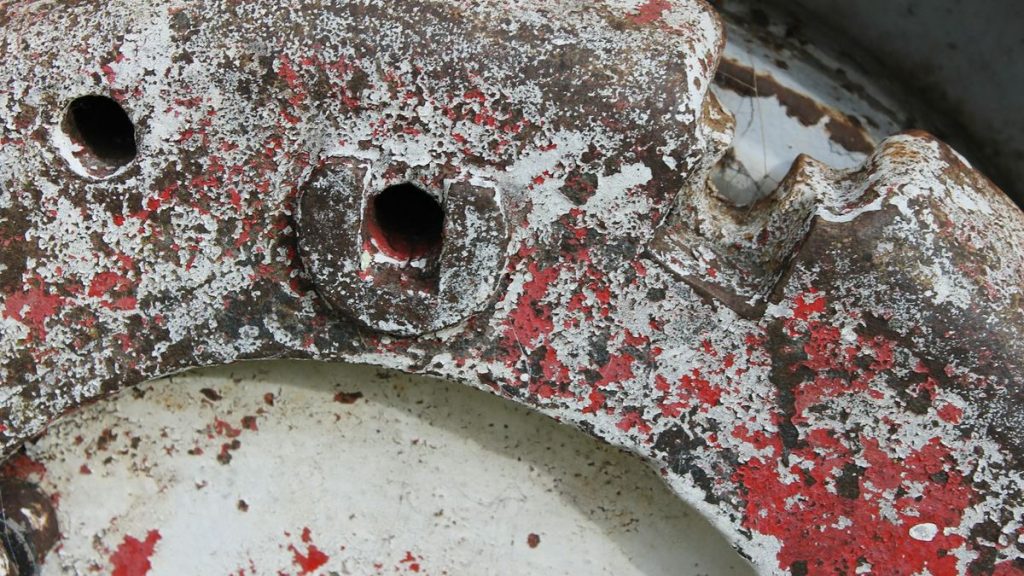
Brakes in West Michigan sit in brine and slush for months, and bare iron rusts quickly once salt reaches it. The worst spots are ones brake cleaner can’t fix: rust under pad clips that pushes pads tight, scale between rotor and hub, and corroded slide pins.
There is also a buying detail for Michigan drivers. CRC’s product pages list some higher-VOC Brakleen formulas as restricted from sale in Michigan, so the best brake cleaner for rust jobs here is a 50-state formula like the Pro Series above.

Cleaning and lubricating the brackets at the fall and spring tire swaps keeps rust from building up. Pair that with underbody protection from our undercoating for road salt guide, keeping every coating off brake parts.
When Rusty Brakes Need a Mechanic
Cleaning only helps when the parts underneath are still sound. Have the brakes checked if a rotor has deep pitting or rust flaking off its braking surface, if a caliper won’t slide or the car pulls to one side, or if you feel a pulsing pedal that may come from rust on the hub. Our guide to sticking brake caliper symptoms explains what a hung-up caliper feels like.
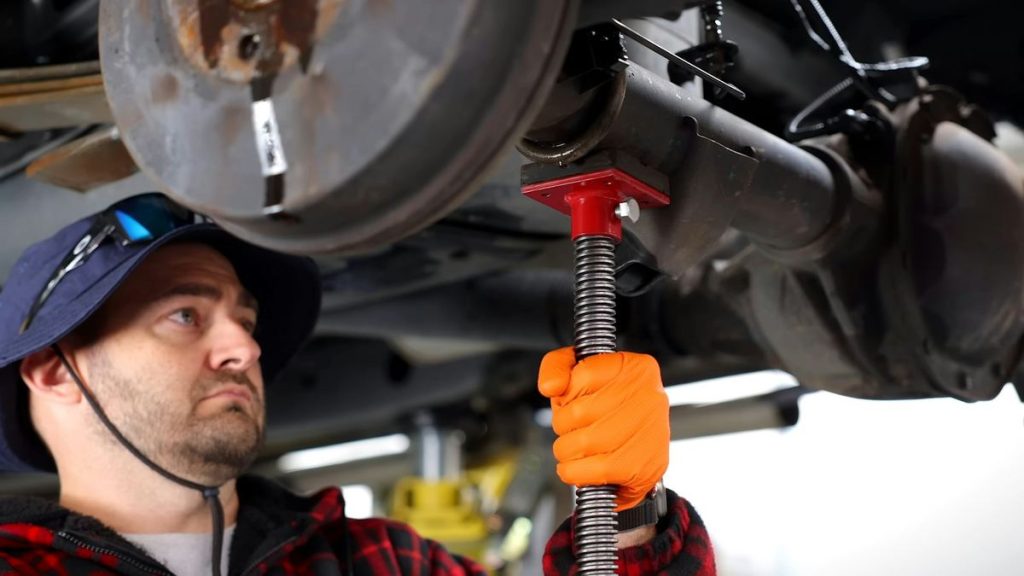
Rust on the steel lines along the frame is a different matter, because no spray restores a weak line, so read our page on brake line rust before you treat anything there. When the job is bigger than a brush and a can, our brake repair in Grand Rapids covers rotors, calipers, hardware and lines.
More Buying Guides
Frequently Asked Questions
Will brake cleaner remove rust from rotors?
No. It removes oil, dust and loose flakes, but bonded rust stays. A light orange film after rain usually clears in the first few stops, while pitted or scaling rotors need resurfacing or replacement.
Can I use penetrating oil on brake parts?
Use it on bolts, studs and the rotor-to-hub joint, never on pads or rotor faces. Once the parts are apart, flush the area with brake cleaner so no oil is left where the friction surfaces sit.
Is chlorinated or non-chlorinated brake cleaner better for rusty parts?
Both remove grease and debris, and neither dissolves rust. Non-chlorinated formulas are flammable, so keep them away from sparks and hot parts. In Michigan, pick a formula the maker lists as legal for sale here, such as a 50-state version.
Should I paint rusty brake calipers?
Caliper paint or a rust converter only improves the look and slows new surface rust. Clean and degrease first, and mask the piston, boots, bleeder, pads and rotor faces. A caliper that sticks needs repair, not paint.
Rust making your brakes grab, pull or pulse in Grand Rapids? Call 456 AutoFix at 616-279-3832, Monday to Friday 8am to 5pm, or book a brake check through our contact page.
Can’t make it during the day? Use our after-hours drop-off. We’re at 456 Carrier St NE in Creston.