
As an Amazon Associate, 456 AutoFix earns from qualifying purchases. Product links below go to Amazon, where you can confirm the right part for your vehicle.
Plastic headlight lenses lose their clarity slowly, then all at once. A few summers of sun break down the thin factory hard coat, and the lens turns yellow, chalky and dim. The best ceramic coating for headlights puts a fresh UV barrier on the lens, either over a new headlight that is still clear or over one you have just sanded and restored.
Below, we separate coat-only products from full restoration kits and review six options. For the rest of the car, our roundup of ceramic coatings for car paint covers the body panels.
Quick answer
What keeps plastic headlights from turning yellow again?
A UV-blocking coating made for polycarbonate lenses. On clear or freshly restored lenses, a coat-only product such as CARPRO CQUARTZ DLight or the CERAKOTE Step 3 wipes adds the protection. If the lenses are already hazy, choose a kit with sanding discs, like Nasiol or Nano Bond, so the coating goes on clean plastic.
Our Quick Picks
Three starting points: a coat-only UV coating for clear or new lenses, a sanding kit for heavy yellowing and a quick no-sanding kit for light haze. All six are reviewed below.

CARPRO CQUARTZ DLight
A dedicated UV coating for clear, new or freshly restored lenses.

Nasiol Headlight Restorer
Wet sanding removes oxidation, then a ceramic coat seals the lens.

Turtle Wax Speed Lens Restorer
A polishing compound and ceramic acrylic wipes for light haze.
Why Plastic Headlights Go Cloudy
Almost every modern car uses polycarbonate headlight lenses. The plastic is light and hard to shatter, but it breaks down under ultraviolet light, so carmakers protect it with a thin clear hard coat at the factory. Sun and road grit wear it away over the years.
Once the hard coat fails, the surface oxidizes. You see a yellow tint, a frosted haze or fine cracks, and less light reaches the road. Sanding removes the damaged layer, but it also leaves bare plastic with no UV shield at all, which is why a restored lens left uncoated can yellow again within months.
Clear lenses matter more than looks. The Insurance Institute for Highway Safety’s headlight research notes that about half of traffic deaths happen in the dark or at dawn or dusk, and it links headlights with good visibility to fewer nighttime crashes.
Coat-Only or Full Kit: New vs Restored Headlights
Picking the best ceramic coating for headlights starts with the lens you have now. The products here fall into two groups. Coat-only products are just the protective layer, so they suit new headlights, lenses that are still clear and lenses you have already restored by another method. Full kits pair the coating with wet-sanding discs or a polishing compound to remove oxidation first.
- Check the lens: run a fingertip over it. Rough, chalky plastic needs sanding; light yellowing may clear with a compound or remover wipe.
- Mask the paint: tape the bumper, fender and trim around the lens before any sanding.
- Clean and dry: wash off slurry and residue, then dry the lens fully, since water or polish oils under the coating will cloud it.
- Coat and cure: apply in shade at a mild temperature and keep the lens dry for the cure time on the label.
If you are not sure how much sanding your lenses need, our guide to the headlight restoration kits for heavy oxidation covers deeply yellowed and crusty plastic. Wear gloves and follow the label’s ventilation advice.
Best Ceramic Coating for Headlights: The Six Options in Detail
Two of these are coat-only products and four are kits that remove oxidation before they seal the lens. Durability figures are each maker’s own claim, taken from the Amazon listing.
1. CARPRO CQUARTZ DLight: UV Ceramic Coating for Headlights, PPF and Plastics, 30 ml
- UV absorbers and light stabilisers
- Listed UV rejection from 260 to 360 nm
- Up to 3 years of UV blocking per maker
- Applicator block and 4 suede pads included
CQUARTZ DLight is a ceramic coating that CARPRO built around UV protection rather than gloss alone. The listing names headlights, paint protection film and other automotive plastics as its main targets, and says the formula carries UV absorbers and light stabilisers that reject light across a 260 to 360 nanometer range. That band covers the UVA and UVB light that breaks down polycarbonate and turns lenses yellow.
It is a coat-only product, so there are no sanding discs or oxidation removers in the box. You get a 30 ml bottle, an applicator block, four 4-inch microfiber suede applicators and a user manual. The maker claims up to three years of UV blocking, along with better scratch resistance and protection against loss of gloss. Because the same bottle also suits PPF and black plastic trim, a single purchase can cover more than the lights.
This coating makes most sense on new headlights, lenses that are still clear, or lenses you have just restored with a separate sanding kit. It will not remove existing haze, so yellowed plastic needs work first. The listing warns against applying it in direct sun or on a hot surface, and asks you to wear gloves and a painter’s mask while you work.
View CARPRO CQUARTZ DLight on Amazon
2. CERAKOTE Ceramic Headlight Detailer Pack: 20 Step 3 Ceramic Clear Coat Wipes

- 20 ceramic clear coat wipes
- Enough for up to 10 vehicles
- No sanding materials or Step 1 wipes
- Cures in hours per the maker
This pack holds only the final coating stage of the CERAKOTE headlight system. Each of the 20 individual wipes is a Step 3 ceramic clear coat, and the maker says the pack covers up to 10 vehicles. It was designed for detailers and car lots that restore many sets of lights, but it also works for a household with several cars or a driver who wants to recoat later.
CERAKOTE describes the coating as inorganic ceramic technology and claims protection from surface oxidation for the lifetime of the vehicle. Once the lens surface is prepped, the listing says the wipe-on application takes minutes and the coating cures in hours. A pre-soaked wipe is simple to handle, since there is no bottle to measure and no applicator pad to load.
Note what is missing: the pack contains no Step 1 oxidation wipes and no sanding materials. That makes it a good partner for new headlights, lenses that are still clear, or plastic you have already sanded with another kit. If your lenses are yellow or rough today, buy a full restoration kit, or plan to sand first and then use these wipes to seal the work.
View CERAKOTE Step 3 Detailer Pack on Amazon
3. Nasiol Headlight Restorer: Nano Ceramic Restoration Kit with Wet-Sanding Discs
- Two steps: wet sand, then ceramic coat
- 500, 1000 and 2000 grit discs, two of each
- Up to 3 years per the listing
- Four applicators and two gloves included
Nasiol is a car care maker based in Turkey, and this kit combines lens restoration with its nano ceramic coating in two steps. Step one is wet sanding with the included discs, two each of 500, 1000 and 2000 grit, which cut through yellowing and oxidation. Step two is applying the Nasiol coating to seal the freshly sanded plastic. No power tools are needed.
The listing claims the coating keeps headlights clear for up to three years and protects against UV rays, oxidation and environmental damage. Along with the sanding discs, the box includes the restorer liquid, four applicators, two pairs of gloves and a user manual. Having three grits lets you start coarse on heavily damaged lenses and finish fine enough for the coating to level clear.
This kit fits headlights that have gone well past a light haze, where the surface feels rough or looks deeply yellow. Wet sanding takes patience and careful masking of the paint around each lens, so give yourself an unhurried afternoon. If your lenses are new or still clear, the sanding stage is unnecessary, and a coat-only product will do the same protective job with less effort.
View Nasiol Headlight Restorer on Amazon
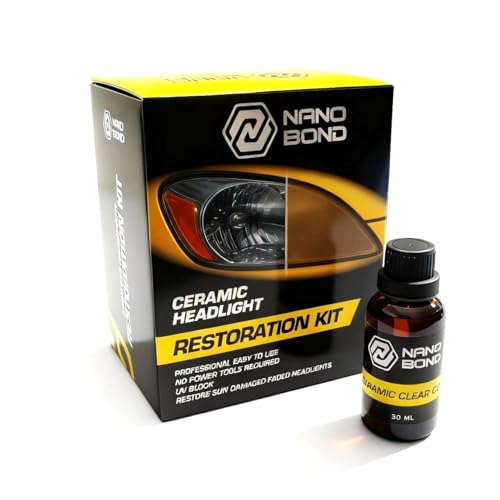
4. Nano Bond Ceramic Headlight Restoration Kit: 3-Step Hand Kit with Self-Leveling Coat
- Three steps by hand, no power tools
- Sanding discs included
- Self-leveling liquid ceramic clear coat
- Enough for two vehicles per the listing
Nano Bond, a brand known for its paint coatings, sells this three-step kit for oxidized, cloudy and yellowed plastic lenses. The process starts with the included sanding discs to cut through oxidation, moves to a cleaning step, and finishes with a liquid ceramic clear coat. According to the listing, the kit holds enough material to treat the headlights on two vehicles.
The coating is described as self-leveling, meaning it flows out into an even film after you apply it, with no wiping needed after the initial application. That matters on a curved lens, where buffing off a coating unevenly can leave streaks. Nano Bond calls the ceramic layer permanent UV protection against yellowing and cracking, a durability claim that comes from the maker rather than an independent test.
Like the Nasiol kit, this one suits lenses that are hazy or yellowed enough to need sanding, and it is done entirely by hand. The two-vehicle quantity is useful if you want to restore a second car or a pair of fog lights. Mask the surrounding paint before sanding, work out of direct sun, and keep the lenses dry until the coating cures.
View Nano Bond Headlight Kit on Amazon
5. Turtle Wax 53435 Speed Headlight Lens Restorer: Compound Kit with Ceramic Acrylic Wipes
- Lens Repair and Renew compound, 2 fl oz
- Four ceramic acrylic protection wipes
- Precision polishing pad included
- Protection for over a year per the listing
Turtle Wax built this kit for headlights and taillights with yellowing, oxidation or sun damage that has not gone deep. Instead of sanding discs, it relies on a 2 fl oz Lens Repair and Renew clarifying compound, which the maker says removes scratches, swirl marks and oxidation. You work the compound in with the included precision polishing pad, then seal the lens with a ceramic acrylic wipe.
The kit lays out four steps and includes four ceramic acrylic protection wipes and a pair of plastic gloves. Turtle Wax says the resin wipes protect and prolong plastic clarity for over a year. The coating is a ceramic and acrylic blend rather than a pure ceramic, so expect shorter protection than the products that claim several years, and plan to reapply when the lens starts to dull.
This is a sensible pick for lenses with a light film of yellow, or for anyone who would rather not wet sand. It is less suited to heavily oxidized plastic with a rough, crusty surface, where a compound alone may not reach clear material. Spare wipes also make it easy to treat the taillights or recoat the headlights later.
View Turtle Wax Speed Lens Restorer on Amazon
6. XPERTCHEMY Ceramic Headlight Restoration Kit: Oxidation Remover and Ceramic Coating Wipes

- Four oxidation remover wipes
- Two ceramic coating wipes
- Up to 18 months per the listing
- No sanding or power tools
XPERTCHEMY packs this restoration kit entirely around wipes. Inside are four oxidation remover wipes, two ceramic coating wipes, two protective gloves and two tissues. The process has two steps: put on the gloves and rub the lens with a remover wipe to lift yellowing and haze, then apply a ceramic coating wipe to seal it.
The maker positions the kit for moderate oxidation and says the ceramic wipes bond chemically to the restored lens without leaving a sticky residue. The listing claims up to 18 months of protection against UV rays, road tar and oxidation before you need to reapply. The box holds two coating wipes, so check the instructions for how many lenses each one covers before buying for more than one car.
Because nothing here involves sanding discs, water or a drill, it suits a driver who wants a tidy job in a parking space or driveway. The trade-off is that remover wipes have limits on rough, deeply oxidized plastic, which may need wet sanding to come clear. For lenses with moderate haze and no cracking, it is a straightforward way to restore and coat in one session.
View XPERTCHEMY Ceramic Headlight Kit on Amazon
Matching the Product to Your Lens Condition
| Lens condition | What it needs | Products above | Prep involved |
|---|---|---|---|
| New or still clear | Clean, then a UV coat | CARPRO DLight, CERAKOTE Step 3 wipes | Wash and wipe down only |
| Just restored by another method | A UV coat right away | CARPRO DLight, CERAKOTE Step 3 wipes | Remove sanding residue and dry |
| Light yellowing or haze | Remover or compound, then coat | Turtle Wax Speed kit, XPERTCHEMY kit | Hand polishing, no sanding |
| Heavy oxidation, rough surface | Wet sanding, then coat | Nasiol, Nano Bond | Several grits by hand, masking |
If you want to compare kits that focus on restoring rather than protecting, our main headlight restoration kit guide and the Cerakote vs 3M kit comparison go deeper on sanding methods.

Protecting Car Headlights Through a Michigan Winter
Summer sun starts the yellowing, but winter wears lenses down too. Salt spray dries into a gritty film, and dragging a snow brush or ice scraper across that film scratches the plastic. Rinse the lenses before you brush them off, and use a soft brush rather than the scraper edge.
Plan a coating job for a dry fall day or a heated garage, since most labels ask for a mild temperature and a dry cure. While you are thinking about salt, the winter car maintenance checklist covers lights, wipers and fluids, and our picks for undercoating against road salt deal with the rust you cannot see.

When a Dim Headlight Is Not a Lens Problem
A coating only treats the outside of the lens. Fog or water droplets inside the housing point to a cracked seal or blocked vent, and a light that flickers, works on one side only or dims when the engine idles may be a wiring, ground or charging fault. Aging bulbs dim too, and our guide to LED headlight bulbs for night driving covers replacements.

Our shop handles car electrical repair in Grand Rapids, including lighting circuits. Shopping for a used car? Standing water or a muddy line inside both headlights is one warning sign worth noting, and our guide on how to tell if a car has flood damage lists the others.
More Buying Guides
Frequently Asked Questions
What is the best ceramic coating for plastic headlights?
Choose a coating made for polycarbonate lenses with UV protection on the label, such as CARPRO CQUARTZ DLight or the CERAKOTE Step 3 wipes. If the plastic is already hazy, a kit with sanding discs, like Nasiol or Nano Bond, removes the damaged layer before it seals the lens.
Should you ceramic coat new headlights?
It can help, since the factory hard coat wears down over time. Wash the lens, wipe it free of oils, and apply a coat-only product while the plastic is still clear. No sanding is needed on a lens that has not oxidized.
Can I use my paint ceramic coating on car headlights?
Many paint coatings will bond to a clean lens and add some gloss and water beading. Products sold for headlights add UV absorbers aimed at plastic, which is the main reason lenses yellow, so they are the better choice for long-term clarity.
How long does a headlight ceramic coating last?
Makers quote anywhere from about a year to the life of the vehicle, depending on the product. Sun exposure, automatic car washes and winter scraping all shorten it, so check the lenses each spring and recoat when water stops beading.
Still squinting at the road after the lenses are clear? Give 456 AutoFix a call at 616-279-3832 on any weekday from 8am to 5pm, or send us a note through the contact page to have the lighting circuit checked.
If work hours are tight, the after-hours drop-off is an option. Leave the car at our shop on 456 Carrier St NE in Grand Rapids and we will take it from there.