
As an Amazon Associate, 456 AutoFix earns from qualifying purchases. Product links below go to Amazon, where you can confirm the right part for your vehicle.
Airing down at the trailhead is the cheapest traction upgrade a truck or SUV can get, but doing it with a pencil gauge and a twig takes forever and leaves four tires at four different numbers. The best tire deflator for off road use gets every tire to the same target quickly and lets you read the result before you roll.
Below we explain the two deflator styles, then review six kits from ARB, Staun, Rhino USA and Boulder Tools. For airing back up, see our guide to the tire inflator for off road trips.
Quick answer
Which tire deflator should I buy for off-road driving?
If you want speed and a gauge in one tool, get a manual rapid deflator such as the ARB600 E-Z Deflator. If you would rather screw on four valves and walk away, a preset automatic set like Staun’s 6-30 PSI kit suits you. Heavy trucks on high street pressure need a higher range, such as Staun HD.
Our Quick Picks
Three starting points: a hands-on rapid deflator, a preset automatic set for light trucks and SUVs, and a high-range automatic set for heavy trucks. All six kits are reviewed below.

ARB600 E-Z Deflator Kit
Rapid air-down tool and trail gauge in one, read in 1 PSI steps.

Staun Automatic Tire Deflator Kit
Screw one onto each stem and each stops at the preset pressure.

Staun Tyre Deflators HD
Higher-range preset deflators for tires that run high road pressure.
Automatic or Manual: Two Ways to Air Down
- Automatic (preset) deflators: small brass valves that screw onto each stem. You set a spring to a target pressure once, thread one onto every tire, and each stops venting on its own when the tire reaches that number.
- Manual rapid deflators: a gauge on a short hose with a screw-on chuck and a release. Most pull the valve core out through the tool, so air leaves through a wide bore and the gauge reads live. You stay at each wheel, but you see the exact figure as you go.
Automatic sets suit people who air down often to the same number, while manual tools suit drivers who change pressure for each trail section.
What Separates the Best Tire Deflators for Off Road Use
Before you order the best tire deflator for off road use, check four details:
- Pressure range: 6-30 PSI suits most light trucks and SUVs, while heavy pickups on high street pressure need a higher range.
- Gauge quality: a gauge with fine increments and a protective boot will read the same next season. Digital readouts suit dusk; analog dials need no batteries.
- Valve fit: screw-on chucks seal well on Schrader valves. Thread them by hand, never with pliers.
- Storage: a pouch keeps grit out of the threads and small parts together.
The Picks: Best Tire Deflator for Off Road Trips, Kit by Kit
We start with the two manual ARB tools, move to automatic sets for light and heavy vehicles, and finish with gauge-and-valve kits that combine both ideas.
1. ARB600 E-Z Deflator Kit: 10-60 PSI Rapid Air-Down Tool with Bourdon Tube Gauge
- 10-60 PSI and 0-4 bar dual-scale gauge
- Bronze Bourdon tube gauge movement
- Brass and stainless deflator body
- Canvas pouch and instruction sheet
The ARB600 E-Z Deflator Kit is a manual air-down tool built around an analog gauge that reads from 10 to 60 PSI, with a second 0 to 4 bar scale on the same dial. You fit it to the valve, release air until the needle shows your trail figure, and the same tool then tells you where every tire sits. For anyone who adjusts pressure as the surface changes, that combination keeps the job to one instrument.
ARB uses a bronze Bourdon tube gauge with a fully geared, solid brass movement, and the listing says this design keeps readings steady through changes in temperature, humidity and altitude. The deflator body itself is brass and stainless steel to resist corrosion, a useful trait for a tool that rides around in a damp recovery bag and gets splashed with road brine on the drive to the trail.
A canvas pouch and an instruction sheet come in the box, so read the sheet before the first trip. The ARB600 is not a set-and-walk-away tool: you stay at each wheel while it works, so drivers who want all four tires venting at once will lean toward an automatic set.
View ARB600 E-Z Deflator Kit on Amazon
2. ARB510 E-Z Digital Tire Deflator: Backlit LCD Gauge, 0-200 PSI, Braided Hose
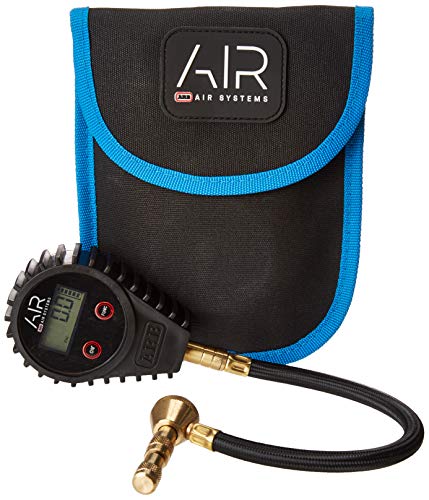
- Blue backlit LCD readout
- Reads psi, bar, kPa and kgf
- Screw-on chuck for Schrader valves
- 250 mm braided line with bump guard
The ARB510 E-Z Digital Tire Deflator swaps the analog dial for a large LCD with a blue backlight, which is easier to read at a trailhead in fading light or under a canopy of trees. It shows pressure in four units: 0 to 14 bar, 0 to 200 psi, 0 to 1,400 kPa and 0 to 14 kgf.
A screw-on chuck threads onto any Schrader valve for a positive seal, so you are not holding the tool against the stem while air rushes out. The 250 mm braided line keeps your hand away from the wheel, and a rubber bump guard protects the gauge housing when it gets dropped on a rock. ARB lists accuracy at plus or minus 1 psi between 15 and 75 psi, and the unit switches itself on and off to save battery life.
Keep spare batteries in the pouch, since a dead display leaves you without a gauge. Like the analog ARB, it airs down one tire at a time. Check that your own valve stems are Schrader type before ordering, since a few specialty wheels use something else.
View ARB510 E-Z Digital Tire Deflator on Amazon
3. Staun Automatic Tire Deflator Kit: Four Preset Deflators, Adjustable 6-30 PSI
- Set of 4 automatic deflators
- Adjustable from 6 to 30 PSI
- Factory set at 18 PSI
- Leather pouch, made in Australia
Staun’s Automatic Tire Deflator Kit is the preset style in its original form: four small brass deflators that screw onto the valve stems and vent air until each tire reaches the pressure you set, then stop on their own. There is no valve core to remove and no need to crouch at each corner watching a gauge.
The deflators adjust anywhere from 6 to 30 PSI, which Staun describes as the most commonly used range, and they leave the factory set at 18 PSI. You can change the setting as often as you like, so a sand trip and a rocky one can run different numbers. The whole set fits in the palm of your hand and stores in the included Australian leather pouch, small enough for a glovebox or door pocket.
Each set is made and checked by a technician at Staun’s workshop in Queensland, Australia, where the company has built deflators since 1998. Set one deflator first, confirm the tire with a gauge, then match the other three to it. This kit tops out at 30 PSI, so it suits light trucks, Jeeps and SUVs better than a heavy pickup running high street pressure.
View Staun Automatic Tire Deflator Kit on Amazon
4. Staun Tyre Deflators HD: Automatic Air-Down Kit, Adjustable 15-55 PSI
- Automatic stop at a preset pressure
- Adjustable 15-55 PSI range
- Made for high-pressure heavy vehicle tires
- Staun design, in production since 1998
The Staun Tyre Deflators HD use the same automatic idea as the standard Staun set, but with a higher working range of 15 to 55 PSI. Staun aims this version at heavy vehicles whose tires run high street pressures, the kind of load-rated rubber you find on many three-quarter-ton and one-ton pickups, loaded camper rigs and vans built for overlanding.
Screw one onto each valve stem and air vents until every tire reaches the preset, then each deflator stops on its own. Staun says the kit takes all four tires from street pressure to trail pressure in a few minutes, and because each corner runs at the same time you are not waiting on one tire after another. That matters with large-volume tires, which take noticeably longer to drop than a passenger tire.
Because heavy trucks carry more weight on each corner, the right trail pressure is usually higher than on a light Jeep, so start conservatively and follow your tire maker’s load guidance. Check the preset with a reliable gauge the first time you use the set. If your truck rarely runs below 20 PSI on the trail, this range covers the job comfortably.
View Staun Tyre Deflators HD on Amazon
5. Rhino USA Rapid Tire Deflator: 0-60 PSI Glow Dial Gauge with Pull-Back Collar
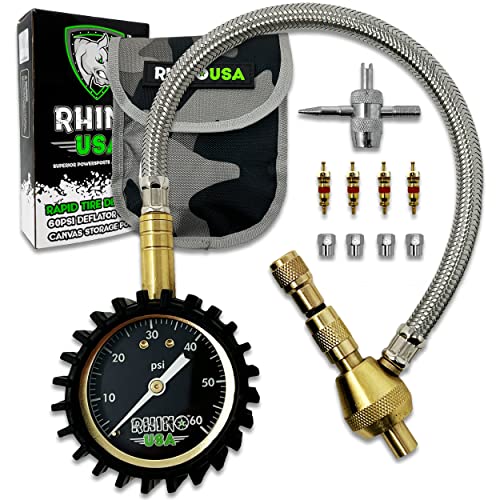
- 0-60 PSI range
- 2 in glow-in-the-dark dial
- Pull-back collar to deflate
- Solid brass hardware
The Rhino USA Rapid Tire Deflator is a manual tool that pairs a screw-on chuck with a 2-inch analog gauge reading 0 to 60 PSI. You thread it onto the valve, pull back the collar to start releasing air, and slide the collar forward again to check the pressure. That back-and-forth lets you creep up on your target instead of overshooting it, which is handy when you want all four tires within a pound or two of each other.
The dial glows in the dark, which helps on early starts and late finishes, and the gauge housing is built to feel solid in the hand. Rhino USA builds the hardware from solid brass, and the company describes itself as an American-owned, family-operated business. The listing names Jeeps, trucks, ATVs and UTVs as typical users, so the 0-60 PSI scale covers a wide spread of off-road tires.
As with any manual deflator, you work one wheel at a time, so it takes a few more minutes than a set of four automatic valves. In exchange, you get a single tool that both airs down and acts as your trail gauge.
View Rhino USA Rapid Tire Deflator on Amazon
6. Boulder Tools Automatic Tire Deflator Kit: Four Adjustable Deflators Plus 80 PSI Gauge

- 4 adjustable automatic deflators
- Included 80 PSI pressure gauge
- Brass build, 360-degree swivel chuck tip
- Black and chrome valve caps
Boulder Tools packages four adjustable automatic deflators together with a pressure gauge, so you get both halves of the job in one kit. You preset the deflators, screw them onto the valve stems and let each tire drop to the chosen number, then use the gauge to confirm the result and make small corrections.
The listing gives an adjustable range of 0 to 80 PSI for the deflators, and the included gauge reads to 80 PSI as well, which means the kit can also cover trucks that start from higher street pressures. The deflators are made from rust-resistant brass and use a 360-degree swivel chuck tip to help them seal on the stem. Black and chrome valve caps are included as spares, useful since caps tend to disappear in the dirt at the trailhead.
Boulder Tools lists the kit for Jeeps, trucks, SUVs and overlanding setups on sand, rock and trail. Because adjustable valves can drift slightly from one to the next, set the first, check that tire with the gauge, and match the rest to it. Store the set in a closed bag between trips so dust and moisture stay away from the springs.
View Boulder Tools Automatic Tire Deflator Kit on Amazon
Matching the Deflator to Your Rig and Your Trail
The right answer depends more on how you air down than on the truck itself.
| Your situation | Deflator style | Kit to look at | Watch for |
|---|---|---|---|
| Same trail pressure every trip, light truck or SUV | Automatic, 6-30 PSI | Staun Automatic | Check the preset with a gauge the first time |
| Heavy truck with high street pressure | Automatic, high range | Staun HD | Range starts at 15 PSI |
| Changing pressure for sand, rock and gravel | Manual rapid with gauge | ARB600 or Rhino USA | You stay at each wheel |
| Reading in low light or switching units | Manual digital | ARB510 | Needs batteries |
| Want both styles in one pouch | Automatic set plus gauge | Boulder Tools kit | Set each valve to the same number |
If you only air down twice a year, the best tire deflator for off road weekends is the one you remember to pack, so keep it in the same bag as your recovery strap.

How Low to Go, and Getting Back on the Pavement Safely
There is no single trail number that suits every truck. Tire size, load range, wheel type, vehicle weight and the surface all change it, and ARB’s own guide to off-road driving techniques notes that correct pressures vary by vehicle and terrain. Start with a modest drop and go lower only if the tires still spin.
- Set every tire to the same figure, ideally while they are cold.
- Slow down. Soft tires flex more, heat up faster and can lose a bead in a hard turn, so keep speeds low and steering inputs smooth.
- Watch the rocks. Lower pressure lets a sharp edge reach the rim lip, so pick your line carefully.
- Reinflate before the road. Bring tires back to the door-placard pressure before you return to pavement, then confirm with an accurate digital tire pressure gauge.
Wear eye protection when you pull valve cores, because a fast stream of air carries grit with it. Carry a tire repair kit made for off-road punctures in case a low tire picks up a stick.

West Michigan Trails, Winter Roads and After-Trail Care
West Michigan gives you plenty of reasons to air down: sandy two-tracks through state forest land, dune sand that swallows a fully inflated tire and seasonal roads packed with snow. Cold mornings lower tire pressure too, so recheck after the truck sits outside overnight.
A small deflator and gauge also earn a place in your winter car emergency kit, since a little less air can help a stuck truck creep out of deep snow, if you can refill before the highway. Our winter car maintenance checklist covers what to check before you air back up and head home on frozen roads.

Rinse mud and salt off the brass threads and dry the deflators before storing them. The same wash is a good time to work white lithium grease for hinges and latches into tailgate and door hardware that took on grit, and to put a fresh coat from our car wax buying guide on paint that brush and sand scuffed.
When a Trail Day Calls for a Mechanic
A steering wheel that sits crooked on the drive home, a new clunk over bumps or a tire wearing on one edge points to bent steering or suspension parts.
Our suspension and steering repair in Grand Rapids covers tie rods, ball joints and shocks.
More Buying Guides
Frequently Asked Questions
What is the best tire deflator for offroading on a budget?
A gauge-and-valve kit such as Boulder Tools gives you four automatic deflators plus a gauge to check them, which covers most light trucks. If you prefer one tool, the Rhino USA rapid deflator reads pressure while it vents. Either way, verify the final number with a gauge you trust.
Are automatic tire deflators accurate?
Good ones stop close to their preset, but springs and seals vary from piece to piece. Set the first valve, check the tire with a gauge, then match the other three to that reading. Recheck the preset every season.
Can I use a tire deflator on TPMS valve stems?
Most TPMS stems use a standard Schrader valve, so screw-on deflators thread onto them. Tighten by hand only, because aluminum stems and their seals can be damaged by force, and follow any notes from the sensor or deflator maker.
Is it safe to drive home with aired-down tires?
Not at road speed. Low pressure lets the tire flex and heat up, weakens steering response and raises the risk of a bead coming off the rim. Reinflate to the door-placard pressure before you leave the trail.
Came back from the trail with a truck that drives differently than it did on the way out? Talk to 456 AutoFix at 616-279-3832 between 8am and 5pm on weekdays, or request a time through our contact page.
If you roll in after closing, still muddy, park at 456 Carrier St NE, Grand Rapids, MI 49505 and use our after-hours drop-off, with a note on which bump or rut started the new noise.