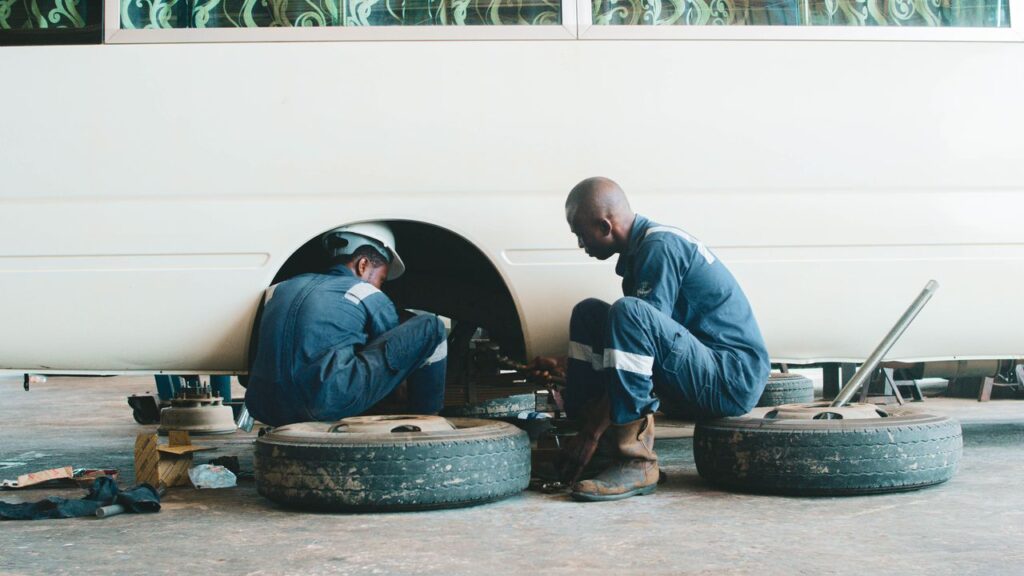
How long do brake pads last? The honest answer is that it depends. Pad life depends on what the pads are made of, how and where you drive, and how much your vehicle weighs.
Below is the honest range, why it is so wide, how West Michigan winters change things, and how to check your own pads instead of guessing from the odometer.
Quick answer
How long do brake pads last on a typical car?
There is no single number. The Drive puts an average pad at about 50,000 miles, but real life varies widely: city driving, heavy vehicles, hard stops and softer organic pads shorten it, while gentle highway miles stretch it. Your owner’s manual and a pad thickness check tell you more than mileage alone.

Why Brake Pad Life Varies So Much
Every stop turns your car’s motion into heat by pressing the pads against the rotors. The friction material wears a little each time, so anything that adds stops, weight or heat uses pads up faster.
A carmaker’s car-care guide on the signs you may need new brake pads lists the main factors: how you drive, where you drive, pad type and quality, vehicle weight and how well the brakes are maintained. Here is what each one means day to day.
Your Driving Habits
Frequent hard braking and riding the brakes wear pads quickly, and the guide says aggressive driving can significantly shorten their life. The Drive adds hard stops and sharp stabs at the pedal. Looking further ahead and coasting toward red lights is the simplest way to stretch a set.
City Traffic vs Highway Miles
Stop-and-go traffic means far more stops per mile than steady highway cruising.
Vehicle Weight
Heavier vehicles such as trucks and SUVs typically put more strain on the brakes, according to the same guide. Towing or a full load adds to it.
Front Pads vs Rear Pads
On most cars the front pads do most of the stopping and wear out first, because weight shifts forward when you brake. Some newer vehicles use the rear brakes more for stability control and brake force balancing, so their rear pads can wear as fast as the fronts or faster.

Brake Pad Types and Typical Lifespan
The Drive’s guide to how long brake pads last and the three pad types groups pads into non-metallic organic, semi-metallic and ceramic. Each one trades noise, dust and heat handling against lifespan.
| Pad type or driving | Typical life | How soon |
|---|---|---|
| Organic pads | Shortest of the three; The Drive says they wear the fastest, though they run quieter | Soon Check them at every oil change |
| Semi-metallic pads | The most common type; more brake dust, handles heat well | Moderate Check at routine service |
| Ceramic pads | The Drive credits them with the most longevity and less dust | Low Check at routine service |
| Mostly city, stop-and-go driving | Shorter than average for any pad type | Soon Check them at every oil change |
| Heavy SUV, truck or regular towing | Shorter than average | Soon Check them at every oil change |
| Pads that squeal, grind or trigger a warning light | At or near the end of their life | High Book an inspection right away |
For your car’s own figure, it points to the owner’s manual or the carmaker’s website, and aftermarket pads list an engineered lifespan on the box.
How Long Do Brake Pads Last in a Michigan Winter?
Salt and slush do not grind away the friction material directly. They attack the parts that let the pads move freely. Caliper slide pins and pad clips rust and stick, so a pad can stay in light contact with the rotor and wear out long before its partner.
The Drive lists faulty calipers among the reasons pads wear out quickly. On cars that have seen many salty winters, a sticking caliper or seized slide pin often explains why one pad is far thinner than the rest. For how salt attacks the rest of the system, see our guide to brake line rust and the damage it does to calipers and rotors.
Rust also forms on rotor faces when a car sits, and a rough or uneven rotor wears pads unevenly. The Drive even lists leaving a car parked for more than a year as a cause of fast wear. If braking makes the car shudder, our guide on why your car shakes when braking covers rotors and slide pins.
How to Check Your Brake Pads Instead of Counting Miles
Mileage only tells you when to look. The pads themselves tell you when to replace them.
- Look through the wheel: on many alloy wheels you can see the outer pad pressed against the rotor. The car-care guide says pad material less than 1/4 inch thick means it is time to consider new pads, and The Drive says to replace them when they are almost as thin as the backing plate.
- Listen when you brake: many pads carry a small metal wear indicator that squeals once the material gets thin.
- Watch the dash: many European cars, including Audis, use electronic wear sensors that light a warning on the cluster. Our guide to the Audi brake pad warning light and its wear sensors explains how they work.
- Remember the inner pads: they often wear differently from the outer pads, and you cannot see them through the wheel.
If you already hear grinding or feel the pedal change, you are past the “how long” question. Our list of the signs you need new brakes covers those warnings and how urgent each one is.

Ways to Get More Life From Your Brake Pads
- Brake early and gently, and coast toward stops instead of braking late.
- Replace pads in pairs on the same axle, as The Drive recommends, for even brake feel and wear.
- Have the slides and hardware cleaned and lubricated when pads are replaced, so new pads release fully.
- Keep the brake fluid fresh; our guide on how often to change brake fluid explains why it ages.
- Follow your owner’s manual for brake inspections.

When to Have Your Pads Checked in Grand Rapids
A good habit is to have the brakes looked at whenever the wheels come off, and any time you notice a new noise or feel. Spring is a smart time in West Michigan, after salt season has done its work on slides and rotors.
Our brake repair in Grand Rapids covers pads, rotors and calipers on foreign and domestic vehicles. Hendrick Hoffman, our owner and head mechanic, is ASE and State of Michigan certified in brakes. We measure what is left on both sides of each axle and tell you plainly how much life remains.
Frequently Asked Questions
How many miles do brake pads last?
It varies widely. The Drive puts the average pad at about 50,000 miles, but city driving, vehicle weight, hard braking and pad type can move that a long way in either direction. Check your owner’s manual and have the pads measured.
Do front brake pads wear faster than rear?
Usually, because the front brakes do most of the stopping. Some newer vehicles use the rear brakes more for stability control, so their rear pads can wear as fast or faster. Only an inspection tells you which set is lower.
How do I know when to replace brake pads?
Replace them when the friction material is thin, when the wear indicator squeals, or when a wear sensor light comes on. One carmaker’s car-care guide says pad material less than 1/4 inch thick means it is time to consider new pads.
Why is one brake pad more worn than the others?
Uneven wear usually points to a caliper or slide pin that sticks and keeps one pad dragging on the rotor. Road salt makes this common on older cars in Michigan. Replacing the pad without freeing the caliper means it will happen again.
Need brake repair in Grand Rapids? Call 456 AutoFix at 616-279-3832, Monday to Friday 8am to 5pm, or book through our contact page.
Can’t make it during the day? Use our after-hours drop-off. We’re at 456 Carrier St NE in Creston.