
As an Amazon Associate, 456 AutoFix earns from qualifying purchases. Product links below go to Amazon, where you can check the details for your engine before you buy.
A dark spot under the middle of the car, right where the engine bolts to the transmission, usually starts a search for the best oil stop leak for rear main seal problems. The reason is simple: replacing that seal means pulling the transmission, so a bottle that buys time is worth a look. Some of these treatments genuinely help, but only on the right kind of leak.
Below we explain how to confirm the leak, how seal conditioners work, and which five bottles are built for main seal seepage. If you are still deciding between additives in general, our oil additive guide sorts them by job.
Quick answer
What stop leak works on a rear main seal?
Bar’s Leaks Rear Main Seal Repair is the bottle made specifically for this job and treats a typical 4 to 6 quart engine. BlueSeal is a petroleum-free alternative, and Bar’s Leaks One Seal suits a minor seep. None of them can fix a torn seal or a grooved crankshaft.
Our Quick Picks
Three bottles that cover the usual rear main seal situations; two more are reviewed below.
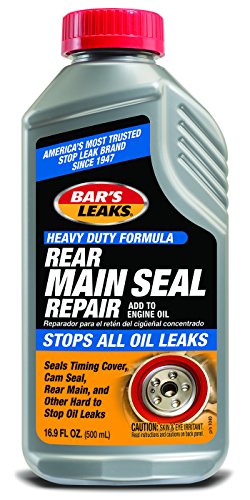
Bar's Leaks Rear Main Seal Repair
Formula aimed squarely at rear main, timing cover and cam seal seepage.

BlueSeal Oil Stop Leak
Non-clogging seal conditioner sold for rear main seal leaks.

Bar's Leaks One Seal
Multipurpose sealer for small leaks from normal wear and age.
Is the Oil Really Coming From the Rear Main Seal?
The rear main seal sits behind the flywheel or flexplate, where the crankshaft exits the back of the block. When it leaks, oil collects at the bottom of the bell housing and drips from the seam between engine and transmission. The trouble is that oil from several other places ends up in exactly the same spot.
Before you buy anything, rule out these common look-alikes:
- Valve cover gasket: oil runs down the back of the cylinder head and drips off the bell housing, looking just like a main seal leak.
- Oil pan gasket and drain plug: a wet rear pan rail or a loose plug washer leaves drips near the same spot.
- Oil filter or filter housing: a double gasket or loose filter can spray oil rearward while you drive.
Clean the area with degreaser, drive for a few days and look again with a flashlight from above and below. The highest wet point is usually the source. A UV dye added to the oil makes the trail easier to follow if the engine is dirty.
Check the PCV valve and hose too. A clogged PCV system lets crankcase pressure build up, and that pressure pushes oil past seals that would otherwise hold. Fixing it costs little and sometimes slows a leak on its own.
How Seal Conditioners Work, and Where They Stop Working
Most engine stop leaks are seal conditioners. They contain chemicals that soak into rubber, letting a seal that has dried out, hardened and shrunk with age swell back toward its original size. A softer, fuller lip presses against the crankshaft again, and a slow seep can tighten up over a few hundred miles.
That explains the limits. A conditioner can only work on a seal that is still in one piece and still seated. It does nothing for a lip that has torn or rolled, a seal that has walked out of its bore, or a crankshaft surface worn into a groove.
Older rope-style seals, found on some classic engines, also respond differently from modern lip seals. Bar’s Leaks describes main seal leaks as a mix of normal wear and seals that dry, harden and shrink, which is the condition these products target.
Best Oil Stop Leak for Rear Main Seal: Five Bottles Reviewed
Each product below goes into engine oil and is aimed at seal leaks. Use one bottle at a time, follow the label’s treat rate, and give it a few hundred miles before judging the result.
1. Bar’s Leaks Rear Main Seal Repair 1040: 16.9 oz Heavy Duty Oil Seal Formula
- Made for rear main, timing cover and cam seal leaks
- One bottle treats 4 to 6 quarts of oil
- Conventional, high mileage and synthetic oil
- Add at or between oil changes
This is the product Bar’s Leaks sells specifically for rear main seal leaks, and it is the most direct match for the problem on this page. The 16.9 ounce bottle goes into the crankcase through the oil filler, and the maker says one bottle treats 4 to 6 quarts of oil. That covers most four- and six-cylinder cars and many V8s, though a larger diesel sump may need more than one bottle.
According to Bar’s Leaks, the formula restores seals that have shrunk and hardened, and it also carries additives intended for more worn seals and crankshafts. Besides the rear main, it targets timing cover and cam seal leaks, which often show up on the same older engine. The maker lists it for gasoline and diesel engines running conventional, high mileage or synthetic oil.
You can add it at an oil change or partway through an interval. The listing says most leaks stop within 100 miles or 2 days of driving, and it warns against overfilling, so check the dipstick before you pour. It suits a slow seep from an aging seal rather than a steady drip from a torn or displaced one.
View Bar's Leaks Rear Main Seal Repair on Amazon
2. BlueSeal Oil Stop Leak: 8 oz Petroleum-Free Rear Main Seal Repair
- Petroleum-free, non-clogging formula
- Gasoline and diesel engines
- Also for transmissions and power steering
- Pours straight into the crankcase
BlueSeal takes a different approach from the thicker, oil-based treatments on the shelf. The listing describes a petroleum-free, non-clogging formula made in the USA, sold in an 8 ounce bottle and marketed for rear main seal repair. The idea is to recondition rubber seals that are starting to dry out without changing the oil’s character much.
It is listed for both gasoline and diesel engines, and the maker says it will not harm internal seals or gaskets. The same bottle can also go into transmissions, power steering systems, differentials, rack and pinion units and hydraulic systems. That flexibility is handy if you have a seep in more than one place, although each system needs its own dose.
Application is simple: pour it into the oil sump through the filler, with no tools or disassembly. The listing recommends it for existing leaks and for higher-mileage vehicles whose seals are just beginning to dry, so it can also be used as a preventive step. The listing does not name a treat rate per quart or say which oil types it suits, so read the label for your engine’s capacity before adding it. Like any conditioner, it will not repair a torn seal.
View BlueSeal Oil Stop Leak on Amazon

3. Bar’s Leaks One Seal 1334: 11 oz Multipurpose Stop Leak for Oil, ATF and Steering
- Seals minor oil, transmission and steering leaks
- One bottle treats one system
- Safe for gas, turbo and diesel engines
- Works with all engine oils
One Seal is the multipurpose member of the Bar’s Leaks range. The 11 ounce bottle is designed for minor seal and gasket leaks caused by normal wear and age, and one bottle treats a single system. You can use it in engine oil, automatic transmission fluid or power steering fluid, which makes it a useful bottle to keep on the garage shelf.
For a rear main seal, it fits the lighter end of the scale: a seep that leaves a few spots rather than a stream. Bar’s Leaks lists it as safe for gasoline, turbocharged and diesel engines, and says it works with all engine oil, transmission and power steering fluids. That covers most daily drivers without worrying about the oil type already in the crankcase.
Because it is built for a wider range of systems, it is not as focused on main seals as the dedicated Rear Main Seal Repair from the same maker. If your leak is small and you would like to start with the milder option, it is a sensible first try. If the spot under the car keeps growing after a few hundred miles, move to a dedicated main seal product or have the leak inspected.
View Bar's Leaks One Seal on Amazon
4. Slick 50 Recharged Engine Seal Stop Leak: 16 oz Seal Conditioner for All Oil Types

- Conditions and rejuvenates engine seals
- Aimed at high-mileage engines
- Conventional, blend and full synthetic oil
- Helps prevent future leaks
Slick 50 Recharged is a 16 ounce seal stop leak and conditioner aimed at engines with plenty of miles behind them. Rather than targeting one seal, it is formulated to condition and rejuvenate engine seals in general, restoring flexibility to rubber that has aged and stopping or preventing oil leaks as a result.
That broad approach suits an older engine where the rear main is only one of several damp spots, such as a valve cover or front crank seal that is also starting to weep. The listing says it works with conventional, semi-synthetic and full synthetic motor oils, so you do not need to change oil type to use it. Slick 50 also says it helps maintain seal condition over time, which reduces the chance of new leaks starting.
Pour it in through the oil filler and follow the treat rate printed on the bottle, checking the dipstick so you do not overfill. Give it time to soak into the seals before deciding whether it has worked. It is a reasonable choice for general seal conditioning, while a dedicated main seal product is the more focused option when you have confirmed the leak comes from the back of the crankshaft.
View Slick 50 Recharged Engine Seal Stop Leak on Amazon

5. MotorKote All Seal Stop Leak Preventer: 8 oz for Engine, Transmission and Steering

- Conditions gaskets, seals and O-rings
- Engine, transmission, steering and hydraulics
- Conventional and synthetic oils
- No tools or disassembly needed
MotorKote All Seal is an 8 ounce stop leak and leak preventer designed to rejuvenate and condition gaskets, seals and O-rings. The listing places it in engine oil, transmission fluid, power steering and hydraulic systems, and names cars, trucks, SUVs and motorcycles along with other machinery that runs on hydraulics.
For a rear main seal, it works the same way as the other conditioners here: it softens and restores rubber that has hardened, helping a slow seep tighten up. The listing says it is compatible with conventional and synthetic oils and is meant to cause no harm to the engine or hydraulic system. Its small bottle and wide range of uses suit someone who keeps a mixed fleet of a daily driver, a truck and outdoor equipment.
Add the recommended amount from the label directly to the oil, with no special tools or disassembly. If you plan to use it in a motorcycle that shares oil with a wet clutch, check the owner’s manual first, since some additives affect clutch grip. As with every product on this list, expect it to help a dried-out seal, not one that is torn or pushed out of place.
View MotorKote All Seal Stop Leak on Amazon
Matching a Bottle to Your Leak
The leak’s speed tells you more than the label does. A seep that leaves a few spots overnight is a reasonable candidate for a treatment, while a steady drip that drops the dipstick between fill-ups usually is not.
| Your leak | Reasonable first step | Picks that fit |
|---|---|---|
| Slow seep, spots on the driveway | Dedicated main seal treatment | Bar’s Leaks Rear Main Seal Repair, BlueSeal |
| Minor seep on a car you want to keep simple | Small-dose multipurpose sealer | Bar’s Leaks One Seal, MotorKote All Seal |
| Aging engine with several damp seals | Seal conditioner, then high mileage oil | Slick 50 Recharged |
| Steady drip, oil level dropping fast | Inspection, not a bottle | Seal replacement |
Whichever bottle you choose, the best oil stop leak for rear main seal seepage works more reliably when it stays in the oil. After the treatment, many owners switch to a high mileage oil, which carries its own seal conditioners and keeps the rubber supple between changes.

Do not combine a stop leak with a thick oil stabilizer or a second sealer in the same fill. Stacking products changes the oil’s viscosity and makes it impossible to tell which one did anything. If your engine also burns oil, our guide to the oil additive for burning oil covers that separate problem.
Cold Starts, Road Salt and Tired Seals in West Michigan
Rubber stiffens in the cold, so a seal that barely holds in July can leak more on a January morning in Grand Rapids. Many drivers notice the spot under the car grows over the winter and shrinks again in spring. That pattern points to a hardened seal, which is exactly the case a conditioner is designed for.
Road salt and slush also keep the underside of the engine dirty, which hides where oil is really coming from. Wash the area before you diagnose. A fresh film after a short drive is far easier to read than a winter’s worth of grime.

A few safety basics apply to every bottle here. Add the treatment with the engine off and cool, wear gloves and eye protection, and wipe any spill off the exhaust manifold before you start the engine. Check the dipstick afterwards, because adding a full bottle to an engine already at the full mark can overfill the crankcase.
Signs the Seal Needs Replacing Instead
Skip the bottle and book an inspection if you see any of the following.
- Oil drips steadily while the engine idles, or leaves a puddle rather than spots.
- You add more than a quart between oil changes because of the leak.
- The oil pressure warning flickers at idle, which needs attention right away (see our page on the oil pressure light).
- A manual-transmission car starts slipping, a hint that oil may be reaching the clutch.
- Oil is dripping onto the exhaust and you smell it burning.

Leaks are easiest to spot when the car is on a lift. During an oil change at our Creston shop, we look underneath and can show you where the oil is coming from, so you know whether a seal treatment, a gasket or a deeper repair is the sensible next step. If rough running is part of the picture, our fuel system cleaner guide covers the fuel side.
More Buying Guides
Frequently Asked Questions
Does rear main seal stop leak actually work?
It can, on a seal that has dried, hardened or shrunk with age. The conditioner swells the rubber so the lip seals against the crankshaft again. It will not help a torn, displaced or badly worn seal, or a grooved crankshaft.
How long does it take to stop a rear main seal leak?
Seal conditioners work gradually as the rubber absorbs them. Bar’s Leaks says most leaks stop within 100 miles or 2 days of driving with its Rear Main Seal Repair. Clean the area first so you can judge the result.
Can I use a stop leak with synthetic oil?
Bar’s Leaks, Slick 50 and MotorKote all state that their formulas work with synthetic oil, and One Seal is listed for all engine oils. BlueSeal’s listing does not name an oil type, so read its label first. Whatever you choose, keep to the stated treat rate.
Should I add the treatment at an oil change?
Either works for most products, and Bar’s Leaks allows adding it at or between changes. Adding it with fresh oil gives you a full interval to see the effect. Watch the dipstick so the engine does not end up overfilled.
Not sure whether that drip is the rear main seal or something simpler? Call 456 AutoFix at 616-279-3832 on a weekday between 8am and 5pm, or send us a booking request.
You can bring the car to 456 Carrier St NE in Grand Rapids during the day, or leave it with us after hours and we will take a look underneath when the shop opens.