
As an Amazon Associate, 456 AutoFix earns from qualifying purchases. Product links below go to Amazon, where you can confirm the right part for your vehicle.
The engine revs climb but the car barely picks up speed, or a shift seems to hang in neutral for a beat. When you shop for the best transmission additive for slipping, the honest goal is a bottle that matches your transmission type and the cause of the slip, because no additive suits every gearbox.
This guide covers what an additive can and cannot reach, a quick fluid check to do first, five bottles sorted by job, and the signs that call for a shop visit. For general conditioners and cleaners that are not slip-specific, see our wider guide to transmission additives.
Quick answer
Which is the best transmission additive for slipping?
For a conventional automatic with a mild slip, a dedicated stop-slip formula such as Rislone 4501 is the usual first try. CVT and dual-clutch owners need a label that lists their unit, such as Bar’s Leaks Trans Fix. Check the fluid level first, and expect no bottle to fix burnt clutches.
Our Quick Picks
Three quick picks: a stop-slip formula for conventional automatics, a treatment whose label covers CVTs and dual-clutch units, and a high-mileage fluid that also targets leaks. All five bottles are reviewed below.
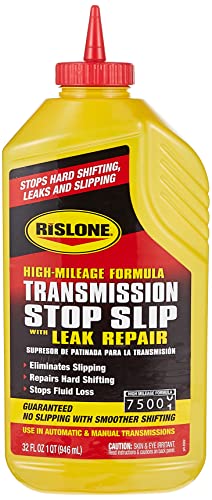
Rislone Transmission Stop Slip
A purpose-made slip treatment for conventional geared automatics.

Bar's Leaks Trans Fix
One of the few slip treatments whose label lists CVTs and dual-clutch units.

CRC Trans-X High Mileage
A high-mileage treatment that pairs slip prevention with leak repair.
Why Gears Slip and What a Bottle Can Reach
An automatic transmission holds each gear by squeezing clutch packs and bands with hydraulic pressure. A slip happens when that grip is lost for a moment, so the engine spins faster than the wheels. The causes fall into a few groups, and only some of them respond to a treatment.
- Low fluid: a seeping seal or cooler line drops the level, the pump draws air and pressure falls. Topping up and conditioning the seals can help.
- Tired or varnished fluid: heat breaks down the friction modifiers, and varnish makes valves stick. Fresh fluid plus an additive often improves shift feel.
- Worn friction material: glazed or burnt clutch plates may grip a little better with a thicker, friction-balanced fluid, but only for a while.
- Electrical or mechanical failure: a failed shift solenoid, a weak pump or a broken part needs diagnosis and repair, not a bottle.
That is why reviews of slip treatments swing from “it saved my truck” to “it did nothing.” The product was the same; the cause was different. Some slips that feel internal are actually electronic, and the transmission may set a stored code or turn on the check engine light.
Check the Fluid Before You Pour Anything
A five-minute check tells you more than any product label. Many automatics are checked warm, in park or neutral, with the engine running, but procedures vary and some newer units have no dipstick at all. Your owner’s manual gives the correct method.
- Level: low fluid is the most common reason for a sudden slip. Top up with the fluid type your manual names before adding anything else.
- Color: healthy ATF is usually red or pink and see-through. Dark brown fluid is worn out.
- Smell: a sharp burnt odor means the friction material has overheated, and an additive is a stopgap at best.
- Debris: metal flakes or gritty particles on the dipstick point to internal wear that needs a professional look.
If the fluid is old but not burnt, a drain and fill with the right fluid does more than an additive alone. Our guide to the best transmission fluid for high mileage cars covers the options, and CVT owners can compare factory-spec choices in our CVT fluid buying guide.
Best Transmission Additive for Slipping: Five Bottles in Detail
Each pick below states which transmission types its maker approves, so match the label to your car before you buy.
1. Rislone 4501 Transmission Stop Slip: 16 oz High Mileage Formula with Leak Repair
- 16 fl oz bottle, part number 4501
- Viscosity improvers and friction modifiers
- Seal conditioning for small fluid leaks
- Not for CVT transmissions
Rislone’s Transmission Stop Slip with Leak Repair, part number 4501, is one of the few bottles whose main claim is the exact problem in your search. Rislone describes the formula as a blend of viscosity improvers, anti-wear friction modifiers and extreme-pressure additives, aimed at slipping, hesitation, rough shifts and the shudder or whine that often comes along with them. It is sold for vehicles past roughly 75,000 miles.
The thicker, friction-balanced fluid it creates is meant to help worn bands and clutch packs grip, while the seal conditioner targets the small leaks that let the level drop in the first place. Rislone says one 16 oz bottle treats a normal car, SUV or light truck transmission, with one bottle per 8 quarts on larger units. You can add it when topping up low fluid or with a fresh drain and fill, without overfilling.
The limits are printed on the label. Rislone says not to use it in a CVT, and in a manual gearbox it only helps with leaks, noise and notchy shifting, not slipping. It suits a conventional step automatic with a mild, early slip, and it will not rebuild friction material that is already burnt.
View Rislone Transmission Stop Slip on Amazon
2. Bar’s Leaks 1415 Trans Fix: 11.5 oz Synthetic Blend for Automatic, CVT and DCT
- 11.5 fl oz synthetic-blend treatment
- Labeled for automatics, manuals, CVTs and DCTs
- Seal conditioners plus anti-wear agents
- One bottle treats 7 to 11 quarts
Bar’s Leaks Trans Fix, product 1415, takes a different route from most slip treatments by covering nearly every transmission type. Bar’s Leaks lists it for conventional automatics, manuals, CVTs and dual-clutch transmissions, which matters if your slipping car has a belt-and-pulley CVT that most stop-slip bottles warn against. The 11.5 oz bottle holds a synthetic-blend package rather than a single thickener.
That package has four parts, according to the maker: seal conditioners for current leaks, extreme-pressure and anti-wear agents for better metal-to-metal friction, detergents and antioxidants to loosen sludge and varnish, and a booster aimed at worn bands and heat-damaged fluid. Together they target slipping, jerking, hard shifts and shudder. Bar’s Leaks also lists it for small to medium leaks and some fluid-related warning lights.
Dosing is clearly spelled out. One bottle treats 7 to 11 quarts of total fluid capacity, half a bottle covers 3 to 6.9 quarts, and larger systems take a bottle per 9 quarts, so look up your unit’s total capacity first. It suits drivers who are unsure of their transmission type or own more than one car. It cannot replace the correct factory fluid.
View Bar's Leaks Trans Fix on Amazon

3. CRC Trans-X High Mileage: 16 oz Automatic Transmission Treatment for Leaks and Slips
- 16 fl oz, for vehicles over 75,000 miles
- Repairs and prevents leaks
- Aimed at slips and rough shifting
- Not compatible with CVT or manual units
CRC’s Trans-X High Mileage Automatic Transmission Treatment is sold under CRC’s long-running K&W brand. CRC’s Trans-X High Mileage product page lists three jobs: repairing and preventing leaks, preventing transmission slips and premature failure, and restoring smooth shifting. It is formulated for vehicles with 75,000 miles or more.
Leaks and slips are often the same problem in an older automatic. A seal that has hardened lets fluid seep out, the level drops, the pump starts pulling air at the pickup, and clutch packs no longer get full pressure. A treatment that softens those seals while improving shift feel addresses both ends of that chain, which is why this bottle suits a transmission that slips and also leaves spots on the driveway.
Read the compatibility notes before you pour. CRC says it is not compatible with CVT fluids, and the Amazon listing adds that it is not for manual transmissions either. The liquid is flammable, with a flash point CRC lists at 57°F, so store it away from heat and sparks and wear safety glasses and gloves. It will not help a transmission with worn-out clutch friction.
View CRC Trans-X High Mileage on Amazon
4. Hot Shot’s Secret Shift Restore: 16 oz Transmission Additive for Automatic and CVT

- 16 oz bottle treats 10 quarts
- Listed for automatic and CVT units
- Aims to reduce stiction and heat
- Smooths out gear changes
Hot Shot’s Secret Shift Restore takes a friction-modifier approach instead of the thickening route that many stop-slip bottles use. The listing says it reduces stiction in automatic and CVT transmissions, minimizes metal-to-metal contact, lowers operating temperature and smooths gear changes. The listing rates one 16 oz bottle to treat 10 quarts of fluid.
Stiction is the slight sticking a valve or clutch shows before it moves, and it can feel like a flare or a lazy shift even when the friction material is still healthy. Varnish in the valve body and hot, tired fluid make it worse. By lowering friction and heat in the moving parts, Shift Restore is aimed at that kind of shift quality complaint, and the CVT listing gives owners of belt-driven units another option to consider.
That same approach is also its main limit. A product that lowers the coefficient of friction is not designed to make worn clutches grip harder, so it suits hesitant, sticky or rough shifts more than a transmission that flares badly under load. Check your owner’s manual for fluid capacity before dosing, and pair it with fluid of the specification your maker calls for.
View Hot Shot's Secret Shift Restore on Amazon

5. Bar’s Leaks 1400 Transmission Repair-It: 16.9 oz High Mileage Stop Slip and Seal Conditioner

- 16.9 fl oz bottle, product 1400
- High-mileage formula aimed at slipping
- Seal conditioners for small leaks
- Mixes with all types of transmission fluid
Bar’s Leaks Transmission Repair-It, product 1400, is the older of the two Bar’s Leaks transmission bottles and the one built around a high-mileage, stop-slip formula. The listing says it reduces rough shifting and friction while eliminating slip, controlling temperature, and quieting shudder, chatter and whining. It comes in a 16.9 oz bottle.
Its other job is leak control. Seal conditioners in the formula are meant to soften and swell hardened seals so they hold fluid again, and the listing calls it a fluid stabilizer for worn ATF. Bar’s Leaks suggests adding it when you top off low fluid or with a fresh fill, and its own product page lists a dose of one bottle per 2 to 3 quarts of transmission fluid, so read the label for your unit before pouring.
Readers comparing labels will notice its claims closely match Rislone 4501, so pick one rather than stacking both. Repair-It says it works with all types of transmission fluid, but the listing does not name CVTs or dual-clutch units, so owners of those should use Trans Fix instead. It suits an older step automatic that slips a little and needs regular top-ups. It cannot replace worn clutch material.
View Bar's Leaks Transmission Repair-It on Amazon
Matching the Bottle to Your Transmission
The biggest mistake with slip treatments is pouring a conventional-automatic formula into a CVT. A CVT moves power through a steel belt or chain clamped between pulleys, and it depends on specific friction properties in its fluid. A product that thickens fluid or changes friction for clutch packs can make a belt slip worse.
| Transmission type | Bottles whose label covers it | What to watch |
|---|---|---|
| Conventional step automatic | Rislone 4501, Bar’s Leaks Trans Fix and Repair-It, CRC Trans-X, Hot Shot’s Shift Restore | Match the dose to total fluid capacity |
| CVT (belt or chain) | Bar’s Leaks Trans Fix, Hot Shot’s Shift Restore | Rislone 4501 and Trans-X say not for CVTs |
| Dual-clutch (DCT) | Bar’s Leaks Trans Fix | Many DCTs use special fluid; check the manual |
| Manual gearbox | Bar’s Leaks Trans Fix; Rislone for leaks and shift feel only | A slipping manual clutch is a clutch problem, not a fluid one |
Chevy and GM trucks are a common search here, and they follow the same rule. Most use conventional step automatics, so a stop-slip formula can be tried on a mild slip, but confirm the transmission and fluid spec for your year and engine first. GM units that slip after a long tow or a hot summer often have overheated fluid, which points to a fluid service before any bottle.

If your complaint is a vibration at steady speed rather than a flare between gears, the cause is usually the torque converter clutch. That is a separate problem with its own treatments, covered in our guide to the best transmission additive for torque converter shudder.
Cold Starts, Short Trips and Michigan Driving
West Michigan winters are hard on a tired transmission. Cold ATF is thick, so a worn unit may engage slowly or flare on the first few shifts of a January morning, then behave once it warms. Short trips in town never let the fluid reach full temperature, which lets moisture and varnish build up.
A slip that only shows up cold and fades within a few minutes is the type most likely to respond to fresh fluid and a conditioner. A slip that gets worse as the transmission heats up on the highway is more serious, because hot fluid is thinner and worn clutches lose their grip. Note when it happens before you choose a product.

The same habit that protects your engine helps here: regular maintenance on schedule. If you are already treating an older engine, our guides to the best oil additive for aging engines, the best high mileage oil and the best fuel system cleaner cover the rest of the drivetrain upkeep.
When a Slip Needs More Than an Additive
Give a treatment a fair trial, often a few hundred miles of normal driving, and follow the label on dosing. Stop and get the car checked if the slip keeps getting worse, the fluid smells burnt, the car will not move in drive or reverse, or a warning light comes on. Driving on a badly slipping transmission builds heat fast and can turn a repairable problem into a replacement.

A warning light is worth reading before you buy anything, since a stored code can point to a solenoid or sensor rather than worn clutches. Our check engine light diagnostic in Grand Rapids reads those codes, and if the car is due for routine service, an oil change at our Creston shop is a good time to tell us what you are noticing. If the problem turns out to be internal, we can tell you what we found so you can plan the repair.
More Buying Guides
Frequently Asked Questions
Can a transmission additive really stop slipping?
It can when the slip comes from low or worn-out fluid, hardened seals or varnish. It cannot restore clutch material that has burnt away or fix a failed solenoid or pump. If the slip is no better after a full treatment and a correct fluid level, the cause is probably mechanical or electrical.
What is the best CVT transmission additive for slipping?
Use only a product whose label names CVTs, such as Bar’s Leaks Trans Fix or Hot Shot’s Secret Shift Restore. Rislone 4501 and CRC Trans-X both say they are not for CVTs. The correct factory-spec CVT fluid matters more than any additive.
What’s the best transmission additive for slipping in a Chevy?
Most Chevy and GM trucks and cars use conventional step automatics, so a stop-slip formula like Rislone 4501 or a high-mileage treatment like CRC Trans-X fits the label. Confirm your transmission and fluid spec for your year and engine first, and check the fluid for a burnt smell.
How long does a slip treatment take to work?
Rislone says results are either immediate or show up within a few days of driving. Give any product a few hundred miles of normal use. If the slip gets worse in that time, stop driving hard and have the transmission checked.
Transmission flaring between gears or a warning light on in Grand Rapids? Call 456 AutoFix at 616-279-3832 on weekdays from 8am to 5pm, or set up a code reading through our contact page.
Working all day? Our after-hours drop-off lets you leave the keys after we close. For transmission additive for slipping work, bring it to 456 Carrier St NE, Grand Rapids, MI 49505.