
As an Amazon Associate, 456 AutoFix earns from qualifying purchases. Product links below go to Amazon, where you can confirm the right part for your vehicle.
A receiver hitch is good for more than towing. Slide a carrier into it and the cooler, the tent, the snow blower or the muddy hockey bags ride outside the car instead of on the back seat. Choosing the best hitch cargo carrier comes down to three things: what you haul, what your receiver is, and how much weight the back of the vehicle can take.
Below we cover carrier styles, the weight math, and six products. If you are still weighing roof against hitch, our guide to cargo carriers for SUVs compares both.
Quick answer
Which hitch cargo carrier should you buy?
For most loads on a 2-inch receiver, the CURT 18153 folding basket is a solid all-round choice. The VEVOR basket kit adds a waterproof bag, net and straps in one box, and the CURT 18112 has a built-in ramp for scooters, mowers and snow blowers. Always load within your hitch’s tongue weight limit.
Our Quick Picks
Three quick picks: an all-round folding basket, a basket kit with a waterproof bag and a ramp carrier for wheeled equipment. All six products are reviewed below.

CURT 18153
A full-size folding basket with tall sides and a raised shank.

VEVOR Folding Hitch Cargo Carrier
A folding basket sold with a waterproof bag, net and straps.
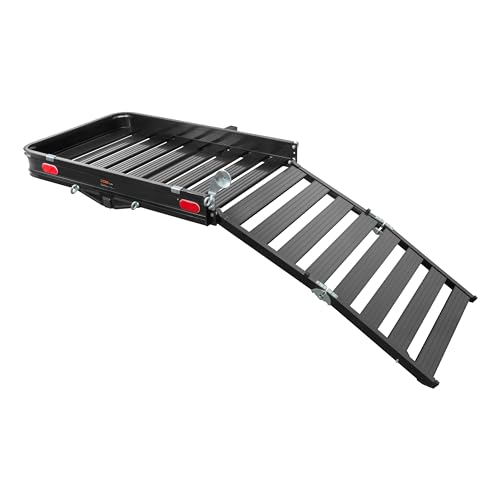
CURT 18112
A wide aluminum deck with a fold-out ramp for rolling gear on.
Basket, Tray, Ramp or Box
The best hitch cargo carrier for you starts with the shape. There are four main types.
- Basket: a platform with side rails that hold straps and bags. The everyday choice for camping gear.
- Tray: a flat deck for square items like coolers and bins.
- Ramp carrier: a wider deck with a fold-out ramp for wheeled equipment.
- Enclosed box: a locking hard shell that keeps gear dry, with less weight capacity.
Also check the receiver size. Most carriers use a 2-inch shank for Class III and IV hitches, while many small cars and crossovers have a 1-1/4-inch receiver. A folding shank lets the empty carrier tilt up, and an angled shank adds ground clearance.
Tongue Weight Is the Number That Matters
A carrier listed at 500 pounds does not mean your vehicle can carry 500 pounds on the hitch. The carrier, plus everything strapped to it, presses down on the receiver as tongue weight. Your real limit is the lowest of three ratings: the carrier, the hitch, and the vehicle itself.
- Vehicle: the tongue weight limit in the owner’s manual, plus the door jamb loading placard.
- Hitch: the label on the receiver. Small Class I or II hitches are often rated well below a basket.
- Carrier: the listed capacity, counting the carrier’s own weight.
Put the heaviest items close to the bumper and centered side to side, then strap everything down twice. A hitch tightener or stabilizer cuts the rattle and wobble that loosen loads on rough roads.
Best Hitch Cargo Carrier Options: Six Products Reviewed
Picks one to five are open carriers, and pick six is an enclosed box that needs its own platform. Capacities below are as each listing states them, so compare them with your hitch label before you buy.
1. CURT 18153 Folding Hitch Basket: 60 x 24 Inch, 500 lb Steel Carrier
- 60 x 24 inch basket with 6 inch tall sides
- 500 lb capacity, fits 2 inch receivers
- Folding, angled shank for clearance and parking
- Tubular steel, mesh base, carbide black powder coat
The CURT 18153 is a basket-style hitch cargo carrier for 2-inch receivers. The listing gives a 60 by 24 inch platform with 6-inch tall sides and a 500 lb capacity. It is built from tubular steel with a mesh base and a carbide black powder coat, with reflectors on the frame.
Two shank details set it apart. The shank is angled, which lifts the basket higher off the ground for steep driveways, curbs and boat launches. It also folds, so you can tilt the empty carrier up against the back of the vehicle when you park in a garage or a tight lot. The tall sides give straps and cargo nets plenty of anchor points and keep soft bags from sliding off over bumps.
This basket suits drivers who want one carrier for camping trips, coolers, sports gear and moving-day boxes. Being steel, it is heavier to lift in and out than an aluminum basket, and on salted roads it lasts longer if you rinse it and touch up chips. It does not come with a bag or straps, so budget for those separately, and stay within your hitch and vehicle tongue weight ratings rather than the basket’s 500 lb figure alone.
2. VEVOR Folding Hitch Cargo Carrier: 60 x 24 x 6 Inch Basket with Waterproof Bag
- 60 x 24 x 6 inch steel basket, 500 lb capacity
- Waterproof cargo bag, cargo net and ratchet straps
- Coded lock and hook stabilizer included
- Folds up when not in use, fits 2 inch receivers
The VEVOR folding hitch cargo carrier is a steel basket kit for vehicles with a 2-inch receiver. The listing describes a 60 by 24 by 6 inch basket rated for 500 lbs, with upgraded 5mm supporting tubes and a black powder coating to resist rust and weather.
What makes it different is everything in the box. You get a waterproof cargo bag, a cargo net, ratchet straps and a coded lock, plus a hook stabilizer meant to steady the basket on bumpy roads. When the carrier is empty, it folds up for parking, and the bag packs into its own storage pouch. Reflectors on the frame add visibility at night.
This kit suits someone buying a first hitch carrier who wants to load up and leave without hunting for accessories. The bag is handy on wet highways and in winter, when spray from the rear tires coats anything left in an open basket. As with any steel carrier, rinse off road salt and watch for chipped coating. Check that your hitch and vehicle tongue weight ratings cover the loaded weight, since the 500 lb figure is the basket’s own limit.
View VEVOR Folding Hitch Cargo Carrier on Amazon

3. MaxxHaul 70108 Aluminum Cargo Carrier: 49 x 22.5 Inch Basket with High Side Rails

- Extruded aluminum basket, resists rust
- Steel under support frame, 2 inch hitch shaft
- 500 lb capacity, Class III and IV receivers
- Inner basket 47-1/4 x 20-1/4 x 6 inches
The MaxxHaul 70108 is a basket-style hitch carrier made from extruded aluminum on a heavy-duty steel under support frame. Its 2 by 2 inch hitch shaft is listed for standard Class III and IV receivers, and the carrier is rated for 500 lbs. MaxxHaul gives outer dimensions of 49-1/4 by 22-1/2 by 7-1/4 inches and inner dimensions of 47-1/4 by 20-1/4 by 6 inches.
The aluminum basket is the main reason to choose it. It is lighter to handle than an all-steel basket and resists the rust that road salt causes on chipped steel. The high side rails hold cargo in place and double as tie-down points, and reflector lenses with red corner accents help following drivers see the carrier after dark.
This carrier suits drivers who leave a basket on through a Michigan winter or simply want something easier to lift in and out of the receiver. It is shorter than the 60-inch baskets in this list, so measure long items such as tents or folding tables first. The steel frame and shaft still benefit from a rinse after salty drives. Keep the loaded weight inside your hitch and vehicle tongue weight ratings.
4. CURT 18112 Aluminum Hitch Cargo Carrier: 50 x 30-1/2 Inch Deck with Ramp
- Built-in three-position loading ramp
- Double-folding ramp stows flat in the carrier
- Black aluminum, 50 x 30-1/2 inch deck
- Folding 2 inch shank for parking and storage
The CURT 18112 is a black aluminum hitch cargo carrier with a 50 by 30-1/2 inch deck and a built-in loading ramp. It fits 2-inch receivers, and the shank folds up so the carrier can be stowed against the vehicle when parked or stored.
The ramp is the headline feature. CURT lists it for scooters, push mowers, snow blowers and similar wheeled equipment, which you roll on rather than lift. The ramp has three positions: extended for loading, folded vertically, or stowed inside the carrier. It is double folding, which makes it easier to handle and reduces wind resistance, and it lies flat in the carrier for compact storage and access to the rear of the vehicle.
This carrier suits owners who move a mobility scooter, a lawn mower or a snow blower between home, a cabin and the shop. The deck is wider than a standard basket, so measure your bumper and confirm the carrier will clear the hatch or tailgate when loaded. Wheeled machines can be heavy for a hitch, so compare the machine’s weight with the listed carrier capacity, your hitch label and the tongue weight limit in your owner’s manual before you load it.

5. CURT 18110 Steel Tray Cargo Carrier: 48 x 20 Inch, 1-1/4 Inch Shank, 300 lb

- 48 x 20 inch tray, 300 lb maximum rating
- 1-1/4 inch shank, 2 inch sleeve adapter included
- Two-piece steel tray with mesh base
- Angled shank, hitch pin and clip included
The CURT 18110 is a tray-style hitch cargo carrier built around a 1-1/4 inch shank, which is the receiver size found on many sedans and small crossovers. It also includes a sleeve adapter for compatible 2-inch receivers. The 48 by 20 inch tray carries a maximum rating of 300 lbs when used within the limits of the vehicle and hitch.
The tray is heavy-duty steel with a mesh base, finished in E-coat under a carbide black powder coat. It comes as two pieces that bolt together with the supplied hardware, and CURT says to tighten the fasteners to the specified torque and inspect them from time to time. Openings around the edge work as attachment points for nets, straps or bungees, and the angled shank raises the tray for better ground clearance. A hitch pin and clip are included.
This carrier suits small-car owners who want room for a cooler, a couple of bins or a weekend bag without moving up to a bigger hitch. The low-edge tray is better for square items than for loose soft bags. CURT advises checking the receiver opening and pin-hole alignment before ordering, and many 1-1/4 inch hitches carry modest tongue weight ratings, so read yours first.
6. Thule Arcos Box: 14 Cu Ft Hitch-Mounted Cargo Box with SlideLock

- Up to 14 cu ft of hard-shell storage
- Requires the Thule Arcos Platform (sold separately)
- SlideLock system locks the lid automatically
- Sits low for easy loading and unloading
The Thule Arcos Box is an enclosed, hard-shell cargo box that rides on the back of the vehicle instead of the roof. The listing gives up to 14 cubic feet of extra loading space. It must be used with the Thule Arcos Platform, which is sold separately and mounts in the hitch receiver, so plan to buy both.
Thule designed the box with an aerodynamic shape meant to have little impact on fuel consumption or on an electric car’s range. One person can attach it to the platform. The SlideLock system has separate locking and opening functions, locks the lid automatically, and shows when the box is closed securely. Because it sits low to the ground, heavy duffels and ski bags are easier to load than they would be on the roof.
This box suits drivers who want weatherproof, lockable storage for luggage, winter sports gear or groceries on long trips, without lifting anything overhead. It is not a hauler for firewood, coolers of ice or a deer, where an open basket makes more sense. The listing does not state a weight rating on the box page, so check the platform’s limits along with your hitch label and the owner’s manual before packing it full.
View Thule Arcos Box on Amazon
Matching the Carrier to the Load
Start with what you carry most often.
| Your load | Carrier style | Receiver | Pick |
|---|---|---|---|
| Camping gear and luggage | Folding steel basket | 2-inch | CURT 18153 |
| Gear that must stay dry | Basket with bag kit | 2-inch | VEVOR folding carrier |
| Year-round use on salted roads | Aluminum basket | 2-inch, Class III or IV | MaxxHaul 70108 |
| Scooter, mower or snow blower | Carrier with ramp | 2-inch | CURT 18112 |
| Small car, lighter loads | Steel tray | 1-1/4-inch, 2-inch adapter | CURT 18110 |
| Skis, duffels, locked storage | Hard-shell box | Thule Arcos Platform | Thule Arcos Box |
A hitch carrier also costs less fuel than a roof box. According to the U.S. Department of Energy’s fuel economy guide, a rear-mount cargo box or tray lowers fuel economy by only 1% to 5% on the highway, while a large roof-top box can cost 6% to 17%. Whichever best hitch cargo carrier you pick, check before the first trip that the loaded carrier leaves your plate and tail lights in plain view.

Salt, Slush and Deer Season
Around Grand Rapids, a hitch carrier rides right in the spray zone behind the rear tires. In winter that spray is brine, and it finds every chip in a powder-coated steel basket. Aluminum resists rust better, while steel lasts longer if you rinse it after salty drives and touch up bare spots each spring.
- Grease the shank now and then so it doesn’t seize in the receiver.
- Use a waterproof bag or sealed totes in an open basket.
- Hunters often bring a deer home on a basket. Weigh that against your tongue weight limit, and cover or secure it so nothing shifts at highway speed.

Winter road trips put more on the car than the carrier. Our Michigan winter car maintenance checklist covers the basics, and a winter car emergency kit belongs inside the cabin, not in the basket where you cannot reach it. If the engine cranks slowly after a night at a cold cabin, read our guide on a car not starting in cold weather before you head home.
When the Rear End Needs a Look
Weight hung behind the rear axle leverages the rear springs and shocks harder than the same weight in the trunk. If the back of the car sits noticeably low with the carrier loaded, bounces more than once after a bump, or clunks over railroad tracks, the suspension may be worn or the load too heavy.

Lighten the load first, then have the rear end checked if the symptoms stay. Our suspension repair in Grand Rapids covers worn shocks, struts, springs and mounts.
More Buying Guides
Frequently Asked Questions
How much weight can I put on a hitch cargo carrier?
Use the lowest of three ratings: the carrier’s listed capacity, the tongue weight rating on your hitch label, and the tongue weight limit in your owner’s manual. Count the carrier’s own weight as part of the load.
Can I use a 2-inch carrier with a 1-1/4-inch hitch?
No, a 2-inch shank will not fit a smaller receiver. Choose a carrier with a 1-1/4-inch shank, such as the CURT 18110, which also includes a sleeve adapter for 2-inch receivers.
Is steel or aluminum better on Michigan roads?
Aluminum resists rust better and is easier to lift on and off. Steel is usually stiffer and heavier, but road salt attacks any spot where the coating chips, so rinse it often in winter.
What is the best hitch cargo carrier for a scooter or snow blower?
A carrier with a built-in ramp, such as the CURT 18112, lets you roll wheeled equipment on. Compare the machine’s weight with the carrier and hitch ratings before loading.
Rear end sagging or clunking since you started hauling a loaded carrier? Call 456 AutoFix at 616-279-3832, Monday to Friday 8am to 5pm, or set up a suspension check through our contact page.
Rolling back into town after hours with the basket still on? Pull it from the receiver, leave the car in our after-hours drop-off at 456 Carrier St NE in Creston, and jot down how heavy the load was.