As an Amazon Associate, 456 AutoFix earns from qualifying purchases. Product links below go to Amazon, where you can confirm the right part for your vehicle.
Cold hands make every bolt harder to start. The best garage heater for you depends less on the brand and more on what your garage already has: a spare 240-volt circuit, a gas line, or just a wall outlet.
This guide starts with the power source, then walks through sizing and safety before reviewing six heaters across five types. If you mostly need to keep the car itself happy on frozen mornings, our engine block heater guide is the better place to begin.
Quick answer
What kind of heater works best in a home garage?
For most attached one- or two-car garages, a 240V ceiling-mount electric heater such as the Comfort Zone 5000W or Dr. Infrared DR-975 gives steady, fume-free heat. Large or drafty spaces with a gas line suit a vented unit heater, and a 120V NewAir unit only warms the spot where you stand.
Our Quick Picks
Three ways to heat a garage: a hardwired 240V ceiling heater, a 120V plug-in for bench work and a vented gas unit for big spaces. All six heaters are reviewed below.

Comfort Zone 5000W Ceiling Heater
A ceiling heater that keeps the floor clear and holds a set temperature.

NewAir NGH160GA00
No wiring needed: point it at the bench and plug it in.

Mr. Heater 50,000 BTU Unit Heater
Serious output for big or detached garages with a gas supply.
Which Garage Heater Type Fits Your Space?
Start with the energy you can deliver to the garage. A heater you cannot power properly trips breakers or never catches up.
- 240V hardwired electric: mounts on the ceiling or wall, runs on a dedicated circuit and has no flame or fumes. The common choice for attached garages.
- 240V plug-in electric: the same power class, but with a cord and a specific high-amp receptacle, so it can move or come down in summer.
- 120V portable electric: plugs into a standard outlet.
- Gas unit heater: burns natural gas or propane, vents outside and puts out far more heat than a household circuit can.
- Portable propane radiant: cordless and quick, with a low-oxygen shutoff on approved indoor models.
Sizing a Heater Without Guesswork
Makers rate heaters by square feet, but those numbers assume a reasonably sealed room. A detached garage with an uninsulated overhead door loses heat fast, so plan on the upper end of a heater’s range or the next size up.
As a rough guide from the listings below, 5,000 watts is a typical match for a one-car or small two-car garage, 7,500 watts for a larger two-car space, and a 50,000 BTU gas unit heater for something closer to three bays.
Before you order, open your electrical panel and look for free breaker space, then read the listing for the circuit size, wire gauge and receptacle it calls for. If those details do not match what you have, budget for an electrician before the heater arrives.
Best Garage Heater Options: Six Models in Detail
These six cover every power source above, from a plug-in bench heater to a vented gas unit, so the best garage heater for your hookup should be among them.
1. Comfort Zone 5000-Watt Ceiling Mount Heater: 240V Hardwired with 3 Heat Settings
- 3,000, 4,000 and 5,000-watt settings
- 240V single-phase, hardwired install
- Knob thermostat with high-limit cut-out
- Adjustable louvers and tilting bracket
The Comfort Zone 5000-watt heater is a fan-forced unit built to hang from the ceiling and be wired straight into a 240-volt circuit. Getting it off the floor keeps it clear of creepers, jacks and the car door, which is a real advantage in a crowded single bay. The body is heavy-gauge steel, and the listing gives an ETL safety listing.
Output is selectable in three steps. The listing puts 3,000 watts at 12.5 amps and about 10,240 BTU, 4,000 watts at 16.7 amps, and 5,000 watts at 20.9 amps and about 17,060 BTU. A knob thermostat cycles the heater to hold the temperature you set, while front louvers and a tilting bracket let you aim the warm air down toward the floor where you actually kneel and work.
Because it is hardwired, plan on a licensed electrician running a dedicated circuit sized to the 5,000-watt draw, following local code. There is no remote or digital display, so adjustments happen at the unit. That simplicity suits a garage where you want steady background heat all winter, but a bigger two-car space with a drafty door may outpace it on the coldest nights.
View Comfort Zone 5000W Ceiling Heater on Amazon
2. Dr. Infrared DR-975: 7500W 240V Hardwired Heater with Remote Thermostat

- 4,700W or 7,500W on 240V single phase
- Remote thermostat, 50 to 85 degrees
- Five louvers to direct airflow
- UL/CUL listed, timer, enclosed motor
The Dr. Infrared DR-975 steps up to 7,500 watts, which makes it a better match for a full two-car garage than a 5,000-watt unit. It runs on 240-volt single-phase power and also has a lower 4,700-watt setting for milder days. The heater mounts on a wall or ceiling, and the listing states it is UL and CUL listed.
Control is the main difference from simpler ceiling heaters. A remote handles the thermostat, which ranges from 50 to 85 degrees, so you can bump the heat from across the garage without climbing a step stool. Five adjustable louvers point the airflow, a timer can shut it down on schedule, and the fan motor is fully enclosed to keep shop dust out.
This is a hardwired heater with no cord in the box. The listing calls for 8 AWG copper wire, and the circuit, breaker and connection should be handled by a licensed electrician to local code. If your panel is already close to full, check capacity first. For a small one-car space it can be more heater than you need, but for evening work in a larger bay it brings the temperature up faster.
View Dr. Infrared DR-975 on Amazon
3. Dr. Infrared DR-988: 5600W 240V Plug-In Heater with NEMA 6-30P Cord

- 5,600-watt element on 240V
- 6 ft cord with NEMA 6-30P plug
- Thermostat from 37 to 113 degrees
- Floor, wall or ceiling use
The Dr. Infrared DR-988 delivers 240-volt heat without being wired in. It comes with a 6-foot cord and a NEMA 6-30P plug, and the listing says it needs a dedicated NEMA 6-30R, 250-volt, 30-amp receptacle. That makes it a good fit if you rent, if you want to take the heater down in spring, or if you already have a 240V outlet for a welder or compressor.
The 5,600-watt element sits inside an all-metal housing with a steel safety grille and aluminum fan blades. The thermostat runs from 37 to 113 degrees, and a fan switch with On and Auto modes lets it hold temperature or simply circulate air. You can set it on the floor or mount it to a wall or ceiling, and built-in cord storage keeps the lead tidy.
Auto overheat cut-off is included, and the listing gives UL and C-UL listings. Do not adapt the plug or run it on an extension cord; if the right receptacle is missing, have an electrician add one to code. Used on the floor, give it the full 3 feet of clearance from anything that can burn, including the car’s tires and a stack of cardboard.
View Dr. Infrared DR-988 on Amazon
4. NewAir NGH160GA00: 1500W 120V Portable Garage Heater with Tilting Head
- 1,500-watt fan-forced ceramic element
- Plugs into a standard 120V outlet
- Tilting head and carry handle
- Cool-touch exterior, auto shut-off, ETL
The NewAir NGH160GA00 is the no-installation option here. It plugs into a normal 120-volt outlet and uses a 1,500-watt fan-forced ceramic element, which the listing rates for spaces up to 160 square feet. That is roughly a corner of a garage rather than a whole bay, so think of it as spot heat aimed at you, not a way to warm the room.
A tilting head points the warm air where you are working, and the carry handle makes it easy to move from the bench to the side of the car. The metal housing is built for dusty shop conditions, and you get two heat settings plus adjustable temperature control. NewAir lists a cool-touch exterior, automatic shut-off and ETL certification.
At 1,500 watts it pulls close to the limit of a typical household circuit, so plug it directly into the wall and avoid sharing that circuit with a compressor or battery charger. It is a practical buy for short tasks like rebuilding a carburetor at the bench or swapping wiper blades. For hours under a car in January, one of the 240V heaters above will do far more.
View NewAir NGH160GA00 on Amazon

5. Mr. Heater 50,000 BTU Forced-Air Unit Heater: Propane or Natural Gas, Ceiling Mount
- 50,000 BTU, up to 1,667 sq ft
- Runs on propane or natural gas
- Works with 24V or Wi-Fi thermostats
- High-temp and flame-sensor shut-offs
The Mr. Heater 50,000 BTU forced-air unit heater is the high-output pick for garages that a household electric circuit cannot keep up with. The maker rates it for up to 1,667 square feet, or about a three-car garage, and it can be set up for propane or natural gas. It hangs from the ceiling and pairs with a standard 24-volt or Wi-Fi thermostat, which is sold separately.
The low-profile cabinet keeps it out of the way, but the listing sets firm space rules: a minimum 10-foot ceiling and 8 feet of clearance from the bottom of the heater to the floor. Safety features include a high-temperature shut-off switch and a flame sensor that cuts the gas if the flame goes out. The color may come in grey or tan.
This is not a weekend plug-and-play job. A vented gas heater needs a fuel line, a flue and the correct gas conversion, so have a licensed gas installer do the hookup to local code, and fit a carbon monoxide alarm in the garage. For a detached or poorly sealed garage that stays in use all winter, it is often the most practical way to get real heat.
View Mr. Heater 50,000 BTU Unit Heater on Amazon
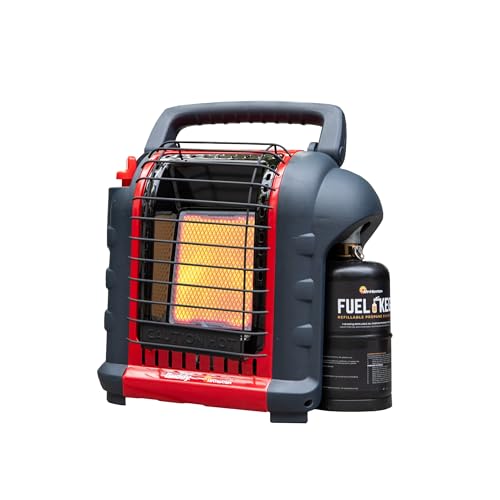
6. Mr. Heater Portable Buddy: 4,000 or 9,000 BTU Radiant Propane Heater
- 4,000 or 9,000 BTU radiant heat
- Approved for indoor and outdoor use
- Low-oxygen safety shutoff
- Runs on 1 lb propane cylinders
The Mr. Heater Portable Buddy is a radiant propane heater that runs on 1-pound cylinders, so it works anywhere, including a detached garage with no power. It has two settings, 4,000 and 9,000 BTU per hour, and the listing says it heats about 225 square feet. Run time is listed at 5.4 hours on low and 2.4 hours on high per cylinder.
Radiant heat warms the person and the surfaces in front of it rather than the air, which suits standing at a vise or kneeling at a wheel. Mr. Heater states the Buddy is approved for indoor and outdoor use and has an emergency low-oxygen safety system. Its housing uses self-extinguishing materials, and the maker warns against unauthorized accessories or attachments.
Even with those features, it is an unvented heater burning fuel in an enclosed space. Crack a door or window for fresh air, install a carbon monoxide alarm, never run it with a car idling inside and keep it well clear of gas cans and solvents. It is a short-session heater for a cold Saturday, not a substitute for a permanent electric or vented gas setup.
View Mr. Heater Buddy MH9BX on Amazon
Garage Heater Types Compared
If you are still torn, the best garage heater is usually the one that matches the hookup you already have and how long you spend out there on a typical evening.
| Heater type | Power or fuel needed | Suits | Picks in this guide |
|---|---|---|---|
| 240V hardwired electric | Dedicated 240V circuit, wired in | Attached one- or two-car garages, all-winter use | Comfort Zone 5000W, Dr. Infrared DR-975 |
| 240V plug-in electric | NEMA 6-30R 30-amp receptacle | Renters and shops that move the heater | Dr. Infrared DR-988 |
| 120V portable electric | Standard household outlet | Bench or spot heat, small spaces | NewAir NGH160GA00 |
| Vented gas unit heater | Natural gas or propane line, vent, 24V thermostat | Large or detached garages | Mr. Heater 50,000 BTU |
| Portable propane radiant | 1 lb cylinders, fresh air | Short jobs with no power nearby | Mr. Heater Buddy |
A warm garage is only half the setup. Good light matters as much in winter (see our best mechanic work light picks).

Is the Best Garage Heater Also a Safe One?
A garage holds things a living room does not: gasoline, solvents, brake cleaner and a car that may drip fuel or oil. The U.S. Fire Administration’s heating safety page advises keeping anything that can burn at least 3 feet from every heat source and switching space heaters off when you leave the room.
- Hire the electrician: 240V hardwired heaters and new 30-amp receptacles should be installed by a licensed electrician to local code.
- Vent gas properly: a gas unit heater connects to a fuel line and a flue, which is a job for a licensed gas installer.
- Fit a CO alarm: any propane or gas heater calls for a carbon monoxide alarm and fresh air, and an unvented heater should never run with the car idling inside.
- Mind the cord: plug portable units straight into the wall, not into a thin extension cord.
A heater also changes where tools end up. Keeping sockets and wrenches in a rolling tool chest means you can park the work close to the warm side of the bay without clutter near the heater.
Warm Garage, Winter Car Care
A heated bay makes the small winter jobs realistic: checking tire pressure after a cold snap, topping up washer fluid or swapping wiper blades before the next lake-effect band rolls in. A solid mechanic tool set covers most of that.
Some work still belongs on a lift. If your car is due for its mileage service, our factory scheduled maintenance in Grand Rapids follows the maker’s schedule, and a cabin that stays cold no matter how warm the garage is points to a car heater repair rather than a new shop heater.

More Buying Guides
Frequently Asked Questions
Is a gas garage heater better than an electric one?
Not better, just suited to different garages. A vented gas unit heater puts out much more heat for big or drafty spaces, while a 240V electric heater is simpler to install, has no flame and suits most attached garages.
What is the safest type of garage heater?
An electric heater that is correctly wired, thermostat controlled and has an overheat shutoff avoids combustion and carbon monoxide altogether. Any type is only as safe as its install, clearance from flammables and the habit of turning it off when you leave.
Can a garage heater double as a fan or an AC in summer?
The heaters here do not cool. Some, like the Dr. Infrared DR-988, have a fan-only setting that moves air, but true heating and cooling in one unit means a heat pump or mini-split, which an HVAC installer sizes and fits.
Which garage heater brands should I look at first?
Comfort Zone, Dr. Infrared and Fahrenheat are common names in 240V electric heaters, NewAir makes 120V portables, and Mr. Heater covers both gas unit heaters and portable propane. Choose the type first, then compare models within it.
Got the garage warm and want a second set of eyes on a winter repair? Ring Hendrick’s team at 616-279-3832 between 8am and 5pm, Monday through Friday, or send us the details through our contact page.
Short on daylight hours? Bring the car to 456 Carrier St NE once your own day is done, use the after-hours drop-off and tape a note to the dash about what you were working on in the garage.