As an Amazon Associate, 456 AutoFix earns from qualifying purchases. Product links below go to Amazon, where you can confirm the right part for your vehicle.
Pulling old oil up through the dipstick tube means no jack stands, no drain plug and no pan to balance under the car. The best fluid extractor for oil changes is the one that matches your power source, your engine’s oil capacity and how often you plan to use it.
Below we explain how hand-pump, compressed-air and 12V extractors differ, where topside extraction works and where it doesn’t, and then review six pumps. If you’re still working out your service schedule, read our guide on how often to change oil first.
Quick answer
What kind of fluid extractor should you buy for oil changes?
For most home garages, a 6 to 9 liter manual or dual-mode vacuum tank such as the Mityvac 7201 or OEMTOOLS 24937 covers a typical car. Choose a pneumatic unit like the Mityvac MV7300 if you own an air compressor, and a 12V pump if you want powered suction without one.
Our Quick Picks
Three quick picks, one for each power source: hand pump, shop air and 12V. All six extractors are reviewed below.
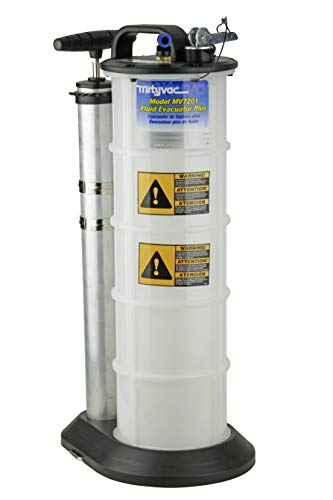
Mityvac 7201
A no-power vacuum tank that can also pump fluid back in.
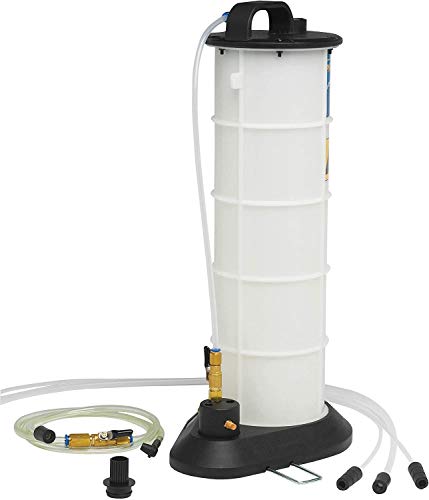
Mityvac MV7300
Uses compressed air to create steady suction with no pumping.

Faitio 12V Oil Pump
A powered pump that moves oil into any container you supply.
Hand Pump, Shop Air or 12V: How the Three Types Work
Every extractor does the same job: a thin probe goes down the dipstick tube to the bottom of the oil pan, and suction pulls the oil up into a tank or a separate container. What changes is how that suction is made.
- Manual vacuum tanks: you pump a handle to pull a vacuum inside a sealed tank, and the tank keeps drawing oil while you do something else. No power needed.
- Pneumatic (Venturi) tanks: shop air blows through a Venturi fitting that creates the vacuum. They need a compressor that can keep up, but they save your arm on larger engines.
- Dual-mode tanks: a hand pump plus an air fitting on the same tank, so you can use whichever suits the day.
- 12V electric pumps: a small motor pump with inlet and outlet hoses that pushes oil into any container you provide. They have no tank of their own.
Pulling Oil Through the Dipstick Tube: Pros and Cons
Topside extraction is clean and quick on the right engine. Some engines, many European designs among them, are built with a dipstick tube that reaches the lowest point of the pan, and on those an extractor can pull out close to what a drain would. On other engines the probe stops on a baffle or a bend, and more oil stays behind.
- Pros: no lifting the car, no stripped drain plug threads, no crush washer to replace and far less mess on the floor.
- Pros: the same tool handles transmission fluid, coolant, power steering fluid and boat or mower engines.
- Cons: you can’t see the drain plug, the pan or any metal on a magnetic plug, so you miss a quick look underneath.
- Cons: the oil filter still has to come off, and on many cars it sits underneath anyway.
A simple check tells you how well it worked. Compare what’s in the tank with the oil capacity in your owner’s manual, and if a lot is missing, drain from below at the next change to see what’s left.
Best Fluid Extractor for Oil Changes: Six Pumps Reviewed
These six cover manual, pneumatic, dual-mode and 12V designs. Check each listing’s tube sizes against your dipstick tube before you order.
1. Mityvac 7201: 2.3 Gallon Manual Fluid Evacuator and Dispensing Pump
- 2.3 gallon tank, manual operation
- Extracts and dispenses fluids
- Automatic overflow prevention
- Quick-drain spout and large base
The Mityvac 7201 is a hand-operated fluid evacuator with a 2.3 gallon tank, which is enough to hold the oil from most car and light truck engines in one go. You pump the handle to build vacuum inside the tank, feed the probe down the dipstick tube, and the tank keeps drawing oil while the vacuum holds. Its body is made of chemical-resistant polyethylene, so Mityvac lists oil, coolant and transmission fluid among the fluids it can handle.
What sets the 7201 apart from a basic extractor is that it works in both directions. A push-button control lets you switch from extraction to dispensing, so the same tool can refill a transmission, a differential or a coolant reservoir after you’ve drained it. An automatic overflow prevention system stops extraction once the tank is full, which protects the pump from being flooded with oil.
The large base keeps it steady on a garage floor, and a quick-drain spout makes it easier to pour the old oil into a recycling jug. Because it relies on your arm, it suits owners who change oil a few times a year rather than a busy shop. Cold, thick oil will extract slowly, so warm the engine first.
2. Mityvac MV7300: 2.3 Gallon Pneumatic Venturi Fluid Evacuator
- Compressed-air Venturi vacuum pump
- 2.3 gallon chemical-resistant tank
- Air shut-off valve and overflow prevention
- Quick-drain spout for disposal
The Mityvac MV7300 is the pneumatic counterpart to Mityvac’s manual tanks. Instead of a hand pump, it uses compressed air flowing through a Venturi fitting to pull a vacuum, so the suction stays steady for as long as air is connected. The tank holds 2.3 gallons and is made from chemical-resistant polyethylene, and Mityvac lists engine oil, brake fluid, transmission fluid and coolant among its uses.
That steady vacuum is its main benefit. On a larger engine or a vehicle with a long, narrow dipstick tube, a manual tank needs topping up with more strokes as the vacuum fades, while the MV7300 keeps working without extra effort. An air shut-off valve lets you control the airflow, and overflow prevention helps keep the tank from being overfilled during a long extraction.
A quick-drain spout makes emptying the tank into a recycling container straightforward, and the wide base keeps it stable beside the car. The trade-off is that it needs a compressor that can supply air continuously, plus the noise that comes with running one. It is the wrong choice for a driveway or parking spot with no air supply, where a manual or 12V option makes more sense.
3. Pela PL-6000: 6 Liter Oil Extractor with 43 Inch Probe Tube

- 6.0 liter (6.34 qt) capacity
- 21.5 inch tall when assembled
- 43 inch probe, 3/16 inch OD
- 39 inch clear section, 3/8 inch OD
The Pela PL-6000 is a long-running oil extractor design with a 6.0 liter (6.34 quart) container. It works on the vacuum principle: you build suction in the tank, and oil is drawn up through the probe and into the container. Assembled, it stands 21.5 inches tall with a 9 inch diameter, so it takes up little space on a shelf between oil changes.
The tubing is the detail to check first. The listing gives a probe of 3/16 inch outside diameter and 43 inches long, joined to a clear section that is 3/8 inch across and 39 inches long. A thin, long probe can reach the bottom of a deep or narrow dipstick tube, and the clear section lets you watch the oil move so you can tell when the pan is empty.
Six liters covers the oil capacity of many four- and six-cylinder engines, along with mowers, motorcycles and outboard motors. It is not large enough for a heavy-duty truck engine that holds more, so check your owner’s manual before you rely on it. As with any thin probe, warm oil makes a big difference, so give the engine a few minutes of running time before you start.
4. EWK 6.5L: Pneumatic and Manual Oil Extractor with Two Suction Tubes

- Manual or pneumatic operation
- Suction up to 1.8 L/min
- Two extended suction tubes
- Oil, ATF, coolant and power steering fluid
The EWK 6.5L extractor combines a hand pump and a pneumatic connection on one tank, so you can choose how to build vacuum depending on where you are working. In manual mode it needs no power at all, which suits a driveway or a boat slip. Connected to an air compressor, the listing rates suction at up to 1.8 liters per minute, which clears a typical engine’s oil quickly.
Two extended suction tubes come in the kit, giving you a choice of diameter and reach for different dipstick tubes and reservoirs. EWK lists engine oil, transmission fluid, coolant and power steering fluid as suitable, and names cars, motorcycles, boats, jet skis and lawn mowers among the uses. The 6.5 liter tank handles the oil from most passenger car engines in one session.
There are two cautions in the listing worth reading before you buy. EWK states that it is not compatible with the Mercedes W212 E350 or C218 CLS 350, and it should not be used with gasoline or other highly volatile fluids. Outside those limits, it is a flexible choice for owners who sometimes work with shop air and sometimes without it.
View EWK 6.5L Extractor on Amazon

5. OEMTOOLS 24937: 6L Pneumatic and Manual Extractor with Dipstick Adapters

- 6 liter (1.5 gallon) dual-mode tank
- Automatic shut-off valve
- 5 ft suction hose and two 41 inch adapters
- Milton M-style coupler, 1/4 inch NPT
The OEMTOOLS 24937 is a 6 liter (about 1.5 gallon) fluid extractor that runs either from an air compressor or from its oversized hand pump. That lets you use shop air in the garage and switch to manual pumping when you are working away from a compressor. The listing describes removing oil, coolant, transmission fluid and power steering fluid through dipstick tubes or fluid openings, without pulling drain plugs.
An automatic shut-off valve stops suction when the tank reaches capacity, which helps prevent a messy overflow if you walk away during an extraction. The kit includes a 5 foot suction hose and two 41 inch dipstick adapters, giving you extra reach for engines with deep pans and for equipment with awkward fill points.
For pneumatic use, it connects through a Milton M-style quick-connect coupling with a 1/4 inch NPT fitting, a common setup on home compressors. Check that your compressor uses the same style before you rely on air mode. A 6 liter tank suits most cars and small SUVs, but an engine with a larger oil capacity will need the tank emptied partway through the job.
6. Faitio 12V 100W: Electric Oil Transfer Pump for Topside Changes
- 12V DC, 100W motor
- Flow rate up to 4.2 qt per minute
- Up to 30 minutes of continuous use
- Self-priming, pure copper motor
The Faitio 12V oil pump is an electric transfer pump rather than a vacuum tank. A 100W motor running on 12V DC draws oil up through the dipstick tube and pushes it out through a second hose into whatever container you provide. The listing rates flow at up to 4.2 quarts per minute, so a warm engine can be emptied in a few minutes once the pump has primed itself.
Faitio describes it as a topside oil change tool for motor oil, gear oil, differential fluid and transmission fluid, with cars, motorcycles, lawn mowers, boats and jet skis among the listed uses. The motor uses pure copper windings, and the pump is rated for up to 30 minutes of continuous running. The maker suggests warming the engine for three to five minutes first, because warm oil flows far more easily.
Because there is no tank, you need a sealed container large enough for your engine’s full oil capacity, and you need to watch the outlet hose while it runs. It is not for gasoline, diesel or water. It suits owners who want powered speed without buying a compressor, and anyone who already has a drain container they like.
View Faitio 12V Oil Pump on Amazon
Matching an Extractor to Your Garage
Start with what you already own. A compressor points to a pneumatic or dual-mode tank, and a garage without one points to a hand pump or a 12V unit. Then check capacity: the tank should hold your engine’s full oil capacity with room to spare.
| Type | Power needed | Strengths | Trade-offs |
|---|---|---|---|
| Manual vacuum tank | None, just the hand pump | Works anywhere, quiet, holds the oil | Slower with cold oil; you re-pump as vacuum fades |
| Pneumatic tank | Air compressor | Steady suction with little effort | Compressor noise and air use; tied to a hose |
| Dual-mode tank | Hand pump or compressor | Flexible for home and driveway | More fittings to keep sealed |
| 12V electric pump | 12V DC supply | Fast flow, small to store | No tank; duty-time limits; you supply the container |
If you look after a truck, a boat or a couple of family cars, a larger tank saves emptying it halfway through, and a model that also dispenses can refill a transmission or coolant reservoir.

Choosing the right oil matters as much as removing the old one. Our comparison of synthetic vs conventional oil explains which one your engine needs.
Cold Oil, Michigan Garages and Getting Rid of Used Oil
Oil thickens in the cold, and an unheated Grand Rapids garage in January makes any extractor slow. Run the engine for a few minutes so the oil is warm but not hot, then shut it off before you insert the probe. Wear gloves, because the probe and the oil can still be hot enough to burn.
The refill matters in winter too. Our guide to the best motor oil for cold weather covers viscosity grades for cold starts.

Used oil needs a proper home once it is in the tank. The EPA’s used oil guidance says the oil from one change can contaminate a million gallons of fresh water. It asks do-it-yourselfers to move it into a leak-proof container and to drain and recycle the old filter as well, usually at the same collection point.
When the Oil Change Belongs at a Shop
An extractor is a good tool for routine changes, but it can’t tell you what’s going on inside the engine. Milky oil, a burning smell or a warning light on the dash all need a closer look before the next change. If you see a light while driving, read our post on an oil pressure light that comes on.

A shop oil change also puts the car in the air, which lets a technician check the drain plug, the pan and nearby leaks. Our oil change service in Creston handles foreign and domestic vehicles.
More Buying Guides
Frequently Asked Questions
Does an oil extractor remove as much oil as draining the pan?
On engines designed for topside service, it can come close. On others the probe can’t reach the lowest point, so some oil stays behind. Compare the amount removed with your owner’s manual capacity to find out.
Should the engine be warm before using an extractor?
Yes. Warm oil flows through a thin probe much faster than cold oil. Run the engine for a few minutes, shut it off, and wear gloves in case the oil is still hot.
What is the best fluid extractor for oil changes without an air compressor?
A manual vacuum tank such as the Mityvac 7201 or Pela PL-6000 needs no power, and dual-mode tanks work by hand too. A 12V pump like the Faitio 100W is the powered option without a compressor.
Can I use the same extractor for other fluids?
Most tank extractors list transmission fluid, coolant and power steering fluid as well as oil. Clean the tank and tubes between fluids, and never use one with gasoline or other flammable liquids.
Rather skip the mess this time? Call 456 AutoFix at 616-279-3832, Monday to Friday 8am to 5pm, or schedule an oil change through our contact page.
Can’t make it during the day? Use our after-hours drop-off. We’re at 456 Carrier St NE in Creston.