As an Amazon Associate, 456 AutoFix earns from qualifying purchases. Product links below go to Amazon, where you can confirm the right part for your vehicle.
A temperature gauge that creeps up in July traffic makes people reach for a different jug of antifreeze. The best coolant for hot weather is usually the one your owner’s manual already names, mixed at the right strength and running in a system with a sound cap, pump and fan.
That said, a few products do target heat. Below we explain how coolant handles summer, how a coolant differs from an additive, and review five options: three coolants and two additives that sit on top of the coolant you already run.
Quick answer
What coolant keeps an engine safest in summer heat?
Start with the coolant type your owner’s manual specifies, mixed 50/50 or as the label directs. For extra heat margin, a wetting additive such as Red Line WaterWetter or Royal Purple Purple Ice can lower temperatures, and Evans waterless coolant raises the boiling point to 375F after a full conversion.
Our Quick Picks
Three quick picks: a waterless coolant for the most heat margin, a premixed coolant for builds, and an additive for a healthy system. All five are reviewed below.

Evans EC53001 Waterless Coolant
A waterless fill that will not boil over in normal use.

Mishimoto Liquid Chill Synthetic Coolant
A ready-to-pour synthetic coolant from a radiator maker.

Red Line WaterWetter
Pours into the coolant you already run to improve heat transfer.
How Heat Pushes a Cooling System
Plain water boils at 212F at sea level, close to where many engines run under load. Two things raise that limit. Glycol in the mix lifts the boiling point, and the radiator cap holds the system under pressure, which lifts it again.
That is why a 50/50 mix in a healthy system rarely boils, even on a hot day. Most summer overheating starts somewhere else: a cap that no longer holds pressure, a weak water pump, a fan that stops spinning, a sticking thermostat or a radiator packed with bugs and road grime. A different coolant will not fix any of those.
Heat also wears coolant out faster. The corrosion inhibitors deplete with time and temperature, so an old fill protects metal less well just when the engine is working hardest. Our guide to the coolant brand that matches your car’s spec explains the main chemistries, and the rule from that page still applies here: never top up one type with another.
Coolant or Additive? Know What Is in the Bottle
A coolant is the main fluid in the system. It carries the glycol, the corrosion package and, unless it is a concentrate, the water. You choose it by your vehicle’s specification, and it fills the whole system.
An additive is a small bottle poured into the coolant you already have. The two in this guide are wetting agents: they lower the surface tension of the liquid so it stays in contact with hot metal instead of forming steam bubbles on it. Royal Purple states plainly on its Purple Ice product page that the additive gives no freeze protection, so an additive never replaces antifreeze.
Waterless coolant is a third category. It skips water entirely, which removes the boiling problem, but it only works after the old water-based fluid is drained out of the block, radiator and heater core.
Best Coolant for Hot Weather: Five Products Reviewed
The first three are coolants and the last two are additives. Read the label and your owner’s manual before buying, since a coolant that does not match the required spec is the wrong choice no matter how hot it gets.
1. Evans EC53001 High Performance: Waterless Engine Coolant with 375F Boiling Point
- Contains no water
- 375F boiling point per the listing
- For cars, light trucks and light diesels
- Needs a full drain of old coolant first
Evans High Performance Waterless Engine Coolant, part EC53001, is a coolant that contains no water. Most antifreeze is either mixed with water or sold already diluted, while Evans is meant to go into the engine straight from the jug. The listing gives a boiling point of 375F, well above a water-based mix, and says the fluid will not vaporize and cause after-boil when a hot engine is shut off.
Because there is no water, Evans says the coolant removes the conditions that cause water pump cavitation, liner erosion and much of the corrosion seen in older systems. It also runs at low vapor pressure, which puts less strain on hoses, the radiator and the cap. The maker lists it for gasoline cars and light trucks as well as light-duty diesels, and LP and CNG engines.
The conversion is the real work. Evans says all old water-based coolant and water must come out first, including from the block and heater core, and it sells a separate Prep Fluid to flush what a drain leaves behind. The fluid also absorbs moisture, so keep the jug sealed. That makes it a good fit for a classic or performance car that gets a full cooling system overhaul, and a poor fit for a quick top-up on a daily driver.
View Evans EC53001 Waterless Coolant on Amazon
2. Mishimoto Liquid Chill: Premixed Synthetic Radiator Coolant, 265F Boil-Over Protection
- Premixed, ready to pour
- Boil-over 265F, freeze -26F
- Safe for all radiator types
- Gas and diesel engines
Mishimoto is known mainly for aluminum radiators, and Liquid Chill Synthetic Engine Coolant is its fluid for those systems. This 64 oz bottle comes premixed with deionized water, so it goes in without measuring. The listing gives protection against boil-over to 265F and freezing to -26F, and Mishimoto notes on its own page that those figures assume a 15 psi radiator cap.
The maker describes the formula as a propylene glycol base with organic acid additives, and says it passes the ASTM D3306 and D6210 coolant tests. It is listed as safe for all radiator types and for gasoline and diesel engines, with claims of reduced engine wear, corrosion protection and lower operating temperatures. Mishimoto backs the product with its lifetime warranty.
Propylene glycol is a different base from the ethylene glycol in most factory coolants, so this is a fill for a drained and flushed system, not a top-up for whatever is already in the radiator. That suits a track car, a swap or an engine running an aftermarket radiator, where the owner is already setting up the system from scratch. A single 64 oz bottle will not fill most cars, so plan on several, and check your owner’s manual or warranty terms before using it in a newer vehicle that calls for a specific coolant.
View Mishimoto Liquid Chill Synthetic Coolant on Amazon

3. Valvoline Multi-Vehicle: Ready-to-Use 50/50 Antifreeze Coolant with Alugard Plus

- Premixed 50/50 with deionized water
- Protects to 265F and -34F
- Alugard Plus for aluminum parts
- Cars and light-duty trucks
Valvoline Multi-Vehicle Antifreeze Coolant is a universal ethylene glycol formula sold here as a one-gallon, ready-to-use 50/50 mix with deionized water. The listing gives protection against summer boiling to 265F and winter freezing to -34F, which covers the range a West Michigan car sees across a year without any mixing in the driveway.
The formula contains Valvoline’s Alugard Plus inhibitors, which the maker says fight corrosion, scale and rust while protecting every metal in the system, including aluminum. Valvoline also says the additives will not harm gaskets, hoses, plastics or paint. The coolant is yellow, and it includes a bittering agent to make it less appealing to children and pets.
Valvoline lists it as compatible with all ethylene glycol coolants in cars and light trucks, but compatible does not mean ideal. Many newer vehicles, especially European and Asian models, call for a specific chemistry, and their makers expect that coolant only. This one makes the most sense for an older domestic car or truck whose manual allows a universal coolant, or where the previous fill is unknown and the system is being drained and refilled anyway. For a full change, drain and flush first rather than mixing it into an old fill, and keep the empty jug as a record of what went in.
View Valvoline Multi-Vehicle 50/50 on Amazon
4. Red Line 80204 WaterWetter: 12 oz Cooling System Wetting Agent, 2 Pack
- Additive, not a coolant
- One bottle treats 3-5 gallons
- Compatible with DEX-COOL and long-life
- Meets ASTM D2570 and D1384 tests
Red Line WaterWetter is a cooling system additive, not a coolant. It goes into the coolant already in the engine, and Red Line describes it as an agent that doubles the wetting ability of water. In plain terms, it lowers surface tension so the liquid keeps contact with hot metal rather than forming a layer of vapor bubbles, which the maker says improves heat transfer and lowers cylinder head temperature.
Red Line says one 12 oz bottle treats 3 to 5 gallons, which covers most passenger cars and light trucks, while larger systems take two bottles. The company states it works with new or used antifreeze, including DEX-COOL and long-life versions, in ethylene and propylene glycol systems, and that it satisfies the ASTM D2570 and D1384 corrosion tests for glycol antifreeze. It contains no ethylene glycol. This listing is a two-pack.
Racers use it with straight water, and Red Line mentions reduced antifreeze levels in warm climates. Michigan winters rule that out for street cars, so the sensible use here is one bottle added to a proper 50/50 mix in a car that tows, idles in traffic or runs a little warm. It will not mask a failing pump, fan or cap, and it gives no freeze protection on its own.
View Red Line WaterWetter on Amazon

5. Royal Purple 01600 Purple Ice: 12 oz Radiator Coolant Additive with Corrosion Inhibitor
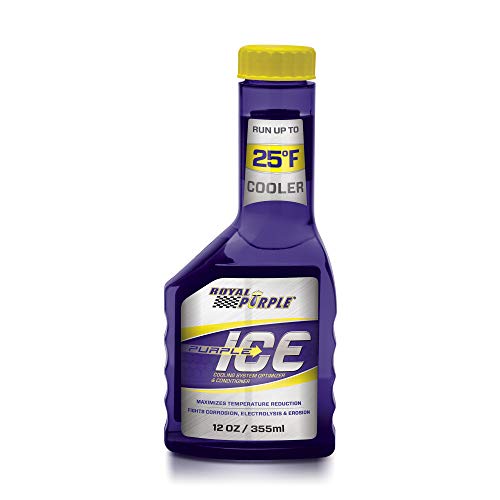
- Additive, no freeze protection
- Wetting agent plus corrosion inhibitor
- Compatible with all coolant types
- Contains water pump lubricants
Royal Purple Purple Ice is also an additive rather than a coolant. Royal Purple calls it a radiator conditioner with a two-in-one formula: a corrosion inhibitor plus a wetting agent that reduces the surface tension of the coolant to help lower engine temperatures. The Amazon listing adds that it contains lubricants to protect the water pump and is compatible with all coolant types.
The maker gives a clear treat rate. With a 50/50 antifreeze mix, use 1 oz per quart of cooling system capacity, and with straight water or a high water mix, 2 oz per quart. Royal Purple recommends at least 20 percent antifreeze in street-driven vehicles and states plainly that Purple Ice gives no freeze protection, so the right amount of antifreeze for local winters still has to be there. Look up your system capacity in the owner’s manual before pouring, because one 12 oz bottle may not be enough at the 1 oz per quart rate.
The product page also lists benefits such as cooler operation, reduced pre-ignition and less overheating. As with any additive, it does its job in a cooling system that is already sound, with a clean radiator and a cap that holds pressure. If an engine overheats outright, find the cause before adding anything.
View Royal Purple Purple Ice on Amazon
Which Pick Fits Your Summer Problem?
Match the product to the situation, then confirm it agrees with your manual.
| Situation | Option here | Type | Key number (maker’s figure) |
|---|---|---|---|
| Classic or performance car that boils over | Evans EC53001 | Waterless coolant | 375F boiling point |
| Track or custom build wanting a premix | Mishimoto Liquid Chill | Propylene glycol 50/50 | 265F boil-over, -26F freeze |
| Older domestic car with a green or yellow fill | Valvoline Multi-Vehicle | Ethylene glycol 50/50 | 265F boil, -34F freeze |
| Healthy system, runs warm when towing | Red Line WaterWetter | Additive | One bottle per 3-5 gallons |
| Healthy system, warm in traffic | Royal Purple Purple Ice | Additive | 1 oz per quart with 50/50 |
For most daily drivers, the best coolant for hot weather is a fresh fill of the factory-spec coolant plus, if you want more margin, one bottle of a wetting additive. The waterless and propylene glycol options make more sense for builds where the owner has already changed the cooling system or wants a long-term setup.

Summer in West Michigan, With Winter Close Behind
Our summers are humid, and a lot of local driving means stop-and-go traffic, a loaded car on the way to the lake or a trailer behind a truck. Those are the moments when idle airflow is low and the A/C condenser dumps extra heat in front of the radiator.
The catch is that the same coolant has to survive a January cold snap. Red Line notes on its WaterWetter product page that the additive allows reduced antifreeze levels in warm climates, but that advice suits places without hard freezes, not Grand Rapids. Keep a full-strength mix year round, and if you are curious about the cold side, our post on antifreeze for winter protection covers testing the freeze point.

Heat affects more than coolant. Batteries also suffer under a hot hood, and a car that runs warm with the A/C on may have a cooling fan or condenser issue worth checking, as our article on an A/C blowing warm air explains.
When Running Hot Points to a Repair
If the gauge climbs even with fresh coolant at the right mix, the fluid is not the problem. A seeping weep hole, a wobbly pulley or coolant crust around the pump all point to a failing water pump. Our list of water pump failure symptoms on Audi engines describes what that looks like, and most of it applies to other makes too.
On many engines the water pump sits behind the timing belt and is driven by it, so the two are often replaced together. Our guide to timing belt kit brands that include a water pump explains why that pairing saves labor later.

Draining and refilling a modern system also means bleeding out trapped air, and an air pocket can make an engine overheat right after a coolant change. If the pump, belt or bleeding process is more than you want to tackle, our timing belt and water pump replacement service in Grand Rapids covers the job on foreign and domestic vehicles.
More Buying Guides
Frequently Asked Questions
Is there a special coolant just for summer?
Not for most cars. The coolant your manual specifies, mixed at the right strength, protects against both boiling and freezing. Heat problems usually come from the cap, pump, fan, thermostat or radiator rather than the coolant type.
Can I add more water to my coolant in hot weather?
Not in Michigan. Extra water improves heat transfer but lowers freeze protection, and the same fill has to handle winter. Keep the mix the label and manual call for.
Is WaterWetter safe with Dex-Cool?
Red Line says WaterWetter is compatible with new or used antifreeze, including DEX-COOL and long-life versions, and that it meets the ASTM D2570 and D1384 corrosion tests for glycol antifreeze.
Do I need to flush before switching to Evans waterless coolant?
Yes. Evans says all water-based coolant and water must come out first, and it sells a Prep Fluid as a waterless flush for the leftovers. Any water left behind cuts into the benefit.
Want a second opinion on the best coolant for hot weather in your car, or a gauge that keeps climbing? Call 456 AutoFix at 616-279-3832, Monday to Friday 8am to 5pm, or ask about a cooling system check on our contact page.
Busy until the evening? Park it in our after-hours drop-off and leave the keys for us. The shop is at 456 Carrier St NE, Grand Rapids, in the Creston neighborhood.