As an Amazon Associate, 456 AutoFix earns from qualifying purchases. Product links below go to Amazon, where you can confirm the right part for your vehicle.
A cold snap in Grand Rapids is the wrong time to find out your coolant is weak. The best antifreeze for winter is rarely a special winter product: it is the type your owner’s manual names, mixed at the right strength and checked before the first hard freeze.
Below we cover what a 50/50 mix protects to, how to test it at home, and six picks: three correct-type coolants and three testers. For what the coolant types and brands mean, see our guide to the best coolant brand.
Quick answer
Which antifreeze is best for a Michigan winter?
The type your owner’s manual specifies, mixed 50/50 with distilled water. A 50/50 ethylene glycol mix protects to about -34°F, which covers a normal Michigan winter. Stronger is not better: Ford says to keep concentration between 40% and 60%. Check yours each fall with a refractometer, a disc tester or test strips.
Our Quick Picks
Three quick picks: a correct-type coolant for European cars and two ways to test the mix you already have. All six are reviewed below.

PEAK OET European Blue 50/50
Prediluted blue coolant made to match European specs.

Vee Gee CTX-2 Refractometer
Reads the freeze point from a few drops of coolant.
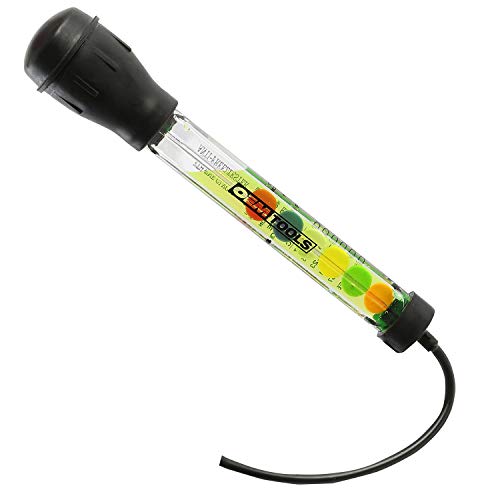
OEMTOOLS Antifreeze Tester
Squeeze, draw coolant, count the floating discs.
What a 50/50 Mix Protects To, and Why More Isn’t Better
Antifreeze lowers the freezing point of the water in your cooling system and raises its boiling point. According to Motorcraft’s ethylene glycol protection chart, a 50/50 mix of coolant and distilled water protects down to -34°F and against boil-over up to 265°F, as long as the pressure cap is the right one and in good condition. Nearly every 50/50 coolant on the shelf carries that same -34°F rating, whatever its color or brand.
That is far colder than a typical West Michigan winter night, even with lake-effect snow blowing in. So the best antifreeze for winter is simply the right coolant at the right strength.
| Mix (concentrate / water) | Protects to about | What it means |
|---|---|---|
| 40 / 60 | -12°F | Ford’s minimum; little margin for a deep cold snap |
| 50 / 50 | -34°F | The standard mix most makers specify |
| 60 / 40 | -62°F | Ford’s upper limit; more cold margin, less cooling |
| Straight concentrate | Freezes warmer than 50/50 | Never run it undiluted |
Going stronger has limits. Water carries heat away from the engine better than glycol, so a heavy mix cools less well in summer and in stop-and-go traffic. Ford’s chart says not to let concentration go above 60%, and undiluted concentrate actually freezes at a warmer temperature than a proper mix. Some makers allow up to 70%, so follow the label on your coolant.
The opposite problem is more common: years of topping up with plain water slowly weaken the mix, so test it.
How to Test Freeze Point at Home
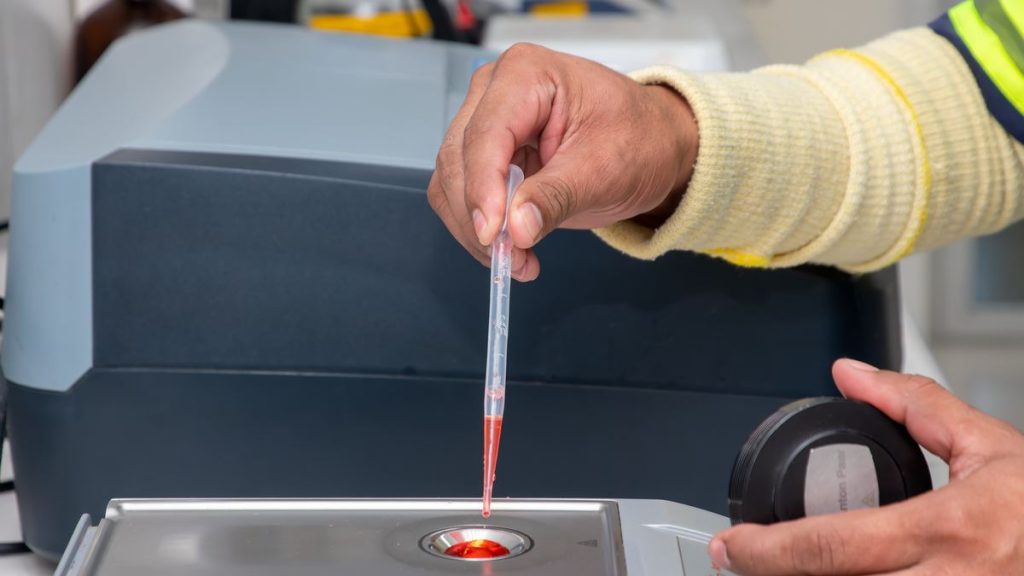
Test with the engine cold, since the cap on a hot system is under pressure. Draw a sample from the reservoir or radiator, then read it with one of three tools:
- Refractometer: put a few drops on the glass prism, look through the eyepiece toward the light and read the freeze point where the shaded area meets the clear area. It is the most precise home option and reads ethylene and propylene glycol on separate scales.
- Hydrometer (float, ball or disc tester): draw coolant into the tube and compare the floating pointer, balls or discs with the chart. It is cheap and quick, but made for ethylene glycol and less precise.
- Test strips: dip a strip, wait and match the pad colors to the chart on the bottle. Many also show pH, a rough sign that the additives are worn out.
If the reading is weaker than -34°F, or than the protection your manual calls for, the mix needs correcting. A small shortfall can be fixed by draining some coolant and adding concentrate. A badly diluted or dirty system usually needs a full drain and refill.
Best Antifreeze for Winter: The Picks in Detail
The first three are 50/50 prediluted coolants for common requirements, so you can top up without mixing; confirm the type in your owner’s manual before you buy. The last three are testers for checking the mix already in your car.
1. PEAK OET Extended Life Blue 50/50: Si-HOAT Coolant for European Vehicles
- 50/50 prediluted, ready for top-ups
- Blue Si-HOAT formula
- Listed for Audi, VW, BMW, Mercedes and more
- Compatible with other extended-life coolants
PEAK OET Extended Life Blue is a 50/50 prediluted coolant made to match the silicate-enhanced hybrid organic acid (Si-HOAT) formula that many European makers specify. The listing names Audi, Volkswagen, BMW, Mini, Mercedes-Benz, Porsche, Volvo, Jaguar, Land Rover and the Sprinter van among the vehicles it is recommended for. Because it is already mixed with water, what you pour in carries the standard 50/50 freeze protection without any measuring.
That makes it a practical jug to keep in the garage over winter. If the reservoir drops below its MIN mark on a cold morning, you can top up with the right type and the right strength at the same time, instead of reaching for plain water and weakening the mix. PEAK states it is compatible with other extended-life coolants, though matching the type your car already uses is still the safer habit.
PEAK rates it for up to 150,000 miles or five years of service when it goes in as part of a complete flush and fill. It is the wrong choice for a car whose manual calls for a different formula, so check your owner’s manual or the reservoir cap before you buy.
View PEAK OET European Blue 50/50 on Amazon
2. Zerex G05 50/50: Phosphate-Free HOAT Coolant, Ready to Use

- Hybrid organic acid (HOAT) formula
- Rated to -34°F and 265°F
- Phosphate free, lower silicate
- Pack of two 1-gallon jugs
Zerex G05 is Valvoline’s hybrid organic acid technology (HOAT) coolant, sold here as a 50/50 ready-to-use mix in a pack of two gallons. It is premixed with deionized water and rated to protect against freezing down to -34°F and boiling up to 265°F. The formula is phosphate free and lower in silicate, and Valvoline says it protects all cooling system metals, including aluminum.
G05 is a specific formula that some manufacturers call for by name, so it suits owners whose manual or reservoir cap lists a G05-type coolant. It also contains nitrite, which helps protect diesel cylinder liners from cavitation, so it works in both gasoline and diesel engines that need this type. Valvoline says its additives will not harm gaskets, hoses, plastics or the original paint.
As a prediluted product, it is meant for topping up or refilling without mixing, which keeps the freeze protection at the labeled strength. Two gallons is plenty for winter top-ups, though a full drain and refill on most cars takes more. If your car needs a different coolant, this is not a substitute, so check the manual first.
View Zerex G05 50/50 on Amazon
3. Zerex Dex-Cool 50/50: Orange OAT Coolant, Ready to Use
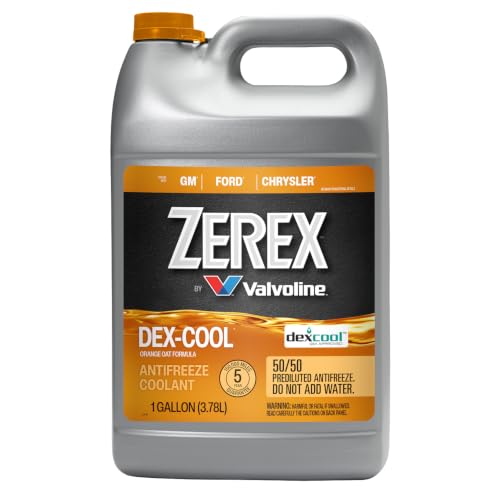
- Organic acid technology (OAT) formula
- Premixed with deionized water
- Rated to -34°F and 265°F
- 1-gallon ready-to-use jug
Zerex Dex-Cool is an orange organic acid technology (OAT) coolant in a 50/50 ready-to-use gallon. Dex-Cool is the coolant type General Motors has long specified for its cars and trucks. This one comes premixed with deionized water and is rated to protect against freezing down to -34°F and boiling up to 265°F.
For winter use, the point is simple: if your manual calls for Dex-Cool, this lets you top up with the correct type at the correct strength. That matters on older systems, where years of topping up with water can leave the mix weaker than you think. Valvoline says the formula resists rust, scale and corrosion, protects aluminum and other cooling system metals, and won’t harm gaskets, hoses or plastics.
Keep the level at the correct mark, since a system that runs low lets air in and loses heater output on cold mornings. This jug is the wrong choice for a car that calls for a HOAT or Si-HOAT coolant, so match the type on your reservoir cap or in the manual before you pour. After any large top-up, test the freeze point to confirm the mix is where it should be for winter.
View Zerex Dex-Cool 50/50 on Amazon
4. Vee Gee Scientific CTX-2: Handheld Coolant Refractometer with Fahrenheit Scales
- Ethylene glycol scale, -60°F to 32°F
- Propylene glycol scale, -50°F to 32°F
- Automatic temperature compensation
- No batteries; metal housing, glass prism
The Vee Gee Scientific CTX-2 is a handheld refractometer that reads coolant freeze point directly in degrees Fahrenheit. You place a few drops of coolant on the glass prism, close the cover and look through the eyepiece toward the light. The freeze point shows where the shaded area meets the clear area, with separate scales for ethylene glycol (-60°F to 32°F) and propylene glycol (-50°F to 32°F).
That dual reading is its main advantage over a float tester, which is made for ethylene glycol and can mislead with propylene glycol coolant. Automatic temperature compensation keeps readings consistent across a working range of about 50°F to 86°F. The scale is lit by ambient light, so there are no batteries to replace.
A third scale reads battery acid specific gravity, which is useful only for batteries with removable caps. The body is metal with a rubber grip and a non-roll stand. You need only a small sample, so a few drops drawn from the reservoir with a pipette is enough. It takes a moment to learn, but it gives the most precise reading of the three tester types here.
View Vee Gee CTX-2 Refractometer on Amazon
5. OEMTOOLS Professional Series: Disc-Type Ethylene Glycol Antifreeze Tester
- Floating-disc reading, hot or cold
- Five discs means ideal protection
- Sixth disc flags overprotection
- Clear body shows rust and debris
The OEMTOOLS Professional Series tester is a simple bulb-and-tube hydrometer for ethylene glycol coolant. You squeeze the bulb, draw coolant through the neoprene dip tube into the clear body, and count how many discs float. The count is compared with the chart printed on the tester, and five floating discs indicates ideal protection.
A sixth disc shows overprotection, meaning too much concentrate and a loss of cooling efficiency, which ties in with the point that stronger is not always better. OEMTOOLS says the disc design reads accurately with the engine hot or cold, though you should still only open the cap on a cold engine. The clear body also lets you see rust or debris in the sample, a quick clue to coolant condition.
It is quick enough to check every car in the driveway in a few minutes each fall. The trade-off is precision: you get a band of protection rather than an exact freeze point, and it is designed for ethylene glycol, not propylene glycol coolant. For most passenger cars running a standard ethylene glycol coolant, that is enough to tell whether the mix is ready for winter.
View OEMTOOLS Antifreeze Tester on Amazon
6. Robinair 75134 Econo-Clean: Coolant Test Strips for Freeze Point and pH

- Shows freeze point and pH
- Works with ethylene and propylene glycol
- Color key on the bottle label
- 50 strips per bottle
Robinair’s 75134 Econo-Clean coolant test strips are the simplest way to check a cooling system. You dip a strip in coolant, wait for the pads to change color, and match them to the color-coded keys on the bottle label. One pad shows the freeze point and another shows the pH, so a single strip covers both strength and a rough sign of condition.
The strips work with both ethylene glycol and propylene glycol coolants, and Robinair lists cars, trucks, SUVs, vans, motorcycles, ATVs and snowmobiles among the vehicles they suit. That makes a bottle of 50 handy for a household with several vehicles to check before winter. There is no glass to clean and nothing to calibrate.
pH matters because coolant additives wear out over time, and coolant that has turned acidic protects metal less well even when its freeze point still looks fine. The trade-off is resolution: reading colors gives an approximate freeze point, not the exact figure a refractometer shows. Test the coolant as it sits in the car, not straight concentrate, and keep the bottle closed so the strips stay dry.
View Robinair 75134 Test Strips on Amazon
Your Pre-Winter Coolant Check
Even the best antifreeze for winter only works at the right level and strength, so do this check in the fall with the engine fully cold.
- Level: coolant should sit between the MIN and MAX (or COLD) marks on the reservoir. Top up only with the type your system already uses.
- Condition: it should look clear and bright. Rust, brown sludge, an oily film or floating bits mean it needs replacing, not topping up.
- Strength: test the freeze point with one of the tools above.
- Type: match the spec in the manual or on the reservoir cap, not the color in the jug.
If you add coolant, check the level again after a day or two of driving. Prestone’s guide to changing antifreeze and coolant says to have the system checked for leaks if the level keeps dropping.
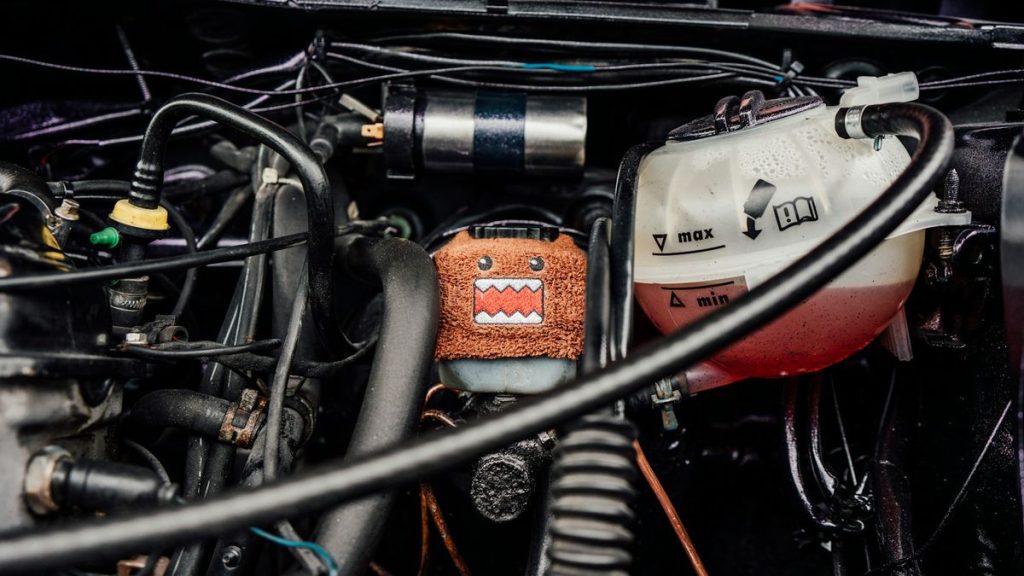
Mixing your own from concentrate? Use distilled water, since minerals in tap water can leave deposits inside the system. A jug of the right 50/50 coolant in the garage avoids guesswork in January.
When Low Coolant Points to a Repair
Coolant that keeps disappearing is going somewhere. Common sources are hoses, the radiator, the heater core and the water pump. On many Audi engines a weeping water pump is a known cause, and our guide to Audi water pump failure symptoms covers the warning signs.
On many engines the water pump is driven by the timing belt, so the two are often replaced together. If a belt is due, see our timing belt replacement in Grand Rapids, and our roundup of the best timing belt kit brands explains which kits include a new pump.

A heater that blows cold on a frosty morning is another clue, since low coolant or trapped air starves the heater core. Our guide to a car heater blowing cold air lists the causes, and our car heater repair in Grand Rapids traces them.
Never open a hot radiator or reservoir cap. If the temperature gauge climbs or you see steam, pull over safely, shut the engine off and let it cool before checking anything.

Antifreeze is toxic and tastes sweet to pets, so wipe up spills and store jugs closed.
More Buying Guides
Frequently Asked Questions
What temperature does 50/50 antifreeze protect to?
A 50/50 mix of ethylene glycol coolant and distilled water protects to about -34°F, and against boil-over to about 265°F with a good pressure cap. That covers a normal Michigan winter with room to spare.
Is a 70/30 mix better for extreme cold?
It protects to a lower temperature, but it cools less well, and Ford’s chart says not to exceed 60%. Follow the limit on your coolant’s label, and never run straight concentrate, which freezes at a warmer temperature than a 50/50 mix.
How do I know if my antifreeze is ready for winter?
Test it with the engine cold using a refractometer, a float or disc tester, or test strips. If it reads weaker than -34°F, or looks rusty or murky, correct the mix or replace the coolant before the first hard freeze.
What is the best antifreeze for winter in Michigan?
The type your owner’s manual specifies, at a 50/50 mix. At the same strength, no color or brand protects better against the cold, so focus on the right type and a tested freeze point.
Losing coolant or heat this winter in Grand Rapids? Call 456 AutoFix at 616-279-3832, Monday to Friday 8am to 5pm, or book a heater check through our contact page.
Can’t make it during the day? Use our after-hours drop-off. We’re at 456 Carrier St NE in Creston.