
As an Amazon Associate, 456 AutoFix earns from qualifying purchases. Product links below go to Amazon, where you can confirm the right part for your vehicle.
An old car’s cooling system was built around the fluid it left the factory with, and most of them left with green. Finding the best coolant for classic cars usually means going back to that traditional formula, or deciding on purpose to switch to a waterless one. What you want to avoid is a jug grabbed at random because the label says it fits every make.
Below we explain why older radiators matter, how the coolant types differ, and review five products for an older engine. For the chemistry behind every coolant color on the shelf, see our guide to picking a coolant brand by specification.
Quick answer
What coolant should go in an older car?
For most classic and vintage cars, use a traditional green low-silicate (IAT) coolant mixed 50/50 with distilled water, and change it about every two years. PEAK OET Green, Zerex Original Green and Prestone Prime Green fit that brief. Evans Collectors Choice is a waterless option for stored or show cars.
Our Quick Picks
Three quick picks for three kinds of owner: a green concentrate for full refills, a green premix for topping off and a waterless option for cars that sit. All five coolants are reviewed below.

PEAK OET Green
Traditional green that names older domestic vehicles on the maker page.

Prestone Prime Green 50/50
Prediluted green, so no mixing and no tap-water mistakes.

Evans Collectors Choice
Water-free coolant with a tester to confirm the old water is gone.
Why Old Radiators and Heater Cores Still Call for Green
Through the 1970s and much of the 1980s, most domestic cars used copper and brass radiators with soldered seams, brass heater cores, cast iron blocks and plenty of rubber and cork gaskets. Traditional green coolant uses inorganic inhibitors such as silicates and phosphates that coat metal surfaces quickly. That chemistry is what those systems were engineered around.
The maker pages for the green products below say plainly who they are for. PEAK states that its OET Green concentrate for North American vehicles is designed for Chrysler, Jeep and Dodge models before 2000, Ford, Lincoln and Mercury before 2002, and GM before 1995. That covers a very large share of the collector cars you will see at a summer cruise night.
The trade-off is service life, because inorganic inhibitors wear out faster than the organic acids in extended life coolant, even while the car sits. Prestone lists its Prime Conventional Green antifreeze at 25,000 miles or two years for cars and light trucks, and says it is compatible with conventional green coolant only.
Green, Extended Life or Waterless: Picking a Lane
An older engine has three reasonable paths. Whatever you choose, do a proper flush rather than topping up one type with another.
- Traditional green (IAT): the factory-style choice for most older cars, easy to find and suited to copper, brass and solder, on a two-year change cycle.
- Extended life or “all makes” coolant: built for modern aluminum engines, and mixing it with leftover green muddies the protection both are meant to give.
- Waterless coolant: glycol with no water, giving a very high boiling point and low pressure, but every trace of water must come out first.
Not sure what is in the radiator now? Drain a sample into a clear cup, and if it looks brown, rusty or oily, flush the system before any new fluid goes in.
Concentrate is better value for a full refill, blended with distilled water rather than tap water, which leaves scale in narrow radiator tubes. A prediluted 50/50 jug is the easy choice for top-offs. Whichever you buy, the best coolant for classic cars is only as good as the flush that comes before it.
Best Coolant for Classic Cars: Five Picks Up Close
Four of these are traditional green coolants and one is a waterless option, and the fitment notes come from the Amazon listing or the maker’s own page. Before you buy, check what your owner’s manual or a factory service manual calls for, whether you have a 1966 pickup or a 1985 coupe, and confirm the details on the Amazon listing.
1. PEAK OET Green: Concentrate IAT Antifreeze/Coolant for North American Vehicles, 1 Gallon
- Green conventional low-silicate IAT formula
- For older Chrysler, Ford and GM vehicles
- Concentrate for flushing, filling or topping off
- Compatible with other green conventional coolants
PEAK OET Green is a concentrated, ethylene glycol coolant built on conventional inorganic additive technology, the classic green chemistry. The Amazon listing says it is recommended for Chrysler, Jeep, Dodge, Ford, Lincoln, Mercury and GM vehicles that require a green low-silicate IAT formula. PEAK’s own product page narrows that to Chrysler, Jeep and Dodge before 2000, Ford, Lincoln and Mercury before 2002, and GM before 1995.
The maker describes a balanced mix of inorganic corrosion inhibitors with a silicate stabilizer, free of nitrite and amines and compatible with non-metallic cooling system parts. The listing states that it is fully compatible with other green conventional coolants, which helps if you do not know which brand of green went in last. PEAK guarantees up to 50,000 miles or two years of protection when it is installed as part of a complete flush and fill.
Because it is a concentrate, you blend it with distilled water before it goes in, usually at a 50/50 ratio, so one gallon makes roughly two gallons of coolant. That makes it a sensible pick for a full refill on a domestic classic after a flush. It is not the right fluid for a later car whose manual calls for an extended life type, so check the specification first.
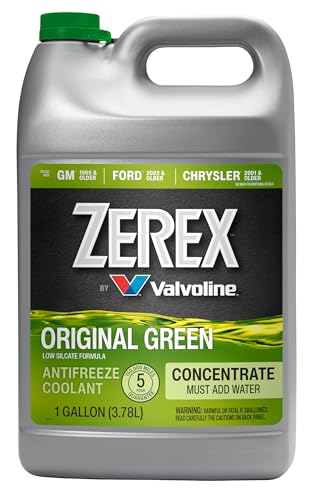
2. Zerex Original Green: Low Silicate Concentrate Antifreeze/Coolant, 1 Gallon
- Low-silicate green formula
- Protection down to -34°F, per the listing
- Helps prevent rust and corrosion
- Concentrate with a bittering agent
Zerex Original Green is a low-silicate concentrate sold in a one-gallon jug, and it carries the familiar green color that most older domestic cars left the factory with. The listing quotes freeze protection down to minus 34 degrees Fahrenheit and says the formula helps prevent rust and corrosion. Like most glycol coolants, it contains a bittering agent to discourage pets and children from drinking it.
One bullet on the Amazon listing also mentions a patented organic acid corrosion inhibitor package, which is unusual wording for a traditional green. If the exact chemistry matters for your restoration, read the back label in the listing photos or on the jug before you pour. The title and color make clear that it is aimed at cars that call for a low-silicate green, which is the main thing to match.
As a concentrate, it needs mixing with distilled water, and a 50/50 blend is the usual target for year-round use in Michigan. It suits a classic or older daily driver that gets regular use and a coolant change every couple of years. It is not intended for engines whose manual specifies an orange, yellow, pink or blue extended life coolant, and it should not be poured on top of one.
View Zerex Original Green on Amazon

3. Prestone AF3300 Prime Green: Silicate 50/50 Prediluted Antifreeze, 1 Gallon (Pack of 6)
- Conventional green, prediluted 50/50
- Demineralized water already blended in
- Meets or exceeds ASTM requirements
- Six one-gallon jugs in the pack
Prestone AF3300 is the prediluted version of the company’s Prime Conventional Green, sold here as a pack of six one-gallon jugs. Because it is already mixed 50/50, it goes straight into the radiator with no measuring. The listing notes that the water in the blend is demineralized, which avoids the hard water deposits and scale that tap water can leave in narrow radiator tubes.
The listing says it meets or exceeds ASTM requirements and protects all cooling system metals, including aluminum, for a minimum of one year. Prestone’s product page lists the AF3200 and AF3300 as a conventional low-silicate green, compatible with IAT coolant only, and rates it for 25,000 miles or two years in cars and light trucks. For heavy duty use, Prestone says supplemental coolant additives are required.
A six-pack is more than one car needs for a top-off, but it suits an owner with a garage full of older vehicles or a full drain and refill on a big-block with a large system. Premix is also handy to keep a jug in the trunk on the way to a show. It is not meant for an engine that already runs an extended life coolant.
View Prestone Prime Green 50/50 on Amazon
4. Prime Guard Original Green: Low Silicate Concentrate Antifreeze/Coolant, 1 Gallon

- Low-silicate green concentrate
- Freeze-up to -84°F, boil-over to +276°F (maximums)
- For cars, diesels and heavy equipment
- Contains a bitterant
Prime Guard Original Green is a low-silicate green concentrate in a one-gallon jug, positioned as one product for automobiles, diesel engines and heavy-duty equipment. The listing compares it to Prestone Prime AF3200, NAPA Green and PEAK Green, which tells you it is meant as a conventional green rather than an extended life coolant. It contains a bitterant, as most glycol coolants now do.
The listing quotes freeze-up protection to minus 84 degrees Fahrenheit and boil-over protection to 276 degrees. Those are maximum figures, and the protection you actually get depends on the ratio you mix and the pressure cap on your system, so a standard 50/50 blend gives less than the headline number. The listing also notes that heavy-duty use calls for a separate supplemental coolant additive.
For a classic car owner, this jug makes sense as an economical way to do a full flush and fill with conventional green, mixed with distilled water. The listing gives less detail on the inhibitor package than the PEAK or Prestone pages do, so it suits someone who simply wants a basic green to match what the car was built with. As with any green, change it on a two-year rhythm.
View Prime Guard Original Green on Amazon
5. Evans Collectors Choice: Waterless Engine Coolant, 1 Gallon with Analog Refractometer
- Waterless coolant for vintage and classic engines
- Boiling point above 375°F
- No phosphates, silicates, borates, amines or nitrite
- Refractometer included to check residual water
Evans Collectors Choice takes a different approach from the green coolants above: it contains no water at all. The listing says it is engineered for vintage and classic gasoline vehicles as well as light and medium duty diesels. It comes ready to use and needs no supplemental coolant additive, and this bundle pairs a gallon of the coolant with an analog refractometer for checking residual water.
Evans states a boiling point above 375 degrees Fahrenheit, so the coolant will not vaporize or boil over, and it runs at very low vapor pressure, which reduces strain on hoses, seals and the radiator. The formula contains no phosphates, silicates, borates, amines or nitrite. Those traits appeal to owners who worry about an old radiator under pressure or a car that runs hot in parade traffic.
The catch is the installation. The listing says every trace of water and old water-based coolant must come out before Evans goes in, and the refractometer exists to prove that it has. You cannot top it up with ordinary coolant or water afterwards, so it suits a committed owner of a stored or show car rather than someone who wants a quick swap.
View Evans Collectors Choice on Amazon
Which Jug Suits Your Old Car?
Use this table to narrow the choice, then match it to how often you drive the car and what is in the system today.
| Coolant | Type and form | Maker or listing note | Good fit |
|---|---|---|---|
| PEAK OET Green | Green IAT, concentrate | Older Chrysler, Ford and GM vehicles | Full refills on domestic classics |
| Zerex Original Green | Green low silicate, concentrate | Protection to -34°F on the listing | Drivers that see regular use |
| Prestone Prime Green 50/50 | Green IAT, premix, 6 gallons | Demineralized water already added | Owners with several old cars |
| Prime Guard Original Green | Green low silicate, concentrate | Compares itself to Prestone and PEAK green | Budget flush and fill |
| Evans Collectors Choice | Waterless, ready to use | Boiling point above 375°F | Stored and show cars |
For a typical weekend driver, the best coolant for classic cars is one of the green jugs, changed on schedule. Evans makes sense for a car that sits for long stretches, if you accept the more involved switch.

Laying Up a Classic for a West Michigan Winter
Many older cars here spend November to April in an unheated garage or a pole barn. That is exactly when weak coolant does its damage, because a mix diluted by summer top-ups with water can freeze and crack a block or split a radiator. Test the freeze point with a hydrometer or refractometer before you park it, and our article on the best antifreeze for winter and how to check your mix walks through the steps.
Spent inhibitors leave metal unprotected for months while the car sits, so fresh coolant before storage beats old coolant after it. If the two-year mark is close, do the change in the fall rather than the spring.

Road salt attacks the underside rather than the cooling system, and our guide to the best undercoating for classic cars covers protecting the floors and frame. Open the radiator cap only on a cold engine, since even an older low-pressure system can spray hot coolant.
Water Pumps, Heater Cores and When to Bring It In
A cooling system that keeps losing fluid is telling you something, and on an old car the usual suspects are hoses, the radiator, freeze plugs and the water pump seal. The warning signs of a failing pump are much the same on most engines, and our write-up on water pump failure symptoms to watch for covers drips, bearing noise and overheating.
Some later classics and many 1980s and 1990s engines run a timing belt, and on those the water pump often sits behind the timing cover. It makes sense to replace the pump while the belt is off, and our roundup of timing belt kit brands, including kits with a water pump shows what comes in the box.

If that job is due, our timing belt and chain replacement in Grand Rapids includes refilling the system with the coolant type your engine needs. A heater that blows lukewarm after a coolant change often points to trapped air or a clogged heater core, and our car heater repair service can track down the cause.
More Buying Guides
Frequently Asked Questions
Can I put extended life coolant in a classic car?
You can, but it is not what most older systems were designed for. Traditional green suits copper, brass and solder, and its makers list older vehicles by name. If you do switch, flush the old green out completely rather than mixing the two.
How often should coolant be changed in a car that sits most of the year?
Go by time, not miles. Prestone rates its conventional green for two years or 25,000 miles in cars and light trucks, and the inhibitors wear out even when the car is parked. A change every two years, ideally in the fall before storage, is a sound routine.
Is waterless coolant worth it for a vintage car?
It can be for a car that sits for long periods or runs hot in traffic. Evans Collectors Choice is aimed at vintage and classic gasoline engines and boils above 375°F. The catch is the install, since all water and old coolant must come out first, and you cannot top it up with ordinary coolant.
Can I mix different brands of green coolant?
Traditional green coolants built on the same low-silicate formula are generally compatible, and PEAK says its OET Green works with other green conventional coolants. Mixing green with orange, yellow or another extended life type is the combination to avoid.
Old car running warm, dripping green or blowing cold air from the heater? Call 456 AutoFix at 616-279-3832 on weekdays from 8am to 5pm, or set up a visit through our contact page.
If your classic only comes out on weekends, drive it over after closing and leave it with the after-hours drop-off at our 456 Carrier St NE shop in Grand Rapids.