
As an Amazon Associate, 456 AutoFix earns from qualifying purchases. Product links below go to Amazon, where you can check the torque range, drive size and included bits before you order.
A battery clamp nut, a ground strap bolt and a crankshaft sensor screw have one thing in common: the right tightness is small, and a big wrench overshoots it without you noticing. The best torque wrench for electrical work reads in inch-pounds or low newton-meters, so the spec lands in the middle of its scale instead of at the very bottom.
Below you will find why these fasteners need their own tool and six picks from battery hardware down to tiny connector screws. If you are still building your first kit, our list of car maintenance tools for beginners puts these in context.
Quick answer
Which torque tool suits battery terminals and sensor screws?
For battery clamps, ground straps and starter or alternator nuts, a 3/8 in. click wrench reading 30 to 200 in-lb, such as the CDI 2002MRMH, covers most specs. For sensor, connector and terminal screws, an adjustable torque screwdriver like the insulated Wiha 28789 or the Wera 7440/41/42 set works better.
Our Quick Picks
Three tools that cover battery hardware, terminal screws and small sensor fasteners; all six are reviewed below.

CDI 2002MRMH
Inch-pound click wrench for clamp nuts, grounds and cable studs.

Wiha 28789 Insulated Set
Insulated click screwdriver with slim blades for terminal screws.

Wera 7440/41/42 Set
Three-driver set that keeps tiny specs mid-scale.
Why Small Electrical Fasteners Need Their Own Torque Tool
Electrical hardware on a car is usually small, soft or both: lead or alloy battery clamps, sensors threaded into aluminum, plastic brackets with thin inserts. Too little clamping force leaves a joint that heats up and drops voltage, while too much splits a clamp, cracks a sensor body or strips a thread that is expensive to repair.
The specs reflect that. Many of these values are written in inch-pounds, and 12 in-lb equals just 1 ft-lb, so a typical lug nut wrench starting at 20 or 25 ft-lb cannot even reach them. To convert newton-meters, multiply by 8.85. Click tools are usually rated for accuracy only from 20 to 100 percent of scale, and exact values vary by vehicle, so check your service manual.
Wrench, Click Screwdriver or Slip Driver: Matching the Tool to the Job
An inch-pound click wrench takes standard sockets, which suits hex nuts and bolts such as battery clamp nuts, ground strap bolts and the main cable nut on a starter or alternator. Keep wheel work on a larger tool: our guide to a torque wrench for lug nuts covers that end of the range.
A torque screwdriver holds 1/4 in. hex bits and reads from a few inch-pounds up to about 50, which suits sensor screws, connector brackets, fuse box hardware and wiring block terminals. Click versions signal the setting and keep turning freely after, while slip or cam-over versions simply stop transferring force once the limit is reached.
Best Torque Wrench for Electrical Jobs: Six Picks in Detail
Two inch-pound click wrenches handle nuts and bolts, and four torque screwdrivers handle smaller screws. Ranges come from the maker or the Amazon listing, so compare them with your own vehicle’s specs.
1. CDI 2002MRMH: 3/8 in. Drive Click Torque Wrench, 30 to 200 in-lb
- 30 to 200 in-lb and 4.0 to 22.0 Nm scales
- Plus or minus 4% clockwise from 20% to 100%
- Serialized, NIST-traceable calibration certificate
- Made in the USA, ships in a blow-molded case
CDI makes torque tools for industrial and aviation buyers, and the 2002MRMH brings that approach to a range that fits a lot of under-hood electrical hardware. It is a 3/8 inch drive micrometer click wrench with dual scales reading 30 to 200 inch-pounds and 4.0 to 22.0 newton-meters, so you can set it straight from whichever unit your service information uses.
The listing states accuracy of plus or minus 4 percent clockwise and 6 percent counterclockwise, measured from 20 to 100 percent of full scale. Each wrench is serialized and comes with a matching calibration certificate traceable to NIST. The scales are laser marked, a spring-loaded pull-down ring locks the setting, a quick release button holds sockets securely, and the lightly knurled handle gives a firm grip. At about 10.15 inches long, it fits into most engine bays without much trouble.
That range suits battery clamp nuts, ground strap bolts and the cable nut on many starters and alternators, all of which take ordinary sockets. Because the accuracy band starts at 20 percent of the scale, values under about 40 inch-pounds are better handled by a torque screwdriver. The wrench is made in City of Industry, California, and is stored in a blow-molded case.
2. Capri Tools Industrial: 1/4 in. Drive Torque Wrench, 50 to 250 in-lb

- 50 to 250 in-lb and 5.7 to 28.2 Nm
- Engraved dual scales that will not wear off
- Plus or minus 3% clockwise, 6% counterclockwise
- All-steel body with knurled grip
Some battery trays and alternator mounts sit so deep that a 3/8 inch ratchet head will not swing, and this Capri Tools wrench answers that with a 1/4 inch drive. Its range runs from 50 to 250 inch-pounds, or 5.7 to 28.2 newton-meters, which reaches slightly higher than many inch-pound wrenches while keeping the smaller head and lighter sockets.
Capri lists accuracy of plus or minus 3 percent clockwise and 6 percent counterclockwise, and the wrench is calibrated in both directions. The dual scales are engraved rather than printed, so they will not fade with handling and cleaner. A positive-lock pull-down ring holds the chosen value, a quick release button frees the socket, and the body is all steel with a knurled handle. Capri describes the build as intended for daily industrial use.
Good targets include battery hold-down bolts, ground strap bolts on the body or engine, and alternator or starter fasteners where the spec sits in the upper inch-pound range. Since the scale begins at 50 inch-pounds, it is not the right choice for small sensor screws or terminal block screws. Pair it with a torque screwdriver if your work list covers both kinds of fastener.
View Capri Tools 50-250 in-lb Wrench on Amazon

3. Wiha 28789: Insulated TorqueVario-S Torque Screwdriver Set, 10 to 50 in-lb, 11 Pieces
- 10 to 50 in-lb adjustable handle
- Tested to 10,000 V AC, rated 1,000 V AC (VDE)
- 8 slim insulated blades, including Terminal Xeno
- Serial number and calibration certificate
Wiha built this kit for electricians who tighten breaker and terminal screws to a set value, and it carries over well to careful car wiring work. The core is an insulated TorqueVario-S handle adjustable from 10 to 50 inch-pounds, with a SlimLine blade holder, a torque adjustment tool and a canvas pouch that closes with a hook-and-loop strap.
Eight insulated blades are included: slotted 4 and 6.5 mm, Phillips 1 and 2, square 1 and 2, and Terminal Xeno 1 and 2. Each tool is tested to 10,000 volts AC, rated to 1,000 volts AC and meets VDE standards. According to Wiha’s product page for the 28789, the handle signals with an audible and perceptible click at plus or minus 6 percent, resets itself automatically, and is rated for 5,000 cycles or one year between checks.
The blade shafts are about a third narrower than standard, which helps them reach screws recessed inside a fuse box or terminal block. Every handle has a serial number and calibration certificate. The insulation is for low-voltage and panel safety; it does not make high-voltage hybrid or EV components a home job. It also takes no sockets.
View Wiha 28789 Insulated Set on Amazon
4. Klein Tools 57032: Torque Screwdriver Set, 5 to 40 in-lb, with Case

- 5 to 40 in-lb adjustable range
- Phillips, slotted and square bits plus 1/4 in. nut driver
- NIST-traceable calibration certificate
- Made in the USA, foam-lined blow-molded case
Klein Tools is a familiar name in electrical trades, and the 57032 is its compact answer for screws that need a specific tightness. The torque screwdriver adjusts from 5 to 40 inch-pounds, which reaches a little lower than many 10 to 50 inch-pound drivers and suits lighter screws that would be easy to overdo by hand.
The kit includes 3.5 inch power bits in Phillips 1 and 2, slotted 3/16 and 1/4 inch, and square 1 and 2, along with a 1/4 inch nut driver for small hex heads. The handle uses a tri-lobular shape with a textured finish for grip and comfort. Klein makes the set in the USA, supplies a NIST-traceable calibration certificate, and packs everything in a blow-molded case with foam inserts that keep each piece in its slot.
On a car, the set fits aftermarket wiring blocks, connector bracket screws and accessory terminal screws, and the nut driver handles small hex fasteners on brackets. Electricians will recognize the square bits from breaker and lug set screws. The bit selection does not include Torx, which many newer cars use on electrical hardware, so you may need to add those bits separately.
View Klein Tools 57032 on Amazon

5. Wera 7440/41/42: Torque Screwdriver Set, 0.3 to 6.0 Nm, 27 Pieces
- Three drivers: 0.3-1.2, 1.2-3.0 and 3.0-6.0 Nm
- Plus or minus 6% per DIN EN ISO 6789
- Rapidaptor quick-release bit holder
- 24 Torx, Torx Plus and Hex-Plus bits in a case
Many modern sensor and module specs are listed in newton-meters, often in single digits, and this Wera set is built around exactly that. Instead of one handle stretched across a wide range, it splits the work between three drivers covering 0.3 to 1.2, 1.2 to 3.0 and 3.0 to 6.0 newton-meters. That keeps a small value near the middle of a scale, where it reads most accurately.
Each driver gives an audible and tactile signal at the preset value, with plus or minus 6 percent accuracy to DIN EN ISO 6789. The 3.0 to 6.0 newton-meter driver uses a Kraftform pistol handle for more leverage at the top of the range. Bits snap into the Rapidaptor holder and release with a push of the sleeve, without disturbing the setting, and the 24 included bits cover Torx, Torx Plus and Hex-Plus profiles.
That mix suits sensor screws, connector bracket screws and module mounting hardware, much of which uses Torx heads on current vehicles. The upper limit of 6.0 newton-meters is roughly 53 inch-pounds, so battery clamp nuts and cable studs above that belong on a click wrench. It is a three-tool set, not a single compact driver.
View Wera 7440/41/42 Set on Amazon
6. Capri Tools CP21075: Torque Limiting Screwdriver Set, 10 to 50 in-lb
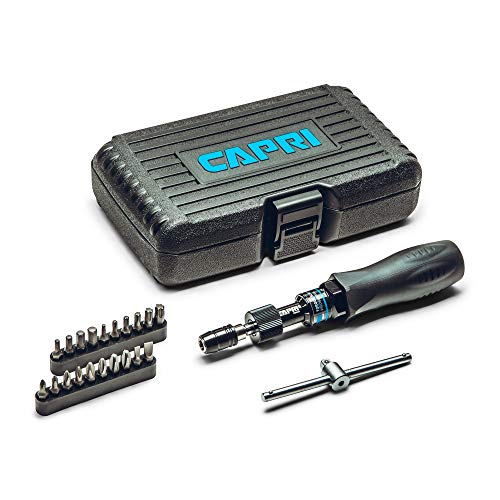
- 10 to 50 in-lb in 1 in-lb steps
- Slips at the set value to prevent overtightening
- Setting locks automatically after adjustment
- 20 bits, T-bar attachment and carry case
A torque limiting screwdriver works a little differently from a click type, and the Capri Tools CP21075 is a straightforward example. Once the handle reaches the value you set, it slips and stops passing force to the screw, so you cannot add more by turning harder. That makes it forgiving on plastic housings and soft threads that would suffer from even a small overshoot.
The range runs from 10 to 50 inch-pounds in 1 inch-pound steps, and the 1/4 inch female hex drive accepts standard bits. Capri states that the adjustment locks automatically after each setting, so the value does not drift while you work. The set includes 20 screwdriver bits and a T-bar attachment, all stored in a sturdy carry case that holds the driver as well.
This style suits jobs where many screws share one value, such as a row of terminal screws on a fuse or relay block, a sensor cover, or an accessory wiring panel. The slipping action also makes it a good pick for anyone new to torque tools. It is not a substitute for a socket wrench on battery clamp nuts or cable studs.
View Capri Tools CP21075 on Amazon
Matching the Range to the Fastener
Pick the tool whose range puts your common specs near mid-scale. The jobs below are typical examples; your car’s service information gives the actual values.
| Tool | Range and drive | Typical electrical jobs | Choose it when |
|---|---|---|---|
| CDI 2002MRMH | 30 to 200 in-lb, 3/8 in. square | Battery clamp nuts, ground straps, starter and alternator cable nuts | Your specs are nuts and bolts above about 40 in-lb |
| Capri Tools 50-250 in-lb | 50 to 250 in-lb, 1/4 in. square | Battery hold-downs, alternator and ground bolts in tight bays | You want a slim 1/4 in. head for crowded spaces |
| Wiha 28789 | 10 to 50 in-lb, insulated blades | Terminal blocks, breaker and panel lugs, fuse box screws | Electrical safety and slim blades matter most |
| Klein Tools 57032 | 5 to 40 in-lb, 1/4 in. bits | Wiring block screws, connector brackets, lug set screws | You want a compact kit with a calibration certificate |
| Wera 7440/41/42 | 0.3 to 6.0 Nm, three drivers | Small sensor screws, Torx connector hardware, module brackets | Specs are given in low newton-meters |
| Capri Tools CP21075 | 10 to 50 in-lb, slip type | Repeat screws at one setting, plastic housings | You prefer a driver that slips instead of clicking |
For most car owners, the best torque wrench for electrical tasks is really a pair: one inch-pound click wrench for nuts and one torque screwdriver for screws.

Salt, Corrosion and Cold Garages
West Michigan winters are hard on electrical joints. Road salt and slush mist work their way onto battery posts, ground strap ends and body grounds, and the white or green crust they leave raises resistance even when the hardware feels tight. On a corroded joint, thread friction eats much of the force, so the torque reading means little.

Clean the post, clamp and ground surfaces to bright metal before you tighten anything, and replace a clamp or strap end that has thinned or cracked. Torque values assume clean, dry threads unless the service information says otherwise. In an unheated January garage, plastic connector housings and sensor bodies also become brittle, so let the part warm up and go gently.
When the Problem Is Bigger Than a Loose Clamp
A properly torqued terminal cures many slow cranks and flickering lights, but not all. If a no-start, warning light or battery drain comes back after the connections are clean and tight, the fault may sit in a cable, a module or the charging system. Our car electrical repair service in Grand Rapids traces those faults, and Hendrick Hoffman holds ASE and State of Michigan certification in electrical work.

If your car is due for routine service, our factory scheduled maintenance in Grand Rapids follows the maker’s plan for your vehicle and is a good moment to check the electrical basics.
More Buying Guides
Frequently Asked Questions
What is the best torque wrench for electrical lugs and battery terminals?
For battery clamp nuts and cable lugs held by nuts or bolts, an inch-pound click wrench such as the CDI 2002MRMH fits most specs. For screw-type lugs in panels or terminal blocks, an insulated torque screwdriver like the Wiha 28789 is the better match.
Do I really need a torque tool for battery terminals?
It is not strictly required, but it removes guesswork. A loose clamp causes slow cranking and voltage drops, while an overtightened one can crack.
Can I use my lug nut torque wrench on sensor bolts?
Usually not. Most 1/2 in. wrenches start well above the inch-pound values small sensors use, and readings near the bottom of any scale are the least accurate. Use a low-range wrench or a torque screwdriver instead.
Are insulated torque screwdrivers necessary for car work?
Not for most 12 volt jobs, though they add protection if you work near a connected battery. They are designed for electricians working on energized panels. Hybrid and EV high-voltage systems need trained technicians and proper procedures, not just insulated tools.
Clamps tight but the car still cranks slowly on a cold morning? Phone 456 AutoFix at 616-279-3832 on weekdays from 8am to 5pm, or request an electrical check through our contact page.
Working hours not on your side? Bring the car by 456 Carrier St NE in Grand Rapids after closing and use our after-hours drop-off, then ring us during business hours to talk through the symptoms.