
As an Amazon Associate, 456 AutoFix earns from qualifying purchases. Product links below go to Amazon, where you can confirm the right part for your vehicle.
A dead battery, a dim headlight or a fuse that pops every week all start with one question: where is the voltage going? The best multimeter for automotive use answers that quickly and safely, without loading delicate computer circuits or blowing its own fuse the first time you check a parasitic draw.
Below we explain which functions matter on a car, then review six meters that range from a full automotive diagnostic unit to a simple tach-and-dwell meter for older engines. If your real goal is keeping a weak battery alive through the cold months, our roundup of the best car battery charger for winter pairs well with any meter here.
Quick answer
Which multimeter should I buy for working on cars?
Pick an auto-ranging meter with 10 megohm input impedance, a fused 10 A current range and Min/Max recording. The Fluke 88V adds pulse width and duty cycle for sensor and injector work, the Innova 3340 bundles an RPM clamp and temperature probe, and the Power Probe DM300AUTO reads current through fuses for drain hunting.
Our Quick Picks
Three quick picks: a full automotive meter for serious diagnosis, a budget automotive meter with an RPM clamp, and a car-focused meter that reads current through fuses. All six meters are reviewed below.

Fluke 88V
A dedicated automotive meter with the functions sensor and injector work calls for.
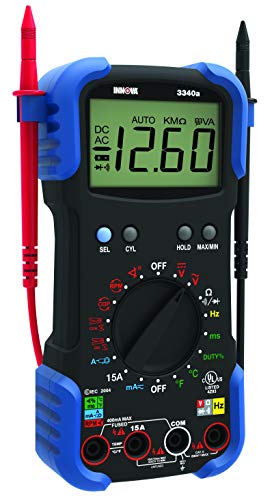
Innova 3340
An automotive meter that comes with the RPM and temperature accessories in the box.

Power Probe DM300AUTO
Reads current through a fuse in place, which speeds up parasitic draw checks.
What a Car-Ready Meter Has to Do
Car circuits run at 12 to 15 volts DC, so voltage range is rarely the limit. What matters is how the meter behaves around modules and sensors. Check these on any listing:
- High input impedance: 10 megohm or more, so the meter will not drag down a sensor signal.
- Auto-ranging: the meter picks the scale, which avoids misread decimals.
- A fused 10 A range: needed for parasitic draw tests.
- Min/Max recording: captures the lowest voltage during cranking.
- Duty cycle and frequency: useful for solenoids, some sensors and PWM-controlled fans.
- Good leads: thin tips that back-probe connectors.
Fluke’s own 88V product page makes the case for the 10 megohm point plainly: high input impedance won’t damage computer circuits. Treat that number as a baseline rather than a bonus feature.
Automotive Functions Versus a General Meter
A general electrician’s meter handles battery, charging, continuity and voltage drop checks, which covers most home mechanic work.
Automotive meters add engine functions: pulse width for injectors, an inductive clamp for RPM, dwell for points ignition and a thermocouple for temperature. If you chase sensor faults, those extras earn their place; for batteries and fuses, a quality general meter is enough.
Best Multimeter for Automotive Use: Six Meters Reviewed
The meters below run from a full diagnostic unit to a basic engine meter. Function lists come from each Amazon listing and, where noted, the maker’s own page.
1. Fluke 88V Deluxe: Automotive Multimeter with Pulse Width and Duty Cycle
- Pulse width, duty cycle and Min/Max/Avg recording
- 10 megohm input impedance for computer circuits
- Large display with bright backlight
- Built for conventional and hybrid vehicles
The Fluke 88V Deluxe is a meter designed around car work rather than house wiring. The listing describes measurement functions and accuracy aimed at conventional and hybrid vehicles, plus pulse width, duty cycle and Min/Max/Avg recording. Fluke’s product page adds voltage to 1000 V, current to 10 A continuous or 20 A for up to 30 seconds, and frequency to 200 kHz.
Pulse width is the function that sets it apart. It reads fuel injector on-time in milliseconds, and duty cycle shows how hard a solenoid or control valve is being driven. Min/Max/Avg recording catches a brief voltage dip while you wiggle a harness or crank the engine, which is how many intermittent faults show themselves. The 10 megohm input impedance keeps the meter from loading sensitive computer circuits, and an optional inductive pickup adds RPM.
This meter suits a home mechanic who reads wiring diagrams and wants to measure signals, not just battery voltage. Its CAT ratings on Fluke’s page cover high-energy circuits, but that does not make hybrid high-voltage work a DIY job. If you only check batteries and fuses a few times a year, a simpler meter covers that, and the Deluxe kit contents are worth confirming on the listing.
2. Innova 3340: Auto-Ranging Automotive Multimeter with RPM Clamp and Temperature Probe
- Tests alternator diodes, duty cycle and solenoids
- Auto-ranging with auto shut-off and overload protection
- 10 megohm input impedance, up to 15 A
- Includes temperature probe, inductive RPM clamp and case
The Innova 3340 is an automotive meter from a brand best known for code readers. The listing describes it as built to pinpoint engine problems, with tests for alternator diodes, duty cycle, solenoids, breaker points, wiring and switches. It is auto-ranging, shuts itself off, has overload protection and measures up to 15 amps for device testing.
What stands out is the kit. The box includes an inductive RPM clamp, a temperature probe and a carrying case, so you can read engine speed, check coolant or exhaust temperature and test circuits without buying extras. The 10 megohm input impedance is the listing’s answer to the common worry about damaging a vehicle’s computer when probing sensor circuits, and the diode test helps when a charging fault points to the alternator rectifier.
This suits a home mechanic who wants proper car functions for battery, charging, sensor and older ignition work. The breaker point and dwell style tests also help owners of older vehicles. It is not a meter for household mains work, since the listing focuses on automotive use, and it does not record fast signal changes like a higher-end meter. Read the manual’s fuse and current limits before running an amp draw test.
3. Power Probe DM300AUTO: Automotive Test Meter with Fuse Current Reading and Guided Tests
- Reads current through fuses, up to 80 A, without pulling them
- Fuse voltage drop testing
- Guided cranking voltage and charging tests
- 1000 V AC/DC and up to 30 A current
The Power Probe DM300AUTO is a car-focused meter from a company known for circuit testers. The listing highlights a feature most meters lack: it measures current flowing through a fuse without removing it, up to 80 amps. It also lists fuse voltage drop testing, AC and DC voltage to 1000 V, and direct current measurements up to 30 A.
Reading current at the fuse is useful when a battery goes flat overnight. Instead of breaking the circuit at the battery and pulling fuses one at a time, you can look for the circuit that is still drawing power with the modules left undisturbed. Power Probe’s announcement adds True RMS readings, automatic AC/DC voltage detection and a color display with adjustable brightness. The guided cranking voltage and alternator charging tests walk newer users through two checks they will use most.
This suits a DIYer or tech who spends more time on drains, charging complaints and fuse-level diagnosis than on injector timing. The guided tests help when you are unsure what a normal reading looks like. It is newer than the long-running meters here, so check the current listing for included leads and accessories, and follow the manual’s limits for the fuse current function.
View Power Probe DM300AUTO on Amazon
4. Fluke 115: True-RMS Digital Multimeter with Backlit Display and CAT III 600 V Rating

- True-RMS readings
- Large white LED backlit display
- Min/Max recording for fluctuating signals
- CAT III 600 V safety rating
The Fluke 115 is a compact general-purpose meter rather than a dedicated automotive model. The listing describes True-RMS readings, a large white backlit display, resistance and continuity, and Min/Max recording to follow fluctuating signals. Its inputs are protected to CAT III 600 V, and it is listed with UL, CSA, TÜV and VDE.
For car work, the 115 covers what most owners actually do: resting and running battery voltage, voltage drop across cables and grounds, continuity on a wire you suspect is broken and resistance on a sensor or heater element. The Min/Max function helps catch a sag in voltage while someone cranks the engine. The bright backlight is useful under a dash or in a dim corner of a garage, and the battery comes installed.
This is a good fit if you want one meter for the car and for household electrical checks. It lacks automotive extras like an RPM clamp, pulse width and a dedicated temperature function, so it is less useful for engine sensor timing. If you want to go deeper into injector and ignition testing, the dedicated automotive meters above are a closer match.

5. Klein Tools MM450: Slim Auto-Ranging TRMS Multimeter with Lead-Alert and Duty Cycle

- 600 V AC/DC, 10 A current, 50 megohm resistance
- Frequency, duty cycle, temperature and capacitance
- Lead-alert LEDs show the correct jack
- Slim body rated for a 6.6 ft drop
The Klein Tools MM450 is a slim, auto-ranging True RMS meter that names automotive work among its uses. The listing covers AC and DC voltage to 600 V, 10 A current and 50 megohm resistance, plus continuity, temperature, capacitance, frequency, duty cycle and diode tests. The box includes a carrying case, test leads with CAT III/CAT IV safety caps, a thermocouple and batteries.
Two features help on cars. The lead-alert LEDs light up to show which jacks the leads belong in, which reduces the classic mistake of probing a battery with the leads still in the amps jack and blowing the meter fuse. Duty cycle and frequency let you look at some sensor and solenoid signals, and the thermocouple reads temperature. The reverse-contrast display stays readable in bright light or in a shaded engine bay.
This meter suits someone who wants a compact, rugged unit that rides in a toolbox or glovebox and still covers battery, charging, continuity and basic signal checks. The listing states a 6.6 foot drop rating. It does not include an RPM pickup or pulse width function, so injector and ignition timing work is better served by the 88V or the Innova 3340.
View Klein Tools MM450 on Amazon
6. Performance Tool W2972: Digital Automotive Multimeter with Tach and Dwell Settings

- Tests starting and charging systems
- Tach and dwell settings for engine work
- Extra-large LCD display
- UL-listed 42 inch test leads
The Performance Tool W2972 is a straightforward automotive meter aimed at basic engine and electrical checks. The listing says it tests starting and charging systems and includes tach and dwell settings, with an extra-large LCD, UL-listed 42 inch leads and overload protection. It uses a 0.5 A, 250 V, 5×20 mm fuse, which is worth noting so you can keep a spare.
Tach and dwell are the functions that make this meter relevant to older cars. Dwell is how long breaker points stay closed, and it matters for engines with points ignition that still need periodic adjustment. The tach setting lets you set idle speed on a carbureted engine. The long leads reach from the battery to the driver’s seat, which helps when you want to watch voltage while someone cranks.
This suits a classic car owner or a beginner who mainly checks batteries, charging and older ignition systems. The listing does not mention auto-ranging, True RMS, duty cycle or high-impedance input, so confirm those on Amazon before using it on modern computer-controlled circuits. For late-model sensors and injectors, one of the higher-end meters above is the safer choice.
View Performance Tool W2972 on Amazon
Which Meter Fits Which Job
Start from the job you do most often, then match it to a row.
| Meter | Car-specific extras | Current range | Strongest for |
|---|---|---|---|
| Fluke 88V | Pulse width, duty cycle, Min/Max/Avg | 10 A, 20 A for 30 s | Sensor and injector diagnosis |
| Innova 3340 | RPM clamp, temperature probe, duty cycle | Up to 15 A | All-round DIY engine work |
| Power Probe DM300AUTO | Fuse current reading, guided tests | 30 A direct, 80 A via fuse | Parasitic draw and charging |
| Fluke 115 | Min/Max | Check listing | Car and household checks |
| Klein Tools MM450 | Duty cycle, temperature, lead-alert | 10 A | Compact toolbox meter |
| Performance Tool W2972 | Tach and dwell | Check listing | Older points-ignition engines |
For most owners, the best multimeter for automotive use is the one whose extras match the faults they actually chase.
Three Tests Worth Learning First
Battery and charging. With the engine off and the car rested for a few hours, a healthy 12 V battery typically reads about 12.6 V. Running, most charging systems hold roughly 13.5 to 14.5 V, though some newer vehicles vary the target. A low running voltage points toward the charging side, and our guide to bad alternator symptoms covers what comes next.
Voltage drop. Put one lead on the battery post and the other on the far end of a cable, then switch on the load. More than a few tenths of a volt usually means a corroded or loose connection. West Michigan road salt eats at grounds and terminals, so this test often explains slow winter cranking.
Parasitic draw. Connect the meter in series between the negative post and cable, lock the doors and wait for the modules to sleep before reading. Never crank with the meter in series, or its fuse can blow. If the battery still dies overnight, our article on why a car battery dies overnight walks through the usual suspects.
A meter also shines when a fuse keeps failing. Checking resistance to ground on the circuit, with the fuse out, helps tell a shorted wire from an overloaded accessory; our guide on what to do when a car fuse keeps blowing explains the steps.
Safety Limits and When to Hand It Over
CAT ratings describe how well a meter withstands voltage spikes, and several meters here list CAT III or CAT IV ratings. Those ratings do not make hybrid or EV high-voltage systems a home project. Never probe the orange high-voltage cables, battery packs or inverters.

Check that the leads sit in the right jacks before every test, and carry a spare fuse of the exact rating. Power Probe’s DM300AUTO announcement notes automatic AC/DC voltage detection, one example of a meter helping prevent input mistakes.
Even the best multimeter for automotive use only shows numbers; reading a wiring diagram and knowing what is normal for your vehicle is the harder part. When a drain, short or charging fault won’t show itself, our car electrical repair in Grand Rapids covers circuit tracing, drain testing and charging checks on foreign and domestic vehicles.
More Buying Guides
Frequently Asked Questions
Do I need an automotive multimeter, or will any multimeter work?
Any decent auto-ranging meter with high input impedance and a fused 10 A range handles battery, charging, continuity and voltage drop tests. Automotive models add pulse width, RPM, dwell or temperature, which matter mainly for engine sensor and ignition work.
What voltage should a car battery show on a multimeter?
A rested, fully charged 12 V battery typically reads around 12.6 V with the engine off. With the engine running, most charging systems show roughly 13.5 to 14.5 V, but some newer vehicles vary this, so check your service information.
Why did my multimeter stop reading amps?
The current input fuse has most likely blown, often from cranking or switching on a load with the meter in series. Replace it with the exact fuse rating listed in the manual, never a higher one.
Can I use a multimeter on a hybrid or electric car?
You can test the ordinary 12 V system the same way as on any car. Leave the orange high-voltage cables, battery pack and inverter alone; that work needs insulated equipment, training and the maker’s safety procedure.
Got a battery that drains for no clear reason, or a circuit your meter can’t make sense of? Call 456 AutoFix at 616-279-3832, Monday to Friday 8am to 5pm, or request an electrical check through our contact page.
If daytime hours don’t work for you, bring the vehicle by after closing and use our after-hours drop-off at 456 Carrier St NE, Grand Rapids, with a short note on when the electrical trouble shows up.