As an Amazon Associate, 456 AutoFix earns from qualifying purchases. Product links below go to Amazon, where you can confirm the right part for your vehicle.
The best brake bleeder for DIY work is the one that lets you finish the job alone, without a helper pumping the pedal on command. Which tool that is depends on three things: whether you own an air compressor, what kind of reservoir cap your car has, and whether you are topping up after a pad job or replacing every drop of old fluid.
Below we explain how bottle, vacuum, pressure and reverse bleeders work, what to check before you order, and six tools from established makers that suit a home garage. If you are still weighing up the full range of shop and home kits, our earlier guide to the brake bleeder kits we compared by method covers the larger professional units too.
Quick answer
Which brake bleeder works for one person in a home garage?
Without a compressor, a hand vacuum kit such as the Orion Motor Tech one-man kit or a Motive Power Bleeder with the right cap adapter does the job. With shop air, the Mityvac MV6830 speeds up full flushes. A check valve bottle like the Phoenix 7002-B suits occasional single-corner bleeds.
Our Quick Picks
Three bleeders that cover pressure, hand vacuum and air-powered work. All six tools are reviewed below.

Motive Products 0108
Pressurizes the reservoir so each bleeder simply drains.

OMT One-Man Brake Bleeding Kit
Pulls fluid out at each wheel with no air line or special cap.

Mityvac MV6830
Shop-air vacuum bleeder for full, fast flushes.
Four Ways to Bleed Brakes Without a Helper
Every bleeder moves fresh fluid out through each bleeder screw until no air or dark fluid remains. Only the source of the push or pull differs. The Car Care Council’s brake system overview explains how pedal force becomes hydraulic pressure in the lines, which is why a single bubble left in a caliper can make the pedal feel soft.
- Check valve bottle: you open the bleeder, pump the pedal yourself, and a one-way valve stops air from being drawn back in. Cheap and simple, but slow.
- Vacuum: a hand or air-powered pump pulls fluid out at the wheel. Fast and tidy, though air can sneak in around the bleeder threads and show up as bubbles in the hose.
- Pressure: a tank pressurizes the reservoir through a cap adapter and pushes fluid out of each bleeder. Steady and quick, and it never lets the reservoir run dry.
- Reverse: fluid is pushed in at the caliper and travels upward, so air rises with it toward the reservoir. Handy when a system has been run dry.
What to Check Before You Order a Bleeder
Start with your air supply. Pneumatic vacuum bleeders need a compressor that can keep up, and a small pancake unit may cycle constantly. Hand pumps and pressure tanks with a built-in pump work anywhere, including a driveway with no power outlet.
Next, look at your reservoir cap. Pressure bleeders seal on with an adapter matched to the cap style, so European, GM and Ford caps each need their own part. Confirm the adapter against your year, model and engine on the Amazon listing before you buy.
Finally, match the tool to the job. A full flush moves far more fluid than a one-corner bleed after a caliper swap, so the best brake bleeder for DIY flushes has a larger catch reservoir.
The Best Brake Bleeder for DIY Use: Six Tools Reviewed
Features below come from each maker or the Amazon listing, not from testing of our own. They run from a pocket-sized bottle to an air-powered unit, so pick the one that matches the equipment already in your garage.
1. Motive Products 0108 Power Bleeder: 2-Quart Pressure Tank with GM Three-Prong Cap Adapter
- 2-quart tank with built-in hand pump
- Precision pressure gauge on the lid
- 1108 three-prong twist cap adapter
- Made in the U.S.A.
The Motive Products 0108 is a pressure bleeder kit set up for General Motors vehicles. It pairs Motive’s 2-quart tank with the 1108 three-prong twist adapter, which the listing says suits most GM models from 1992 onward. Cap designs still vary, so confirm your year, model and engine on the Amazon listing before you order, and look at Motive’s other kits if your car uses a different reservoir cap.
Using it is straightforward. You pour fresh fluid into the tank, lock the adapter onto the master cylinder reservoir, then build pressure with the hand pump while watching the gauge. With the system pressurized, you walk from wheel to wheel opening each bleeder until clear fluid runs into your catch bottle, and nobody has to sit in the driver’s seat pumping the pedal.
Because pressure pushes fluid out instead of pulling it, air is not drawn in around loose bleeder threads, and the reservoir cannot run dry mid-job while the tank still holds fluid. No compressor or outlet is needed, which suits a driveway or a cold garage. The kit is tied to one cap style, so drivers who work on several brands may prefer a universal vacuum tool.
View Motive Products 0108 on Amazon
2. Orion Motor Tech One-Man Brake Bleeding Kit: Aluminum Hand Vacuum Pump with Dial Gauge
- Anodized aluminum hand pump
- Dial vacuum gauge
- Silicone tubing with clamps
- Blow-molded storage case
The Orion Motor Tech one-man kit is a hand vacuum bleeder built around an anodized aluminum pump with a dial gauge. Aluminum keeps the pump light and resists corrosion, which matters for a tool that may sit in a damp garage between jobs. You fit the hose to the bleeder screw, open it a fraction and squeeze the handle until fresh fluid without bubbles fills the clear line.
Orion lists silicone tubing rather than plain vinyl, chosen for better flexibility, heat resistance and sealing, and the barbed pump nozzle and included clamps hold the tubes firmly so the vacuum does not leak away at the joints. The adapter set is meant to fit nearly any vehicle’s brake or clutch bleeder, so the kit is not tied to one make or reservoir cap. Everything packs into a blow-molded case for storage.
The pump also pulls oil and power steering fluid and can test vacuum systems, so it keeps earning its place between brake jobs. As with any hand vacuum method, a full four-wheel flush takes steady pumping, and air can slip past loose bleeder threads and look like bubbles in the line. It suits owners who want one universal tool without buying a compressor.
View OMT One-Man Brake Bleeding Kit on Amazon
3. Performance Tool W87030: Hand Vacuum Pump Brake Bleeder Kit with Inch-Hg Gauge

- Holds up to 25 inHg of vacuum
- About 1 cubic inch per stroke
- Gauge reads in inches of mercury
- Bleeding and diagnostic accessories
The Performance Tool W87030 is a complete hand vacuum kit aimed at one-person brake bleeding and basic system testing. The pump develops and holds up to 25 inches of mercury and moves roughly one cubic inch of fluid per stroke, according to the listing. A gauge marked in inches of mercury lets you see whether a line or component is holding vacuum, which also helps when you are chasing a leak.
For bleeding, the kit adds bleeding accessories to the pump so you can draw fluid from a caliper or wheel cylinder. You fit the hose to the bleeder screw, open it slightly and squeeze the handle until clear fluid without bubbles appears. It works on any vehicle, needs no compressor and packs into a small space, which makes it a sensible first purchase for someone just learning brake work.
The trade-off is pace. Hand pumping a full flush on four wheels takes time and some grip strength, and you will empty the reservoir often. The diagnostic accessories also make it useful on non-brake jobs, such as testing a vacuum-operated actuator, so it earns a place in a toolbox even between brake services.
View Performance Tool W87030 on Amazon
4. Mityvac MV6830: Air-Operated Vacuum Brake Bleeder with 1.9-Quart Reservoir
- 1.9-quart (1.8 L) reservoir
- Moves about 2 quarts per minute
- Automatic shutoff valve
- Variable thumb throttle, swivel air inlet
The Mityvac MV6830 is a pneumatic vacuum bleeder for home mechanics who already own an air compressor. It runs on shop air, so you hold the tool at the bleeder screw and squeeze a variable thumb throttle instead of working a hand pump. Mityvac lists a flow of about 2 quarts per minute and a 1.9-quart, or 1.8 liter, reservoir.
That reservoir is large enough to hold the old fluid from a full flush on most cars without stopping to empty it. An automatic shutoff valve prevents the tank from overfilling, and a 360-degree swivel air inlet keeps the air hose from twisting as you move around the car or reach into a tight wheel well. The listing also covers clutch systems, motorcycles and ATVs.
The catch is the air supply. A small compressor may struggle to keep up and run constantly, so check its output before relying on it for this tool. Like any vacuum bleeder, it can pull air past loose bleeder threads, which shows up as bubbles that are not really in the lines. Owners without a compressor are better served by a hand pump or a pressure tank.

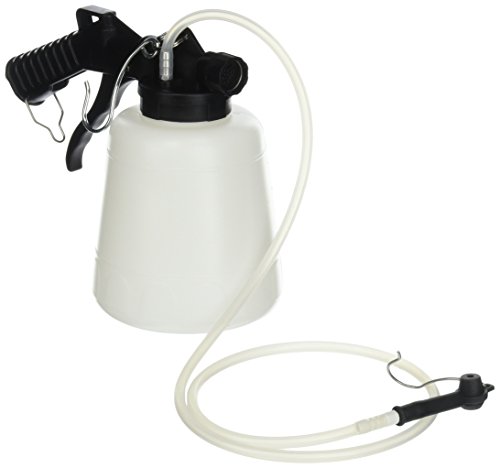
5. Titan 51885: 1-Liter Air-Powered Vacuum Brake Fluid Bleeder with Locking Trigger
- 1-liter catch reservoir
- Runs on standard workshop air
- Universal rubber bleeder fitting
- Hanging hook and locking trigger
The Titan 51885 is a compact air-powered vacuum bleeder with a 1-liter reservoir for old fluid. It runs on a standard workshop air supply, so it suits a home garage that already has a compressor and air hose. A universal rubber fitting presses onto the bleeder screw and holds there, which means you do not need a drawer of adapters for different calipers.
Two details make it easier to use alone. A hanging hook lets you suspend the bleeder from the suspension or a wheel-well edge, and a locking trigger keeps the vacuum running without your hand on it. That leaves you free to watch the transparent drain hose, where you can see the old fluid change to clean fluid and spot any bubbles as they pass, and to keep an eye on the reservoir level.
A 1-liter reservoir is roughly the amount a full flush on a typical car moves, so you may need to empty it once on larger systems. Like other vacuum tools, it can draw air in around loose bleeder threads, so judge bubbles with care. If your garage has no compressor, one of the hand-powered tools above is the practical route.
6. Phoenix Systems 7002-B: 12-Ounce One-Man Brake Bleeder Bottle with Check Valve and Magnet

- 12 oz capture bottle
- One-way check valve in the line
- 20 lb magnet and lanyard
- Made in the USA
The Phoenix Systems 7002-B is the plainest way to bleed brakes alone: a 12-ounce capture bottle with tubing, bleeder fittings and a one-way check valve. You push the hose onto the bleeder screw, crack it open and pump the brake pedal yourself. The check valve stops fluid and air from being sucked back into the caliper on the pedal’s return stroke, so you do not need a partner to close the screw at the right moment.
A 20-pound magnet and a lanyard let you hang the bottle upright on a strut, spring or other metal surface near the wheel. The lid has a two-way valve that lets displaced air escape as the bottle fills. Phoenix makes the bottle in the USA and also sells it as a replacement part for its bleeder kits, so check that the listing you choose includes the tubing and quick-coupler cap.
Since your own foot does the work, this bottle suits bleeding one or two corners after replacing a caliper or hose rather than a full flush. It needs no power and takes up very little drawer space. Expect several trips between the pedal and the wheel, and keep checking the reservoir so it never runs low.
View Phoenix Systems 7002-B on Amazon
Matching the Bleeder to Your Garage Setup
This table lines up the six tools by method and by what each one needs from you before the first bleeder screw is opened.
| Tool | Method | Power source | Suits |
|---|---|---|---|
| Motive Products 0108 | Pressure | Built-in hand pump | GM vehicles with the three-prong cap |
| Orion Motor Tech one-man kit | Vacuum | Hand pump | Any make, bleeds plus vacuum testing |
| Performance Tool W87030 | Vacuum | Hand pump | First kit for a home toolbox |
| Mityvac MV6830 | Vacuum | Air compressor | Frequent full flushes |
| Titan 51885 | Vacuum | Air compressor | Hands-free bleeds with a locking trigger |
| Phoenix Systems 7002-B | Check valve bottle | Your foot on the pedal | Quick single-corner bleeds |
If you have no compressor and drive more than one make of car, one of the two hand vacuum kits is the flexible choice. If one GM vehicle is the main patient, the Motive tank offers the most hands-off flush of the group.

Fluid type matters as much as the tool. Use the grade printed on your reservoir cap or in the owner’s manual; the federal FMVSS No. 116 brake fluid standard sets the boiling point and other limits for DOT 3, DOT 4 and DOT 5.1. Never mix silicone DOT 5 into a system built for glycol fluid.
Bleeding Brakes After a Michigan Winter
Glycol brake fluid absorbs moisture from the air, and humid West Michigan summers followed by months of slush give it plenty of chances. Our guide on how often to change brake fluid covers typical intervals, though your owner’s manual has the final word.
Road salt is the other enemy. Bleeder screws that have sat under brine for years can seize or snap, so soak them with penetrating oil the day before and use a six-point flare wrench, not an open-end one. If a screw rounds off, stop there rather than forcing it.
Bleed the corner farthest from the master cylinder first unless your service manual says otherwise, and support the car on rated stands. If you are fitting new pads at the same time, our guide to brake pads for daily driving helps you pick a compound that suits commuting.
Signs the Job Needs a Brake Shop
A pedal that stays soft after a careful bleed, or one that sinks slowly while you hold it, points to a leak, a failing master cylinder or air trapped in the ABS unit. If the pedal drops sharply, read our article on why a brake pedal goes to the floor and do not drive the car.

Some ABS units also need a scan tool to cycle their valves during a bleed, and fluid on the inside of a tire or a damp brake hose means a part has failed. Our brake repair team in Grand Rapids can flush the system, find the leak and check the pads and rotors while the wheels are off.
More Buying Guides
Frequently Asked Questions
What is the best brake bleeder for DIY use without a compressor?
A hand vacuum kit such as the Orion Motor Tech one-man kit or the Performance Tool W87030, or a Motive Power Bleeder with its built-in hand pump. None of them needs shop air.
Why do I see bubbles in the hose when vacuum bleeding?
Often the vacuum draws air in around the loosened bleeder screw threads rather than out of the brake lines. Wrapping the threads with thread tape or a little grease, as many techs do, helps you tell real air from false bubbles.
Will a pressure bleeder fit any car?
Only with the right reservoir cap adapter. Motive sells separate kits and adapters for different cap styles, so confirm your year, model and engine on the listing before you order.
How much brake fluid do I need for a full flush?
Most cars and small SUVs use roughly a liter, but systems vary. Buy a sealed bottle of the grade your owner’s manual lists and keep a spare on hand so the reservoir never runs dry.
Pedal still soft after a bleed, or a bleeder screw that refuses to turn? Ring 456 AutoFix on 616-279-3832 between 8am and 5pm, Monday to Friday, or set up a brake visit using our contact form.
Busy during the workday? Our after-hours drop-off means you can leave the car at 456 Carrier St NE, Grand Rapids, whenever it suits you, and we will phone once we know what it needs.