
As an Amazon Associate, 456 AutoFix earns from qualifying purchases. Product links below go to Amazon, where you can confirm the right part for your vehicle.
Ask most drivers about Lucas and they picture the thick honey-colored Oil Stabilizer on the parts store shelf. Ask about Liqui Moly and they think of German oil in tall cans. A liqui moly vs lucas search usually comes from someone who wants a straight answer on the motor oil itself, so that is what this page compares.
Both companies sell full synthetic motor oil on Amazon US, so we leave the additives aside and set one grade for both: 5W-50. It is an uncommon grade with a clear reference car, the Ford Mustang Shelby GT350, which makes the spec question easy to test. For a wider look at everyday synthetics, see our synthetic oil roundup.
Quick answer
Should a 5W-50 engine get Liqui Moly or Lucas?
If your manual names Ford spec WSS-M2C931-C, as on a Shelby GT350 or Boss 302, Lucas Synthetic 5W-50 is the one of the two that lists it, along with API SP. Liqui Moly Molygen New Generation 5W-50 lists only API SN, so it suits engines that just ask for a 5W-50 meeting that category.
Our Quick Picks
One 5W-50 full synthetic from each brand, plus Lucas Synthetic 20W-50 as a closely related third pick from the same Lucas line for engines that call for the heavier grade. All three are reviewed below.

Lucas Synthetic 5W-50
Performance 5W-50 that lists the Ford spec special Mustangs call for.

Liqui Moly Molygen 5W-50
Low-friction German synthetic with a distinctive green tint.
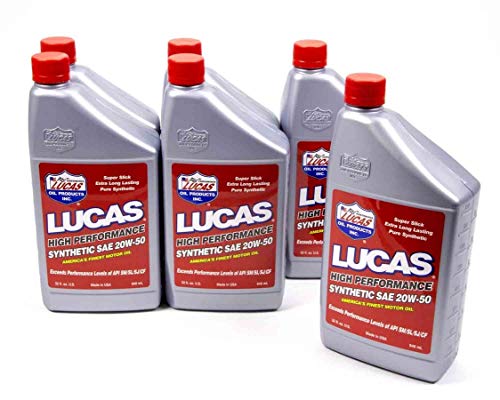
Lucas Synthetic 20W-50
Same Lucas synthetic line in a thicker grade for older engines.
Why a 5W-50 and a Mustang Make a Fair Test
Comparing two brands across different grades proves nothing, because a thicker oil and a thinner oil are built for different engines. Our other Liqui Moly matchups already covered 0W-20, 5W-20, 5W-30 and 5W-40. Lucas and Liqui Moly both sell a 5W-50 full synthetic, and few comparison pages look at that grade at all.
5W-50 shows up mainly in performance engines that run hot and spin high. Ford calls for it in several special Mustangs, including the Shelby GT350 and the Boss 302, and Lucas names those cars on its 5W-50 data sheet. Some European sports cars and track-built engines also use the grade. If your owner’s manual lists 5W-20 or 5W-30, stop here: a 50-weight oil is not an upgrade for that engine.
Two very different companies
Lucas Oil Products is an Indiana company mostly known for its additives, but it also blends a full line of API-licensed passenger car oils. Liqui Moly is a German maker of oils, additives and workshop chemicals, and its Molygen family is built around a friction-reducing formula it calls MFC. Neither name on the bottle matters as much as the spec printed on the back.
Oil Stabilizer Is Not Motor Oil
Plenty of shoppers who type liqui moly vs lucas oil really mean the additives. Lucas Oil Stabilizer is a thick supplement poured in with fresh oil, and Liqui Moly sells its own additives such as Cera Tec. This article compares complete motor oils only, the product that fills the crankcase on its own.
A modern synthetic already carries a full additive package, balanced to pass the tests on its label. Adding a supplement changes that balance, and a carmaker spec only covers the oil as sold. On an engine under warranty, run the correct oil straight and skip the bottle of extras.
Liqui Moly vs Lucas 5W-50 by the published numbers
The Lucas column comes from its Synthetic Motor Oils product page and the 5W-50 data sheet linked there. The Liqui Moly column comes from the maker’s Molygen New Generation 5W-50 page and the Amazon listing.
| Point | Lucas Synthetic 5W-50 | Liqui Moly Molygen New Generation 5W-50 |
|---|---|---|
| Base | Fully synthetic | Fully synthetic with MFC additive technology |
| API category stated | Meets API SP, SN, SM and SL | API SN |
| Ford 5W-50 spec | Lists WSS-M2C931-C | Not listed |
| Size on Amazon | Six 1 quart bottles (part 10101) | 5 liter canister (SKU 20310), about 5.3 quarts |
| Maker’s target | High RPM performance engines, named Mustangs, Hemi and LS engines | Asian and American engines needing a current-spec oil |
The biggest gap is paperwork rather than chemistry. Lucas spells out the Ford number that special Mustangs ask for, while Liqui Moly stops at an older API category. That does not make Molygen a poor oil, but it narrows where it belongs.
Liqui Moly vs Lucas in 5W-50: Each Bottle Reviewed
Below are the two 5W-50 oils, plus the 20W-50 from the same Lucas synthetic line for older or hot-running engines whose manual calls for the heavier grade.
Lucas Oil Synthetic SAE 5W-50: Full Synthetic Performance Motor Oil, 1 Quart 6-Pack
- Full synthetic 5W-50, six 1 quart bottles (part 10101)
- Maker states API SP and Ford WSS-M2C931-C
- Named for Shelby GT350, GT500 and Boss 302
- Formulated to resist foaming and fuel dilution
This is the Lucas Oil full synthetic 5W-50, sold here as a case of six 1 quart bottles under part number 10101. Lucas describes it as a race-proven oil that is also suitable for road use, with the cold flow of a 5W grade and the hot film thickness of a 50-weight. The company says the extra film helps hold oil pressure in high-performance engines at high temperatures.
The data sheet says the oil meets the engine test requirements for API SP and meets or exceeds API SN, SM and SL as well as Ford WSS-M2C931-C, the 5W-50 spec used on special Mustangs. Lucas names the Shelby GT350, GT500 and Boss 302, plus modern Hemi and LS engines with power adders, as main applications. It adds boosted anti-wear and detergent additives and a formula meant to resist foaming and fuel dilution.
Quart bottles make it simple to buy the exact count your engine needs and keep one spare for top-ups after a track day. Lucas states it blends with other conventional and semi-synthetic oils. A maker statement is not a Ford license, so compare the number with your manual. It is not meant for engines that specify a thinner grade.
View Lucas Synthetic 5W-50 on Amazon

LIQUI MOLY Molygen New Generation SAE 5W-50: Full Synthetic with MFC Friction Control, 5 Liter
- Full synthetic 5W-50, 5 liter canister (SKU 20310)
- MFC additive technology to cut friction and deposits
- API SN listed on the maker's page
- Safe with turbochargers and catalytic converters
Molygen New Generation is the Liqui Moly family built around MFC, short for Molecular Friction Control, and this listing is the 5W-50 in a 5 liter plastic canister, SKU 20310. That is about 5.3 quarts. The maker calls it a fully synthetic specialty oil, and its fluorescent green color comes from the MFC formulation, so it looks different on the dipstick from amber oils.
Liqui Moly says the MFC technology prevents deposits from forming while cutting friction losses inside the engine, which it links to wear protection, lower fuel use and longer engine life. The Amazon bullets add stability against aging, shear resistance, quick lubrication after a cold start, and safe use with turbochargers and catalytic converters. The listing also says it mixes with most engine oils.
The maker positions it for Asian and American engines that need an oil to current specifications. However, the only spec on its US page is API SN, with no Ford 5W-50 number and no newer API category. That makes it a fair choice for an older performance engine or a build whose manual simply asks for 5W-50 meeting API SN, and a weaker match for a car under warranty that names a carmaker spec.
View Liqui Moly Molygen 5W-50 on Amazon
Lucas Oil Synthetic SAE 20W-50: High Performance Full Synthetic Motor Oil, 1 Quart 6-Pack
- Full synthetic 20W-50, six 1 quart bottles (part 10054)
- Lucas lists API SQ and SP for the line
- Low phosphorus and zinc for emissions parts
- Blends with conventional and synthetic oils
This is the 20W-50 from the same Lucas Synthetic Motor Oils line as the 5W-50 above, sold as a case of six 1 quart bottles, part number 10054. It is included for engines whose manuals call for 20W-50, often older or air-cooled designs and some engines used in hot climates. It is a different grade, not a substitute for a car that specifies 5W-50.
Lucas says the line is blended from Group III and Group IV base oils and meets or exceeds API SQ and SP along with older categories, and the 20W-50 is among the grades listed. The data sheet mentions protection against low speed pre-ignition, shear-stable polymers to hold viscosity, reduced sludge and varnish, and low phosphorus and zinc to protect emissions parts. Lucas states the oil blends with other conventional and synthetic motor oils.
The 20W cold rating flows more slowly on a frozen morning than a 5W oil, so in a Grand Rapids winter it suits a car that stays parked or gets driven only in warm weather. Owners of flat-tappet classics wanting high zinc should look at Lucas Hot Rod and Classic oil, since this synthetic is the low-zinc type.
View Lucas Synthetic 20W-50 on Amazon

Day-to-Day Differences Once You Own One
Quarts versus a 5 liter can
Lucas sells its 5W-50 in single quarts packed six to a case, while the Liqui Moly listing is one 5 liter canister. High-output V8 engines with this grade often hold far more than five quarts, so check the capacity in your manual and count bottles before ordering. Running a quart short means a second order or a trip to a store that may not stock the grade.
Keeping a spare for top-ups
Hard-driven performance engines can use some oil between changes, especially after track days. Single quarts make Lucas easy to keep on the garage shelf. With Liqui Moly, save whatever is left in the can after the change and keep it sealed for the next top-up.

Mixing the two brands
Lucas says its synthetics blend with other conventional and synthetic oils, and Liqui Moly says Molygen mixes with most engine oils. Adding a quart of one to the other in the same grade will not harm the engine. Go back to one product at the next change so the oil in the sump matches a single label again.
How long to run it
Lucas mentions extended drains for normal highway use, yet the interval that counts is the one in your maintenance schedule or oil life monitor. Track sessions, short trips and long idling all count as severe service on most cars. Our piece on how far you can push an oil change explains what happens when that schedule slips.
Which of the Three Suits Your Car
Start with the grade and spec in your manual, then use the table to narrow it down.
| Your engine or situation | Closer fit | Reason |
|---|---|---|
| Shelby GT350, GT500 or Boss 302 calling for WSS-M2C931-C | Lucas Synthetic 5W-50 | Lucas lists that Ford spec and API SP |
| Engine that only asks for a 5W-50 meeting API SN | Either oil | Both state API SN or newer |
| You top up between changes | Lucas Synthetic 5W-50 | Sold in single quarts |
| You prefer a friction-reducing formula and only need API SN | Liqui Moly Molygen | Built around its MFC additive technology |
| Older or hot-running engine whose manual says 20W-50 | Lucas Synthetic 20W-50 | Same line, heavier cold rating |
European turbo engines are another story. A VW or Audi four-cylinder needs the exact VW approval in its manual, and the wrong oil is one of the first things to rule out when that engine starts burning oil, as our write-up on Audi 2.0T oil use covers. Neither 5W-50 here is meant for those engines.

Running a 50-Weight Through a Michigan Winter
The 5W part of the label means the oil passes the same cold-cranking and pumping limits as any other 5W grade, so a 5W-50 still starts a car on a frozen Creston morning. The 50 part only describes how thick it stays once hot. Most GT350 and Boss 302 owners park the car for the winter anyway, which raises a different issue.
Oil ages in a parked car too, and moisture collects in a crankcase that sits through months of damp cold. Changing the oil before storage, rather than in spring, keeps used oil and its acids off the bearings for the season. If you drive year-round, our cold-weather motor oil guide explains how the winter rating affects start-up.

Spring brings the opposite job. Before the first drive, check the oil level, look under the car for drips on the garage floor and let the engine reach full temperature before you use the upper revs. A performance engine that has sat for months deserves a gentle first few miles.
Signs the Problem Is Bigger Than the Oil
A new brand of oil will not cure a mechanical fault. Low oil pressure, a level that drops between changes, blue smoke at start-up or a new tick from the valvetrain all point to something inside the engine. Those call for a diagnosis, not a different bottle.
If you would rather leave the job to us, our Creston oil change service fills to the grade and spec in your manual and checks for leaks while the car is on the lift. Owner Hendrick Hoffman has worked on cars since 2005 and studied at Universal Technical Institute, so anything more serious gets a proper look.
More Buying Guides
Frequently Asked Questions
Is Lucas oil as good as Liqui Moly?
Brand alone does not settle it. In 5W-50, Lucas Synthetic states API SP and lists Ford WSS-M2C931-C, while Liqui Moly Molygen New Generation states API SN. For an engine that needs the Ford spec, Lucas is the closer match on paper.
Should I add Lucas Oil Stabilizer to Liqui Moly oil?
There is no need. A full synthetic already contains a complete additive package, and a supplement changes the balance the oil was tested with. Keep the engine on the correct oil and grade, and change it on schedule.
What oil does a Shelby GT350 take?
Ford calls for a 5W-50 full synthetic meeting its spec WSS-M2C931-C, and Motorcraft 5W-50 is the factory oil. Check the manual for your model year, since Ford has revised the spec, and confirm the oil capacity there too.
Can I mix Lucas and Liqui Moly motor oil?
Yes, for a top-up in the same grade. Both makers say their oils mix with other engine oils. Switch back to one product at the next oil change.
Wondering whether your engine really wants a 5W-50? Call 616-279-3832 between 8am and 5pm, Monday through Friday, or request an oil change through our contact page.
Working the same hours we are? Leave the car with our after-hours drop-off at 456 Carrier St NE in Creston, and we will handle it from there.