As an Amazon Associate, 456 AutoFix earns from qualifying purchases. Product links below go to Amazon, where you can confirm the right part for your vehicle.
A rusted hard line usually gives up at the worst moment, and in West Michigan that moment tends to arrive in February. The best brake line flaring tool for you is the one that makes the exact flare your car’s fittings expect, on the tubing you are using, in the space you have to work.
Below we sort out flare types first, then review five flaring tools, from compact on-car units to a hydraulic kit. If you still need the tubing itself, start with our companion guide to the best brake lines for replacement jobs.
Quick answer
Which brake line flaring tool should you buy?
Match the tool to your flare type first. For one or two 3/16 inch repairs, a compact on-car tool such as the Titan 51535 or Capri dual head works well. For frequent jobs, mixed sizes or both SAE double and ISO bubble flares, a hydraulic kit like the Mastercool 72475-PRC gives the most repeatable results.
Our Quick Picks
Three starting points: a hydraulic kit for repeat work, an arbor-press master kit and a compact on-car tool. All five are reviewed below.

Mastercool 72475-PRC
Hydraulic ram forms flares with little hand force and wide die coverage.

OTC 6502
Arbor-press kit that covers all three flare types in one hard case.

Capri Tools Dual Head Flaring Tool
Compact tool that forms both common brake flares where the line sits.
Double, Bubble or Single: Know Your Flare First
A properly formed flare seals metal to metal under high pressure. The catch is that there are two common styles, and they are not interchangeable. A flare that looks fine but does not match the fitting can weep, or let go when you stand on the pedal.
- SAE 45 degree inverted double flare: the end of the tube is folded back on itself, then formed into a cone. It is common on domestic and many Asian vehicles.
- ISO or DIN bubble flare: a rounded bulb formed on the end of the tube. Many European vehicles use it, and some other makes do too.
- Single flare: one layer of metal formed into a cone. It suits some fuel and low-pressure lines, but brake lines on cars call for a double or bubble flare.
The surest way to tell which one you need is to look at the old line and its nut. Size matters as well: 3/16 inch (4.75 mm) tubing is the most common brake line, while some vehicles also use 1/4 inch or metric sizes. Check a service manual or your parts supplier for your exact year, model and engine.
Tool Styles and Line Materials That Change the Result
Flaring tools fall into four broad groups. Compact on-car tools clamp the tube and form the flare with a wrench, so you can repair a line where it sits. Bar and yoke kits hold the tube in a split bar while a screw presses an adapter into it. Arbor-press kits and hydraulic kits hold the tube in a die and push the forming punch straight in, which keeps the flare centered.
Tubing matters as much as the tool. Copper-nickel line is soft and easy to flare by hand, and it resists corrosion well. Coated steel line is stiffer and needs more force, so cheap yoke tools tend to slip or produce lopsided flares on it.
Stainless line is the hard case. Most manual tools in this guide say plainly that they are not for stainless, and forum reports describe double flares cracking on it. Mastercool lists annealed stainless among the tubing its hydraulic set handles, but anyone planning a stainless job should read the tool maker’s notes before buying.
Best Brake Line Flaring Tool Options Reviewed One by One
Each pick for the best brake line flaring tool below lists the flare types and tubing sizes it covers, so confirm yours before ordering.
1. Mastercool 72475-PRC: Hydraulic Flaring Kit for Brake, Fuel and Transmission Lines
- 45 degree single and double, ISO bubble and push connect flares
- Tubing from 3/16 to 1/2 inch and 4.75 to 10 mm
- Hydraulic ram with die stabilizing arm
- 70027 mini tube cutter and molded case included
The Mastercool 72475-PRC is a hydraulic flaring kit for brake, fuel and transmission lines. Instead of turning a screw against the tubing, you pump a hydraulic ram that presses the forming die straight in. According to Mastercool’s page for the 72475 set, it works with annealed stainless, tern plate steel, soft aluminum and soft copper tubing from 3/16 inch up to 1/2 inch.
The listing covers 45 degree single and double flares, ISO bubble flares, push connect flares and GM fuel line flares, with metric sizes from 4.75 mm to 10 mm. That range matters when one garage sees both a domestic truck with SAE double flares and a European car with bubble flares. A stabilizing arm keeps the tube and die aligned, and a magnetic holder keeps the small adapters from rolling away.
The kit includes a Mastercool 70027 mini tube cutter for 1/8 inch to 5/8 inch tubing and a fitted case. Because the ram does the pushing, flares come out consistent from one to the next, which helps on stiff coated steel. It is more tool than a single repair calls for, and it belongs at the bench or near the car rather than squeezed into a tight frame rail. For a rust-belt garage that replaces lines every season, it covers almost every job.
View Mastercool 72475-PRC on Amazon
2. OTC 6502 Master Brake Flaring Tool Kit: SAE and Metric Single, Double and Bubble
- Single, double and bubble flares
- Double flares on 3/16 to 1/2 inch and 4 to 10 mm
- Bubble flares on 3/16 to 1/2 inch and 4.75 to 10 mm
- Flaring bar, arbor press, cutter and deburring tool
The OTC 6502 is a master brake flaring kit built around a flaring bar and an arbor press. You clamp the tubing in the bar, set the adapter for the flare you need, and the press drives the forming tool straight into the tube end. OTC lists all three common flare types: single, double and bubble, in both SAE and metric sizes.
According to the listing, single flares run from 3/16 inch to 5/8 inch and 4 mm to 14 mm. Double flares cover 3/16 inch to 1/2 inch and 4 mm to 10 mm, while bubble flares cover 3/16 inch to 1/2 inch and 4.75 mm to 10 mm. That makes it one of the more complete manual kits for anyone who works on domestic, Asian and European vehicles.
A tube cutter and a deburring tool are included, so the prep steps that make or break a flare are covered from the start. Everything packs into a hard case. Because it is a press-style kit, it is happiest on a bench or in a vise with the line out of the car or with a free end you can reach. If you only need to patch one section of 3/16 inch line in place, a compact on-car tool is simpler.
3. Capri Tools 3/16 inch. Dual Head Flaring Tool: ISO/DIN Bubble and SAE Double Flares
- ISO/DIN bubble and SAE double flares on 3/16 inch (4.75 mm)
- Works on and off the vehicle
- Detachable die for bench vise use
- Needs only a 10 mm and a 17 mm wrench
The Capri Tools dual head flaring tool is a compact, single-size tool for 3/16 inch (4.75 mm) tubing, the size most brake lines use. What sets it apart from many on-car tools is that one die makes both an ISO/DIN bubble flare and a 45 degree SAE double flare. Capri also lists an SAE bubble flare from the same die.
Because it is small, the tool can be used on the vehicle, clamped to a line in a tight spot under the car, or off the vehicle on a bench. The die detaches so you can mount it in a bench vise when you are making new lines from a coil. Operation needs only two wrenches, a 10 mm and a 17 mm, so there is no handle or yoke to fit into a cramped space.
Capri rates it for non-stainless steel, nickel and copper tubing, which covers the coated steel and copper-nickel lines most owners buy. It does not cover 1/4 inch or other sizes, and it is not meant for stainless. For someone in the salt belt patching a rotted section of 3/16 inch line, it is a practical way to handle either flare type without a full kit.
View Capri Tools Dual Head Flaring Tool on Amazon
4. Titan 51535 3/16-Inch Double Flaring Tool: On-Car SAE Inverted Flares

- SAE 45 degree inverted double flare on 3/16 inch line
- Steel and nickel-copper tubing; not stainless
- Compact for tight under-car spaces
- OP1/OP2 punch, positioning bolt and die lube
The Titan 51535 is a compact tool with one job: forming a 45 degree SAE inverted double flare on 3/16 inch brake line. That is the flare and size found on a large share of domestic and many Asian vehicles, so it covers a lot of repairs with very little hardware. The listing rates it for steel and nickel-copper tubing and says it is not recommended for stainless.
Its body is small enough to use on the vehicle, so you can cut out a rusted section and flare the remaining line where it runs. The handle comes off if you would rather mount the tool in a bench vise. A positioning bolt sets how much tube sticks out, and a double-ended OP1/OP2 punch does the two steps of a double flare: the first folds the end in, and the second forms the cone.
Titan includes a container of die lubricant, which helps the tubing form smoothly. The tool does not make bubble flares, so it is the wrong choice for a car that uses ISO fittings, and it handles only one size. For a single repair on an SAE-flare vehicle, it is a straightforward tool that does not take up much room in a drawer.
5. Lisle 33260 Double Flaring Tool Kit: 3/16 and 1/4 inch. Low-Profile Design
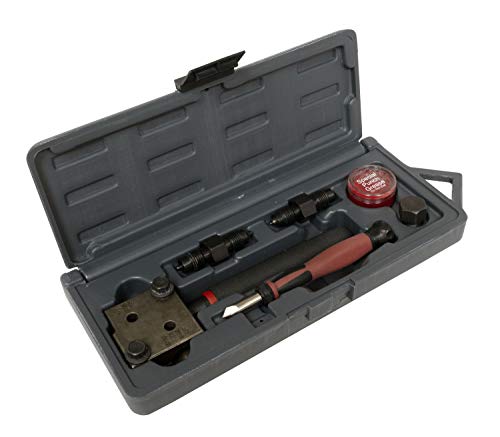
- Single or double flares on 3/16 inch (4.75 mm) and 1/4 inch
- Low-profile design for tight spaces
- Vise assembly centers tubing without marring
- Depth stop sets tube length; not for stainless
The Lisle 33260 is a low-profile flaring tool that makes single or double flares on 3/16 inch (4.75 mm) and 1/4 inch tubing. Covering two sizes in one compact tool is useful because some vehicles run 1/4 inch lines near the master cylinder and 3/16 inch lines elsewhere. Its slim shape is designed to reach lines in tight spaces.
A vise assembly holds the tubing centered so the flare forms evenly, and Lisle says it does so without marring the tube. A depth stop sets how much tubing sticks out before you form the flare, which takes some of the guesswork out of getting the height right. Lisle’s 33260 product page also lists the individual replacement parts, such as the vise halves and the handle.
Lisle states that the tool does not work on stainless tubing, so plan on coated steel or copper-nickel line. It makes SAE-style single and double flares, not ISO bubble flares, so it is not the tool for a car with bubble fittings. For an owner working on an SAE-flare vehicle that uses two line sizes, it is a compact, uncomplicated option.
Matching a Tool Style to Your Job
The best brake line flaring tool for a one-off fix is rarely the one a restorer needs. It comes down to how many flares you will make, where you will make them and which flare type your car needs.
| Tool style | Examples above | Strengths | Watch out for |
|---|---|---|---|
| Compact on-car | Titan 51535, Capri dual head | Repairs a line in place; small and simple | Usually one tube size; wrench access needed |
| Low-profile clamp | Lisle 33260 | Two sizes; fits tight spots | No bubble flare; not for stainless |
| Arbor press kit | OTC 6502 | Single, double and bubble in SAE and metric | Bench or vise work; more parts to track |
| Hydraulic kit | Mastercool 72475-PRC | Repeatable flares with little effort; many dies | Bulkier case; more than a one-time job needs |
For a single rusted section on a 3/16 inch line, a compact tool is enough. If you restore older cars, keep a fleet running or work on both domestic and European cars, the wider die range of an arbor-press or hydraulic kit saves buying a second tool later. Either way, add a tube cutter, a deburring tool and a bender.
Salt-Belt Lines: Making a Flare That Seals
Road salt and freeze-thaw cycles are hard on steel brake lines, and the damage hides along the frame rails and above the fuel tank. Our article on brake line rust and what it means for your safety covers how to spot it. When one section has rotted, nearby sections are often close behind, so inspect the whole run before you cut.
A few habits separate a flare that seals from one that weeps:
- Cut square: use a tube cutter, not a hacksaw, and keep the end at a right angle.
- Deburr inside and out: a burr gets folded into the flare and leaves a leak path.
- Slide the nut on first: it cannot go on once the flare is formed.
- Set the height: use the tool’s depth gauge or stop so the right length of tube sticks out.
- Lubricate and check: a drop of the tool’s die lube helps, and the finished flare should look even all the way around.
Practice on a scrap piece of the same tubing before you form the flare that goes on the car. Once the line is in, the brakes need bleeding, and our guide to the best brake bleeder kit for home use covers the tools for that step.
When to Hand the Job to a Shop
A flawed flare leaks under pressure, and a brake line that leaks can take the pedal with it. If you are not confident in your flare, or the car has a soft pedal after the repair, do not drive it. Our page on a brake pedal that goes to the floor explains why that symptom needs attention right away.
Some jobs are better left to a lift and experience: lines that run over the fuel tank, lines at the ABS unit, seized fittings that round off, or several rotted sections at once. Our brake repair service in Grand Rapids replaces lines and bleeds the system, and if pads are due at the same time, our guide to the best brake pads for daily driving can help you choose.
More Buying Guides
Frequently Asked Questions
Do I need a double flare or a bubble flare?
Match what the car already uses. Look at the old line end and nut: a folded cone is an SAE double flare, and a rounded bulb is an ISO bubble flare. Mixing the two will not seal properly.
Can I flare brake lines without removing them from the car?
Yes, with a compact on-car tool such as the Titan 51535, the Capri dual head or the low-profile Lisle 33260. You still need room to swing a wrench and a straight section of line to clamp.
Which is the best brake line flaring tool for stainless steel line?
Most manual tools are not rated for stainless, including several in this guide. Mastercool lists annealed stainless for its 72475 hydraulic set. Copper-nickel line is far easier to flare and resists salt well, so many DIY owners choose it instead.
Is a hydraulic flaring tool worth it for one repair?
Usually not. A compact tool handles a single 3/16 inch section well. A hydraulic kit pays off when you make many flares, work with stiff steel line or need several sizes and flare types.
Rather have a professional replace that rusted brake line? Call 456 AutoFix at 616-279-3832, Monday to Friday 8am to 5pm, or set up a brake line repair through our contact page.
Working hours don’t suit you? Bring the car to 456 Carrier St NE in Grand Rapids and leave it with our after-hours drop-off.