As an Amazon Associate, 456 AutoFix earns from qualifying purchases. Product links below go to Amazon, where you can confirm the right part for your vehicle.
Pop the hood on most modern Hondas and the coolant reservoir shows a pale blue fluid. Picking the best coolant for Honda engines starts with that color, but it doesn’t end there, because several different blue formulas share the same shelf.
This guide explains what Honda Type 2 is, when an aftermarket blue jug is a sensible stand-in, and which coolants fit a CR-V, Accord, Odyssey or Civic. If you want the wider picture across every make, our walkthrough on choosing a coolant brand by the spec it meets covers the chemistry families.
Quick answer
Which coolant does a Honda need?
Most gas Hondas and Acuras call for Honda Type 2, a blue premix you pour in without adding water. A blue phosphate-enhanced organic acid (POAT) coolant that names Honda on its label, such as PEAK OET Asian Blue or Prestone MAX Asian Blue, is the usual alternative. The electric Prologue uses its own Type PZ.
Our Quick Picks
Three quick picks: the genuine factory premix, a blue concentrate for flush jobs and a multi-gallon blue for busy garages. All five coolants are reviewed below.

Honda Type 2 Coolant
Honda's own long-life blue coolant, the same formula Type 2 Hondas leave the factory with.

PEAK OET Asian Blue
A blue Asian-vehicle concentrate that lists Honda and Acura by name.

Prestone MAX Asian Blue
Prestone's blue Asian-vehicle formula in a six-jug case for repeat use.
What Honda Type 2 Actually Is
Type 2 is Honda’s name for its long-life blue coolant, sold under part number OL999-9011. It is an ethylene glycol fluid with a corrosion package designed to protect both the metal and the plastic and rubber parts in a Honda cooling system. Honda ships it already blended at 50/50, so the jug goes straight into the radiator or reservoir.
Aftermarket makers sell their own versions under labels like “Asian Vehicles Blue.” These use a phosphate-enhanced organic acid formula, often shortened to POAT, which is the family Honda’s blue coolant belongs to. The color is a dye, not a spec, so the useful check is whether the back label names Honda or Acura.
- Read the manual first: it names the coolant your model year expects, and older Hondas may differ from current ones.
- Look for Honda on the label: a generic “all makes” jug is not the same as one written for Honda’s blue formula.
- Don’t blend families: green conventional coolant or orange Dex-Cool doesn’t belong in a Honda that runs blue.
Premix, Concentrate and the Water Question
The genuine Honda jug is premixed, and adding water to it only weakens the freeze protection. Concentrate is different: it has to be cut with distilled water before use, normally to a 50/50 ratio. Tap water leaves mineral scale in thin radiator and heater core passages, which slowly cuts heat transfer.
A concentrate makes sense when you flush the system first, since some plain water always stays behind in the block and heater core. Mixing a little stronger than 50/50 offsets that leftover water. For simple top-offs, premix is easier and harder to get wrong.
Most glycol coolants sold in the US are built to ASTM D3306, the standard for glycol-based engine coolant in cars and light trucks. Meeting it is a minimum bar for a coolant, not a sign that it matches what Honda specifies.
Best Coolant for Honda: Five Jugs Reviewed
Every fit claim below comes from the Amazon listing or the maker’s own product page. A listing that names Honda still can’t cover every model year, so check your owner’s manual for the coolant your CR-V, Accord, Odyssey or Pilot calls for before you buy.
1. Honda Genuine Type 2: Extended Life Blue Antifreeze Coolant, 50/50 Premix, 1 Gallon
- Genuine Honda Type 2, replaces OL999-9011
- Pre-diluted 50/50, ready to pour
- Protects metal and non-metal parts
- Up to 5 years or about 60,000 miles
This is Honda’s own long-life blue coolant, sold as Type 2 and listed as the replacement for part number OL999-9011. The listing says it matches the factory fill for Honda cooling systems that call for Type 2, which covers most gas Civic, Accord, CR-V, Pilot and Odyssey models from recent years. It arrives pre-diluted at 50/50, so nothing needs to be measured or mixed before it goes in.
The formula is ethylene glycol with a corrosion package aimed at both the metal parts of the system and the plastic and rubber ones, such as the radiator tanks and hoses. It gives freeze protection and resistance to boil-over, and the listing quotes a service life of up to 5 years or about 60,000 miles under normal conditions. A bittering agent is added to make it less appealing to children and pets.
Because it carries Honda’s part number, the next person to work on the car knows exactly what is in the system. It suits top-offs and full refills alike. It is less suited to someone who wants concentrate to offset water left behind after a flush, and it is not the coolant for the electric Prologue. Confirm your year and model in the owner’s manual before ordering.
View Honda Type 2 Coolant on Amazon
2. Honda 08CLA-P99-0E0A8 Extreme Cold Weather Type 2: Freeze Enhancement Coolant Concentrate

- Genuine Honda part 08CLA-P99-0E0A8
- Concentrate for freeze enhancement only
- Protection down to -62°F (-52°C)
- Keeps the original service interval
Honda sells this concentrate for one narrow job: raising the freeze protection of a cooling system that already runs Type 2. The listing describes it as being for freeze enhancement only and gives protection down to -62°F (-52°C). In plain terms, it is an add-in for owners who expect colder weather than a standard 50/50 mix is built to handle, rather than a coolant you fill an empty system with.
Because it is formulated by Honda for Honda vehicles, it keeps the same chemistry as the Type 2 already in the engine. The listing says it maintains the original cooling system service interval, so adding it should not shorten the time until the next scheduled coolant change. That matters if your car follows the Maintenance Minder and you would rather not reset that clock.
Most drivers will never need it, since ordinary Type 2 is designed for normal winters. It makes more sense for a Honda that sits outside through long cold spells or travels to colder regions. The right amount depends on your system, so follow the label or your service information instead of guessing, and check your owner’s manual or a Honda parts desk before using it in your model.
View Honda Extreme Cold Weather Type 2 on Amazon
3. PEAK OET Extended Life Blue: POAT Antifreeze Coolant Concentrate for Asian Vehicles, 1 Gallon
- Blue phosphate-enhanced organic acid (POAT)
- Recommended for Honda and Acura
- Concentrate for flush, fill or top-off
- 150,000 miles or 5 years with full flush
PEAK’s Original Equipment Technology line splits coolants by vehicle origin, and this blue concentrate is the version for Asian vehicles. The listing recommends it for Acura, Honda, Infiniti, Mitsubishi, Nissan, Subaru and Suzuki models that require a blue phosphate-enhanced organic acid formula, often called POAT. That is the same family as Honda’s own blue coolant, which is why it shows up as a common aftermarket alternative.
As a concentrate, it gives you control over the final strength. You mix it with distilled water before it goes in, which suits a full flush where some plain water always stays trapped in the block and heater core. PEAK says it is compatible with other extended life coolants, and when it goes in as part of a complete flush and fill, the company guarantees protection for up to 150,000 miles or 5 years.
It is a sensible choice for owners doing their own drain and refill on a Honda that runs blue coolant. It asks a little more of you than a premix, since a jug of straight concentrate in the reservoir would be a mistake. If you only need a quick top-off, a premix is simpler. Confirm the coolant your model calls for in the owner’s manual first.
View PEAK OET Asian Blue on Amazon
4. Prestone AF6310 MAX Asian Vehicles Blue: Antifreeze and Coolant, 1 Gallon, Pack of 6
- Engineered for Honda and all Acura
- Tops off or replaces any blue coolant
- 15+ years and/or 350,000 miles guarantee
- Six 1-gallon jugs, contains bitterant
Prestone’s MAX range includes a blue formula built for Asian vehicles, sold here as part number AF6310 in a case of six one-gallon jugs. The Prestone product page for MAX Asian Vehicles Blue says it is engineered for Honda, all Acura, and 2009 and newer Nissan, Infiniti and Subaru models. It also says the coolant can top off or replace any blue coolant in those vehicles.
Prestone describes the formula as Advanced Original Equipment Technology, aimed at protection from winter freezes, summer heat, rust and corrosion. The company backs it with a guarantee of 15 or more years and/or 350,000 miles, which it calls the longest fluid life in the industry. Like the other coolants here, it contains a bitterant to discourage accidental swallowing by children and pets.
The six-jug case is the main reason to pick it. It suits a household with two or three Hondas or Acuras, or someone who handles regular top-offs and refills for family cars. For a single car that needs one top-off, a single gallon of another coolant is easier to store. Check the jug for mixing directions and confirm your model in the owner’s manual before you pour.
View Prestone MAX Asian Blue on Amazon

5. Honda OL999-9033 Type PZ: Long Life Antifreeze Coolant, 50/50 Premix for Prologue
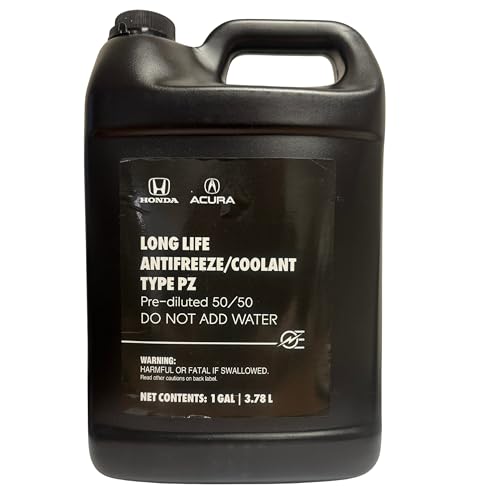
- Genuine Honda part OL999-9033
- Listed for Honda Prologue 2024 and newer
- Pre-diluted 50/50, do not add water
- Freeze -34°F, boil-over 265°F
The Prologue is Honda’s electric SUV, and its thermal system does not take the blue Type 2 used in gas Hondas. This genuine Honda coolant, part OL999-9033 and labeled Type PZ, is listed for the Prologue from 2024 on. It comes pre-diluted at 50/50, and the listing states plainly that you should not add water to it.
The listing gives freeze protection to -34°F and boil-over protection to 265°F, and says the coolant meets or exceeds ASTM D3306 and SAE standards for corrosion protection. Rather than quoting a fixed change interval, it points owners to the vehicle’s service manual for intervals, coolant concentration, system capacity and service steps. That is sensible advice for an electric vehicle, where coolant typically helps manage battery temperature as well.
This one is on the list for a single reason: Prologue owners searching for Honda coolant need to know their car is the exception. It is not a substitute for Type 2 in a Civic, CR-V or Odyssey, and Type 2 should not go into a Prologue. Because an EV cooling system can involve service procedures beyond a simple top-off, check the owner’s manual and leave larger jobs to qualified service.
View Honda Type PZ Coolant on Amazon
Which Jug Suits Which Honda
Use this as a shortlist. The fit column repeats what each maker or listing says, and your manual has the final word.
| Coolant | Form | Maker or listing says | Good fit for |
|---|---|---|---|
| Honda Type 2 (OL999-9011) | Blue 50/50 premix, 1 gallon | Matches the factory fill for Type 2 Hondas | Any refill or top-off on a Type 2 Honda |
| Honda Extreme Cold Weather Type 2 | Concentrate add-in | Freeze enhancement to -62°F | Hondas that see deep cold snaps |
| PEAK OET Asian Blue | Concentrate, 1 gallon | Blue POAT, lists Honda and Acura | Flush and fill jobs |
| Prestone MAX Asian Blue | 1 gallon, pack of 6 | Engineered for Honda and all Acura | Households with several Hondas |
| Honda Type PZ (OL999-9033) | 50/50 premix | Honda Prologue 2024 and newer | Prologue only |
For a gas Civic, Accord, CR-V, Pilot or Odyssey, the best coolant for Honda owners who want zero guesswork is the genuine Type 2 premix. The aftermarket blues earn their place when you want concentrate for a flush or need several gallons at once. The Prologue is the outlier: it shares little with other Hondas under the skin, so it gets its own coolant.
Topping Off and Refilling Without Trapped Air
Only open the radiator cap on a cold engine. The system holds pressure when hot, and the cap can release a burst of scalding fluid. For a simple top-off, add coolant to the reservoir until it sits between the MIN and MAX lines.
A full drain and refill takes more care. After filling the radiator, many Honda procedures have you run the engine with the heater on its hottest setting and the cap off until the thermostat opens, then top up as air bubbles out. Some engines also have a bleed bolt near the thermostat housing, so follow the service steps for your engine.
Even the best coolant for Honda engines can’t do its job around an air pocket. A heater that blows cool air after a refill, or a temperature gauge that climbs and falls, usually means air is still trapped. If the reservoir keeps dropping between fills, look for wet spots on hoses, the radiator seams and around the water pump. Used coolant tastes sweet to pets even with a bittering agent, so catch it in a pan and take it to a recycler.
Pumps, Belts and When to Call a Mechanic
Grand Rapids winters test a cooling system in a way that a mild climate never does. Whatever you decide is the best coolant for Honda use, test its strength each fall, since a weak mix can freeze in a radiator overnight, and our guide to the antifreeze picks and testing tips for winter shows how. Humid summer traffic on the highways then pushes the same coolant hard the other way.
The V6 engines found in many Accord, Odyssey and Pilot models use a timing belt, and the water pump sits behind it, so the two are usually replaced together. That job always means draining and refilling coolant. Our comparison of timing belt kit brands that bundle a water pump lists what each kit includes.
A seeping pump weep hole, a whine from the front of the engine and a slowly falling reservoir are warning signs on most makes, and our write-up on water pump failure symptoms to watch for covers them in detail. When the belt is due, our timing belt replacement service in Grand Rapids handles the belt, pump and coolant refill in one visit. If the cabin stays cold after a refill, our car heater repair team can track down trapped air or a stuck thermostat.
More Buying Guides
Frequently Asked Questions
Do I have to use genuine Honda Type 2 coolant?
Honda’s manuals name Type 2, and it is the easiest way to match the factory fill. A blue POAT coolant whose label lists Honda, such as PEAK OET Asian Blue or Prestone MAX Asian Blue, is a common alternative. Avoid green conventional or orange coolants in a Honda that runs blue.
Can I add water to Honda Type 2?
No. Type 2 is already a 50/50 premix, so extra water only lowers its freeze and boil protection. Concentrates are the ones that need distilled water mixed in.
What is the best coolant for Honda CR-V and Accord models?
For recent gas CR-V and Accord models, Honda Type 2 is the factory match and the safest pick. If you prefer a concentrate for a full flush, a blue Asian-vehicle formula that names Honda works too. Check your owner’s manual for the exact coolant your model year calls for.
How often should Honda coolant be changed?
The Type 2 listing gives up to 5 years or about 60,000 miles under normal conditions, and many Hondas show the change through the Maintenance Minder. Follow the schedule in your owner’s manual, since intervals vary by model and year.
Seeing a low reservoir, a sweet smell after a drive or a temperature gauge that won’t settle? Call 456 AutoFix at 616-279-3832, Monday to Friday 8am to 5pm, or request a cooling system appointment through our contact page.
Working the same hours we do? Our after-hours drop-off at 456 Carrier St NE lets you leave your Honda and the keys on your own timetable.