
As an Amazon Associate, 456 AutoFix earns from qualifying purchases. Product links below go to Amazon, where you can confirm the right part for your vehicle.
The best CVT fluid for your car is the one that matches the spec printed in your owner’s manual, not the bottle with the boldest label. A continuously variable transmission relies on precise friction between a steel belt or chain and two pulleys, and the wrong fluid can bring on shudder, slipping or worse.
Below we explain how CVT fluid differs from regular ATF, how to read the spec your car calls for, and then review six bottles: four factory fluids from Nissan, Subaru, Honda and Toyota, plus two multi-vehicle options. If your car has a stepped automatic instead, our guide to the best transmission fluid for high mileage cars is the better fit.
Quick answer
Which CVT fluid should go in my car?
Use the exact fluid your owner’s manual names, such as Nissan NS-3, Subaru CVTF-II, Honda HCF-2 or Toyota CVT Fluid FE. The factory bottle is the safest choice, especially under warranty. A multi-vehicle CVT fluid makes sense only when its listing names your spec, and regular ATF should never go into a CVT.
Our Quick Picks
Three quick picks for the best CVT fluid by spec; all six are reviewed below.

Nissan Genuine CVT-3 Fluid
The same NS-3 formula Nissan fills at the factory.

Subaru Genuine CVTF-II
Subaru's own fluid for many Lineartronic models.

Castrol Transmax ATF/CVT Universal
One jug with a long, specific application list.
ATF Fluid vs CVT Fluid: Why One Can’t Stand In for the Other
A conventional automatic shifts through fixed gears using clutch packs and bands. A CVT works differently: as the U.S. government’s fuel economy site explains, it uses a pair of variable-diameter pulleys connected by a belt or chain to produce a smooth range of ratios instead of set gears.
That design changes what the fluid has to do. In a CVT, the belt or chain must grip the pulley faces through a thin film of oil without slipping, so the fluid needs a specific steel-on-steel friction profile. ATF is tuned for clutch plates and gear sets, and its friction behavior is wrong for a pulley drive.
- Is ATF and CVT fluid the same? No. They share a look and a dipstick tube on some cars, but the additive packages are built for different hardware.
- What goes wrong with the wrong one: owners commonly report shudder, a whining or droning sound, delayed engagement or warning lights after a fluid mix-up.
- Mixing CVT specs is a risk too: NS-2, NS-3, CVTF-II and HCF-2 are separate formulas for separate transmissions.
Reading the Spec Before You Buy a Bottle
Your owner’s manual, the maintenance section of the service booklet or a label near the fill point names the fluid by its spec code. Write that code down, with your year, model and engine, before you shop for the best CVT fluid.
- Factory (OE) fluid: the same formula the transmission was filled with at the plant. Some makers want OE fluid only, and it removes any warranty debate.
- Multi-vehicle CVT fluid: one bottle that lists several specs. Use it only if the maker’s own list includes the exact code your manual gives.
- How much to buy: a drain-and-fill typically takes only part of the total capacity, so check the refill amount for your model and order a little extra.
- Model changes: the same nameplate can switch fluids between years or engines, so confirm year, model and engine on Amazon before you buy.
Best CVT Fluid Picks, Bottle by Bottle
The first four are factory fluids for the most common CVT makers, then come two multi-vehicle options. Fitment and features below come from each Amazon listing, so match the spec code to your manual before ordering.
1. Nissan Genuine CVT-3 Fluid 999MP-NS300P: 5-Quart NS-3 Factory Fluid
- Genuine Nissan NS-3 CVT fluid
- Part 999MP-NS300P, 5 quarts
- Friction modifiers for stable operation
- Flows well in the cold, holds pressure in heat
This is the factory CVT fluid from Nissan, sold as part 999MP-NS300P in a 5-quart pack. The listing describes it as the original equipment fluid for vehicles that require NS-3, which covers a large share of Nissan and Infiniti CVTs from recent years, along with some other makes that use the same transmission family.
According to the listing, the formula uses a blend of friction modifiers and additives meant to keep the belt and pulleys working in a stable, precise way. It is also described as flowing well at low temperatures for smoother operation while holding proper pressure when the transmission runs hot. For a Michigan driver, that combination matters on a January cold start just as much as in summer stop-and-go traffic.
Five quarts is a practical amount for a typical drain-and-fill, which replaces only part of the total fluid, though the exact refill amount varies by model, so check yours before ordering. Because this is the OE fluid, it avoids any question about warranty coverage. It is not the right bottle for older Nissan CVTs that specify NS-2, for Nissan stepped automatics, or for other brands that use a different CVT spec, so confirm the code in your owner’s manual first.
View Nissan Genuine CVT-3 Fluid on Amazon
2. Subaru Genuine CVTF-II SOA427V1660: 6-Quart Lineartronic CVT Fluid
- Genuine Subaru CVTF-II, green fluid
- Part SOA427V1660, 6 quarts
- Listed for many Crosstrek, Forester and Impreza CVTs
- Listed for 2010-2019 Legacy and Outback CVTs
This six-quart set contains genuine Subaru CVTF-II, part SOA427V1660, a green fluid made for the Lineartronic CVT used across much of Subaru’s lineup. Buying the factory fluid is the simplest route for Subaru owners, since the brand is particular about which CVT fluid goes into which model.
The listing spells out fitment by model and engine. It names 2013-2019 Crosstrek models with a CVT (non-hybrid) and the 2014-2016 Crosstrek Hybrid, 2014-2023 Forester 2.5 non-turbo models with a CVT, 2010-2019 Legacy and Outback 2.5 models and 2010-2014 Legacy and Outback 3.6 models with a CVT, plus 2012-2023 Impreza 2.0 non-turbo models. That level of detail makes it easy to check your car against the list rather than guessing.
Six quarts covers a typical drain-and-fill on most of these models with some left for topping off, though capacity varies. The listing states plainly that it is not for the Forester Wilderness, and turbocharged engines and several newer Subarus call for a different fluid such as CVTF-III. If your car falls outside the listed years and engines, confirm year, model and engine on Amazon and in your owner’s manual before buying.
View Subaru Genuine CVTF-II on Amazon

3. Genuine Honda HCF-2 08200-HCF2: 1-Quart OEM CVT Fluid
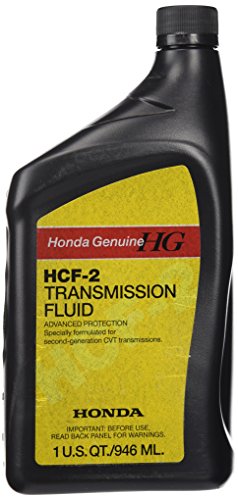
- Genuine Honda HCF-2 fluid
- Part 08200-HCF2
- 1 U.S. quart bottle
- OEM part, not aftermarket
Honda’s HCF-2 is the CVT fluid the company specifies for many of its newer continuously variable transmissions, and this listing is the genuine Honda product, part 08200-HCF2, in a single U.S. quart bottle. The listing describes it as an OEM factory part rather than an aftermarket fluid.
The main advantage of the factory bottle is certainty. Honda tunes each CVT around the friction behavior of its own fluid, and using HCF-2 from Honda removes any doubt about whether a substitute matches it closely enough. It also keeps your service records simple if a warranty question ever comes up.
Because it comes as one quart, plan on ordering several bottles for a drain-and-fill; the exact amount depends on the model, so check the refill capacity in your manual. Honda has used other fluids over the years, including Honda CVTF in some earlier CVTs and ATF DW-1 in its stepped automatics, and HCF-2 is not a match for those. The listing itself gives few technical details, so treat your owner’s manual as the final word: if it says HCF-2, this is the factory option, and if it names a different fluid, look elsewhere. Match your exact year, model and engine on the listing before checkout.
View Genuine Honda HCF-2 on Amazon
4. Genuine Toyota CVT Fluid FE 08886-02505: 4-Liter Factory CVT Fluid

- Genuine Toyota CVT Fluid FE
- Part 08886-02505
- 4-liter container
- Vehicle-specific OEM fluid
This is Toyota’s own CVT Fluid FE, sold under part number 08886-02505 in a 4-liter container. Toyota uses FE in many of its continuously variable transmissions, and the listing describes it as a genuine OEM, vehicle-specific fluid rather than a general-purpose product.
Toyota has used more than one CVT fluid, with CVT Fluid TC appearing in some other models, so the first step is checking which one your manual names. If it says FE, this jug gives you the factory formula without any question about substitutes. The 4-liter size, a little over four quarts, is handy for a drain-and-fill on many smaller Toyota cars, though capacity varies and some models may need more.
The listing offers very little technical detail beyond the part number and its OEM status, so your manual and a Toyota parts counter are the right places to confirm fit. Some Toyota and Lexus models with a CVT also have a launch gear or other design differences, which is another reason to follow the spec exactly. This fluid is not for Toyota stepped automatics, which use WS or other ATF, and it is not a match for CVTs that call for TC. Check the listing’s fit tool with your year, model and engine first.
View Genuine Toyota CVT Fluid FE on Amazon
5. Valvoline CVT Full Synthetic: 1-Quart Multi-Vehicle CVT Fluid

- Full synthetic CVT fluid, 1 quart
- For most belt and chain-driven CVTs
- Anti-shudder and anti-wear additives
- Metal-to-metal friction protection
Valvoline’s CVT fluid is a full synthetic, multi-vehicle product sold in quart bottles. The listing says it meets the demands of most belt and chain-driven continuously variable transmissions, which makes it a common choice for owners who would rather buy one familiar brand than track down a dealer-only fluid.
According to the listing, the formula includes anti-shudder protection for smooth operation and power transfer, anti-wear technology for durability, and metal-to-metal friction protection aimed at the belt and pulleys. It is described as American made and formulated to resist breakdown better than conventional fluids. Those are the right goals for a CVT fluid, and the quart size lets you buy just what your refill needs.
The key word in the listing is “most,” not all. Some carmakers want only their own fluid in their CVTs, especially during the warranty period, and a few transmissions are sensitive to small differences in friction behavior. Before buying, check that Valvoline’s own application information names the spec your manual calls for, such as NS-3 or CVTF-II. If you cannot confirm a match for your exact model, the factory bottle is the safer choice, and Valvoline CVT fluid is not meant for stepped automatics or manual transmissions.
View Valvoline CVT Full Synthetic on Amazon
6. Castrol Transmax ATF/CVT Universal: 1-Gallon Multi-Spec Transmission Fluid
- 1-gallon jug
- Lists Nissan NS-2/NS-3 and Subaru i-CVT specs
- Lists Honda HCF-2 and Toyota CVT FE/TC
- Also lists Dexron VI and Mercon LV ATF uses
Castrol Transmax ATF/CVT Universal is a one-gallon fluid that the maker lists for both conventional automatics and CVTs. Despite the word universal in the name, its value is the detailed application list, which lets you check your exact spec rather than trusting a broad claim.
On the CVT side, the listing names Toyota CVT Fluid TC and FE, Nissan NS-1, NS-2 and NS-3, Subaru i-CVT and Lineartronic High Torque fluids, Honda HCF-2 (excluding the 2001-2007 Fit), Hyundai and Kia SP-III, Mazda CVTF 3320, several Mitsubishi CVT fluids, Ford CVT23 and others. On the ATF side it lists Dexron VI, Mercon LV, Toyota WS and many more. The listing also highlights friction durability, high-temperature oxidation resistance and copper corrosion protection.
That breadth suits a household with several cars or someone who services a few vehicles, since one jug can cover more than one need. Still, a long list is not a guarantee for every model year, and some carmakers want OE fluid while the warranty is active. Only use it where the listing names the exact code from your manual, and note that the Subaru CVTF-II in the factory pick above is not called out by that name in this list.
View Castrol Transmax ATF/CVT Universal on Amazon
Matching the Spec Code to a Bottle
Finding the best CVT fluid starts with the spec code in the first column, then the matching pick. The multi-vehicle columns reflect each maker’s own application list, not a promise of fit for every model year.
| Spec in your manual | Typical makes | Factory pick | Multi-vehicle option |
|---|---|---|---|
| NS-3 (older cars: NS-2) | Nissan, Infiniti | Nissan CVT-3 Fluid | Castrol Transmax ATF/CVT lists NS-1, NS-2 and NS-3 |
| CVTF-II (newer: CVTF-III) | Subaru Lineartronic | Subaru CVTF-II for listed models | Castrol lists Subaru i-CVT and Lineartronic High Torque |
| HCF-2 | Honda, Acura | Honda HCF-2 | Castrol lists HCF-2 (not 2001-2007 Fit) |
| CVT Fluid FE or TC | Toyota, Lexus, Scion | Toyota CVT Fluid FE | Castrol lists both TC and FE |
| Not sure or no spec listed | Any | Ask a dealer parts counter for your VIN | Valvoline CVT only after confirming the spec |

Shopping for the best transmission fluid for Nissan CVT models? Stick with NS-3 unless the manual for an older car names NS-2. For the best transmission fluid for Subaru CVT models, check whether the manual says CVTF-II or CVTF-III, since turbo engines and some newer trims use a different fluid from the listing above.
Grand Rapids Driving and CVT Fluid Life
Most owner’s manuals give a normal and a severe service schedule for the transmission fluid. Short winter trips, cold starts, stop-and-go traffic and towing all count as harder use, and plenty of West Michigan commutes tick several of those boxes.
- Follow the severe schedule if it fits: if most of your trips are short or you drive through months of below-freezing mornings, use the shorter interval.
- Let it warm up gently: on a frigid morning, give the car a minute and drive easy for the first few miles while the fluid thins out.
- Watch the other fluids too: a car due for transmission fluid is often due for others, and our guide to the best power steering fluid covers the steering side.

Not every rough feeling comes from the transmission. Hesitation, a rough idle or poor acceleration can start in the engine, and our guide to choosing the best fuel system cleaner explains when dirty injectors are behind it.
Signs It Is Time for a Professional Look
Even the best CVT fluid will not fix worn internal parts. A shudder from a stop, a loud whine that rises with speed, a flashing transmission warning or the car going into a reduced-power mode all deserve a diagnosis before you spend money on fluid.

If a warning light is on, our team can run a check engine light diagnostic in Grand Rapids and tell you what the stored codes point to. Routine visits such as an oil change in Creston are also a good time to ask us to look for leaks and check what your maintenance schedule says is coming due.
More Buying Guides
Frequently Asked Questions
Is ATF and CVT fluid the same?
No. ATF is made for the clutch packs and gears in a stepped automatic, while CVT fluid is made for the belt or chain and pulleys in a CVT. Putting ATF in a CVT can cause shudder and slipping, so use the CVT spec your manual names.
What is the best transmission fluid for Nissan CVT models?
Genuine Nissan NS-3 suits Nissan and Infiniti CVTs that call for NS-3. Some older models specify NS-2 instead, so check the owner’s manual before buying.
What is the best transmission fluid for Subaru CVT models?
Use the fluid your manual names. Genuine Subaru CVTF-II covers many Crosstrek, Forester, Impreza, Legacy and Outback models in the listing, but turbo engines, the Forester Wilderness and some newer cars use a different fluid.
Can I use a multi-vehicle CVT fluid instead of the dealer fluid?
Only when the bottle’s maker lists your exact spec code. Some carmakers want OE fluid during the warranty period, so many owners stick with the factory bottle until the warranty ends.
Car shuddering from a stop or showing a warning light? Phone 456 AutoFix at 616-279-3832 any weekday from 8am to 5pm, or request a time through our contact page.
If your workday overlaps our hours, after-hours drop-off is available at our shop on 456 Carrier St NE, Grand Rapids.