
As an Amazon Associate, 456 AutoFix earns from qualifying purchases. Product links below go to Amazon, where you can confirm the right part for your vehicle.
A limited-slip axle that groans or shudders through a slow parking-lot turn is usually telling you something about its oil. Choosing the best gear oil for limited slip differentials means matching three things: the viscosity your maker lists, a GL-5 rating, and enough friction modifier for the clutch packs inside.
This guide explains which limited-slip designs care about friction modifier, how to read a gear oil label, and six synthetic oils sold with LS formulas. If your axle is an ordinary open unit, our guide to gear oil for standard differentials covers that side.
Quick answer
What gear oil should go in a limited-slip axle?
Use a GL-5 gear oil in the viscosity your owner’s manual lists, labeled for limited-slip use. Castrol Syntrax Limited Slip 75W-90 suits most cars and light trucks. Red Line 75W140 GL-5 covers axles specified for 75W-140, and Motul Gear Competition 75W-140 is aimed at track and high-load builds.
Our Quick Picks
Three starting points by axle demand: everyday 75W-90 driving, 75W-140 heat and towing, and track use. All six LS gear oils are reviewed below.

Castrol Syntrax Limited Slip 75W-90
A mainstream synthetic gear oil sold specifically for limited-slip axles.

Red Line 75W140 GL-5
A heavy synthetic grade for limited-slip axles that see heat and load.

Motul Gear Competition 75W-140
A racing gear oil built for limited slips under heavy shock loads.
Why Clutch-Type Limited Slips Are Picky About Oil
An open differential lets each wheel turn at its own speed, which is fine until one tire hits ice and spins. A limited-slip unit adds a way to push torque toward the wheel with grip. How it does that decides how fussy it is about the oil.
- Clutch-type units: stacks of friction plates and steel discs that slip against each other in turns. These need oil with friction modifier so the plates release smoothly instead of grabbing and letting go in jerks.
- Gear-type (helical or Torsen-style) units: they bias torque through gear friction, not clutch plates. Many makers list a plain GL-5 oil for them, so check before adding modifier.
- Locking and electronic units: these can carry their own fluid requirements. Follow the axle or vehicle maker’s spec exactly.
The symptom of too little modifier in a clutch-type unit is chatter: a shudder or rapid clicking from the rear on tight, slow turns. It often shows up right after someone refills the axle with a general-purpose oil.
LS Labels, GL-5 and Viscosity: What the Bottle Tells You
Start with the owner’s manual or the tag on the axle cover. It will list a viscosity, such as 75W-90 or 75W-140, and often a note that the axle needs friction modifier. Some makers want a separate bottle of their own additive added in a set amount, while many LS-labeled oils already contain enough.
Next, look for API GL-5. That rating covers the extreme-pressure additives that hypoid ring and pinion gears need. Some bottles also list MT-1 or SAE J2360, which are tougher heavy-duty specs.
Then check whether the oil can share a case with a manual gearbox. Red Line, for example, says its GL-5 differential oils are not designed for most manual transmissions or transaxles, because the slippery formula can upset synchronizer action. For a gearbox, see our manual transmission fluid guide instead.
Best Gear Oil for Limited Slip Differentials: Six Synthetic Options
Every oil below is sold with a limited-slip formula, so the main choice is viscosity and how hard the axle works.
1. Castrol Syntrax Limited Slip 75W-90: Full Synthetic Gear Oil for LS Axles
- Full synthetic SAE 75W-90
- Formulated for limited-slip axles
- Wear protection under severe service
- Thermal and shear stability
Castrol Syntrax Limited Slip 75W-90 is a full synthetic gear oil from one of the largest lubricant brands, and the limited-slip use is printed right in the product name. That makes it a straightforward option when the owner’s manual calls for a 75W-90 oil suitable for a limited-slip axle. The listing for this one-liter bottle describes it as a premium synthetic made for severe service conditions and extended drain intervals.
Castrol highlights two traits: thermal stability, which helps the oil resist breaking down when an axle runs hot, and shear stability, which helps it hold its viscosity as the gears load and unload. Both matter in a limited-slip unit, where clutch plates add heat on top of the normal work of the ring and pinion. The 75W cold rating also helps the oil move more freely in a cold axle than a straight-weight oil would.
This is a sensible default for sedans, coupes and light trucks with a clutch-type limited slip and a 75W-90 spec. Check the fill quantity for your axle, since many take more than one bottle, and confirm whether your maker also asks for a separate friction additive. It is not the right choice where the manual lists 75W-140 or a dedicated factory fluid.
View Castrol Syntrax Limited Slip 75W-90 on Amazon
2. Red Line 75W85 GL-5: Lighter Synthetic Gear Oil with Friction Modifier

- Full synthetic SAE 75W-85, API GL-5
- Friction modifier for clutch-type LSDs
- Covers 75W-80, 75W, 80W and 85W specs
- Two-quart pack
Red Line 75W85 GL-5 is a full synthetic gear oil for axles that call for a lighter grade than the usual 75W-90. Red Line says it satisfies the viscosity requirements for SAE 75W-80, 75W, 80W and 85W gear oils, and it was formerly sold under the name LightWeight Gear Oil, so older forum posts may use that label. The listing names applications such as differential oil, final drive oil and transfer case fluid.
For limited-slip owners, the key line is that it contains additional friction modifiers for clutch-type limited-slip differentials. Red Line states that most LSDs need no extra modifier with this oil, which saves guessing at doses. Like the rest of Red Line’s GL-5 differential range, it is made from polyol ester base stocks, a synthetic base the company uses to reduce sliding friction in hypoid gears.
This oil is not designed for most manual transmissions or transaxles with synchronizers, since its slipperiness can cause shifting problems, so keep it out of a shared gearbox and axle case. It suits a separate differential whose manual lists a 75W-85 or similar light grade. The two-quart pack covers many car axles, but check your fill capacity first.
View Red Line 75W85 GL-5 on Amazon

3. Red Line 75W140 GL-5: Heavy-Grade Synthetic Gear Oil for Limited Slips
- Full synthetic SAE 75W-140
- API GL-5, GL-6, MT-1, SAE J2360
- Friction modifier for clutch-type LSDs
- Polyol ester base stocks
Red Line 75W140 GL-5 is the heavy-grade member of the company’s differential range, sold in a one-quart bottle. Red Line recommends it where an axle calls for API GL-5, GL-6, MT-1, MIL-L-2105E or SAE J2360, and it lists cars and light trucks such as the Ford Mustang and F-150, Toyota Tundra and Sequoia, Jeep Cherokee and Dodge Ram among its popular uses. Always confirm your own vehicle’s spec before relying on that list.
Like its lighter sibling, this oil contains additional friction modifiers for clutch-type limited slips, and Red Line says most LSDs need nothing extra. The polyol ester base and high viscosity index are meant to keep film thickness steady as temperatures change, which matters when a loaded axle heats up on a long grade or a trailer pull.
Red Line notes that this oil is not designed for most manual transmissions or transaxles, because extreme slipperiness can cause synchronizer problems. It is a good match for a separate rear axle whose maker lists 75W-140, especially on trucks that tow or carry heavy loads. It is too thick a choice for an axle specified for 75W-90 alone, so stick with the listed grade.
View Red Line 75W140 GL-5 on Amazon
4. Motul Gear Competition 75W-140: Ester Synthetic Racing Gear Oil for LSDs
- Full synthetic SAE 75W-140
- Ester Core racing formula
- For clutch-type and plated LSDs
- Listed for manual gearboxes too
Motul Gear Competition 75W-140 is a racing gear oil for limited-slip differentials, heavily loaded manual transmissions and competition drivetrains. Motul builds it on its Ester Core synthetic technology, which the company says gives strong film strength and wear resistance under shock loads and high torque. It comes in a one-liter bottle, so most axles will need two or more.
The listing says the limited-slip formulation is designed for clutch-type and plated LSD systems, with stable friction characteristics that help reduce chatter, vibration and harsh engagement. Motul also stresses high-temperature stability, so the oil resists thinning during racing, towing and long hard driving. Unlike the Red Line GL-5 oils above, Motul lists this one for synchronized manual transmissions as well, which can simplify things in some performance setups.
This oil makes the most sense for track-day cars, drag and drift builds, and high-horsepower street cars whose maker or builder specifies a 75W-140 grade. It is more than an ordinary commuter axle needs, and as with every pick here, use it only where the 75W-140 grade fits. If one oil serves both a gearbox and a differential, confirm both specs before filling.
View Motul Gear Competition 75W-140 on Amazon

5. TRIAX Synergy Gear Max 75W-90: GL-5 Limited Slip Synthetic, 1 Gallon

- Full synthetic PAO and ester, SAE 75W-90
- Meets GL-5 and limited-slip requirements
- For LS and non-LS gear systems
- One-gallon jug
TRIAX Synergy Gear Max 75W-90 is a full synthetic gear oil made from PAO and ester base stocks, sold in a one-gallon jug that holds enough for most car and light truck axles. The listing states that it meets API GL-5 and limited-slip requirements and is meant for hypoid and ring gears, differentials, heavy-duty highway trucks, passenger cars, off-road use and racing.
TRIAX aims this oil at long service life, with drain-interval claims built around heavy-duty trucks and fleet use. The listing also cites extreme-pressure and anti-wear test results, including FZG and L-37, and a long list of OEM and industry specifications from axle and truck makers. For a passenger car or light truck, follow the interval in your owner’s manual rather than the fleet figures.
Because it covers both LS and non-LS gear systems, one jug can serve a limited-slip rear axle and an open front axle on a four-wheel-drive truck that calls for 75W-90 in both. The gallon size is practical for larger truck axles or for anyone servicing several vehicles. It is not the pick for an axle that specifies 75W-140, a lighter grade or a dealer-only fluid.
View TRIAX Synergy Gear Max 75W-90 on Amazon
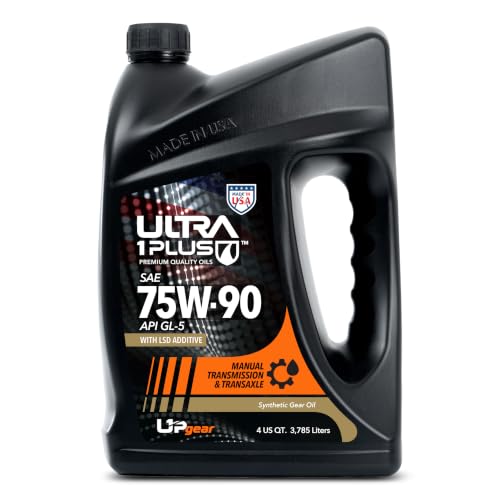
6. ULTRA1PLUS SAE 75W-90: Full Synthetic GL-5 MT-1 Limited Slip Gear Oil, 1 Gallon
- Full synthetic SAE 75W-90
- API GL-5 and MT-1
- LS additives against chatter
- Rust, oxidation and foam resistance
ULTRA1PLUS SAE 75W-90 is a full synthetic gear oil rated API GL-5 and MT-1 and sold specifically as a limited-slip formula. This listing is for a one-gallon container, which makes it a practical buy for a truck with large axles or a household servicing several vehicles that share the same 75W-90 spec.
The listing says its LS additives are engineered to eliminate differential chatter and keep limited-slip operation smooth. It also describes anti-scuffing additives for shock loading and high torque, and a synthetic base that exceeds SAE J306 viscosity requirements for cold flow and steady film strength. Resistance to rust, oxidation, foaming and varnish buildup rounds out the claims, all of which help the oil last between changes.
ULTRA1PLUS is a lesser-known brand than Castrol or Red Line, so check that the GL-5 rating and viscosity match your manual exactly before you buy. It suits clutch-type and other limited-slip axles that call for 75W-90, and the gallon size leaves enough for a top-off later. It is not meant for axles specified for 75W-140 or for gearboxes that need a GL-4 oil, and any leftover oil should be capped tightly and stored dry.
View ULTRA1PLUS 75W-90 GL-5 MT-1 Limited Slip on Amazon
Matching an LS Gear Oil to Your Axle
| Gear oil | Grade | Listed ratings | Good fit for |
|---|---|---|---|
| Castrol Syntrax Limited Slip | 75W-90 | Limited slip, full synthetic | Daily cars and light trucks |
| Red Line 75W85 GL-5 | 75W-85 | GL-5, friction modified | Axles specified for a lighter grade |
| Red Line 75W140 GL-5 | 75W-140 | GL-5, GL-6, MT-1, SAE J2360 | Heat, towing and heavy loads |
| Motul Gear Competition | 75W-140 | Limited slip, racing formula | Track days and high-power builds |
| TRIAX Synergy Gear Max | 75W-90 | GL-5, limited slip | Trucks and multi-vehicle garages |
| ULTRA1PLUS 75W-90 | 75W-90 | GL-5, MT-1, limited slip | Owners servicing several axles |
A heavier grade is not automatically safer. If the manual calls for 75W-90, a 75W-140 can feel stiffer on a cold morning and may not suit the axle, so stay with the listed grade unless the maker approves an alternative for towing or track use.

Refilling an LSD Through a West Michigan Year
Loosen the fill plug before you pull the drain plug. If the fill plug is seized, you can still drive the vehicle to a shop instead of leaving an empty axle on the driveway. Fill until oil just reaches the bottom of the fill hole, with the vehicle level.
Even the best gear oil for limited slip differentials thickens in January, and a clutch-type unit can feel a little grabby until it warms up, which is one reason the 75W cold rating on these synthetics is useful. After a refill, a common step is several slow figure-eight loops in an empty lot to work the new oil into the clutch packs.

Road salt and spring puddles are hard on axle seals and the small breather vent on top of the housing. Water that gets past them turns gear oil milky, and milky oil should come out right away. Drivers who tow boats to Lake Michigan launches in summer should also look at our differential fluid for towing guide, since heat is the bigger enemy there.
Gear oil is a different product from automatic transmission fluid, and the two should never be swapped. If your car also has an aging automatic, our high-mileage transmission fluid picks explain how to match an ATF spec.
When Chatter or Whine Points Past the Oil
Fresh LS oil fixes chatter caused by the wrong fluid. It will not fix worn clutch plates, a pinion bearing that whines at cruising speed or a clunk when you shift from drive to reverse. Those point to mechanical wear that needs the axle inspected.

Our shop can look at axle seals, fluid condition and service intervals while the car is in for an oil change in Creston or factory scheduled maintenance. For the maker’s own wording on friction modifiers and manual transmissions, see Red Line’s 75W140 GL-5 product page.
More Buying Guides
Frequently Asked Questions
Do I need to add limited slip additive to LS gear oil?
Usually not, because LS oils already contain friction modifier. Some vehicle makers still call for a measured dose of their own additive, so follow the manual. Add more only if the maker says so or chatter remains after several slow figure-eight loops.
Can I use limited slip gear oil in an open differential?
In most cases yes, as long as the viscosity and GL rating match what the maker lists. The friction modifier simply goes unused. Check the manual first if the axle shares oil with a transmission.
What causes limited slip chatter on tight turns?
The most common cause is oil without enough friction modifier for the clutch packs. Worn clutch plates can cause it too, and in that case new fluid may only quiet it for a while.
Is 75W-140 better than 75W-90 for a limited slip?
Only when the maker lists it. Some trucks and performance cars call for 75W-140, especially for towing, while many cars specify 75W-90. Use the grade in your owner’s manual.
Hearing a shudder in turns or a whine on the highway? Call 456 AutoFix at 616-279-3832, Monday through Friday from 8am to 5pm, or send us a note through the contact page.
Can’t get away during the workday? Our after-hours drop-off at 456 Carrier St NE, Grand Rapids lets you leave the keys with a short description of the noise and when it happens.