As an Amazon Associate, 456 AutoFix earns from qualifying purchases. Product links below go to Amazon, where you can confirm the right part for your vehicle.
A charger on the garage wall is only useful if its cable reaches the port. Back in, use the second bay or park in the driveway, and a stock cable can come up short. The best EV charger extension cord closes that gap with a matching connector at each end and an amp rating at least as high as your charger’s output.
Below we cover how these cables work and where a household cord fits, then review six J1772 and Tesla extensions. If you are still choosing the charger itself, start with our Level 2 EV charger buying guide.
Quick answer
Which extension cord should you use with an EV charger?
Use a connector-to-connector EV extension rated at or above your charger’s amps, not a household cord. The SEGUMA 50A suits most J1772 Level 2 setups. The leheyhey 32A fits Level 1 cords and plug-in hybrids. Tesla owners can use the Autodecor 1Up 48A NACS cable with a Wall or Mobile Connector.
Our Quick Picks
Three extensions that cover the usual reach problems: a high-amp J1772 cable for a Level 2 wall unit, a lighter J1772 cable for Level 1 cords and plug-in hybrids, and a NACS cable for Tesla chargers.

SEGUMA 50A J1772 Extension Cable
Enough headroom for a 48A J1772 wall unit.

leheyhey 32A J1772 Extension Cable
Right-sized for Level 1 cords and lower-amp chargers.
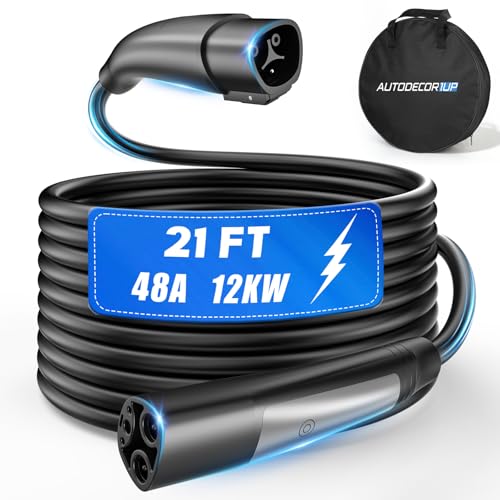
Autodecor 1Up 48A Tesla Extension Cable
Extends a Tesla Wall or Mobile Connector.
How an EV Charger Extension Cord Works
An EV extension does not touch the outlet or the wall wiring. One end is a socket that accepts your charger’s handle, and the other end is a plug that goes into the car. The charger still talks to the car through the extra length, so it can start, pause and end a session as usual.
- Connector type: J1772 extensions suit most non-Tesla EVs and plug-in hybrids. NACS extensions suit Tesla models and other cars with a native NACS port.
- Amp rating: buy one rated at or above the charger’s setting. Your car charges at the lowest rating among the charger, the extension and its own onboard charger.
- Length: measure the walking route from the handle to the port, around the bumper and any shelving, then add a little slack.
- Weather rating: IP66 and IP55 describe dust and water resistance, not permission to leave the joint in a puddle.
Every extra joint is one more spot where heat can build if the contacts are dirty or loose. Before buying the best EV charger extension cord for your setup, read the charger’s manual, because some makers do not allow extensions and may refuse a warranty claim if one was used.
EV Charger Extension Cord Level 1: Is a Household Cord OK?
A Level 1 cord pulls a steady current from a 120-volt outlet for many hours. Many portable charger manuals tell owners not to plug into a household extension cord or power strip for that reason. The safer answer is a J1772 or NACS extension on the car side, so the charger itself still plugs straight into the wall.
OSHA’s guidance on flexible cords notes that cords are more prone to damage than fixed wiring and can be cut by door or window edges and fastenings. A cord shut in a garage door every evening is exactly that risk. If the outlet is simply in the wrong place, ask a licensed electrician to add a dedicated receptacle closer to where you park.
Best EV Charger Extension Cord Picks, Reviewed
Four J1772 cables and two NACS cables made the list, from 32 to 50 amps and about 20 to 21 feet long. Specs below are as each Amazon listing states.
1. SEGUMA EV Charger Extension Cable: 50A 20 ft J1772 with IP66 Rating
- Listed at up to 50 amps
- 20 ft J1772 socket-to-plug cable
- Silver-plated inlet, copper TPE cable
- IP66, UL Listed per the listing title
SEGUMA’s cable adds 20 feet between a J1772 charger handle and the car’s port, and the listing rates it for up to 50 amps. That rating gives headroom over a 48-amp hardwired wall unit, so the extension should not become the limit on a typical home Level 2 setup. It also works with Level 1 cords that use a J1772 handle, for plug-in hybrids and EVs alike.
The listing describes 100% copper wire in a TPE jacket, a silver-plated inlet where the charger handle seats, and an IP66 rating against dust and water. The product title calls it UL Listed, which is worth having on a cable that carries heavy current for hours. A storage bag comes in the box, and SEGUMA lists a one-year guarantee covering quality issues.
This is a sensible all-round choice for a garage where the wall unit sits on the wrong side of the car or the car often parks just outside the door. At 20 feet it is shorter than some rivals, so measure the route before ordering. It will not help a Tesla with a native NACS port unless you add an adapter, and adapter makers do not always approve that stack, so check both manuals first.
View SEGUMA 50A J1772 Extension Cable on Amazon
2. VEVOR EV Charger Extension Cable: 48A 21 ft J1772 for Level 1 and Level 2

- Listed at 48 amps, 120V to 240V
- 21 ft length
- IP66, rated -22F to 122F
- Bag, cleaning cloth and cable tie
VEVOR’s 21-foot J1772 extension is listed at 48 amps and works on both 120-volt and 240-volt chargers, so the same cable can follow you from a Level 1 cord at a relative’s house to a Level 2 unit at home. The 48-amp rating matches the top setting of many hardwired J1772 wall chargers, though not a 50-amp setting.
The listing states an operating range from minus 22 to 122 degrees Fahrenheit, IP66 protection and fire-resistant materials. The handle is PC and ABS plastic over copper conductors in a TPE jacket, with an ergonomic grip for plugging in with cold hands. VEVOR includes a carrying bag, a cleaning cloth for the connectors and a cable tie, which helps keep salt grit off the pins between uses.
That stated cold range makes it a reasonable pick for a driveway setup through a Michigan winter, where a second car often charges outside the garage. It is still a joint in the line, so lift it off wet ground and keep it clear of the snowblower. Owners whose charger runs at 50 amps should choose a 50-amp extension or set the charger at 48 amps or lower.
View VEVOR 48A J1772 Extension Cord on Amazon
3. leheyhey J1772 Extension Cable: 32A 21 ft for Level 1 and PHEV Charging
- Listed at up to 32 amps, 120V to 240V
- 21 ft J1772 cable
- IP66, jacket flexible to -30C
- Silver-plated inlet, pure copper wire
Not every car needs a 50-amp cable. leheyhey’s 21-foot J1772 extension is listed at up to 32 amps on 120 to 240 volts, which covers a Level 1 cord and the smaller Level 2 chargers that many plug-in hybrid owners use. Because the car already accepts less current, a lighter cable can do the job without slowing anything down.
The listing describes pure copper conductors, a silver-plated inlet, an IP66 dust and water rating and a TPU and PVC jacket meant to stay flexible in cold down to minus 30 Celsius. It also mentions protection against over-voltage, over-current and short circuits. The seller states it works with J1772 EVs and PHEVs, and with Tesla models through a J1772 adapter.
This suits a household where the factory Level 1 cord reaches the outlet but not the car, which is the safer fix than plugging that cord into a household extension. It is the wrong choice for a 40-amp or 48-amp wall unit, because the extension would then be rated below the charger. In that case turn the charger down to 32 amps or pick one of the higher-rated cables here.
View leheyhey 32A J1772 Extension Cable on Amazon
4. VIVAVOLT J1772 EV Extension Cable: 40A 20 ft with 9.6 kW Continuous Rating

- Listed for 40A and 9.6 kW continuous
- 20 ft, with longer lengths offered
- UL listed charging wire per the listing
- IP55 both ends, -22F to 122F
VIVAVOLT pitches this cable at the common 40-amp plug-in charger that runs from a NEMA 14-50 outlet. The listing gives a 9.6 kW continuous rating at 40 amps on a 20-foot J1772 cable, and the same listing offers other lengths from 20 up to 50 feet for longer routes. That makes it a direct match for that charger rather than an oversized cable.
Construction per the listing is a PC and ABS plug with silver-plated pure copper conductors and a high-strength TPE jacket. VIVAVOLT says it uses UL listed charging wire with thicker conductors to keep surface temperatures safe during long sessions. Both ends carry IP55 protection, with an operating range from minus 22 to 122 degrees Fahrenheit, and a weatherproof storage bag comes with every order.
IP55 is a lower water rating than the IP66 cables in this list, and the maker itself says to avoid direct exposure in heavy downpours. That points to a garage or carport where the cable stays mostly dry, rather than a joint lying in an open driveway. Owners of 48-amp hardwired chargers should look at the higher-rated picks, or set their charger to 40 amps when using it.
View VIVAVOLT 40A J1772 Extension Cable on Amazon

5. Autodecor 1Up Tesla Charger Extension Cable: 48A 21 ft NACS with IP66 When Connected
- Listed at 48 amps, 240 volts
- 21 ft NACS cable
- Silver-plated copper, UL certified exterior
- IP66 when connected, carrying bag
For a Tesla, or another car with a native NACS port, a J1772 cable is the wrong shape. Autodecor 1Up’s 21-foot NACS extension is listed at up to 48 amps on 240 volts and is made for Level 1 and Level 2 use with Tesla Wall Connectors, Mobile Connectors and destination chargers. The listing names Model 3, Y, S, X and Cybertruck.
The listing describes 5-micron silver-plated copper wiring in a UL certified thermoplastic exterior that resists bending, heat and corrosion. It is rated IP66 only while the joint is plugged together, so cap or bag the ends when the cable is stored. A carrying bag and an instruction sheet come in the box.
Two limits are spelled out in the listing. It is not for Superchargers, and the button on its handle cannot open the car’s charge port, so you open the port from the touchscreen or the app. That suits a driver who wants to charge a Tesla in the driveway without shuffling cars in the garage. A Wall Connector set at a higher current than 48 amps needs a higher-rated cable, or a lower charger setting, before you use this one with it.
View Autodecor 1Up 48A Tesla Extension Cable on Amazon
6. bokman Extension Cord for Tesla: 50A 21 ft NACS with Charging Lock

- Listed at 50A, 240V, 12 kW
- 21 ft NACS cable
- TPE jacket, -30C to +50C
- Locks to the car during charging
bokman’s NACS extension is the higher-rated of the two Tesla cables here, listed at 50 amps, 240 volts and 12 kW over 21 feet. That leaves headroom for a Tesla Wall Connector on a high setting, and it also works with Mobile Connectors and destination chargers according to the listing, for Model 3, Y, S, X and Cybertruck.
The jacket is high-strength TPE with a stated range of minus 30 to plus 50 Celsius, which covers a cold garage or driveway in a Grand Rapids winter. The listing calls out a secure lock that holds the plug in the car while it charges. Like the other NACS cable, it will not work at Superchargers, and its handle has no button to open the charge port.
Unlike the factory Tesla handle, this one has no release button either. To unplug, you stop charging from the car’s screen or the Tesla app first, and the listing stresses doing that every time. Some owners will like the lock outdoors, while others may find the extra step a nuisance. If your charger runs at 48 amps or less, the Autodecor 1Up cable covers the same job.
View bokman 50A NACS Extension Cord on Amazon
Matching the Extension to Your Charger and Car
| Your setup | Connector | Listed rating | Pick |
|---|---|---|---|
| 48A hardwired J1772 wall unit | J1772 | 50A, 20 ft | SEGUMA |
| J1772 charger, frequent winter use outdoors | J1772 | 48A, 21 ft | VEVOR |
| Level 1 cord or a plug-in hybrid | J1772 | 32A, 21 ft | leheyhey |
| 40A plug-in J1772 charger, mostly in a garage | J1772 | 40A, 20 ft | VIVAVOLT |
| Tesla Mobile or Wall Connector | NACS | 48A, 21 ft | Autodecor 1Up |
| Tesla Wall Connector at a higher setting | NACS | 50A, 21 ft | bokman |
Two mistakes come up often. Stacking an adapter on an extension adds another joint, so confirm the adapter maker allows it. Pairing a 32-amp cable with a 48-amp wall unit makes the cable the weak link, so turn the charger down or buy a higher-rated extension.

Driveway Charging Through a Grand Rapids Winter
An extension often lets a second car charge in the driveway, and here that means months of slush, plow ridges and road salt. Run the cable where a snowblower blade or a plow will not catch it. Keep the joint off the ground, on a hook or a short stand, so meltwater cannot pool around it and freeze overnight.
Several of the listings above state a rated range down to about minus 22 degrees Fahrenheit. Wipe salt and grit off both ends before storing the cable, since a dirty pin can heat up when charging resumes.

A plug-in car that sits in the cold still depends on its 12-volt battery to wake up and accept a charge, and a tired one can look like a charging fault. Our guide to the best car battery for hybrids covers replacements. For running a laptop or a small tool from the car, a power inverter for your car does that job, though it cannot charge an EV.
Signs the Problem Is the Car, Not the Cable
Even the best EV charger extension cord wears out. Stop using one that feels hot at the joint, shows melted plastic or discolored pins, or makes the car drop the session. Swap back to the charger’s own cable to see whether the fault follows the extension.

New circuits, breakers and receptacles belong with a licensed electrician working to local code. If the car still refuses to charge on the original cable, or the dash keeps showing electrical warnings, our car electrical repair service in Grand Rapids can test the car’s 12-volt system and wiring.
More Buying Guides
Frequently Asked Questions
What is the best Level 2 EV charger extension cord?
For a J1772 wall unit, choose a cable rated at or above the charger’s setting. The SEGUMA and VEVOR cables list 50 and 48 amps, enough for a 48-amp charger. A 40-amp plug-in charger can use the VIVAVOLT 40A.
Is there an EV charger extension cord for Tesla?
Yes. NACS extensions such as the Autodecor 1Up and bokman connect a Tesla Wall or Mobile Connector to the car. Neither works at a Supercharger, and their handle buttons do not open the charge port, so open it from the screen or app.
Does an extension cord slow down EV charging?
Not if it is rated for the current. The car charges at the lowest rating among the charger, the extension and its onboard charger, so a cable rated below your charger’s setting becomes the limit.
What is the best extension cord for an EV charger on Level 1?
A J1772 extension like the leheyhey 32A, used between the charging cord’s handle and the car. Many charger makers advise against household extension cords, so plug the charger itself straight into a properly wired outlet.
Has a new extension left your EV throwing charge faults, or does the car go dead in the driveway on frosty mornings? Ring our service desk at 616-279-3832 from 8am to 5pm on weekdays, or send us the fault details through the contact page.
If your EV needs a closer look, bring it to 456 Carrier St NE in Grand Rapids. If daytime hours do not work, leave the car in our after-hours drop-off along with a short note on when the charging fault shows up.