
As an Amazon Associate, 456 AutoFix earns from qualifying purchases. Product links below go to Amazon, where you can confirm the right part for your vehicle.
A friend’s car slides into a snowbank, or a dead battery leaves a car stuck at the far end of a parking lot. The best tow strap for those moments is a rated, well-made strap that fits in a trunk corner and connects safely to proper tow points on both vehicles.
This guide explains strap ratings, hooks versus loops and safe pulling. After that come five straps and kits sold on Amazon in the US for everyday cars, crossovers and light pickups.
Quick answer
What is the best tow strap for a car?
For most drivers, a 2 inch by 20 foot polyester strap rated around 10,000 lb, such as the Rhino USA Tow Strap with Hooks, covers short roadside tows. A strap with looped ends, like the Grip 30 ft, is safer for pulling a car out of snow, and the Rhino USA Recovery Combo Kit adds shackles.
Our Quick Picks
Three places to start: a hooked strap for roadside tows, a looped strap for pulls off the shoulder and a kit with shackles and a receiver mount. All five straps are reviewed below.

Rhino USA Tow Strap with Hooks
A hooked strap made for slow tows on paved roads.

Grip 30 ft x 4 in Tow Strap
A wide strap with sewn loops for use with shackles or tow eyes.

Rhino USA Recovery Combo Kit
A static strap packaged with the hardware to connect it safely.
What Separates a Good Tow Strap From a Risky One
Breaking strength is the load at which the webbing or stitching fails. Working load limit is the much lower figure you should stay under in normal use, and a careful maker lists both. Grip, for example, lists 6,666 lb working and 20,000 lb breaking on its 30 foot strap.
A common rule of thumb for the best tow strap rating is a breaking strength of two to three times the weight of the vehicle being pulled. A midsize sedan usually weighs 3,000 to 4,500 lb, so a strap near 10,000 lb suits it. Even the strongest tow strap cannot make up for a weak anchor point on the car.
- Length: 20 feet is the usual size and keeps the towed car close enough to follow. A 30 foot strap helps when the stuck car sits off the road edge and the other vehicle needs to stay on firm ground.
- Width: 2 inch webbing handles passenger cars, while wider straps suit trucks.
- Material: polyester stretches little, which suits steady towing. Nylon stretches more and is used for kinetic recovery, which is a different job.
Hooks, Loops or a Full Kit?
Hooked straps are quick to use and suit a slow on-road tow from a solid tow eye or frame-mounted hook. Their weak point is the hook itself: if it slips or the strap fails, a steel hook can fly back with real force. Pick hooks with spring safety latches and never point them toward people.
Looped ends have no metal in the strap, so they are the safer choice for pulling a car out of a snowbank or ditch. You join a loop to a rated recovery point with a D-ring shackle, or thread it through a screw-in tow eye. A tow strap kit bundles the strap with matching shackles. Avoid looping a strap around a hitch ball, since the ball is not rated for a sideways or sudden load.
Best Tow Strap Picks for Everyday Drivers
The five straps below cover hooked roadside straps, looped straps and one starter kit. Ratings, lengths and contents come from each Amazon listing.
1. Rhino USA Tow Strap with Hooks: 2 in x 20 ft, 10,321 lb Break Strength for Roadside Towing
- 2 in x 20 ft webbing
- 10,321 lb break strength
- Forged steel hooks with spring keeper clips
- Bright green with reflective stitching
Rhino USA built this strap for one specific job: moving a disabled vehicle on paved roads. The listing describes it as an on-road strap for highways, city streets and parking lots, and the title states plainly that it is not meant for off-road recovery. It measures 2 inches wide by 20 feet long and carries a listed break strength of 10,321 lb, which suits most passenger cars, crossovers and small SUVs.
Each end has a forged steel hook with a spring-loaded keeper clip. Rhino says the clip helps stop the hook from slipping off the anchor point while the strap is under load. The webbing is bright green with reflective stitching, so other drivers can see the line between two cars more easily at dusk or in falling snow. The maker backs the strap with a lifetime replacement policy that covers rips, tears and fraying.
This is a sensible trunk strap for drivers who want something simple for an occasional short tow. Hook it only to a tow eye or a frame-mounted tow hook, never to a bumper or hitch ball. For pulling a car out of a ditch or deep snow, a looped strap with shackles is the better tool, since hooks are the part most likely to cause harm if anything fails.
View Rhino USA Tow Strap with Hooks on Amazon
2. QWORK Towing Strap: 2 in x 30 ft, 11,000 lb Capacity with Snap Safety Hooks
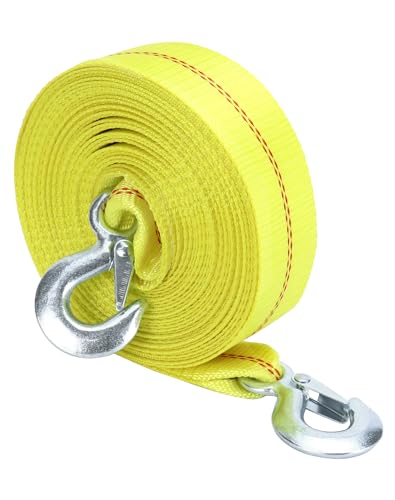
- 2 in x 30 ft polyester webbing
- 11,000 lb maximum capacity
- Snap-on safety hooks on both ends
- Rust-resistant hooks, rot-resistant strap
QWORK’s strap uses the same 2 inch width as most car straps but adds length, measuring 30 feet in total. The listing gives a maximum towing capacity of 11,000 lb, describes it as a 5 ton strap and pitches it for recovering stuck or broken-down vehicles. The extra reach is the main reason to choose it over a 20 foot strap.
Each end has a quick snap-on safety hook, so connecting to a tow eye takes only a few seconds with gloves on. QWORK says the hooks are rust resistant and the polyester webbing resists rot, two useful traits for gear that rides through a salty winter in a trunk. The strap comes boxed for storage, which keeps it tidy and away from sharp tools or battery acid in a cargo area.
A 30 foot strap helps when a car has slid off the shoulder and the other vehicle needs to stay on solid pavement, well away from the soft edge. That longer gap also makes the towed car slower to react, so it suits short pulls more than towing down a street. Hook only to tow eyes or frame hooks, and pull slowly with steady throttle rather than a jerk.
View QWORK 30 ft Tow Strap on Amazon

3. Grip Heavy Duty Tow Strap: 4 in x 30 ft, 20,000 lb Breaking Capacity with Reinforced Loops
- 4 in x 30 ft polyester web strap
- 6,666 lb working capacity
- 20,000 lb breaking capacity
- Reinforced looped ends, no hooks
Grip’s heavy duty strap swaps metal hooks for reinforced looped ends. It is 4 inches wide and 30 feet long, and the listing gives both of the figures that matter: a working capacity of 6,666 lb and a breaking capacity of 20,000 lb. Grip lists cars, ATVs, SUVs, boats and light trucks as typical loads.
The webbing is polyester, which the maker describes as abrasion and weather resistant and says will not rot or tear in extreme conditions. Wide webbing spreads the load and is less likely to roll or twist into a narrow rope while you pull. Because the ends are sewn loops, there is no steel hook on the strap to fly back if something lets go, which is why many drivers prefer this style for anything beyond a gentle tow.
Loops need a matching connection. Thread a loop through a screw-in tow eye, or join it to a rated recovery point with a D-ring shackle. Do not drop a loop over a hitch ball. With 30 feet of length and a high working rating, this strap suits a family that keeps one strap for both a car and a light pickup, and it works well for pulling a car out of a snowbank.
View Grip 30 ft x 4 in Tow Strap on Amazon
4. JCHL Recovery Tow Strap: 2 in x 20 ft, 26,000 lb Break Strength with Reinforced Loops

- 2 in x 20 ft high strength polyester
- 26,000 lb break strength
- Reinforced loops with protective sleeves
- Storage bag included
JCHL’s looped strap keeps the common 2 inch by 20 foot size but drops the hooks. The listing gives a break strength of 26,000 lb and describes the high strength polyester as durable and UV resistant. JCHL states a maximum stretch of 10 percent under load, so the strap gives a little without behaving like a stretchy recovery strap.
Both ends are reinforced loops fitted with protective sleeves, which help shield the webbing where it wraps around a shackle or a tow eye. JCHL lists vehicle towing, pickups, ATVs and SUVs among its uses, along with work as a tree saver or winch extension strap. The listing says the strap is built to work in all climates without shrinking. It rolls up into the included storage bag, which keeps it compact enough for a small trunk.
This strap suits drivers who like the safety of loops but want something smaller than a 30 foot heavy strap. Pair it with a D-ring shackle or a soft shackle and a rated recovery point, or thread a loop through a screw-in tow eye. Remember that a high break figure does not make a weak anchor stronger, so the attachment points still set the real limit.
View JCHL Tow Strap with Reinforced Loops on Amazon
5. Rhino USA Recovery Combo Kit: 20 ft Tow Strap, D-Ring Shackles and Hitch Receiver
- 20 ft static tow strap, 31,518 lb break strength
- Two D-ring shackles, 41,850 lb capacity
- Hitch receiver anchor point
- Backed for life, per the listing
Rhino USA’s combo kit is the simplest way to buy a matched set rather than a single strap. It pairs a 20 foot static tow strap, listed at 31,518 lb break strength, with D-ring shackles listed at 41,850 lb capacity and a hitch receiver that turns a trailer hitch into a proper anchor point. Rhino calls it an entry level kit for basic recovery needs.
The receiver slides into a hitch receiver and holds a shackle, so the strap loop never goes over a hitch ball. That one detail removes a common and dangerous mistake. The shackles let you connect the strap loops to rated recovery points on the other vehicle, and because the strap is static, it suits steady pulls rather than snatch recoveries. Rhino states that its gear is backed for life against failure.
This kit makes most sense for a pickup or SUV with a receiver hitch, since that vehicle usually does the pulling. A car without a hitch can still use the strap and shackles with a frame recovery point or a tow eye, depending on the eye’s design. Check that the receiver size on the listing matches your hitch before you order, and keep the shackle pins hand tight and backed off a quarter turn.
View Rhino USA Recovery Combo Kit on Amazon
Tow Strap vs Chain, Rope and Tow Hook
A tow hook is not a pulling line at all: it is the anchor point on the vehicle that a strap, chain or rope attaches to.
| Option | Strength and stretch | Main drawback | Good fit |
|---|---|---|---|
| Polyester tow strap | High rating, little stretch | Hooks can fly if the strap fails | Short, slow tows on pavement |
| Tow chain | Very strong, no stretch | Heavy, scratches paint, shock-loads parts | Farm and equipment use |
| Braided tow rope | Often lower rated | Can fray and stretch unevenly | Light vehicles, occasional use |
| Tow hook or tow eye | Rated by the vehicle maker | Must match the vehicle’s mount | The anchor every line needs |
A strap is lighter and kinder to bumpers than a chain, and it absorbs a little shock that a chain would pass straight into the tow points. Check any rope’s rating before trusting it with a full-size car.
How to Use Tow Straps Without Damaging Either Car
Start with the owner’s manual of the car being towed. Many vehicles keep a screw-in tow eye with the spare tire, and the manual shows where it threads in. The manual also says whether the car may be towed with its drive wheels on the ground, since many automatic transmissions and all-wheel drive systems limit or forbid it.
- Attach only to the tow eye, a frame-mounted tow hook or a rated recovery point. Skip bumpers, tie-down slots, axles, suspension arms and hitch balls.
- Drape a heavy jacket over the middle of the strap.
- Keep bystanders clear and agree on signals first.
- Take up the slack slowly, then pull at walking pace with steady throttle. Never back up and yank the strap.
- The driver of the towed car keeps the ignition on so the steering wheel stays unlocked, and brakes gently to keep the strap taut.
With the engine off, the towed car steers heavily and needs a firm brake pedal. Keep any tow short and slow, and call a tow truck for anything farther than a safe spot nearby.
Snowbanks, Ditches and West Michigan Winters
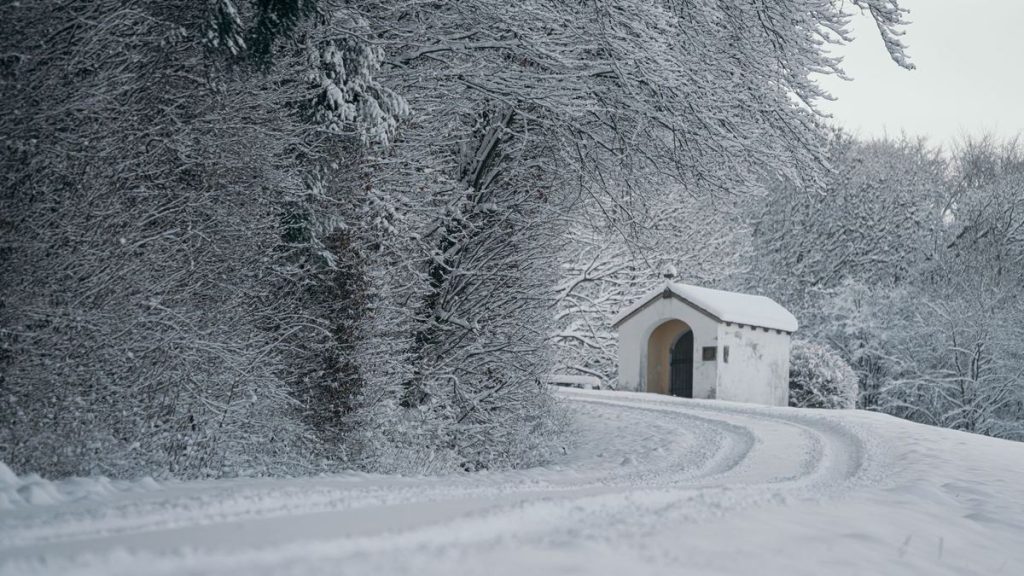
Lake-effect snow can turn a familiar road into a line of cars sitting in the shoulder. AAA’s winter driving tips point to AAA Foundation research linking winter weather to nearly half a million crashes and more than 2,000 road deaths each winter, and they urge drivers to keep cold-weather gear in the car.
Our guide to the best car emergency kit for winter covers the rest of that bag. Road salt attacks steel hooks, so rinse and dry them after use.
Plenty of winter tows start with a car that simply will not turn over. Before you reach for a strap, read our article on why a car is not starting in cold weather, since a jump or a fresh battery may solve it. Our winter car maintenance checklist helps you catch weak batteries and worn tires before the first storm.

When a Pull Turns Into a Repair
Sliding into a curb hidden under snow, or being dragged out sideways, can bend a tie rod or a control arm. Watch for a crooked steering wheel, a pull to one side or a clunk over bumps afterward.
Have those signs checked soon. Our technicians handle suspension repair in Grand Rapids, as well as steering and brake work.
More Buying Guides
Frequently Asked Questions
What length tow strap should I buy?
For the best tow strap length, 20 feet suits most roadside tows and keeps the two cars close. Choose 30 feet if you often need to pull a car from a ditch or snowbank while the other vehicle stays on solid pavement.
Is a tow strap the same as a recovery strap?
No. A tow strap is built to stretch very little for a steady pull, while a recovery strap is usually nylon that stretches to store energy for a snatch pull. Do not yank a stuck vehicle with a static tow strap.
Can I attach a tow strap to a trailer hitch ball?
No. A hitch ball is made for a trailer coupler pushing and pulling in line, not for a strap loop, and it can snap off under a sideways or sudden load. Use a hitch receiver shackle mount or a frame tow hook instead.
Is a tow strap better than a chain?
For cars, usually yes. A strap is lighter, will not scratch paint and absorbs a little shock, while a chain has no give and is heavy to carry. Chains suit farm and equipment work more than roadside help.
Car pulling to one side since it came out of the snowbank? Reach 456 AutoFix at 616-279-3832 on any weekday between 8am and 5pm, or set up an appointment through our contact page.
Working the same hours we do? Drop the car at 456 Carrier St NE in Creston after hours and collect it when the job is finished.