
As an Amazon Associate, 456 AutoFix earns from qualifying purchases. Product links below go to Amazon, where you can confirm the right part for your vehicle.
A camper or a loaded car hauler with electric brakes will not stop well on its own. The truck needs a controller that tells those trailer brakes when and how hard to work. The best trailer brake controller for you is the one that matches your trailer’s axle count, the way you tow and how often the controller moves between vehicles.
Below we explain what a controller does and how to choose one, then review six units from Tekonsha, CURT, REDARC and Hopkins. Planning a first trip with a wide trailer? Pair this with our guide to the best tow mirrors for seeing past the trailer.
Quick answer
Which trailer brake controller should you buy?
For most campers and boat trailers, a proportional controller such as the Tekonsha Primus IQ or CURT TriFlex Next gives the smoothest stops. If you switch trucks, the CURT Echo plugs into the 7-way socket. For a light utility trailer, a time-delay unit like the CURT Venturer Next is simpler.
Our Quick Picks
Three quick picks: a proportional under-dash unit, a mobile plug-in controller and a simple time-delay option. All six controllers are reviewed below; confirm the harness for your year and trim before ordering.

Tekonsha Primus IQ
Compact under-dash unit with boost and an LED readout.

CURT Echo Kit
Plugs in at the bumper and runs from a phone app.

CURT Venturer Next
Simple set-and-go unit with adjustable ramp time.
What a Trailer Brake Controller Does
Most larger trailers use electric drum brakes. Each brake has an electromagnet that grabs the drum when current flows through it. The controller is the box that sends that current, using the brake signal from your tow vehicle and a power setting you choose.
That is the whole purpose of a trailer brake controller: it lets the trailer slow itself instead of pushing the truck. Without it, the tow vehicle’s brakes do all the work, stopping distances grow and the trailer can shove the back of the truck sideways in a hard stop.
Whether a trailer needs brakes depends on its weight and state rules, so check the trailer maker’s documents and current Michigan requirements. Towing capacity and tongue weight come only from your owner’s manual and hitch placard.
How to Choose: Proportional, Time-Delay or Mobile
- Proportional: a motion sensor reads how quickly the truck is slowing and applies matching trailer braking.
- Time-delay: the controller ramps up to the power you set over a fixed time. It is simpler, but brakes the same on every stop.
- Mobile or wireless: the unit plugs into the 7-way socket at the bumper and you adjust it from a phone app.
- Axles and brakes: check how many brakes the unit can drive.
- Harness: many trucks have a plug for a controller behind the dash, but the vehicle-specific adapter is often sold separately. Confirm the right one for your year and trim.
Some newer pickups come with a factory controller built into the dash. If yours has one, you may not need an aftermarket unit at all. Brake controller wiring on older vehicles may need a shop, because it ties into the brake light circuit and needs a properly fused power feed.
Best Trailer Brake Controller Picks: Six Units Reviewed
These six cover proportional, time-delay and mobile designs, and each one makes a case for the best trailer brake controller in a different setup. None fits every vehicle, so confirm the harness and mounting for your year and trim on Amazon before ordering.
1. Tekonsha 90160 Primus IQ: Proportional Controller for 1-3 Axle Trailers
- Proportional braking with an inertia sensor
- Boost with three extra power levels
- LED display with self-diagnostics
- Snap-in dash clip; harness sold separately
The Primus IQ is one of Tekonsha’s long-running proportional controllers, and it suits the most common towing setups: single and tandem axle campers, boat trailers and car haulers with electric brakes. It works with trailers that have one to three axles, so it can drive two, four or six brakes. An internal inertia sensor reads how quickly the truck slows and applies the trailer brakes to match, which gives smoother stops than a fixed ramp.
Tekonsha’s Primus IQ product page says the unit is self-leveling when mounted within a 90-degree vertical range and works proportionally in reverse, which helps when backing down a ramp. A power knob sets the output, and a Boost button adds up to three levels of extra braking for heavier loads. The LED display shows the setting and runs a self-check of the trailer connection.
A snap-in dash clip and a removable connector let you unplug the controller and stow it when you are not towing. The vehicle-specific wiring harness is sold separately, so check which adapter suits your truck before ordering. It does not have a smartphone app or a remote dial, and trailers with four axles need a larger unit.
View Tekonsha Primus IQ on Amazon
2. CURT 51146 TriFlex Next: Proportional Controller with Triple-Axis Sensor

- Triple-axis motion-sensing accelerometer
- Adjusts power going up or down hills
- Operates 2 to 8 trailer brakes
- Low-profile body and dash bracket
The TriFlex Next is CURT’s proportional under-dash controller for bigger trailers. It operates two to eight brakes, which covers single axle trailers up to four-axle setups, so it suits larger travel trailers, toy haulers and equipment trailers as well as everyday campers. The listing describes it as fully adjustable and plug-and-play, with the vehicle adapter chosen separately for your truck.
Its main feature is a triple-axis, motion-sensing accelerometer. Two axes read how hard the truck is slowing so the trailer brakes can match it, and the third reads the slope of the road. That lets the controller add a little braking power when you go downhill and ease it when you climb, which helps keep a heavy trailer from pushing the truck on long grades.
The housing is slim and low profile, and CURT’s bracket system is designed to give more knee and dash clearance than older box-style units. That matters in trucks with little room under the steering column. It is a fixed, wired controller, so it stays with one vehicle, and it has no phone app. For a small utility trailer used a few times a year, a simpler time-delay unit may be enough.
View CURT TriFlex Next on Amazon

3. CURT 51181 Echo Kit: Mobile Bluetooth Controller with Manual Override Button
- Plugs into a 7-way connector, no tools
- Smartphone app over Bluetooth
- Triple-axis accelerometer braking
- Dash button for manual braking
The Echo is a different kind of controller. Instead of mounting under the dash, it plugs into the 7-way trailer connector at the back of the truck and links to your phone over Bluetooth. You set and watch the brakes through CURT’s Smart Control app, and a locking tab and strap hold the unit in the socket. Because nothing is wired in, it moves easily between trucks and trailers.
Braking comes from a triple-axis accelerometer, so it works proportionally like an under-dash unit. The listing says it keeps braking normally even if the phone screen locks, a call comes in or the Bluetooth link drops. This Echo Kit adds a manual override button with an adhesive pad for the dash, so you can apply the trailer brakes without reaching for your phone. Adjust settings only while parked.
It works with trailers that have one or two axles, which means two to four brakes, so it suits most single and tandem campers and boat trailers but not triple-axle rigs. The listing says it is compatible with cruise control, anti-lock brakes and low-voltage systems. Your tow vehicle needs a working 7-way socket, so check that the plug and its wiring are in good shape before relying on it.
4. REDARC Tow-Pro Elite: Dual-Mode Controller with Remote Dash Dial
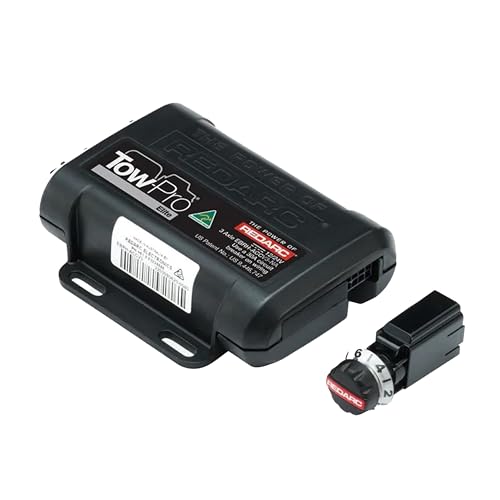
- Proportional and user-controlled modes
- Supports trailers with 1 to 3 axles
- Compact remote head dial
- 12V and 24V compatible
REDARC is an Australian maker, and the Tow-Pro Elite was designed for long towing trips on mixed roads. Its main difference from the other units here is the choice of two braking modes. Proportional mode applies the trailer brakes to match how hard the truck slows, which suits highway driving. User-controlled mode lets you set a fixed braking level yourself, which can help on loose gravel, steep boat ramps or rough tracks.
Instead of a full box on the dash, the main unit hides out of sight and you get a small remote head with a dial. That keeps your knees clear and gives a cleaner look in the cab. The kit includes the remote head, its cable and bezel, the main unit wiring and a universal switch insert panel. The listing also mentions active calibration and sway control.
The Tow-Pro Elite supports trailers with one to three axles and works on 12V and 24V systems, so it suits most pickups and SUVs that tow campers, boats or small car haulers. Confirm the harness and mounting for your year and trim, and plan a little more install time for the remote head than for a clip-on box. It is not a mobile unit.
View REDARC Tow-Pro Elite on Amazon

5. CURT 51116 Venturer Next: Time-Delay Controller for 1-3 Axles
- Time-delay braking, fully adjustable
- Adjustable power and ramp time
- Operates 2 to 6 trailer brakes
- No moving parts, no leveling needed
The Venturer Next is CURT’s time-delay controller, and it suits owners who tow a utility trailer, small camper or lawn equipment trailer now and then. When you press the truck’s brake pedal, it ramps the trailer brakes up to the power level you have set over a short time. It does not sense how hard you are stopping, so the trailer brakes the same way on a gentle stop as on a firmer one.
Both the output power and the ramp time are adjustable, so you can tune it to the trailer and load. It operates two to six brakes, covering trailers with one to three axles. Because it has no internal motion sensor and no moving parts, it needs no leveling and can be mounted at whatever angle fits your dash, which makes placement easy in a crowded cab.
Like the TriFlex Next, it uses CURT’s slim, low-profile housing and a bracket designed to improve dash clearance, and the listing describes it as plug-and-play with the vehicle adapter bought separately. It is a fixed controller, so it stays in one vehicle. If you tow a heavy camper in stop-and-go traffic or down long hills, a proportional unit will usually feel smoother.
View CURT Venturer Next on Amazon
6. Hopkins 47235T Impulse: Time-Based Controller for Up to 6 Brakes
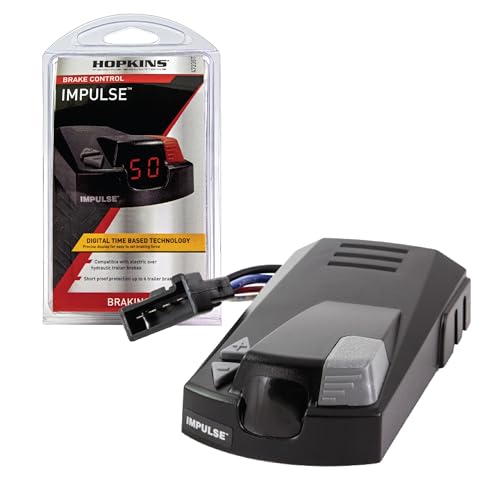
- Time-based braking actuation
- Output adjustable from 5% to 99%
- Mounts at any angle
- Vertical manual slide and digital display
The Hopkins Impulse is a time-based controller, which works the same way as a time-delay unit: it applies the trailer brakes and builds up to your chosen setting over a set time. Hopkins aims it at everyday towing, such as a small camper, a utility trailer or a landscaping trailer, where a simple and predictable setup matters more than proportional braking.
Output is adjustable from 5% to 99% on a digital display, so you can set the braking in fine steps and see the number at a glance. A vertical manual slide lets you apply the trailer brakes on their own, which is useful for testing the setup in a parking lot or calming a trailer that starts to sway. It controls up to six trailer brakes, enough for most single, tandem and triple-axle trailers.
The unit can be mounted at any angle, and Hopkins connects it through its Plug-In Simple system and a vehicle-specific harness, and the listing says it is short-proof protected. Confirm the right adapter for your vehicle before buying. As with any time-based controller, braking does not adjust to how hard you stop, so heavier trailers usually do better with a proportional design.
View Hopkins Impulse on Amazon
Matching the Controller to Your Trailer
Use this table to narrow the list. The best trailer brake controller for a tandem camper is not always the right one for a small utility trailer.
| Your towing | Controller type | Units from this list |
|---|---|---|
| Single or tandem camper, regular trips | Proportional, under dash | Tekonsha Primus IQ, CURT TriFlex Next |
| Triple-axle or larger trailer | Proportional, up to 8 brakes | CURT TriFlex Next |
| Borrowed or shared trucks | Mobile, 7-way plug-in | CURT Echo Kit |
| Gravel roads and boat ramps | Dual mode with remote dial | REDARC Tow-Pro Elite |
| Light utility trailer, occasional use | Time-delay | CURT Venturer Next, Hopkins Impulse |
Whichever unit you pick, set the gain with the trailer loaded the way you normally tow it. On a dry, empty road at low speed, apply the manual control and raise the power until the trailer brakes firmly without locking a wheel. Recheck it when the load changes.

Towing in West Michigan: Salt, Plugs and Cold Starts
Road salt is hard on trailer wiring. The 7-way socket on the bumper collects slush all winter, and green corrosion on the pins is a common reason a controller reports no connection. A dab of dielectric grease and a closed cover help, and our winter car maintenance checklist is a good time to inspect the plug.
Controllers also depend on steady voltage. A truck that is slow to crank on cold mornings may have a weak battery or charging problem, which our article on a car not starting in cold weather covers. Fix that before a long tow, since the trailer’s breakaway battery and brakes both rely on the truck’s charge line.

Spring and fall trips still meet sleet and freeze-thaw potholes, so keep a winter car emergency kit and a spare controller fuse in the truck. Trailer brake magnets and drums rust too, so have them looked at after a winter of storage.
When the Problem Is the Wiring or the Truck’s Brakes
If the display shows a short or an open circuit, the fault is usually in the wiring rather than the controller. Check the 7-way plug and the trailer’s ground first. Faults that come and go over bumps often mean a chafed wire, and our car electrical repair service in Grand Rapids can trace it on the tow vehicle side.

A controller only helps the trailer. If the truck itself pulls, pulsates or needs a long pedal to stop, towing will make it worse. Our brake repair team in Grand Rapids can inspect the pads, rotors and fluid, and our guide to brake pads for towing explains which compounds handle the extra heat.
More Buying Guides
Frequently Asked Questions
Is a proportional or time-delay brake controller better?
For campers, boats and heavier trailers, a proportional controller usually feels smoother because it matches trailer braking to how hard the truck is slowing. A time-delay unit is simpler and works well enough for a light trailer towed now and then.
Do I need a wiring harness for a brake controller?
Most under-dash controllers connect through a vehicle-specific plug-in adapter, which is often sold separately. Confirm the right one for your year, model and trim. A mobile unit like the CURT Echo plugs into the 7-way socket instead.
What is the best trailer brake controller for an RV or camper?
Most travel trailers do well with a proportional unit that handles their axle count, such as the Tekonsha Primus IQ for up to three axles or the CURT TriFlex Next for up to four. Set the gain with the camper loaded for a trip.
Why does my brake controller say no connection?
The controller cannot see the trailer’s brake magnets. Common causes are a corroded 7-way plug, a loose ground, a blown fuse or a damaged wire on the trailer. Clean and check the plug before replacing the controller.
Getting the truck ready for towing season? Talk to us at 616-279-3832 on any weekday from 8am to 5pm, or request a brake and wiring check through our contact page.
Hitched up and short on daytime hours? Park the tow vehicle at 456 Carrier St NE in Creston and leave it with our after-hours drop-off, along with a note about the trailer you tow.