
As an Amazon Associate, 456 AutoFix earns from qualifying purchases. Product links below go to Amazon, where you can confirm the right part for your vehicle.
Tap the pedal with a loaded camper behind you and the trailer either settles in with the truck or gives a shove a split second later. The proportional vs time delay brake controller choice decides which of those you feel. Both types send power to the trailer’s electric brakes, but they decide how much power, and when, in very different ways.
A proportional unit reads how hard the tow vehicle is slowing and matches it. A time-delay unit ramps power up on a timer you set ahead of time, whether you are easing to a light or stopping hard. Below we explain how each one works, what to check before buying, and compare two Tekonsha controllers (one of each type) plus a related time-delay unit from CURT with adjustable ramp time.
Quick answer
Should you buy a proportional or a time-delay brake controller?
Pick a proportional controller if you tow often, tow heavy, or drive in stop-and-go traffic, since it matches trailer braking to how hard you stop. Pick a time-delay controller for light, occasional towing or when the unit must mount at an odd angle. Either one needs correct gain settings.
Our Quick Picks
Here are the two controller types side by side, a proportional Tekonsha and its time-delay Tekonsha counterpart, plus a related third pick: a CURT time-delay unit with adjustable ramp time.

Tekonsha Brake-EVN
Matches trailer braking to how hard the tow vehicle slows.

Tekonsha Brakeman IV
Simple ramp-up braking with flexible mounting.
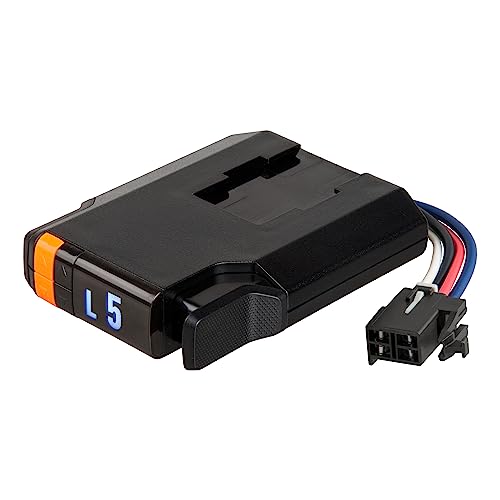
CURT Discovery Next
Time-delay braking with a ramp you can tune.
How Each Type Decides How Hard to Brake
Every electric brake controller does the same basic job. When you press the brake pedal, it sends a controlled amount of current through the 7-way connector to magnets inside the trailer’s brake drums. The difference is in how the controller works out that amount.
A proportional controller has an internal inertia sensor that feels the tow vehicle slow down. Brake gently and the trailer gets a little power, brake hard and it gets more, right away. A time-delay controller has no motion sensor. Once it sees the brake light circuit switch on, it starts at a low output and ramps up at a fixed rate until it reaches the maximum you set with the gain control.
REDARC, which builds electric brake controllers, sums it up in its explainer on electric brake controller types: time-delayed units apply power gradually on a time delay and are simple but less responsive in emergencies, while proportional units match the trailer’s braking force to the vehicle’s. That trade-off runs through the whole comparison.
| Point | Proportional | Time delay |
|---|---|---|
| How output is set | Follows how hard the tow vehicle slows | Ramps up on a timer to the gain you set |
| Feel on gentle stops | Light, matched braking | Can feel late or abrupt if not tuned |
| Feel on hard stops | Full power arrives quickly | Power still climbs on the same ramp |
| Mounting | Must follow the maker’s angle or leveling rules | Usually any angle, no leveling |
| Typical use | Frequent or heavier towing | Light, occasional towing |
Neither type replaces the trailer’s own brakes being in good shape. Worn shoes, weak magnets or corroded wiring at the hitch will make any controller feel poor. The controller only manages the current; the drums still have to do the stopping.
What to Check Before You Buy Either One
Start with the trailer. Count the axles and brakes, since controllers are rated by how many brake assemblies they can run, and confirm the trailer has electric brakes. If it uses electric-over-hydraulic brakes, check the actuator maker’s documentation, because some actuators are meant to be paired with a proportional controller only.
Next, the tow vehicle. Most aftermarket controllers plug into a vehicle-specific harness that is sold separately, and the right harness depends on the year, make, model and factory tow package. Confirm the harness fit on Amazon or with the maker before you order, and never assume one harness fits every trim. Your towing capacity and tongue weight limit come from the vehicle maker, so check the owner’s manual and the placard on the hitch, not the controller box.
Then think about where the unit will sit. A proportional controller needs to be mounted the way its manual describes so the inertia sensor reads correctly, which can be tricky in a crowded footwell. A time-delay unit is far less fussy. Some pickups also come with a factory-integrated controller in the dash, and in that case you may not need an aftermarket unit at all.
Proportional vs Time Delay Brake Controller: Three Units Compared
These three come from the same corner of the towing world: one proportional Tekonsha, its time-delay Tekonsha counterpart, and a CURT time-delay unit that lets you adjust ramp time. Each needs a vehicle-specific harness, so check fit for your tow vehicle on the listing before you buy.
Tekonsha Brake-EVN 8508220: Proportional Controller with Inertia Sensor for 1-4 Axles
- Proportional braking from an internal inertia sensor
- Runs 2, 4, 6 or 8 brakes (1-4 axles)
- Digital LED display with diagnostics and alerts
- Manual control lever; harness sold separately
The Brake-EVN is the proportional side of this comparison. Tekonsha lists it as an electric brake controller that applies trailer braking based on how hard and how quickly you press the tow vehicle’s brakes, using an internal inertia sensor to read the slowdown. As a result, a light touch at a stop sign sends a little power, and a sudden stop sends more without waiting on a timer.
The listing rates it for trailers with 2, 4, 6 or 8 brakes, which covers one to four axles. A digital LED display shows the current setting, real-time diagnostics and alerts, and a manual control lever lets you apply the trailer brakes on their own, up to the power level you have set. A Plug & Play port accepts two plug adapters, and the electrical connector is removable so the unit can be unplugged when you are not towing.
Tekonsha notes that the vehicle-specific Plug & Play wiring harness is not included, so order the correct one for your truck or SUV and confirm fit by year, model and tow package. Because it relies on an inertia sensor, mount it the way the manual describes. It suits owners who tow often or tow heavier campers and haulers, and it is more controller than a twice-a-year utility trailer needs.
View Tekonsha Brake-EVN on Amazon

Tekonsha Brakeman IV 8507120: Time-Delay Controller with Any-Angle Mounting
- Time-delayed output that ramps up at a fixed rate
- Compact body mounts above or below the dash
- Digital display with short circuit protection
- Runs 2, 4, 6 or 8 brakes (1-4 axles)
The Brakeman IV is Tekonsha’s time-delay counterpart and the other half of this comparison. Instead of sensing how hard the vehicle slows, it applies braking power that ramps up over a period of time at a fixed rate once you touch the brake pedal. Tekonsha describes it as a fit for basic, light-duty towing, which matches how time-delay controllers are usually used.
With no motion sensor to keep level, the compact unit can be installed above or below the dash and in any direction, as long as the driver can reach it. That flexibility helps in cabs where there is little room near the steering column. A digital display shows settings and diagnostics and includes short circuit protection, with a red light for increasing power to the trailer brakes and a green light for a secure trailer connection. A manual lever applies the trailer brakes up to the power you have set.
The listing rates it for 2, 4, 6 or 8 brakes, one to four axles, and the vehicle-specific Plug & Play harness is sold separately. Set the gain carefully, since a time-delay unit can feel late on gentle stops if the setting is off. It suits occasional towers with lighter utility or small camping trailers, not frequent heavy hauling.
View Tekonsha Brakeman IV on Amazon
CURT Discovery Next 51126: Time-Delay Controller with Adjustable Ramp Time
- Fully adjustable power and ramp time
- Slim, low-profile body with a dash-clearance bracket
- No internal moving parts and no leveling
- Operates 2-8 trailer brakes, plug-and-play
The Discovery Next is the related third pick, a time-delay controller from CURT that addresses the main complaint about the type. On many basic time-delay units you set only the maximum power. CURT lists both the power and the ramp time on this one as fully adjustable, so you can shorten or lengthen how quickly braking builds to suit the trailer you are pulling.
Like other time-delay controllers, it has no internal moving parts and needs no leveling, so mounting is less fussy than with a proportional unit. The body is slim and low-profile, and CURT uses its own bracket system to give more clearance under the dash. The listing says it runs 2 to 8 trailer brakes and connects with a plug-and-play setup, though the listing title and feature list give slightly different axle counts, so check the axle range against your trailer before ordering.
As with the Tekonsha units, plan on a vehicle-specific harness and confirm it for your year, model and tow package. Adjustable ramp time narrows the gap with proportional braking, but the controller still does not sense how hard you stop. It suits owners who prefer a time-delay unit for cost or mounting reasons and want more tuning than a basic model offers.
View CURT Discovery Next on Amazon

Matching the Controller to Your Trailer
The trailer and how often you tow matter more than the logo on the controller. A family that pulls a travel trailer to the lakeshore every summer weekend will notice the smoother feel of a proportional unit on every stop. Someone who borrows a utility trailer twice a year for yard waste may never feel a difference worth paying for.
| Your towing | Closer fit | Reason |
|---|---|---|
| Travel trailer or camper, many trips a year | Proportional | Smooth, matched stops in traffic and on hills |
| Car hauler or heavy equipment trailer | Proportional | Full power arrives fast in a hard stop |
| Light utility trailer, a few trips a year | Time delay | Simple setup for occasional use |
| Unit must mount sideways or at a steep angle | Time delay | No inertia sensor to level |
If you want to see more controllers before you decide, including models with boost settings and wireless designs, our roundup of trailer brake controllers for every towing setup covers a wider range of both types. The same setup advice applies to all of them: set the gain with the trailer loaded the way you actually tow it.

Seeing the trailer is part of stopping it well. When a wide camper hides the lanes behind you, extended mirrors help you judge how much room you have before you brake or merge. Our guide to tow mirrors for trucks and SUVs explains clip-on and replacement styles and how to confirm fit by year and trim.
Towing on Slick West Michigan Roads
Snow, slush and black ice in Grand Rapids put the proportional vs time delay brake controller question in a different light. On a slick road you want the trailer brakes light enough that they do not lock the trailer wheels, but present enough that the trailer does not push the truck. Many owners lower the gain in winter and test it at low speed in an empty lot before heading out.
Road salt is hard on the connections between the truck and trailer. Corroded pins in the 7-way plug can cut power to the brakes or make them work only some of the time, which no controller can fix. Clean the contacts, use dielectric grease, and add the hitch wiring to your winter car maintenance checklist so it gets looked at with the rest of the vehicle.

Cold mornings also test the tow vehicle’s battery, which feeds the controller and the trailer’s charge line. If the truck cranks slowly before a trip, sort that out first, and our article on a car not starting in cold weather walks through the usual causes. Keep a winter car emergency kit in the cab as well, since a stuck trailer on a snowy shoulder can mean a long wait.
When the Brakes or Wiring Need a Shop
Plug-and-play harnesses make most installs a matter of mounting the unit and clicking connectors together. Older trucks, vehicles without a factory tow package, and some newer models with complex wiring can still need splicing or a fuse added at the battery. If you are not comfortable with that, have a shop that handles vehicle electrical work do it.
A controller that shows a short, an open circuit, or a connection light that flickers over bumps usually points to wiring, not the controller. Our car electrical repair in Grand Rapids covers tracing faults like blown fuses and corroded connectors on the tow vehicle side.

Towing also works the tow vehicle’s own brakes harder, especially with a controller that is set too low. Spongy pedal feel, a grinding noise, or a pull to one side after a towing season are signs to have them checked, and our brake repair service in Grand Rapids handles pads, rotors and calipers for foreign and domestic vehicles. If you tow often, our guide to brake pads for towing explains which compounds handle heat best.
More Buying Guides
Frequently Asked Questions
Is a proportional brake controller worth it over a time-delay unit?
For regular or heavier towing, most owners find it is. A proportional unit matches trailer braking to how hard you stop, so gentle stops stay gentle and hard stops get full power quickly. For a light trailer used a few times a year, a time-delay unit set up correctly can do the job.
Does a proportional brake controller have to be level?
It has to be mounted the way its manual describes, because the inertia sensor reads motion. Some units ask you to level them after mounting, others self-level within a set range. A time-delay controller has no motion sensor, so most can be mounted at any angle.
Do I need a wiring harness for an aftermarket brake controller?
Usually yes. Most controllers, including the three above, plug into a vehicle-specific harness that is sold separately. Confirm the right harness for your year, make, model and tow package before ordering, and expect older or non-tow-package vehicles to need extra wiring.
How do I set the gain on a trailer brake controller?
Load the trailer as you normally tow it, then drive at a slow speed on a dry, empty surface and apply only the manual lever. Raise the gain until the trailer wheels are just short of locking, then back it off slightly. Follow your controller’s manual, and recheck on wet or snowy roads.
Trailer brakes grabbing, fading, or not working at all since you hooked up the new controller? Ring Hendrick’s team at 616-279-3832 between 8am and 5pm Monday through Friday, or tell us about your truck and trailer on the contact page.
Need the truck back before your next haul? Unhook the trailer, drive the tow vehicle to 456 Carrier St NE in Creston, and leave it overnight with our after-hours drop-off along with a note on which controller you run.