
As an Amazon Associate, 456 AutoFix earns from qualifying purchases. Product links below go to Amazon, where you can confirm the right part for your vehicle.
Every fall, salt-belt drivers who skip rubberized coatings end up asking the same thing: fluid film vs nh oil, which one goes on the frame this year? Both are soft, oily treatments that stay wet, creep into seams and get topped up rather than left alone for a decade. The differences sit in the recipe, the drip, and how each maker expects you to look after it.
Here we put a gallon of original Fluid Film beside a gallon of NHOU Original Oil, the New Hampshire brand most people still call NH Oil. A third pick, NH Oil’s V3 hybrid, covers buyers who want something between the two. Product facts come from the makers’ pages and the Amazon US listings, nothing more.
Quick answer
Should you spray Fluid Film or NH Oil on your underbody?
Pick Fluid Film if you want a lanolin treatment you can buy almost anywhere and touch up between seasons. Pick NHOU Original Oil if you prefer a thinner petroleum oil that chases water into seams, in clear or black. Both need reapplying about once a year, and both can drip at first.
Our Quick Picks
The original Fluid Film gallon against NHOU's Original Oil gallon, plus NH Oil's V3 hybrid for drivers who want less drip, all reviewed in full below.

Fluid Film 1 Gallon
The original wool wax treatment in a bulk can for a full underbody coat.

NHOU Clear Oil Gallon
NH Oil's flagship thin oil, built to migrate into seams and folds.
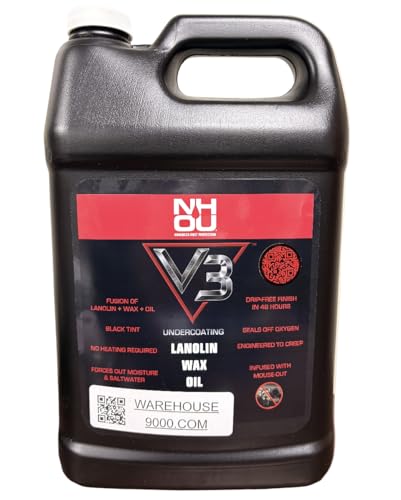
NH Oil V3 Black Gallon
NH Oil's middle-ground formula that borrows from both camps.
Wool Wax or Penetrating Oil: What Is in the Can
Fluid Film comes from Eureka Chemical Company, a family business that has made it since the 1940s, first for ships. The maker describes it as a lanolin product: processed wool wax blended with refined petroleum oils and corrosion inhibitors, with no solvents. It never dries, so the film stays tacky and moves back over small scrapes on its own.
NH Oil Undercoating is a younger, family-run outfit from New Hampshire that sells its products as NHOU. Its flagship, Original Oil, is a petroleum oil formula aimed at creeping into seams, pushing moisture out and keeping oxygen off the steel. The company also makes V3, which blends petroleum oil, wax and lanolin into one low-drip product.
In plain terms, Fluid Film leans on wool wax for staying power and NH Oil Original leans on thin oil for reach. Neither one is a hard shell. If you are weighing those against a thicker wool grease, our Fluid Film vs Woolwax comparison covers that contrast.
Side by Side on the Spec Sheet
This table uses what the two makers publish. Where one stays quiet, we say so rather than guess.
| Point | Fluid Film (original) | NHOU Original Oil |
|---|---|---|
| Base | Wool wax (lanolin) with refined petroleum oils | Petroleum oil, peppermint-infused |
| Finish | Clear straw color; a black version is sold separately | Clear or black (black adds a tint) |
| Drying | Never dries, stays wet | Stays soft and active |
| Maker’s protection claim | Up to a full year | Reapply once a year |
| Coverage guidance | About one gallon per vehicle | Ask the maker for your vehicle size |
| Wet-weather spraying | Not stated | Can go on damp metal, not in heavy rain |
| Rubber caution | May swell rubber that is not oil-resistant | Not stated |
Both makers say their oils are non-conductive and safe around electrical connections once the plugs are connected. Neither product removes rust that is already flaking. They slow the spread on sound metal and keep salt water from reaching it.
Fluid Film vs NH Oil: Three Gallons Up Close
All three come in one-gallon containers for spraying with an undercoating gun. Read each listing for the color and size before you order, since both brands sell several versions under similar names.
Fluid Film 1 Gallon Can: Lanolin-Based Rust Inhibitor and Undercoating
- Lanolin (wool wax) base, solvent free
- Stays wet, will not dry out or crack
- Anti-freezing agent, used on snow blower chutes
- Non-aerosol gallon for undercoating guns
This is the non-aerosol gallon of original Fluid Film, the straw-colored lanolin product Eureka Chemical Company has sold for decades. The Amazon listing describes it as a solvent-free, lanolin-based rust preventive lubricant that will not dry out. Because it has no solvent to flash off, what you spray is what stays on the metal, and the film remains soft enough to move back over small scuffs.
A gallon suits a full underbody job better than spray cans, and Fluid Film’s own guidance puts it at about one gallon for a typical vehicle. You will need an undercoating gun or an airless sprayer, plus a wand for frame rails and rocker panels. The maker notes the product thickens as it sits, so stir or shake the can before loading the gun. The listing also mentions an anti-freezing agent, and leftovers work well on snow blower chutes and door hinges.
Fluid Film is not a rust remover; it stops spread on sound steel and loosens light scale. The maker cautions that it can swell rubber that is not oil-resistant and may soften some factory undercoatings, so test a hidden spot on an older truck. It suits owners who like a familiar product they can find in many stores for midwinter touch-ups.
View Fluid Film 1 Gallon on Amazon

NHOU Clear Oil Undercoating 1 Gallon: Peppermint-Infused Oil-Based Rust Prevention
- Oil-based formula that creeps into seams
- Displaces moisture, blocks salt and oxygen
- Clear finish keeps original surfaces visible
- Stays mobile instead of forming a hard shell
This gallon is NHOU’s Original Oil Undercoating in clear, the product most people mean when they say NH Oil. The listing describes an oil-based formula that migrates into seams, folds and crevices, displaces moisture and forms a barrier against salt and oxygen. Unlike a hard coating, the oil stays mobile, so it keeps working its way into the joints where Michigan brine tends to sit.
The clear version leaves the frame, brackets and factory finishes looking natural, which makes it easier to spot new rust at your next inspection. NHOU also sells a black version that adds a tint without changing the protection, per the maker’s FAQ. The peppermint infusion is mainly about smell. NHOU says the oil can go on damp metal, though dry weather is better and heavy rain is not recommended.
Plan on an undercoating gun and a yearly coat, since the maker recommends annual reapplication. Thin oil reaches tight spots well, but it can drip for a short time after a heavy coat, so park over cardboard. For frames with flaking scale, NHOU points owners to a rust converter first and then its black oil, so this clear gallon suits newer or lightly rusted vehicles best.
View NHOU Clear Oil Gallon on Amazon
NH Oil V3 Black Gallon: Lanolin, Wax and Oil Hybrid Undercoating Fluid
- Petroleum oil, wax and lanolin in one fluid
- Low-drip finish compared with plain oil
- Black tint for a uniform underbody look
- One gallon for gun application
V3 is NH Oil’s answer to people stuck between a thin oil and a lanolin product. According to NHOU, it combines petroleum oil for penetration, wax for staying power and lanolin for moisture resistance in one fluid that needs no mixing or heating. The maker markets it as drip-free, which is the main reason to pick it over Original Oil if you park in a garage or on a clean driveway.
This listing is the black version in a one-gallon container, so the underbody ends up a uniform dark color after spraying. Note that the Amazon page is sparse: it is sold under a generic brand label and its only bullet reads one gallon of NH Oil V3 undercoating fluid. Check the seller and the product photos before ordering, and read the full V3 description on the maker’s site.
Because it shares lanolin with Fluid Film and oil with Original Oil, V3 sits in the middle of this comparison rather than replacing either. NHOU lists it for new vehicles and those with light rust, not heavy scale. Spray it with an undercoating gun, mask the exhaust and brakes, and plan on checking the coat each fall, as with any soft treatment.
View NH Oil V3 Black Gallon on Amazon

Drip, Wash-Off and How Long a Coat Lasts
The first few days
Any oil treatment drips after it goes on, and the driveway is where you notice it. NHOU calls its Original Oil low-drip and offers V3 for owners who want close to none. Fluid Film describes its own application as no-drip, though a heavy coat on a warm day will still shed some. Park on cardboard for the first night or two whichever you choose.
Expect a little smoke and smell the first time the exhaust gets hot if any overspray landed on it. NHOU’s FAQ says that clears quickly. Mask off the exhaust, brake rotors and pads before you spray, and wipe anything that lands on them.

Reapplication
Neither brand promises a one-time job. Fluid Film’s automotive applications page claims up to a year of protection, and NHOU recommends an annual coat in its rust protection FAQ. Many Michigan owners spray in October or early November, before the trucks start laying brine.
The film wears thinnest where tires throw slush and gravel: the rear of the wheel wells, the front of the rear axle, and the lower edges of rocker panels. Touching up those spots in midwinter with a can or a small batch from the gallon stretches the season. NHOU also advises against high-pressure undercarriage washes on its oil, because recycled car wash water often carries salt.
Which One Fits Your Car or Truck
Start with the condition of the steel underneath, then think about how much mess you will accept.
| Your situation | Better fit | Why |
|---|---|---|
| New or nearly new vehicle, clean frame | NHOU V3 or Fluid Film | Either seals bare seams early; V3 drips less |
| Light surface rust on a solid frame | NHOU Original Oil | Thin oil creeps into scale and seams |
| You want to grab a refill locally | Fluid Film | Sold widely in stores as well as online |
| You dislike drips on the driveway | NHOU V3 | Wax and lanolin hold it in place |
| Older truck with old rubberized coating | Check first | Fluid Film says it may soften some factory coatings |
West Michigan roads get a steady mix of rock salt and liquid brine from November into March, and freeze-thaw cycles keep that brine wet in every crevice. That is why an oil that stays mobile tends to suit our winters better than a coating that can crack and trap salt behind it. Pair the spray with the rest of the routine in our winter car maintenance checklist, and keep a brush and scraper handy from our winter car accessories list.

Wash the underbody and let it dry before the first coat, ideally on a mild fall day. Rubberized and wax products such as those in our guide to the best undercoating for road salt are a different approach, and mixing them with an oil on the same panel is usually a poor idea. For a pickup that sees gravel roads, our truck undercoating guide sorts treatments by frame condition.
When Rust Is Past What a Spray Can Fix
Oil keeps sound metal sound, but it cannot rebuild steel that is already scaling away. Brake lines are the part to worry about first, because they are thin and they run the length of the frame. Our article on road salt and brake line rust shows what swollen, flaking lines look like.
A soft brake pedal, a wet spot near a wheel or a fluid level that keeps dropping all call for a look underneath before you spray anything. We handle brake repair in Grand Rapids, including corroded lines, and we can tell you whether the frame and lines are solid enough to be worth coating.
More Buying Guides
Frequently Asked Questions
Is NH Oil the same thing as Fluid Film?
No. Fluid Film is a lanolin (wool wax) product made by Eureka Chemical Company. NH Oil, sold as NHOU, makes a petroleum oil undercoating called Original Oil and a hybrid called V3 that adds wax and lanolin.
Can I spray NH Oil over last year’s Fluid Film?
Both are soft, oil-type films, so owners often switch between them. Wash off loose dirt and salt first so the new coat reaches the metal. Avoid putting either one over a hard rubberized coating you want to keep.
Will these oils hurt rubber bushings or wiring?
Both makers say their products are non-conductive and safe on connected electrical plugs. Fluid Film warns it may swell rubber that is not oil-resistant, so keep overspray off bushings, boots and brake parts and wipe away any that lands there.
Clear or black: does the color change protection?
NHOU says its clear and black oils protect the same way; black only adds a tint for a cleaner look underneath. Fluid Film sells a separate black version as well. Clear makes it easier to spot fresh rust at inspection time.
Worried the salt has already reached your brake lines? Call 456 AutoFix at 616-279-3832, Monday to Friday 8am to 5pm, or ask for an underbody and brake line check through our contact page.
If daytime hours are hard to fit in, drive over to 456 Carrier St NE, Grand Rapids, MI 49505 and use the after-hours drop-off.