
As an Amazon Associate, 456 AutoFix earns from qualifying purchases. Product links below go to Amazon, where you can confirm the right part for your vehicle.
Most people who type mobil 1 vs redline into a search bar are not shopping for a commuter car. They own something that runs hot or hard: a built V8, a track day car, or a weekend toy that sleeps in the garage from November to April. For those engines the thicker grades matter, and both brands sell one that shows up again and again in owner threads.
So this comparison sticks to SAE 15W-50 on both sides: Mobil 1 Advanced Full Synthetic 15W-50 against Red Line 15W50 Motor Oil. Red Line’s 50WT Race Oil, which its maker rates as a 15W50, joins as a third pick for engines that see more track than street. If your owner’s manual lists a thinner grade, stop here and read our full synthetic oil buying guide instead.
Quick answer
For a 15W-50 engine, should you pour Mobil 1 or Red Line?
Choose Mobil 1 15W-50 for a street engine that calls for this grade and gets normal service, since it is easy to find and sold in a five-quart jug. Choose Red Line 15W50 for a modified or high-heat engine that benefits from its ester base and extra ZDDP. Save the 50WT Race Oil for track use.
Our Quick Picks
Mobil 1 and Red Line in the same 15W-50 grade, plus Red Line's 50WT Race Oil, also a 15W50, as a related third pick for track engines. Each one is covered in full below.

Mobil 1 Advanced Full Synthetic 15W-50
The mainstream synthetic in this heavy grade, easy to restock.
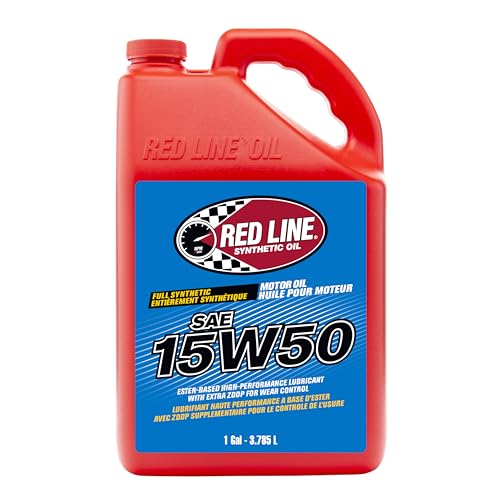
Red Line 15W50 Motor Oil
A high-zinc ester oil with a full published data sheet.
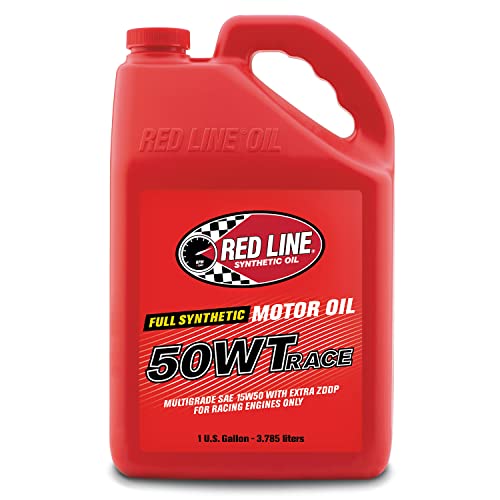
Red Line 50WT Race Oil (15W50)
Red Line's racing version of the same grade, built for short intervals.
Why an Engine Ends Up on 15W-50
The first number in 15W-50 describes cold behavior and the second describes thickness at operating temperature. A 50 holds a heavier film on hot bearings than a 30 or a 40, which is why engine builders choose it for looser bearing clearances, high oil temperatures and sustained high rpm. The trade is slower flow on a cold morning, and that cost grows as the thermometer falls.
Very few modern daily drivers list 15W-50 as their primary grade. You see it in owner’s manuals for some older performance cars, in rebuilt engines where the machinist specified it, and in cars that only come out in warm weather. If your manual gives a thinner grade, a thicker oil will not add protection and can slow oil delivery at startup.
Some owners reach for a heavy oil to quiet a noisy lifter or slow an engine that burns oil. That masks the problem rather than fixing it. Turbo fours that drink oil between changes are a good example, and our write-up on why the Audi 2.0T consumes oil shows how a shop tracks down the real cause.
What Each Maker Actually Puts in Writing
Red Line publishes far more numbers for its oil than the Mobil 1 listing does. The Red Line 15W50 product page describes a PAO and ester base with enhanced ZDDP and lists a high temperature, high shear viscosity of 5.8 cP, a viscosity index of 162 and a Noack evaporation loss of 6 percent. It also claims 25 percent more viscosity than petroleum 20W-50 oils and names API SN through SG and ACEA A3/B3/B4 as the service classes it is recommended for.
The Mobil 1 listing reads more like a label than a data sheet. It promises longer engine life in severe conditions, sludge-fighting additives and a Triple Action formula. Its title cites 10,000-mile protection, yet one bullet mentions a 15,000-mile guarantee tied to a footnote, so read Mobil’s guarantee terms before you count on either figure.
On approvals, the Mobil 1 vs Redline question has no winner, because neither Amazon listing names a carmaker approval for this grade. If a warranty or a builder’s sheet requires a specific approval, look for it printed on the bottle you receive rather than trusting a forum post.
| Detail | Mobil 1 15W-50 | Red Line 15W50 | Red Line 50WT Race |
|---|---|---|---|
| Jug linked | 5 quarts | 1 gallon | 1 gallon |
| Base stock stated | Not stated in the listing | PAO and ester | Polyol ester |
| Anti-wear stated | Not quantified | Enhanced ZDDP | At least 2,200 ppm zinc and phosphorus |
| Mileage wording | 10,000-mile title, 15,000-mile guarantee bullet | Extended drains, no figure | Change more often than street oil |
| Cold caution | None in the listing | Not for climates below -5 F | None stated |
Mobil 1 vs Redline 15W-50: The Three Jugs Up Close
Every oil below is a 15W-50, so you are comparing formulas, not grades. Confirm that 15W-50 is what your manual or engine builder calls for, and work out your sump capacity plus the filter before ordering.
Mobil 1 Advanced Full Synthetic 15W-50: Triple Action Formula Motor Oil, 5 Quarts
- Full synthetic 15W-50 in a five-quart jug
- Triple Action formula with friction reduction
- Additives aimed at fighting sludge
- Listed to protect in severe conditions
This is the 15W-50 member of Mobil 1’s Advanced Full Synthetic line, packed in a five-quart jug. It is one of the few heavy grades a mainstream brand still sells widely, which is why it turns up in so many garages that house a weekend car or an older performance engine.
The listing keeps its claims brief. It says the oil helps extend engine life even in severe conditions, carries additives that fight sludge and uses a Triple Action formula aimed at friction reduction. The title mentions 10,000-mile protection while one bullet cites a 15,000-mile guarantee with a footnote, so read Mobil’s guarantee terms and keep following your manual’s interval. No API category or carmaker approval appears in the bullets, so check the back label if your engine needs one.
This oil suits a stock engine whose manual lists 15W-50 and that gets changed on a normal schedule, especially when you want to find a matching top-up at any parts store. It is less suited to an owner who wants published lab data such as HTHS or zinc levels, or to a built engine where the machinist asked for a high-ZDDP oil. Measure your sump plus filter, since a five-quart jug may leave you a little short on larger V8s.
View Mobil 1 Advanced Full Synthetic 15W-50 on Amazon

Red Line 15W50 Motor Oil: Ester/PAO Full Synthetic with Enhanced ZDDP, 1 Gallon
- Polyol ester and PAO full synthetic base
- Enhanced ZDDP anti-wear additive
- Listed for wider bearing clearances and turbo use
- Recommended for API SN and ACEA A3/B3/B4
Red Line’s 15W50 belongs to its High-Performance Motor Oil range and is sold here as a one-gallon jug, part number 11505. The listing describes a full synthetic ester and PAO formula for passenger cars, light trucks, performance vehicles and marine use, and Red Line’s own page adds a proprietary additive package with enhanced ZDDP.
The claims lean on heat and film strength. Red Line says the oil offers high temperature stability and oxidation resistance, high detergency that allows extended drains, and improved ring seal. Its data sheet lists a viscosity index of 162, an HTHS viscosity of 5.8 cP and a pour point of minus 49 degrees F, yet the same page says the oil is not recommended for cold climates below minus 5 degrees F. It is listed as recommended for API SN through SG and ACEA A3/B3/B4, which is Red Line’s guidance rather than a license.
This jug makes sense for a turbocharged, modified or high-heat engine, a build with wider bearing clearances, or a race engine that also sees street use. It fits poorly in a car driven through a Grand Rapids January or one whose warranty demands a licensed oil. Most V8s will need a second jug or extra quarts to fill the sump.
View Red Line 15W50 Motor Oil on Amazon
Red Line 50WT Race Oil (15W50): Polyol Ester Synthetic Racing Motor Oil, 1 Gallon
- Racing oil that Red Line rates as a 15W50
- Polyol ester base for film strength under fuel dilution
- At least 2,200 ppm zinc and phosphorus per Red Line
- Used in stock car, road racing and sprint cars
The 50WT Race Oil is the racing sibling of Red Line’s street 15W50, sold in a one-gallon jug, part number 10505. Red Line names its race oils by weight, and its 50WT Race Oil page states that 50WT is a 15W50 multigrade.
The listing says it is used in stock car racing, road racing and sprint cars, with a polyol ester base that keeps stability and film strength when fuel dilution is heavy. Red Line’s page says each of its race oils carries no less than 2,200 ppm of zinc and phosphorus, and the 50WT sheet lists averages of 2,350 ppm zinc and 2,050 ppm phosphorus. It also mentions special detergents for lubricity, improved startup protection and lower oil temperatures.
Red Line is direct about the catch: change these oils more often than regular motor oils. That makes the race oil a fit for a dedicated track car, a methanol sprint or midget engine, or a build with wide bearing clearances that gets frequent changes. It is the wrong choice for a daily driver or any car on a long service interval, where the street 15W50 or Mobil 1 15W-50 makes more sense.
View Red Line 50WT Race Oil (15W50) on Amazon

Matching the Oil to How the Car Gets Used
The Mobil 1 vs Redline choice gets easier once you are honest about how the car is driven. A cruiser that sees a few hundred summer miles has different needs from a car that runs lapping sessions at a road course every summer weekend. Find the line that sounds like your car.
| Your car | Lean toward | Why |
|---|---|---|
| Stock engine that specifies 15W-50, mostly street miles | Mobil 1 15W-50 | Widely stocked, five quarts per jug |
| Built or high-heat street engine | Red Line 15W50 | Ester base, enhanced ZDDP, published HTHS |
| Dedicated track or race engine | Red Line 50WT Race Oil | High zinc and phosphorus, short change interval |
| Car driven below zero in January | Neither, unless the manual allows it | A thinner winter grade starts easier |
Switching brands needs no special flush. Red Line states that its products are fully compatible with conventional and synthetic motor oils, so a quart of one topping up the other is fine. For a cleaner switch, do it at a regular change with a fresh filter.

Owner reports split along familiar lines. Red Line fans describe smoother revving and clean internals at teardown, while Mobil 1 owners like that a jug is on the shelf at nearly every parts store when they need a top-up on a road trip. Those are impressions, not lab results, so weigh them lightly next to the manual and the data sheets.
Michigan Winters, Storage and a Thick Grade
Here is the point most Mobil 1 vs Redline articles skip. Red Line says its 15W50 is not recommended for cold climates, giving minus 5 degrees F as the limit, and Grand Rapids mornings can drop below that in a bad January. If the car is driven year round, our guide to oil for cold weather starts explains how the winter number affects flow at startup.

For a summer car the answer is simpler. Change the oil before it goes into storage so used oil with acids and moisture does not sit in the engine for months, then drive it on 15W-50 once spring arrives. A battery maintainer and a full tank of treated fuel round out the routine.
A cold start with a heavy oil in a garage that sits near freezing is still fine for most engines rated for the grade. Let it idle briefly and keep the revs down until the gauge shows temperature, which applies to any brand in this weight.
Change Intervals and When a Mechanic Should Look
Settling Mobil 1 vs Redline does not stretch your schedule, since a premium jug is not a license to skip changes. Follow the interval your manual or builder gives, shorten it for track days, and treat the race oil as a short-change product, as Red Line itself advises. If a change slipped well past due, our article on how long an engine can go between oil changes covers the symptoms to watch for.

Low oil pressure warnings, a level that drops between fill-ups, or metal glitter on the dipstick are reasons to have the engine checked rather than to try a new brand. We can do your next oil change in Creston with the grade your manual names and look into why the level keeps falling at the same visit. The engine work here is led by owner Hendrick Hoffman, whose ASE and State of Michigan certifications include both engine repair and engine tune-up.
More Buying Guides
Frequently Asked Questions
Is Red Line better than Mobil 1 in 15W-50?
It depends on the engine. Red Line 15W50 publishes more data and adds enhanced ZDDP on an ester base, which suits modified and high-heat engines. Mobil 1 15W-50 is the easier pick for a stock engine that calls for the grade and gets regular changes.
Can I use 15W-50 oil in a Michigan winter?
Only if your manual allows it for the temperatures you drive in. Red Line says its 15W50 is not recommended below minus 5 degrees F. For a car driven daily through January, a thinner grade from the manual’s chart is the safer choice.
Is Red Line 50WT Race Oil safe for street driving?
Red Line builds it for racing and tells owners to change its race oils more often than regular motor oils. A car that sees occasional street miles between events can run it on a short interval, but a daily driver is better served by the street 15W50.
Can I top off Mobil 1 with Red Line?
Yes, as long as the grade matches. Red Line states its oils are compatible with conventional and synthetic motor oils. Mixing does not damage the engine, though a full switch at your next change keeps the formula consistent.
Want a second opinion on the grade, or would you rather skip lying on a cold garage floor? Phone 456 AutoFix at 616-279-3832 between 8am and 5pm on weekdays, or book a visit through our contact page.
Busy during our hours? Bring the car to 456 Carrier St NE in Creston and leave your keys in the after-hours drop-off with a note about the grade you want.