
As an Amazon Associate, 456 AutoFix earns from qualifying purchases. Product links below go to Amazon, where you can confirm the right part for your vehicle.
Two straps hang side by side in the auto aisle, both orange or yellow, both rated for thousands of pounds. The recovery strap vs tow strap question matters because they are built to behave in opposite ways once the slack comes out. One stretches on purpose, the other is made to stay nearly the same length.
Picking the wrong one for the job can snap webbing, bend a bumper or turn a metal hook into a projectile. Below we explain what each strap is for, where the kinetic rope fits in, and how to hook up safely, then look at one product of each type.
Quick answer
Should you carry a recovery strap or a tow strap?
Use a stretchy nylon recovery strap to pull a stuck vehicle out of snow, mud or a ditch. Use a low-stretch tow strap, usually with hooks, to pull a car that rolls freely on a flat surface. If you carry only one for winter slide-offs, the recovery strap covers more situations.
Our Quick Picks
For the recovery strap vs tow strap choice, here is one nylon recovery strap, one hooked tow strap, and a related third pick: a kinetic recovery rope for deeper stuck situations.

ALL-TOP Recovery Snatch Strap
A stretchy snatch strap for pulling stuck vehicles free.
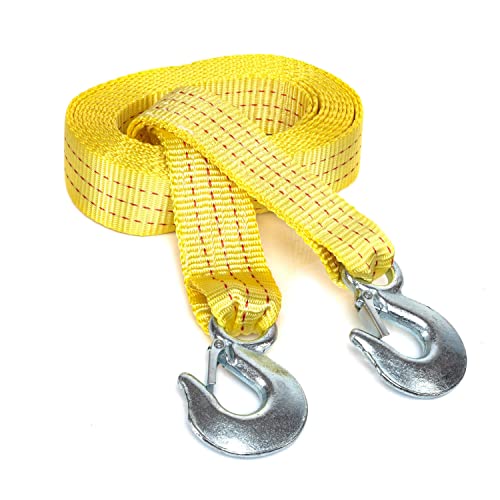
NEIKO 51005A Tow Strap
A low-stretch strap for pulling a car that rolls freely.
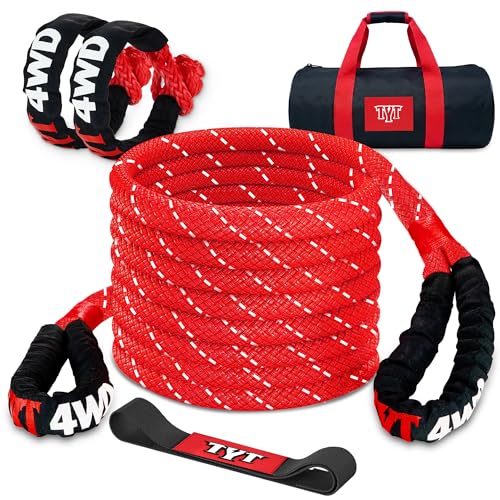
TYT Kinetic Recovery Rope
A kinetic rope with more stretch than a flat strap.
The Difference Between a Tow Strap and a Recovery Strap
The core difference is stretch. A recovery strap, sometimes sold as a snatch strap, is woven from nylon that lengthens under load, often by around 20 percent. As the pulling vehicle moves off, the strap stores energy like a rubber band and then releases it, tugging the stuck vehicle free with a smoother, stronger pull than a dead yank.
A tow strap is usually polyester, which barely stretches. That suits a rolling tow, where the car behind has free wheels and the driver can steer and brake. With no give, the strap keeps a steady distance between the two vehicles instead of bouncing them back and forth.
The ends differ too. Most tow straps finish in hooks, which make a quick connection to a tow loop. Recovery straps finish in sewn eye loops that connect through a rated shackle or a dedicated recovery point, because a hook under a sudden kinetic load can slip off or break.
| Feature | Recovery strap | Tow strap | Kinetic rope |
|---|---|---|---|
| Usual material | Nylon webbing | Polyester webbing | Braided nylon rope |
| Stretch | High, built in | Very little | Highest of the three |
| Ends | Sewn loops for shackles | Hooks, sometimes loops | Protected eyes for soft shackles |
| Main job | Freeing a stuck vehicle | Pulling a rolling vehicle | Freeing a deeply stuck vehicle |
Neither strap is a toy, and both carry ratings you should respect. Read the breaking strength on the label or listing, and pick a strap rated well above the weight of the heavier vehicle. Our tow strap buying guide and our recovery strap roundup go deeper on sizing each type.
Kinetic Recovery Rope vs Tow Strap: Where Rope Fits
A kinetic recovery rope works on the same idea as a recovery strap, only more so. It is a double-braided nylon rope that stretches further and recovers its length more gently, which spreads the pull over a longer moment. Owners of trucks and SUVs that get properly buried often prefer one.
Compared with a tow strap, a kinetic rope is the opposite tool. You would not tow a stalled sedan across town on one, since the stretch lets the cars surge apart and together at every speed change. WARN, the winch maker, lists using a no-stretch tow strap in place of a kinetic strap or rope among the common vehicle recovery mistakes, because the shock can damage the vehicle or hurt someone.
Ropes also tend to need soft shackles rather than steel ones, and they cost more per foot than flat webbing. For a commuter car that slides into a snowbank once a winter, a flat recovery strap is usually enough. Our guide to the kinetic recovery rope covers who should step up.
Recovery Strap vs Tow Strap: Three Products Side by Side
Below is one recovery strap, one tow strap with hooks, and a kinetic rope as the third option. None of them appears in our hub roundups, so you get fresh examples of each type. Figures come from each Amazon listing.
ALL-TOP Recovery Snatch Strap: 3 in x 30 ft Nylon, 35,000 lb Break Strength with 22% Elongation
- 100% nylon N66 webbing
- 22% elongation for kinetic pulls
- 35,000 lb break strength, per the listing
- Triple reinforced eye loops with sleeves
This is a classic flat recovery strap, often called a snatch strap. ALL-TOP weaves it from 100 percent nylon N66 webbing, 3 inches wide and 30 feet long, in a high-visibility orange. The listing gives a break strength of 35,000 pounds and an elongation of 22 percent, which is the stretch that lets it store energy during a pull.
Each end is a sewn eye loop rather than a hook. ALL-TOP describes the loops as triple reinforced and covered with neoprene protective sleeves, which help resist wear where the strap bends around a shackle or recovery point. Because there is no hardware on the strap, you will need rated D-ring shackles or a receiver shackle mount to connect it, and those are sold separately for this listing.
In practice, this strap suits the snowbank and ditch situations most drivers face: a second vehicle takes up the slack slowly, then the stretch helps ease the stuck car out. The 30-foot length gives the pulling vehicle room to stay on firmer ground. It is the wrong tool for towing a dead car down the road, since the stretch makes the two vehicles surge, and it should never be looped over a hitch ball.
View ALL-TOP Recovery Snatch Strap on Amazon

NEIKO 51005A Tow Strap: 2 in x 20 ft Polyester with Forged Safety Hooks, 10,000 lb Capacity
- Woven polyester webbing, 2 in x 20 ft
- 10,000 lb capacity, per the listing
- Drop-forged, heat-treated hooks with safety buckles
- Bright yellow for visibility
The NEIKO 51005A is a straightforward tow strap of the kind many drivers keep in a trunk. It is 2 inches wide and 20 feet long, made of woven polyester with a reinforced weave that NEIKO says resists fraying. The listing rates it at a 10,000-pound capacity, and the bright yellow color makes the line easier for other drivers to see.
Both ends carry hooks that NEIKO describes as drop-forged and heat-treated, each with a safety buckle that closes the hook opening. Polyester is the key detail for this comparison. The listing says the strap will not shrink or stretch in rain, snow or ice, which is what you want when one vehicle is pulling another that rolls on its own wheels.
Use it for the jobs a tow strap does well: pulling a car that will not start onto a driveway, or easing a vehicle onto a trailer at low speed. Hook it only to the tow eyes or tow points your owner’s manual shows, not to suspension parts. Because it has almost no give, it is not suited to yanking a vehicle out of deep snow or mud, where a recovery strap or rope is the safer choice.
View NEIKO 51005A Tow Strap on Amazon
TYT Kinetic Recovery Rope: 1 in x 30 ft Nylon 66, 48,500 lb Breaking Strength
- Double-braided nylon 66 rope
- 48,500 lb breaking strength, per the listing
- Protective sleeves on the eyes
- Storage bag included
The third pick is a kinetic recovery rope, the related option that sits beyond a flat recovery strap. TYT makes this one from 100 percent nylon 66 in a double-braided construction, 1 inch thick and 30 feet long, in red. The listing gives a breaking strength of 48,500 pounds and describes the rope as elastic, so it stretches to soften the sudden pull of a recovery.
TYT says the rope has protective sleeves to reduce wear in mud, sand and rough weather, and it comes with a storage bag that keeps it clean between uses. The feature list also mentions soft shackles for setup, so check the listing’s package contents to confirm exactly what is in the box. Synthetic soft shackles are lighter than steel and less likely to damage paint, though they must be kept away from sharp edges.
This rope makes the most sense for a truck or SUV owner who heads down unplowed roads or two-tracks, where vehicles sink deeper and need a stronger kinetic pull. For an occasional snowbank slide-off in a small car, a flat strap is usually plenty. Like any recovery line, it is not meant for towing a rolling vehicle, and it should only be attached to rated recovery points.
View TYT Kinetic Recovery Rope on Amazon
Where to Hook Up, and Where Never To
The strap is rarely the weak link. The attachment point is. Your owner’s manual shows the factory tow eye or recovery points, and on many unibody cars that means a screw-in eye stored with the spare tire that threads into a hidden socket behind a bumper cover.
Never loop a strap around a trailer hitch ball, an axle, a control arm or a tie rod. A ball can shear off and fly back along the strap, and suspension parts bend long before a strap breaks. If you have a receiver hitch, a shackle mount made to slide into the receiver is the safer way to use it.

Before any pull, clear people well away from the line, and drape a heavy coat or a strap damper over the middle so a broken strap drops instead of whipping. Start gently, take up slack slowly, and stop if the stuck vehicle is not moving after a couple of tries. Digging out snow around the tires first often turns a hard pull into an easy one.
For a rolling tow with a tow strap, keep speeds low, use hazard lights, and agree on hand signals before you leave. The towed driver needs the ignition on so the steering is unlocked, and power assist will be gone if the engine is off, so braking and steering take real effort. Check local rules too, and call a tow service for anything beyond a short, quiet stretch of road.
Snowbanks and Slush: Which Strap Grand Rapids Drivers Use
In West Michigan, the most common call for a strap is a car that slid into a plowed bank or a ditch on a snowy morning. That is a recovery job, not a tow. A recovery strap or rope, plus a shovel and a pair of traction aids, will get most cars out without help from a truck winch.

A tow strap still earns a place if you often help a neighbor whose car will not start in the cold. Pulling a dead car a short way into a driveway is the job it handles well. If that is a regular problem, our article on a car not starting in cold weather covers the usual causes.
Road salt and slush also matter for storage. Rinse a strap in clean water after use, let it dry fully at room temperature, and store it in a bag away from sunlight and battery acid. Check the webbing and stitching for cuts, burns or stiff spots before each season, and retire a strap that shows damage.
Keep the strap with the rest of your cold-weather gear. Our list of what goes in a car emergency kit for winter and our winter car maintenance checklist help you round out the trunk before the first storm.
After the Pull: Signs Your Car Needs a Look

A hard recovery puts force through more than the tow point. If the steering wheel now sits off center, the car pulls to one side, or you hear a clunk over bumps, something in the suspension or steering may have shifted. A bumper cover that sits crooked can hide a bent tow eye socket or bracket.
Those are worth checking before the next long drive. Our team handles suspension repair in Grand Rapids for foreign and domestic vehicles. Hendrick Hoffman, who owns the shop and leads the work in the bays, is ASE and State of Michigan certified in steering and suspension.
More Buying Guides
Frequently Asked Questions
Can I use a tow strap to pull out a stuck car?
It is not recommended. A tow strap has almost no stretch, so a stuck car turns the pull into a sudden shock load on the strap, hooks and attachment points. That is how straps snap and hooks fly. Use a recovery strap or kinetic rope for a stuck vehicle.
Can a recovery strap be used for towing?
Only for a very short, slow pull, and it is not ideal. The stretch lets the two vehicles surge together and apart whenever the lead driver speeds up or brakes. For a rolling tow, a low-stretch tow strap keeps the gap steady.
What is the difference between a tow strap and a recovery rope?
A recovery rope, also called a kinetic rope, is braided nylon that stretches a lot and stores energy to pop a stuck vehicle free. A tow strap is flat, low-stretch webbing for pulling a car that rolls on its own wheels. They solve different problems.
What is the best tow strap for recovery?
For recovery, choose a strap sold as a recovery or snatch strap, made of nylon with a stated stretch figure and sewn loops instead of hooks. Pick a breaking strength well above the heavier vehicle’s weight, and connect it only to rated recovery points.
Is the car steering differently since it came out of the ditch? Phone 456 AutoFix on 616-279-3832, Monday through Friday between 8am and 5pm, or ask for a suspension inspection on our contact page.
Can’t get away while we’re open? Our shop at 456 Carrier St NE, Grand Rapids, offers after-hours drop-off, so the keys can come to us on your schedule.