As an Amazon Associate, 456 AutoFix earns from qualifying purchases. Product links below go to Amazon, where you can confirm the right part for your vehicle.
A door that kissed a painted pole, a bumper that brushed another car in a tight lot, a fender that met the garage wall: each leaves a smear of someone else’s color on yours. The best rubbing compound for paint transfer is one with just enough cut to lift that foreign paint off the clear coat, matched to whether you will work by hand or with a polisher.
Below: how to tell transfer from real damage, what to try first, and six compounds that suit the job. For general scratch products, see our guide to the best car scratch remover.
Quick answer
What removes paint transfer without hurting the clear coat?
Start with clay or a tar remover, then step up to a mild compound. By hand, Mothers California Gold Scratch Remover is sold for scuffs and transfers. With a dual action polisher, Turtle Wax Hybrid Solutions Pro 1 and Done corrects and finishes in one product, and CARPRO ClearCut handles scuffs that cut deeper.
Our Quick Picks
Three starting points: a hand-applied remover for a small smear, a one-step machine compound for bumper scuffs and a heavier cut for marks left behind.

Mothers California Gold Scratch Remover 08408
A gentle hand product the listing says removes scuffs and paint transfers.

Turtle Wax 53478 1 and Done Compound
Corrects and finishes with a pad change, so one bottle covers most scuffs.

CARPRO ClearCut Correction Compound
Fast liquid abrasive for scuff lines left once the transfer is gone.
Paint Transfer, Scuff or Gouge? Check Before You Buff
Paint transfer is color from another object bonded to the top of your finish, often with your clear coat intact underneath. Work out which of three cases you have before you pick up an abrasive.
- Transfer on top: a different color that feels slightly raised. A solvent, clay or light compound usually lifts it.
- Scuff into the clear: dull lines remain once the foreign color is gone. A medium or heavy compound fits here.
- Through to primer or metal: gray, white or bare steel shows. No compound rebuilds missing paint, so this needs touch-up paint or a body shop.
Wash and dry the area first, since grit left on the panel drags under a pad and adds scratches.
Try These Before Any Compound, Then Pick a Cut Level
Because transfer usually sits on the surface, a non-abrasive step can lift much of it. A dedicated bug and tar remover softens rubber and paint smears from bumpers, and a clay bar from our clay bar kit roundup can pull off what is left.
When you do, read the listing for these details:
- Hand or machine: some formulas suit an applicator pad, others need a polisher to do much.
- Cut rating: makers often state cut as the sanding marks a product removes, such as 1,200 grit. Start milder on a small mark.
- Fillers: a filler-free compound shows the true result, so a scuff cannot hide and reappear after a wash.
- Follow-up step: heavier compounds can leave haze, so plan on a polish, then wax or sealant.
Best Rubbing Compound for Paint Transfer: Six Picks Reviewed
The six compounds run from a hand kit for a small scuff to heavy machine cuts for transfer that left deeper marks behind.
1. Mothers California Gold Scratch Remover 08408: Hand-Applied Scuff and Transfer Remover, 8 oz
- Removes surface scratches, scuffs and paint transfers
- Made for easy hand application
- Safe on clear coat and single stage paint
- Suited to door handles, latches and trunk lids
Mothers California Gold Scratch Remover is the gentlest product here, and that is the point for most paint transfer. The listing says it removes surface scratches, scuffs and paint transfers from paint and clear coat, and it is designed for hand application. For a smear from a shopping cart, a garage post or a neighbor’s bumper, it lets you start without buying a machine.
Mothers says it reduces the look of deeper marks without harsh abrasives and restores gloss and clarity as it works. The formula is listed as safe on modern clear coat finishes and on traditional single stage paint, which matters on older cars that never had a clear layer. The listing also points to door handle cups, latches and trunk lids, where fingernail marks build up.
Because it is mild, it will not level a scuff that cut into the clear coat, so expect to step up to a machine compound if dull lines remain. Use a clean foam applicator or microfiber pad, work a small area with firm, overlapping circles and wipe often to check. A coat of wax afterward helps protect the spot through winter.
View Mothers California Gold Scratch Remover 08408 on Amazon
2. Turtle Wax 53478 Hybrid Solutions Pro 1 and Done: Correct and Finish Compound, 16 oz
- Removes up to 1000 grit imperfections
- Listing names paint transfer and swirls
- Zero dust, no sling, extended work time
- One product: swap pads to cut or finish
Turtle Wax built this Hybrid Solutions Pro compound around a simple idea: one liquid that cuts with a cutting pad and finishes with a polishing pad. The listing names paint transfer, scratches and swirl marks among its lighter restoration jobs, and says it removes paint imperfections down to 1000 grit for heavier work. For a bumper corner that brushed another car, that range covers most of what you will meet.
The maker describes the formula as body shop safe, with zero dust, no sling and an extended work time, and says it wipes off easily. Those traits help on a cold-weather project in a home garage, where dried compound on trim and dust in the air are common annoyances. Turtle Wax suggests three or four dime-sized drops on the pad and working two-foot square sections.
The main limit is that it is meant for a machine. Turtle Wax notes the best finish comes with a polisher and the least aggressive pad that does the job, so a hand-only owner should look at the Adam’s kit instead. Follow with wax or sealant, since this is a correction product rather than protection.
View Turtle Wax 53478 1 and Done Compound on Amazon
3. Mothers 08612 Professional Rubbing Compound: Body Shop Formula for Buffers, 12 oz

- Same formulas used in body shops, per Mothers
- Cuts water spots, oxidation and wash scratches
- Works with your choice of buffer
- Compact 12 ounce bottle
Mothers markets its Professional Rubbing Compound as using the same formulas found in body shops, packaged in a 12 ounce bottle that suits spot work. For paint transfer, the small size is an advantage: most scuffs need only a few applications, and you avoid buying a quart you will barely touch. It is a straightforward buffer compound rather than a kit.
The listing says it works with your favorite buffer to cut water spots, heavy oxidation and car wash scratches. Mothers also lists reconditioning worn paint, buffing fresh paint after color sanding and improving factory clear coats. That range means it can clean up the faint scratches that sometimes remain after the foreign color is gone, as well as dull, chalky paint nearby.
Mothers aims it at professional detailers but says it is simple enough for anyone. The listing centers on machine use, so plan on a dual action polisher and a foam cutting pad rather than a hand towel. Because it is a true rubbing compound, follow with a finer polish if you see haze in sunlight, and finish with wax before the next round of road salt.
View Mothers 08612 Professional Rubbing Compound on Amazon
4. CARPRO ClearCut Correction Compound: Heavy Cut for DA and Rotary, 500 ml
- Removes 1200 grit and finer sanding marks
- Zero fillers, low dusting
- Works with DA and rotary machines
- Foam, microfiber and wool pad compatible
CARPRO ClearCut is a heavy cut liquid compound, and it belongs in this list for the second half of many transfer jobs. Once the foreign color is off, a hard scrape often leaves dull lines in your own clear coat. The listing says ClearCut removes scratches, swirls, acid rain marks and 1200 grit and finer sanding marks, which covers that kind of scuffing.
It works with both dual action and rotary machines and with foam, microfiber or wool pads, so it fits most home setups. CARPRO describes the cut as consistent from start to finish, with low dusting and zero fillers. The maker adds that it finishes down like a polish and can be a one-step job on many medium to hard paints, with CARPRO Reflect as the follow-up for a two-step correction.
The trade-off is aggressiveness. On a light smear it is more cut than you need, so use it after a milder product stops making progress, and start with a foam pad before trying microfiber or wool. Mask edges and body lines, keep the pad moving, and check your progress often under good light.
View CARPRO ClearCut Correction Compound on Amazon
5. Malco Tru Grit Heavy Duty Buffing Compound: Removes 1000 to 1500 Grit Marks, 32 oz
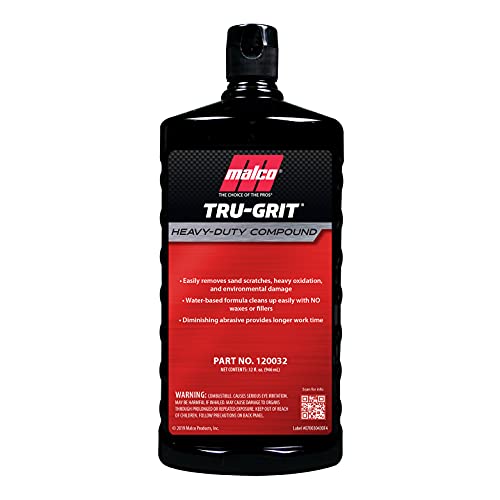
- Removes 1000 grit and finer sand scratches
- Diminishing abrasives cut then polish
- No waxes, silicones or fillers
- Water based for easy cleanup
Malco Tru Grit is a heavy cutting compound in a 32 ounce bottle, made in the USA according to the listing. It targets 1000 grit and finer sand scratches, heavy oxidation and environmental paint damage. For paint transfer, that makes it a choice for a wide scrape along a bumper or several panels, where a small bottle would run out.
The abrasives diminish as you work, so each pass starts aggressive and ends with more polishing action, which Malco says leaves less haze to chase afterward. It contains no waxes, silicones or fillers, so a corrected scuff will not reappear after the next wash. The listing adds that it works on fully cured paint and on clear coats only 24 hours old, across high solids and standard clears.
Malco also says the water-based formula wipes off panels and washes out of pads easily, a practical plus when working in a garage. It is a machine product, and its strength means you should test a small spot first and stay off thin edges. On cars with soft clear coat, a finishing polish is a sensible second step before wax.
View Malco Tru Grit Compound on Amazon
6. Koch-Chemie H9.02 Heavy Cut V2: Silicone-Oil-Free Coarse Compound, 250 ml

- Removes sanding marks up to 1,200 grain
- Abrasion level rated 9.0
- Silicone-oil-free, low dust
- Rotary and dual action compatible
Koch-Chemie H9.02 is the strongest cut in this guide, and it suits transfer only when the impact also left heavy scuffing. The listing describes zirconia alumina abrasive grains for fast correction of oxidized and damaged clear coats, and says it removes sanding marks up to 1,200 grain. Koch-Chemie rates its abrasion level at 9.0 on its own scale.
The formula is silicone-oil-free, so it does not mask defects, and the listing says it polishes for long periods without drying out or sticking to the pad. It is described as suitable for soft and scratch-resistant paints, including modern ceramic clear coats, which some milder compounds struggle to cut. The 250 ml bottle is enough for spot repairs on a few panels, so you are not left with a large container of a compound you may rarely need.
On its H9.02 product page, Koch-Chemie recommends a rotary polisher with a lambskin or Heavy Cut pad at medium speed, followed by its Micro Cut M3.02 polish, and warns against hot surfaces. The Amazon listing says it also works with dual action machines. Either way, this is a compound for experienced hands, not for a first light smear.
View Koch-Chemie H9.02 Heavy Cut on Amazon
Matching the Compound to the Mark
Most transfer jobs fall into one of four situations. The table pairs each with a product from this guide and the main thing to watch.
| Situation | Method | Product from this guide | Watch for |
|---|---|---|---|
| Small smear, no polisher | Hand applicator pad | Mothers California Gold Scratch Remover | Light pressure, work in small circles and crosshatch passes |
| Bumper or door scuff, one-step finish | DA polisher with cutting then polishing pad | Turtle Wax 1 and Done, Mothers 08612 Professional | Keep the pad flat on curved bumper plastic |
| Transfer gone, dull lines remain | DA or rotary with foam or microfiber cutting pad | CARPRO ClearCut, Malco Tru Grit | Follow with a finishing polish |
| Heavy scuffing on hard clear coat | Rotary or strong DA with an aggressive pad | Koch-Chemie H9.02 | Check clear coat thickness on edges and body lines |
If you do not own a machine yet, our guide to the best dual action polisher compares the tools that pair well with these liquids.

How to Remove Paint Transfer With Rubbing Compound
Whichever product you pick as the best rubbing compound to remove paint transfer, this sequence keeps the risk low.
- Clean: wash, dry and, if needed, clay the panel.
- Mask: tape off trim, badges and sharp body lines, where clear coat is thinnest.
- Test spot: work a small section with a few drops and light pressure, then wipe and inspect.
- Repeat or step up: move to a stronger cut only when the mild one stops making progress.
- Refine and protect: follow a heavy cut with a finishing polish, then wax or sealant.
Wear nitrile gloves and eye protection, since compound slings off a spinning pad, and follow the label for ventilation and skin contact. Work on a cool, shaded panel, since Koch-Chemie, for one, tells users not to apply its compound to hot surfaces.

Winter Lots, Salt and Scuffs in West Michigan
Snowbank-narrowed lanes and packed Grand Rapids parking lots make winter prime time for bumper scrapes. A salty, gritty panel is the worst surface to compound, so wait until you can wash the car in a heated garage or a warmer stretch. Even the best rubbing compound for paint transfer will scratch if road salt is still on the panel.
If removing the transfer reveals a chip down to metal, cover it soon, because brine starts rust quickly. Our guide to the best touch up paint for rock chips covers small repairs, and a scrape along a rocker or lower edge may also call for the products in our best undercoating for road salt roundup.

When the Scrape Was More Than Cosmetic
Transfer can signal contact hard enough to matter underneath. A pole strike near a wheel arch can knock a tie rod or the alignment out of spec, and a bumper hit can disturb parking sensor wiring.
If the car now pulls, the steering wheel sits off center or a clunk appears, book an inspection through our suspension repair in Grand Rapids. Warning lights or a sensor that beeps constantly after the bump point to our car electrical repair team.
More Buying Guides
Frequently Asked Questions
Will rubbing compound remove paint transfer?
Usually, yes, when the foreign paint sits on top of your clear coat. Try a tar remover or clay first, then a mild compound. If gray primer or bare metal shows once the transfer is gone, the paint is missing and needs touch-up rather than more compounding.
Can you remove paint transfer by hand?
Small, light transfer often comes off by hand with a compound designed for applicator use, such as Mothers California Gold Scratch Remover. Larger scuffs or marks that left dull lines in the clear coat go faster and more evenly with a dual action polisher.
Does rubbing compound damage clear coat?
Every compound removes a thin layer of clear coat, which is how it levels a scuff. Used sparingly with a test spot and light pressure, that loss is small. Repeated heavy passes on edges and body lines are where people burn through, so mask those areas.
Got the other car’s paint off but now wonder what that parking lot bump did to the suspension or the bumper sensors? Call 456 AutoFix at 616-279-3832 on a weekday between 8am and 5pm, or tell us about the scrape through our contact page.
Snap a photo of the scuffed corner before you clean it, then bring the car and the picture to 456 Carrier St NE in Grand Rapids so we can check what sits behind the panel. If the hit happened on your way to work, our after-hours drop-off lets you leave it after closing.