As an Amazon Associate, 456 AutoFix earns from qualifying purchases. Product links below go to Amazon, where you can confirm the right part for your vehicle.
Hondas are known for running a long time on routine care, and brake fluid is one of the quiet items on that list. The best brake fluid for Honda cars, SUVs and minivans starts with what Honda prints on the reservoir cap, which on most models is DOT 3.
Below we cover what Honda asks for, what its manuals say about other brands, and five bottles for jobs from a full flush to a garage top-up. If your car calls for DOT 4 instead, our DOT 4 brake fluid buying guide covers that grade in more depth.
Quick answer
What brake fluid does a Honda need?
Most Honda owner’s manuals recommend Honda’s own DOT 3 fluid, so a genuine Honda bottle is the closest match for a flush. Honda allows DOT 3 or DOT 4 from a sealed container as a temporary fill, which is where Johnsen’s, Wagner or Pyroil fit. Never use silicone DOT 5, and plan a change every three years.
Our Quick Picks
Three quick picks for Honda owners: the factory DOT 3, a dual-grade spare and a pack of sealed DOT 4 bottles. All five fluids are reviewed below.
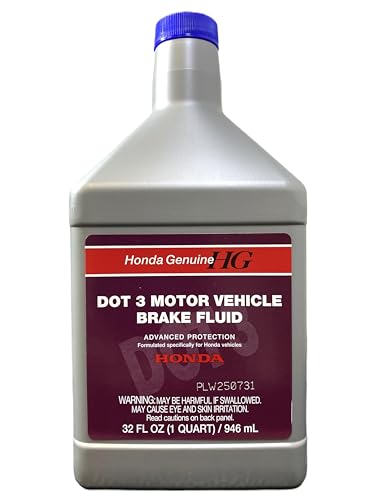
Honda Genuine DOT 3
Honda's own DOT 3 in a quart bottle, the closest match to the manual.

Johnsen's 5032
One quart that covers both grades Honda allows for a temporary fill.

Pyroil DOT 4 12-Pack
Twelve small sealed bottles, so each job opens a fresh one.
What Honda Puts in the Reservoir
Open the hood on a Civic, Accord, CR-V, Pilot or Odyssey and look at the brake master cylinder reservoir near the driver’s side firewall. The cap usually names the fluid grade, and the owner’s manual repeats it in the maintenance section. Honda’s wording is direct: one Honda Canada manual says we recommend using Honda Heavy Duty Brake Fluid DOT 3 and warns that DOT 5 fluid can cause extensive damage.
Some Honda manuals add a fallback. If the Honda fluid isn’t available, they say to use only DOT 3 or DOT 4 from a sealed container as a temporary replacement. That one sentence shapes the whole buying decision, so keep it in mind as you read the picks.
- DOT grade: the federal brake fluid standard, FMVSS No. 116, sets minimum boiling points. DOT 3 must reach 205°C dry and 140°C wet, and DOT 4 must reach 230°C dry and 155°C wet.
- Wet boiling point: the figure measured after the fluid has picked up moisture. It is the more honest number for a car that is a couple of years past its last change.
- Glycol chemistry: DOT 3, DOT 4 and DOT 5.1 are glycol-based and can mix, though mixing lowers you to the weaker fluid’s rating.
- DOT 5: silicone-based, purple in color and not compatible with a Honda system. Keep it out of the reservoir entirely.
Genuine Honda Bottle or a Shelf Brand?
Honda’s manuals favor its own fluid, and on a full flush that is the simplest way to follow the book. The genuine bottle is a DOT 3 made to meet the same federal standard as other DOT 3 fluids, sold through Honda’s parts network and on Amazon.
Store-brand DOT 3 and DOT 4 fluids are still useful to a Honda owner. A sealed bottle in the trunk handles a low reservoir on a road trip, and a quality DOT 4 gives more boiling margin for towing with a Pilot or Odyssey. Honda calls that use temporary, so the cleanest plan is to follow a top-up with a Honda flush at the next scheduled change.
None of the aftermarket brands below claims a Honda approval, and we haven’t found a Honda list of approved third-party fluids. Treat the DOT grade on the label as the minimum check, not as a factory endorsement.
Best Brake Fluid for Honda: Five Bottles Compared
All five are glycol-based fluids listed on Amazon US, from Honda’s own DOT 3 to two DOT 4 options. Check the cap on your car and the manual for your model year before you order.
1. Honda 08798-9108: 32 oz Genuine DOT 3 Brake Fluid
- Honda part number 08798-9108
- Listed as formulated for Honda vehicles
- Meets FMVSS 116 and SAE J1703
- Minimum wet boiling point 140°C (284°F)
This is Honda’s own DOT 3 brake fluid, sold under part number 08798-9108 in a 32 oz bottle. The listing describes it as formulated specifically for Honda vehicles, which lines up with the owner’s manuals that recommend Honda fluid by name. If you want to follow the book on a scheduled change, this is the bottle that removes the guesswork.
Honda states that the fluid conforms to Federal Motor Vehicle Safety Standard No. 116 and meets SAE J1703, the same specifications printed on other DOT 3 bottles. The listing gives a minimum wet boiling point of 140°C (284°F), which is the federal DOT 3 floor. In other words, the selling point here is the Honda match and the corrosion protection Honda describes, not extra heat margin for hard driving.
The quart size is practical for a full flush on a compact car, though a Pilot or Odyssey may need a second bottle depending on the method. Once the seal is broken, the fluid starts taking in moisture, so cap it tightly and use it within one job if you can. It is not aimed at track use or heavy towing, where a DOT 4 with a higher boiling point gives more room.
View Honda Genuine DOT 3 on Amazon
2. ACDelco GM 10-4086: 16 oz DOT 4 Brake and Clutch Fluid

- GM Original Equipment part 10-4086
- DOT 4 for brakes and hydraulic clutches
- High boiling point to resist vapor lock
- Low-temperature stability listed
ACDelco’s 10-4086 is GM’s Original Equipment DOT 4 fluid, packaged in a 16 oz bottle for brakes and hydraulic clutch systems. It isn’t a Honda product, so on a Honda it fits the role the manuals describe for a sealed DOT 3 or DOT 4 used as a temporary fill. That makes it a sensible bottle to keep in the garage for a low reservoir.
The listing highlights three things: protection of internal parts against corrosion under normal use, a high boiling point meant to limit fluid boiling and vapor lock, and stable behavior at low temperatures where lower cold viscosity is needed. The cold-weather point matters in West Michigan, where the ABS pump has to push fluid through small passages on a frozen January morning. Being DOT 4, it also clears higher federal boiling minimums than DOT 3.
The 16 oz size suits a top-up or a clutch reservoir refill on a manual Civic, but it is small for a complete flush. Mixing it with the DOT 3 already in your system is chemically fine, though the blend performs closer to the lower-rated fluid. If you plan a full change, pair it with the Honda bottle at the next scheduled service rather than mixing brands repeatedly.
3. Johnsen’s 5032: 32 oz Premium Synthetic DOT 3 and DOT 4 Brake Fluid
- Synthetic DOT 3 and DOT 4 fluid
- 32 oz single bottle
- Glycol-based, mixes with Honda DOT 3
- Made for DOT 3 or DOT 4 systems
Johnsen’s 5032 is sold as a premium synthetic fluid rated for both DOT 3 and DOT 4 systems, in a single 32 oz bottle. That dual rating is handy for a Honda household, because the same quart can top up a Civic that calls for DOT 3 and a second car whose cap asks for DOT 4. It is a plain, no-frills product from a brand that sells a wide range of automotive fluids.
The Amazon listing is thin on detail beyond the grades, the synthetic label and the size, so we won’t claim boiling figures it doesn’t print. What the dual rating does tell you is that the fluid meets the federal DOT 4 minimums, since a DOT 4 rating cannot be given to a fluid that only reaches DOT 3 numbers. Check the bottle itself for the boiling points and standards once it arrives.
As a glycol fluid, it is compatible with the Honda DOT 3 already in the lines, so a top-up won’t cause a reaction. Honda’s manuals still describe non-Honda fluid as a temporary replacement, so treat this as a spare rather than a permanent swap. A full quart is enough for most compact-car flushes if you decide to use it for a complete change later.
4. Wagner 21B: 32 oz DOT 3 Brake Fluid

- DOT 3 grade, the grade on most Honda caps
- 32 oz (946 ml) bottle
- Maker cites smoother pedal travel
- From a long-standing brake parts brand
Wagner’s name usually shows up on brake pads and rotors, and its 21B is a straightforward DOT 3 fluid in a 32 oz bottle. For a Honda owner, the appeal is simple: it matches the grade printed on most Honda reservoir caps, so a top-up keeps the system on DOT 3 instead of mixing grades. It is the kind of bottle you buy once and leave on the garage shelf, sealed.
Wagner’s listing focuses on how the fluid supports the brake system rather than on numbers. It says the fluid maintains proper movement for effective stopping, helps deliver a quieter braking system, produces smoother pedal travel and supports longer brake life. Those are general benefits of fresh, correct fluid more than unique features, so read them as the maker’s description, not as a measured difference over other DOT 3 brands.
The listing doesn’t print boiling points, so check the label for the DOT 3 and FMVSS 116 marks before pouring. Like every glycol fluid, it absorbs moisture once opened and will strip paint, so wipe up spills on the fender right away. It isn’t the pick for towing or mountain driving, where a DOT 4 gives more boiling margin.
5. Pyroil DOT 4 Synthetic: 12 x 12 oz High-Temp Brake Fluid
- Dry 446°F, wet 311°F minimums listed
- Meets FMVSS 116, SAE J1703 and J1704
- For ABS, disc and drum systems
- Twelve sealed 12 oz bottles
Pyroil’s synthetic DOT 4 comes as a case of twelve 12 oz bottles, and the listing says it is designed for ABS, disc and drum brake systems wherever DOT 3 or DOT 4 fluid is recommended. That wording covers a Honda’s DOT 3 system for the temporary fill Honda’s manuals allow. The case format suits a household with several cars or someone who services family vehicles at home.
The listing gives a minimum dry boiling point of 446°F and a wet boiling point of 311°F, and it names FMVSS 116, SAE J1703 and SAE J1704. The wet figure matches the federal DOT 4 minimum, so it offers more margin than a DOT 3 fluid once some moisture has crept in. That extra room is useful for a Pilot or Ridgeline that tows a trailer or a boat on summer weekends.
Small bottles are the real advantage. Each one stays sealed and dry until you need it, so you never pour from a jug that has been open for a year. Twelve bottles is more than one driveway flush needs, though, and an owner with a single Civic will be better served by one quart.
View Pyroil DOT 4 12-Pack on Amazon
Which Bottle Suits Your Honda Job
Picking the best brake fluid for Honda service work depends on the job: a full change, a top-up or a spare for later. The table sorts the five picks that way.
| The job | Fluids that fit | Why | Keep in mind |
|---|---|---|---|
| Scheduled flush on a Civic, Accord or CR-V | Honda Genuine DOT 3 | The fluid Honda’s manuals name | A full flush can take more than one quart on larger models |
| Top-up between changes | Wagner DOT 3, Johnsen’s 5032 | Sealed DOT 3 fluid, the grade on most caps | Honda calls non-Honda fluid a temporary fill |
| Towing with a Pilot, Passport or Ridgeline | Johnsen’s 5032, Pyroil DOT 4 | DOT 4 boiling minimums sit above DOT 3 | Mixing with DOT 3 drops you to the lower rating |
| Several cars or a home shop | Pyroil DOT 4 12-pack, ACDelco DOT 4 | Small sealed bottles stay dry until opened | Dispose of opened, old fluid properly |
Fresh fluid won’t help much if the pads are worn thin. When the pedal feels fine but the brakes squeal or the rotors look grooved, our guide to quiet, low-dust brake pads for daily driving is a good next read.
Honda’s Three-Year Rule and West Michigan Weather
Many Honda owner’s manuals, including Civic, CR-V and Odyssey editions, say to replace the brake fluid every three years independent of the Maintenance Minder. The Minder may also show sub-item 7, which stands for a brake fluid change. If your manual lists a different schedule for your year, follow the manual.
The reason is time, not mileage. Glycol fluid slowly absorbs water through hoses and seals, even on a car that rarely leaves the garage. Our article on how often to change brake fluid goes deeper into why the clock matters more than the odometer.
Grand Rapids weather adds to the case. Humid summers push more moisture into the system, and once water is inside, road salt and freeze-thaw cycles make corrosion in steel lines and caliper bores more likely. If you want a quick reading between changes, a brake fluid tester pen gives a rough moisture check at the reservoir.
Bleeding a Honda at Home or at Our Shop
On an older Civic or Accord, a two-person bleed with a clear hose and a catch bottle is a reasonable driveway job. A brake bleeder kit makes it a one-person job and keeps the mess down.
Newer Hondas with ABS and Vehicle Stability Assist are less forgiving. If air reaches the modulator, some models need a scan tool routine to cycle the valves and clear it, and our guide to scan tools for Honda models covers that kind of tool. A soft or sinking pedal afterward is a reason to stop driving the car.

Plenty of owners hand the job to a shop for that reason. Our brake repair service in Grand Rapids covers fluid changes, bleeding and the pads, rotors and lines around them, on foreign and domestic vehicles alike.
More Buying Guides
Frequently Asked Questions
Can I put DOT 4 in a Honda that calls for DOT 3?
Yes, as a fill-in. Honda manuals allow DOT 3 or DOT 4 from a sealed container as a temporary replacement when Honda fluid isn’t available. DOT 4 meets higher boiling minimums, but Honda still points you back to its own DOT 3 for the long term.
What is the best brake fluid for Honda CR-V, Civic and Accord models?
These models share the same guidance in most model years: Honda’s own DOT 3 for a flush and a sealed DOT 3 or DOT 4 for a top-up. Check the reservoir cap and the manual for your exact year before buying.
Does the Pilot or Odyssey need a different fluid?
Not usually. Honda’s larger SUVs and minivans list the same DOT 3 grade in their manuals, though they hold more fluid, so a flush may take more than one quart. If you tow often, ask about a change sooner than the three-year mark.
What about a Honda Click 125i or other Honda scooters?
Motorcycles and scooters have their own master cylinder, and the grade is molded or printed on its cap. Follow the Honda Powersports manual for that model, and keep the fluid away from painted parts, since it damages paint.
Is your Honda showing Minder code 7 or past its three-year mark? Call 456 AutoFix at 616-279-3832, Monday to Friday 8am to 5pm, or set up a brake fluid change through our contact page.
Working a day shift? Drop the keys after hours and pick the car up later. Bring your Honda to 456 Carrier St NE, Grand Rapids, MI 49505, for a fluid test or a full flush.