
As an Amazon Associate, 456 AutoFix earns from qualifying purchases. Product links below go to Amazon, where you can confirm the right part for your vehicle.
A classic Mini will run on surprisingly little, but a tired coil turns every cold morning into a fight. Picking the best ignition coil for classic Mini cars is less about brand and more about matching the coil’s resistance to the ignition system under the bonnet, because the wrong match can burn points or starve an electronic module.
This guide covers the 1959 to 2000 Mini with the A-series engine, not the BMW-era MINI Cooper. If you drive an R56 or another modern MINI, its pencil coils are a different part entirely, and our guide to ignition coil brands and factory suppliers is the better starting point.
Quick answer
Which coil should a classic Mini run?
A Mini on contact breaker points with a full 12-volt feed typically wants a 3.0 ohm coil, such as a Lucas Sports Coil or PerTronix 40611. Cars with a ballast resistor or an electronic conversion usually take a 1.5 ohm coil. Measure your old coil and follow your ignition kit’s instructions before ordering.
Our Quick Picks
Three coils that cover the main classic Mini setups: points with a direct 12-volt feed, an any-angle 3 ohm canister, and a 1.5 ohm coil for ballasted or converted cars.

Lucas Sports Coil 3.0 Ohm
A Lucas Sports Coil in the resistance most points Minis expect.
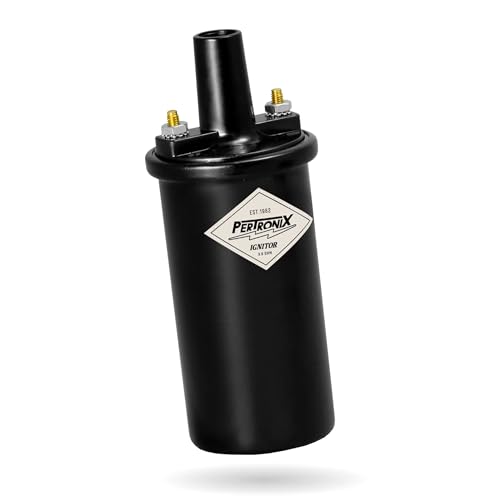
PerTronix 40611 Flame-Thrower
A sealed 3 ohm canister that tolerates vibration and odd brackets.

Lucas Sports Coil 1.5 Ohm
A low-resistance Lucas Sports Coil with an original appearance.
Points, Electronic Conversion or Fuel Injection?
Most carbureted Minis left the factory with a Lucas distributor, a set of contact breaker points and a single canister coil. The points switch the coil’s primary current on and off, and the coil steps that up into the high voltage that jumps the plug gap. Because the points carry that current, the coil’s resistance sets how hard they work.
Plenty of Minis on the road today have been converted. A PerTronix Ignitor kit, listed on Amazon for Lucas 25D four-cylinder distributors, swaps the points for a magnetic trigger inside the original distributor. Kits like this often name a preferred coil resistance, and that instruction outranks any general rule.
The last of the line, the fuel-injected Minis of the 1990s, fire their plugs through an engine-management system rather than points. Their coil is a different part with its own connector, and none of the canister coils below replaces it.
Read the Old Coil Before You Order
A cheap multimeter answers most of the question in two minutes. With the ignition off and the low-tension leads removed, measure across the coil’s two small terminals. A reading near 3 ohms points to a coil meant for a direct 12-volt feed, and a reading near 1.5 ohms suggests the car has a ballast somewhere in the circuit.
- Ballast check: look for a separate ceramic resistor or a pink resistive wire feeding the coil’s positive terminal. If either is present, a lower-resistance coil is normally correct.
- Ignition type: lift the distributor cap. A points gap and condenser mean breaker ignition; a small module and magnet ring mean a conversion.
- Kit paperwork: electronic kits state a minimum coil resistance, so keep those instructions handy.
- Factory spec: for an original car, the British Motor Industry Heritage Trust’s heritage certificate service can confirm the engine number and factory-fitted equipment recorded at the plant.
Write down the reading and what you found on the positive feed. That note decides which of the listings below makes sense for your car.
Best Ignition Coil for Classic Mini: Five Coils Compared
Amazon’s Mini results are crowded with modern MINI coil packs, so we kept only coils that suit an A-series distributor car. Two are 3.0 ohm, two are 1.5 ohm, and one is listed by model year for the 1.3 Cooper.
1. Lucas Sports Coil: 12V 3.0 Ohm Coil with 40,000 Volt Output
- 12-volt canister coil
- 3.0 ohm primary resistance
- Rated at 40,000 volts
- Lucas Sports Coil styling
This listing from British Parts Northwest is a Lucas Sports Coil for 12-volt systems with a primary resistance of 3.0 ohms. The seller rates its output at 40,000 volts. Lucas supplied the electrical parts on a huge range of British cars, so the canister shape and branding look at home under the bonnet of a restored Mini.
The 3.0 ohm figure is the key detail. On a Mini that runs contact breaker points with a plain 12-volt feed to the coil, this resistance limits the current flowing through the points, which helps them last and keeps the coil from running hot. The higher output gives some margin for a slightly wider plug gap or a tired set of high-tension leads, though it won’t cover for worn points or a cracked rotor arm. Fitting it is a simple swap of two low-tension wires and the king lead.
It is not the right part for every car. If your Mini has a ballast resistor or a resistive feed wire, a 1.5 ohm coil is the usual match, and a 1990s injected Mini uses a different coil altogether. Measure your old coil, confirm the feed, and check year, model and engine on the Amazon listing before you buy.
View Lucas Sports Coil 3.0 Ohm on Amazon
2. PerTronix 40611 Flame-Thrower: 3.0 Ohm Epoxy-Filled 40,000 Volt Coil
- 3.0 ohm, 12-volt design
- Up to 40,000 volts
- Epoxy-filled, mounts at any angle
- Suits points and Ignitor I
The PerTronix 40611 is a black canister coil in the Flame-Thrower line, built for 12-volt inductive ignition with a primary resistance of 3.0 ohms and output of up to 40,000 volts. PerTronix says it is optimized for breaker points and its own Ignitor I module, and that the higher resistance helps protect modules and points from drawing too much current. It suits owners who want a sealed modern coil without changing the rest of the ignition.
Its epoxy filling is the main difference from an oil-filled coil. The listing describes better resistance to vibration and shock, and the coil can be mounted in any orientation, which helps on a small engine bay where the original bracket doesn’t sit perfectly upright. The plain black finish also fits a standard coil clamp and keeps a factory look under the bonnet.
This coil suits a Mini still running points or one converted with an early Ignitor kit that calls for 3.0 ohms. It is the wrong choice where the car has a ballast designed for a low-resistance coil, and it doesn’t replace the engine-management coil on fuel-injected Minis. Confirm your ignition type and check fitment on Amazon before ordering. A quick look under the distributor cap settles which system you have.
View PerTronix 40611 Flame-Thrower on Amazon

3. Lucas Sports Coil: 1.5 Ohm Inductive Coil with 40,000 Volt Output
- 1.5 ohm primary resistance
- 40,000 volt rated output
- For inductive ignition systems
- Stock look canister
The second Lucas Sports Coil from British Parts Northwest is the 1.5 ohm version. The listing describes a stock look with a 40,000-volt rating, built for inductive ignition systems. It shares the familiar Lucas canister shape, so it suits an owner who wants an original appearance while matching a lower-resistance circuit. It fits a standard canister clamp, so the mounting bracket usually stays as it is.
A 1.5 ohm coil draws more current than a 3.0 ohm one, which is why it pairs with cars that reduce the coil’s supply through a ballast resistor or resistive wire. The ballast drops the running voltage, then many systems bypass it during cranking for a stronger spark on cold starts. Some electronic ignition kits also call for a 1.5 ohm coil, so check the kit’s instructions first.
On a points Mini with a full 12-volt feed and no ballast, this coil is the wrong match and can shorten the life of the points. Look for the ceramic resistor or resistive wire before ordering, and measure your old coil if you aren’t sure. Then confirm year, model and engine on the Amazon listing. A quick resistance check with a multimeter settles any doubt.
View Lucas Sports Coil 1.5 Ohm on Amazon
4. PerTronix 40011 Flame-Thrower: 1.5 Ohm Oil-Filled 40,000 Volt Coil

- 1.5 ohm primary resistance
- Works on 6 and 12 volt systems
- Oil-filled for heat dissipation
- Optimized for Ignitor systems
The PerTronix 40011 is the oil-filled, 1.5 ohm member of the Flame-Thrower family. The listing rates it at up to 40,000 volts and lists it for 6 and 12-volt systems. PerTronix describes it as optimized for its Ignitor systems while staying compatible with most points or electronic inductive distributor ignitions. Like the 40611, it uses a standard canister size that fits common coil brackets.
Oil filling helps carry heat away from the windings, which the listing ties to consistent spark during street driving. That design comes with one firm rule from PerTronix: the coil must sit vertically with the terminal facing up, never upside down or on its side, or oil can leak and damage it. Check that your Mini’s bracket holds the coil upright before choosing this one over an epoxy-filled design.
This coil makes the most sense on a Mini already converted to a PerTronix Ignitor kit that names a 1.5 ohm coil, or on a ballasted points car. It is not meant for a points car with a direct 12-volt feed and no ballast. Confirm your kit’s coil requirement and check fitment on Amazon before buying. A quick resistance check with a multimeter settles any doubt.
View PerTronix 40011 Flame-Thrower on Amazon
5. Dwvksz Ignition Coil: Replacement for 1967-1969 Austin Mini Cooper 1.3L

- Listed for 1967-1969 Mini Cooper 1.3L
- Also listed for Jaguar 340 3.4L
- Single coil per package
- Fitment tool check advised
This Dwvksz ignition coil is one of the few Amazon listings that names the classic car directly. The seller lists it for the 1967 to 1969 Austin Mini Cooper with the 1.3-liter four-cylinder, along with the 1967 Jaguar 340. It ships as a single coil, and the listing says it is tested to OE standards and suited to both DIY owners and professionals.
Being listed by model year makes the search simpler for an owner who knows exactly what car they have. The coil is a straightforward replacement for a points-era Cooper and keeps the job to two low-tension wires, the king lead and the mounting clamp, so most owners can fit it at home with basic hand tools.
The listing doesn’t state the coil’s primary resistance, so measure it with a multimeter before fitting and compare it with your old coil and any ballast in the feed. It does not cover other Mini years by name, and Dwvksz advises using Amazon’s fitment tool with your year, model and engine. Treat it as a budget option for an original Cooper 1.3. A higher-spec coil above is worth a look if you want a stated resistance.
View Dwvksz Coil for Austin Mini Cooper 1.3 on Amazon
Matching a Coil to Your Mini’s Ignition
Use this as a shortlist, then check your own readings against the coil and kit maker’s instructions.
| Ignition setup | What you’ll find | Coil resistance | Listings above |
|---|---|---|---|
| Points, no ballast | Plain 12V wire to coil positive | About 3.0 ohm | Lucas Sports Coil 3.0 ohm, PerTronix 40611 |
| Points with ballast | Ceramic resistor or resistive wire | About 1.5 ohm | Lucas Sports Coil 1.5 ohm, PerTronix 40011 |
| Ignitor-style conversion | Module and magnet ring in the distributor | As the kit states | PerTronix 40011 or 40611, per kit instructions |
| 1967-1969 Cooper 1.3 | Original points distributor | Not stated on listing | Dwvksz coil, measure before fitting |
| 1990s fuel injection | Engine-management coil | Different part | None of the coils above |
When in doubt between two resistances on a points car, the higher figure is the gentler choice for the points. A lower-resistance coil on a full 12-volt feed pulls more current, which shortens point life and heats the coil.

Damp Grilles, Road Salt and Winter Storage
The Mini’s transverse engine puts the distributor at the front, close behind the grille, where spray from a wet road lands first. Moisture on the cap, the coil tower or the high-tension leads gives spark an easier path to ground than across the plug gap. The classic symptom is a car that starts fine on a dry day and coughs or stalls in heavy rain.
West Michigan winters add salt film and freeze-thaw slush on top of that. Many Grand Rapids owners store their Minis from November to spring, which is a good time to clean the coil tower, check the king lead for cracks and fit fresh boots. A coil that sat in a damp garage all winter can track across a dirty tower, so wipe it clean before the first spring start.
Lucas Classic notes that many factory-fitted parts on classic cars were originally made by Lucas, and it supplies period-correct replacements. That matters if originality is your goal, while owners who drive their Minis hard often accept a modern canister coil for its sealed construction.
When the Misfire Isn’t the Coil
Coils on these cars are rarely the first thing to go. Burned or badly gapped points, a failing condenser, a cracked rotor arm, worn plugs and tired leads all cause the same stumble. On an SU carburetor car, a sticking piston or a lean mixture can feel just like weak spark.

If the Mini bogs when you open the throttle rather than misfiring at idle, our guide on why a car hesitates when you accelerate walks through the fuel and ignition causes in order. Our car electrical repair team in Grand Rapids can test the coil, feed wiring and ballast circuit on the car.
The A-series engine drives its camshaft with a timing chain, and a slack chain on a high-mileage engine lets ignition timing wander. Our timing belt and chain replacement in Grand Rapids covers chain-driven engines as well. For the modern car parked next to the Mini, our rundown of timing belt kit brands and what comes in each box explains the belt side.
More Buying Guides
Frequently Asked Questions
Can I run a 1.5 ohm coil on a Mini with points and no ballast?
It isn’t a good idea. Without a ballast, the lower resistance lets more current through the points, which wears them faster and makes the coil run hot. Fit a 3.0 ohm coil, or add the correct ballast if the coil maker calls for one.
What is the best ignition coil for classic Mini cars with a PerTronix Ignitor?
PerTronix lists its Flame-Thrower coils as optimized for its Ignitor systems. The 40011 is 1.5 ohm and the 40611 is 3.0 ohm, so pick the one your kit’s instructions name. If the paperwork is gone, check the kit’s part number with PerTronix before buying.
Does a modern MINI Cooper coil fit a classic Mini?
No. BMW-era MINIs use a pencil coil on each spark plug, controlled by the engine computer. A classic Mini with a distributor needs a single canister coil that feeds the cap through a king lead.
Will a high-output sports coil make my Mini faster?
Not on its own. A healthy stock coil already fires a correctly gapped plug on a standard engine. A sports coil helps most on a modified engine, with wider plug gaps, or when the old coil was already weak.
Mini still spluttering after a new coil, or unsure whether yours has a ballast? Ring 456 AutoFix at 616-279-3832 on weekdays between 8am and 5pm, or set up an ignition check through our contact page.
Short on daytime hours? Bring the Mini to 456 Carrier St NE in Grand Rapids after closing time and leave it with our after-hours drop-off, along with a note on how it misbehaves.