As an Amazon Associate, 456 AutoFix earns from qualifying purchases. Product links below go to Amazon, where you can confirm the right part for your vehicle.
Ask ten home mechanics how they bleed brakes alone and most will name one of two tools, which is why the motive power bleeder vs mityvac question keeps coming up. One pushes fresh fluid in from the reservoir under air pressure. The other pulls old fluid out at each wheel with a hand pump.
Both methods work, and both let you finish the job without a helper on the pedal. They differ in setup, in what can go wrong and in which cars they suit. Below we compare a Motive Power Bleeder kit with a Mityvac hand vacuum kit, add a Phoenix Systems reverse bleeder as a third option, and use only the makers’ own figures and the Amazon US listings.
Quick answer
Should you bleed with a Motive pressure tank or a Mityvac pump?
Pick the Motive Power Bleeder for full fluid flushes on one or two cars you work on often, as long as a cap adapter fits your reservoir. Pick the Mityvac MV8500 if you need one kit that fits any bleed screw and also handles vacuum and pressure testing. Both work one-person.
Our Quick Picks
A Motive pressure kit and a Mityvac vacuum kit head to head, plus a Phoenix Systems reverse bleeder for awkward systems, each reviewed in full below.

Motive 0107 Power Bleeder
Pressurizes the reservoir so one person can flush every corner in turn.
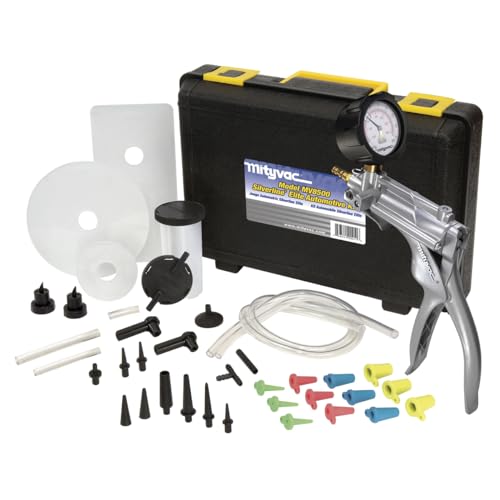
Mityvac MV8500
Draws old fluid out at each bleed screw and doubles as a test pump.

Phoenix Systems MaxProHD
Feeds fluid in at the bleed screw so trapped air rises out the top.
Pushing From the Top or Pulling From the Bottom
A Motive Power Bleeder is a two-quart tank with a hand pump in its lid and a hose that ends in a cap matched to your master cylinder reservoir. You pour fresh fluid into the tank, lock the cap on and pump the tank up to a low pressure. Open a bleed screw and fresh fluid pushes the old fluid and any air out of that corner, in the same direction the fluid travels when you press the pedal.
A Mityvac kit works from the other end. A hand pump creates vacuum in a small catch jar, and a clear hose from the jar slips over the bleed screw. Squeeze the handle, crack the screw and old fluid is drawn out while you watch for bubbles in the line. You top up the reservoir by hand as you go.
Motive’s own Power Bleeder FAQ argues that pressure bleeding keeps fluid moving in its natural direction and avoids the old pump-and-hold routine, which can push the master cylinder piston into rusty or worn parts of the bore. That same page notes that brake fluid absorbs water from the air over time, which is the main reason a full flush matters at all.
Fit, Setup and the Bubble Problem
The Motive’s weak point is the cap. Each kit ships with one adapter, and the right one depends on the shape of your reservoir neck, so a Ford-style kit will not seal on a GM or a Honda. Motive suggests pressure-testing the cap with an empty tank first and says the round universal adapter is meant mainly for Toyota and Honda reservoirs, which take patience to seal.
The Mityvac fits any bleed screw, so one kit covers every car in the driveway, plus the lawn tractor and a motorcycle. Its weak point is air that sneaks in around the bleed screw threads while the pump pulls vacuum. That shows up as a steady trail of fine bubbles that never stops, even when the lines are clear, and it confuses many first-time users.
A wrap of thread tape on the bleed screw, or a smear of grease around its base, usually quiets those false bubbles. Large, separate bubbles that taper off are the real air you are chasing. Small, constant fizz from the threads is not, and chasing it only wastes fluid.
Motive Power Bleeder vs Mityvac: The Three Kits in Detail
The Mityvac MV8500 also appears in our brake bleeder kit roundup; it returns here because it is Mityvac’s own hand vacuum kit and the natural match for a Motive tank. On the Motive side we use the Ford-pattern 0107 rather than the European 0100 covered there. The Phoenix Systems MaxProHD joins as a third choice because it bleeds in reverse, which neither of the other two can do.
Motive Products 0107: 2-Quart Power Bleeder with 3-Prong Twist Cap for Ford
- 2-quart tank with built-in hand pump
- Precision pressure gauge on the lid
- 1107 3-prong twist cap for most 1986-on Ford
- Made in the USA, one-person use
The Motive Products 0107 is the Ford-pattern version of the Motive Power Bleeder, and it is the pressure side of this comparison. It uses a two-quart tank with a hand pump built into the lid and a precision gauge, connected by a hose to a 1107 three-prong twist cap. Motive says that cap suits most Ford vehicles from 1986 on, plus many late model Nissan, Mitsubishi, Kia, Hyundai and Subaru cars.
Setup is simple once the cap seals. Pour fresh fluid into the tank, lock the cap on the reservoir, pump the tank up while you watch the gauge, then open each bleed screw in turn and let clean fluid push the old out. Motive’s FAQ advises pushing the twist cap down until it seats before turning it, and the kit includes a thinner spare o-ring for reservoirs with narrow necks.
The large tank is the main benefit, since one fill covers a complete flush without topping up the reservoir between wheels. Motive backs the kit with a one-year guarantee, recommends cleaning it with isopropyl alcohol rather than brake cleaner, and suggests a new hose every three to four years. It is the wrong kit for a GM or Chrysler reservoir, so confirm your year, model and cap shape on Amazon before buying.
View Motive 0107 Power Bleeder on Amazon

Mityvac MV8500 Silverline Elite: Hand Vacuum and Pressure Pump Bleeding Kit
- MV8510 zinc-aluminum die-cast hand pump
- Vacuum and pressure bleeding modes
- 4.5 oz fluid reservoir
- Also tests fuel, coolant and hydraulic systems
The Mityvac MV8500 Silverline Elite stands in for the vacuum side of this comparison. It is also reviewed in our brake bleeder kit roundup, and it appears again because it is the hand pump most people mean when they say Mityvac. The kit centers on the MV8510 pump, whose body is die-cast from a zinc-aluminum alloy that Mityvac says resists corrosion, along with a 4.5-ounce fluid reservoir.
In use, you fit a hose from the reservoir to the bleed screw, squeeze the ergonomic handle to build vacuum and open the screw a quarter turn. Old fluid and air travel into the jar, where you can watch for the bubbles to stop before closing the screw and moving on. The pump can also switch to pressure, which helps with some clutch systems and diesel fuel priming.
The main strength is coverage. Because it never needs a cap adapter, the MV8500 works on cars, trucks, SUVs and motorcycles with a standard bleed screw, and Mityvac lists vacuum and pressure testing for fuel, coolant, hydraulic and differential components too. The small jar needs emptying several times on a complete flush, and you have to keep the reservoir topped up by hand so the master cylinder never runs dry.
Phoenix Systems MaxProHD: Heavy-Duty Reverse Brake and Clutch Bleeder
- Reverse, vacuum, pressure and bench bleeding
- Fully rebuildable cast-aluminum injector
- Refills a completely dry system
- DOT 3, 4 and 5.1 fluid, hard case
The Phoenix Systems MaxProHD is the third option here, for readers who want neither a reservoir tank nor a suction pump. Its main trick is reverse bleeding, where clean fluid enters at the bleed screw and flows up toward the reservoir, carrying air with it in the direction bubbles already want to go. It can also vacuum bleed, pressure bleed and bench bleed a master cylinder.
Phoenix builds this version around a cast-aluminum injector that can be fully rebuilt, and it ships in a molded hard case. The maker classes it as a heavy-duty tool for everyday shop use, a step above its light-duty V-5. The listing says it can refill and bleed a brake or clutch system that has been run completely dry, which is handy after replacing a master cylinder or a clutch slave cylinder.
Phoenix also claims reverse bleeding is the only way to clear stubborn ABS units without a scan tool, which is the maker’s position rather than a rule for every car. Motive’s FAQ argues the opposite, that pushing fluid upward can move debris toward the ABS unit and master cylinder. Siphon fluid out of the reservoir as it rises, and flush very dirty fluid from the top first.
View Phoenix Systems MaxProHD on Amazon

Side by Side on Paper
Where a listing leaves a detail out, the table says so instead of guessing.
| Point | Motive 0107 | Mityvac MV8500 | Phoenix MaxProHD |
|---|---|---|---|
| Method | Pressure from the reservoir | Vacuum at the bleed screw | Reverse, plus vacuum, pressure and bench |
| Fluid capacity | 2-quart tank | 4.5 oz catch reservoir | Not stated in the listing |
| Vehicle fit | Cap for most 1986-on Ford and some Asian makes | Any bleed screw, cars to motorcycles | Brake and clutch systems, per the listing |
| Other uses | Brake and clutch fluid only | Vacuum and pressure testing, fuel priming | Bench bleeding, dry systems |
| Duty rating | Home, shop or track use | Die-cast pump for pro and DIY use | Heavy duty, everyday shop use |
The capacity row tells most of the story. A two-quart tank holds enough for a full system flush in one go, while a 4.5-ounce jar means emptying it several times on a full flush. For bleeding one caliper after a brake hose swap, that small jar is no hardship.

Which Bleeder Belongs in Your Garage
Start from what you drive and how often you plan to flush, then match the tool to the job.
| Your situation | Better fit | Why |
|---|---|---|
| Full fluid flush on one or two family cars | Motive pressure kit | Big tank, steady flow, no topping up |
| Several makes in the driveway | Mityvac MV8500 | Works at any bleed screw, no cap to match |
| Vacuum leaks and other tune-up checks | Mityvac MV8500 | Gauge and pump double as a test tool |
| New master cylinder or a dry system | Phoenix MaxProHD | Listing covers refilling a completely dry system |
| Track days or frequent flushes | Motive pressure kit | Fast, repeatable flush once the cap is set up |
West Michigan adds a twist. Years of road salt can leave bleed screws seized or rounded, and any bleeder is useless until the screw turns. Soak them with penetrating oil the night before, use a six-point wrench, and stop if a screw feels like it will snap, since a broken bleed screw turns a flush into a caliper job.
Whatever tool you pick, use the fluid type printed on your reservoir cap. Every DOT grade is defined by Federal Motor Vehicle Safety Standard No. 116, which sets minimum boiling points; DOT 3, 4 and 5.1 are glycol-based, while silicone DOT 5 should never be mixed with them.
Our guide to how often to change brake fluid covers intervals and test methods. If you are doing pads at the same visit, our daily driving brake pad guide is a good place to start.
When a Fresh Bleed Does Not Fix the Pedal
Bleeding removes air and tired fluid, but it cannot fix a leaking line, a worn master cylinder or a failing ABS unit. If the pedal still feels soft after two careful bleeds, or keeps sinking while you hold it at a light, the cause is somewhere else in the system.

Our article on a brake pedal that goes to the floor walks through the usual causes. If you would rather hand the job over, our team does brake repair in Grand Rapids, from fluid flushes to lines, calipers and master cylinders.
More Buying Guides
Frequently Asked Questions
Is a pressure bleeder better than a vacuum bleeder?
For a full flush, a pressure bleeder is usually quicker because the tank keeps the reservoir full for you. A vacuum bleeder is more flexible, since it works at any bleed screw without a matching cap. Both do a proper job when used with care.
Why do I keep seeing bubbles when I use a Mityvac?
Most often the pump is drawing air past the bleed screw threads, not out of the brake lines. Thread tape or a little grease around the screw usually stops it. Real air in the system comes out as larger bubbles that fade as you go.
How much pressure should a Motive Power Bleeder run?
Motive’s FAQ talks about holding roughly 10 to 15 psi once the cap is sealed. Pressure-test the cap with an empty tank first, then add fluid and pump it back up. Follow the instructions that ship with your kit.
Will the Motive 0107 fit my car?
The listing says its 3-prong twist cap fits most Ford vehicles from 1986 on and many Nissan, Mitsubishi, Kia, Hyundai and Subaru models. Check your year, model and reservoir cap against Motive’s application guide and the Amazon listing before you order.
Pedal still soft after a flush, or short on time for the job? Call 456 AutoFix at 616-279-3832, Monday to Friday 8am to 5pm, or ask for a brake inspection through our contact page.
A spongy pedal can wait for us overnight, too: leave the car at 456 Carrier St NE, Grand Rapids, through the after-hours drop-off, with a short note on how the pedal feels.