
As an Amazon Associate, 456 AutoFix earns from qualifying purchases. Product links below go to Amazon, where you can confirm the right part for your vehicle.
Shoppers who settle on a ceramic pad often end up with two tabs open, one for each brand. The centric vs akebono decision is less about which company is good, since both have long histories in the aftermarket, and more about what each box actually gives you on your own car. A pad that sounds great on paper still has to fit the caliper, stay quiet through a salty winter and wear evenly.
To make the comparison concrete, we picked one common family SUV and one axle: the front brakes of the 2016-2020 Kia Sorento, which catalogs list with the FMSI D1815 pad shape. Centric brings its Premium Ceramic 301.18150, Akebono brings its ProACT ACT1815, and we added Akebono’s ACT1816 rear set for owners doing the whole car at once. Want a wider list of brands for an ordinary commuter? Our guide to brake pads for daily driving covers more options.
Quick answer
Is Centric or Akebono the smarter front pad for a 2016-2020 Sorento?
Choose Akebono ProACT ACT1815 if quiet stops, clean wheels and a no break-in pad matter most. Choose Centric Premium Ceramic 301.18150 if you want a well-known ceramic set and plan to inspect or replace the hardware yourself. Doing the rear brakes too? Akebono’s ACT1816 matches the same SUV.
Our Quick Picks
One current front pad set from each brand for the 2016-2020 Kia Sorento, plus Akebono's matching rear set for owners doing both axles. All three are reviewed below.

Centric 301.18150
Centric's Premium Ceramic front set for the third-generation Sorento.
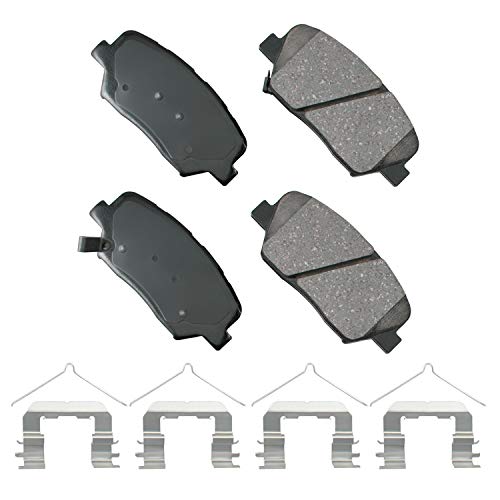
Akebono ACT1815
OE-supplier ceramic aimed at quiet, clean stops with no bedding step.

Akebono ACT1816
The matching ProACT rear set for owners doing both axles.
Two Brands, Two Ways of Building a Ceramic Pad
Akebono’s story starts on the assembly line. The company says it is an original equipment manufacturer on many Asian vehicles, and its ProACT page for Asian vehicles pitches the aftermarket pads as a way to bring back the braking a car had when it was new. It lists ultra clean, quiet and smooth stops, rotor-friendly formulas tuned to each vehicle, and aftermarket pads made in the USA.
The same page claims ProACT pads last up to 40 percent longer. That figure comes from the maker, not from an outside test, and real pad life on a heavy SUV depends far more on traffic, hills and the driver’s right foot. Read it as a statement of what the compound is designed for rather than a promise for your commute.
Centric works from the other direction. It is an aftermarket brand with a very wide catalog and several pad tiers, from basic semi-metallic sets up through its PosiQuiet and Premium families, so the same car can have three or four Centric options at different levels. The Premium Ceramic sets carry part numbers starting with 301, which is why the Sorento front set is 301.18150.
The catch is information. Centric’s Amazon listing for this set names only the line and the number, and we could not reach the brand’s own site to fill in details. Everything we say about the Centric set below comes from that listing and from the pad shape it is built around, and we flag the details nobody states.
Decoding Pad Numbers on the Third-Generation Sorento
Most brands build a standard shape code into their part numbers, and that code comes from the Friction Materials Standards Institute, a trade group founded in 1948 to give the aftermarket one shared numbering system. Once you know the code, cross-shopping gets much easier. On this Kia, the front shape is D1815 and the rear is D1816.
You can see the code inside each number. Centric’s 301.18150 puts 1815 in the middle, Akebono’s ACT1815 puts it at the end, and the rear ACT1816 follows the same rule. Catalogs tie the D1815 front shape to the 2016-2020 Sorento and to the 2017-2018 Hyundai Santa Fe Sport, which shares much of its running gear.
Sellers still disagree at the edges. Some list a single year range for every engine, while others split by trim, and the Akebono front listing names no vehicles at all. Pull a wheel and compare the old pad’s shape and part number, then enter your year, trim and engine in Amazon’s fit checker before ordering either brand.
Centric vs Akebono: The Three Sorento Pad Sets Reviewed
The two front sets below go head to head on the same axle, and the third covers the rear for the same SUV. We describe each one using only what the Amazon listing or the maker states, so check your year, model and engine on Amazon before you buy, because no single listing fits every Sorento.
Centric Premium Ceramic 301.18150: Front Disc Brake Pad Set, FMSI D1815
- Centric Premium Ceramic line (301 series)
- Built around the FMSI D1815 front shape
- Ceramic street compound for daily driving
- No vehicle list on the listing: use the fit checker
The 301.18150 is the Centric Premium Ceramic set made in the D1815 shape, which parts catalogs list for the front axle of the 2016-2020 Kia Sorento and the 2017-2018 Hyundai Santa Fe Sport. The Amazon listing is brief, naming only the product line and part number. Because no vehicles are listed on the page, run your year, trim and engine through Amazon’s fit checker and compare the shape with your old pads.
Premium Ceramic is one of several pad families in Centric’s range, sitting above the brand’s basic semi-metallic sets. A ceramic compound is the usual pick for a family SUV that spends its days on city streets and highways, because it tends to run quietly and leave light, pale dust rather than the dark film that semi-metallic pads often produce. That makes it a practical choice for drivers who want clean wheels without moving to a performance pad.
The listing does not say whether abutment clips, shims or a wear indicator come in the box, so check the contents before the job starts and keep a D1815 hardware kit in mind. That suits a home mechanic who already plans to clean the bracket and grease the slides. It is a street pad, so it isn’t aimed at heavy towing or track use.
View Centric 301.18150 on Amazon

Akebono ProACT ACT1815: Ultra-Premium Ceramic Front Brake Pad Set, No Break-In
- ProACT ultra-premium ceramic compound
- No break-in period required, per the listing
- Made in the USA with a 1-year limited warranty
- Vehicle-specific D1815 front set: confirm fit
Akebono’s ACT1815 is the ProACT pad in the D1815 front shape, the same shape catalogs tie to the 2016-2020 Sorento and the 2017-2018 Santa Fe Sport. Like the Centric set, the Amazon listing names no vehicles and simply calls the pads vehicle-specific. Confirm your exact year, trim and engine in the fit checker and match the part number on your old pads before you order.
The listing gives more detail than most. It says the set offers strong initial bite with no break-in period, carries a one-year limited warranty and is made in the USA. Akebono’s ProACT page adds that the compounds are tuned to each vehicle, run ultra clean and quiet, and are kind to rotors, and the maker claims up to 40 percent longer life. Those are the brand’s own figures, so treat them as design goals rather than a guarantee for your SUV.
Because Akebono supplies original brakes to many Asian automakers, the ProACT line is pitched as a way to restore factory feel rather than change it. It suits commuters and family drivers who want a quiet, smooth pedal and less wheel cleaning. It is not built for track days, and it won’t fix noise caused by seized slides or worn clips.
View Akebono ACT1815 on Amazon
Akebono ProACT ACT1816: Rear Ceramic Disc Brake Pads for Sorento and Santa Fe
- Rear axle ProACT set in the FMSI D1816 shape
- Listing names Sorento 2016-2019
- Also lists Santa Fe and Santa Fe XL 2017-2019
- Made in the United States, per the listing
The ACT1816 is the closely related third pick: Akebono’s ProACT set for the rear axle of the same SUV. Unlike the two front listings, this one names its vehicles in the title, listing the 2016-2019 Kia Sorento along with the 2017-2019 Hyundai Santa Fe and Santa Fe XL. Catalogs extend the D1816 shape into some 2020 Sorentos, so confirm your year and trim on Amazon before buying.
The listing says the pads are designed to virtually eliminate noise, vibration and harshness, and gives the United States as the country of origin. Since it comes from the same ProACT family as the ACT1815, it should give a similar character front and rear, with quiet operation and clean wheels as the stated aim. Matching compounds across both axles also keeps the brake balance feeling consistent, which many owners prefer after a full brake job.
Rear pads on most SUVs wear more slowly than the fronts, so check the lining before you add this set to the cart. If a rear caliper piston is stiff to push back or a slide pin binds, sort that out before the new pads go in. This set makes sense when the rears are close to the wear tab or the rotors are being replaced anyway.
View Akebono ACT1816 on Amazon

Side by Side: What Each Box Promises
The two brands publish very different amounts of detail for these sets, so the table below mixes listing text with what the pad shape tells us. Where a listing or maker page stays silent, the cell says so instead of guessing at a spec.
| Point | Centric 301.18150 | Akebono ACT1815 | Akebono ACT1816 |
|---|---|---|---|
| Axle and shape | Front, FMSI D1815 | Front, FMSI D1815 | Rear, FMSI D1816 |
| Product line | Centric Premium Ceramic | ProACT ultra-premium ceramic | ProACT ultra-premium ceramic |
| Break-in | Not stated | None required, per the listing | Not stated on this listing |
| Where made | Not stated | USA, per the listing | United States, per the listing |
| Vehicles named | None on the listing | None on the listing | Sorento 2016-2019, Santa Fe and Santa Fe XL 2017-2019 |
On paper, the centric vs akebono gap is mostly about how much the brand tells you. Akebono spells out its priorities: quiet operation, clean wheels, no bedding procedure and US manufacturing. Centric leaves the buyer to trust the line name, which is reasonable for an established brand but means you should open the box and check what is inside before the old pads come off.

Both sets are ceramic street pads, so neither is meant for track days or heavy towing at the limit of the SUV’s rating. Ceramic compounds usually leave lighter, less noticeable dust than semi-metallic pads and run quietly once seated. Akebono adds that its ProACT pads meet low-copper rules, which matters for buyers who care about what washes off their driveway.
Loaded Family SUVs and Grand Rapids Winters
A Sorento with a third row full of kids, a roof box and a trip to the lake puts much more heat into its front brakes than one that carries a single commuter. If your SUV often runs heavy, inspect the pads more often than the maintenance schedule suggests and favor a set from a brand that states its compound and design aims clearly.
Salt matters more in West Michigan than any centric vs akebono detail. Brine creeps into the caliper bracket, swells rust under the abutment clips and freezes slide pins, and a pad that cannot float freely wears into a taper or drags on the rotor. Whichever brand you choose, scrape the bracket to clean metal, lube the slides with a brake-specific grease and swap any clip that looks pitted or bent.

Pad life varies widely, even between two Sorentos wearing the same part number. Short trips, steep driveways and constant stop-and-go on city streets all speed up wear, and our article on how long brake pads last explains the habits that stretch a set and the ones that shorten it. Measuring the lining at each tire rotation is the easiest way to avoid a surprise.
Settling the centric vs akebono question for your own Kia comes down to priorities. Buyers who value a quiet pedal, clean wheels and clear maker claims will lean toward the ProACT, while buyers comfortable checking hardware and fit themselves may be happy with the Centric. If the rear pads are also near the wear tab, pairing the front set with the ACT1816 saves a second job.
When a Pad Swap Is Not Enough
However the centric vs akebono choice turns out, new pads cannot repair a caliper that sticks, a rotor worn below its minimum thickness or a spongy pedal caused by tired fluid. A steering wheel that shakes under braking, a pull to one side, metal-on-metal grinding or one wheel that runs much hotter than the rest all point to something beyond the pads. Look at the whole corner before you spend money on friction alone.

The Sorento warns of thin pads with a small metal tab that squeals against the rotor, while many European cars use a wired sensor and a dash light instead, as our explainer on the Audi brake pad warning light describes. Either way, the warning is your cue to book an inspection soon rather than wait until it turns into grinding.
Prefer to have it done for you? Our brake repair in Grand Rapids covers pads, rotors, calipers and hardware on foreign and domestic vehicles, family SUVs included. We measure what is left, check the slides and fluid, and explain which parts need replacing and which can stay.
More Buying Guides
Frequently Asked Questions
Is Akebono better than Centric for a Kia Sorento?
Neither brand wins on every point. Akebono’s ProACT ACT1815 gives you more stated detail, including no break-in period and US manufacturing, and the brand leans on its OE supplier background. Centric’s Premium Ceramic 301.18150 is a familiar aftermarket ceramic with a thinner listing, so it suits buyers happy to check fit and hardware themselves.
Do Akebono ProACT pads need to be bedded in?
The ACT1815 listing says no break-in period is required. Gentle stops for the first few dozen miles still help any new pad seat evenly against the rotor, especially when the rotors are reused, so avoid hard panic stops right after the install if you can.
Does the Centric 301.18150 come with clips and shims?
The Amazon listing does not say. Open the box when it arrives and compare its contents with the old pads. If clips are missing, or the clips on the bracket are rusted or loose, buy a hardware kit for the same D1815 shape so the new pads can slide freely.
Should I replace the Sorento rotors when I change the pads?
Replace them if they are scored, cracked, rusted deeply on the friction face or below the minimum thickness cast into the rotor, or if the pedal pulses. Rotors in good shape with thickness to spare can stay, though a fresh surface helps new pads reach full bite sooner.
Not sure whether your Sorento needs pads now or next season? Ring 456 AutoFix at 616-279-3832 between 8am and 5pm, Monday through Friday, or request a brake inspection through our contact page.
If daytime hours don’t work, our after-hours drop-off lets you leave the SUV at 456 Carrier St NE in Grand Rapids whenever suits you, along with a quick note describing the squeal, shake or pedal feel you noticed.