
As an Amazon Associate, 456 AutoFix earns from qualifying purchases. Product links below go to Amazon, where you can confirm the right part for your vehicle.
A second battery in a truck or camper only helps if something refills it while you drive and keeps it from draining the one that starts the engine. The battery isolator vs dc to dc charger question is really about how much control you want over that refill. An isolator is a switch that joins the two batteries when the alternator is running, while a DC-DC charger is a small charging computer that sits between them.
Both keep a dead camp fridge battery from leaving you stranded, and both have a place. Which one fits depends on the age of your vehicle, the chemistry of the second battery, how far apart the two sit, and whether solar is part of the plan.
Quick answer
Does your setup need an isolator or a DC-DC charger?
An isolator such as the VEVOR 140A relay suits an older vehicle with a fixed-voltage alternator and a lead-acid or AGM second battery mounted close by. Pick a DC-DC charger like the REDARC 25A for a smart alternator, a lithium battery, a long cable run or solar input.
Our Quick Picks
For the battery isolator vs dc to dc charger decision, here is one relay isolator, one DC-DC charger and a related third pick, a Bluetooth monitor that shows how well either one charges.

VEVOR 140A Split Charge Relay Kit
A simple relay that links and splits two batteries.
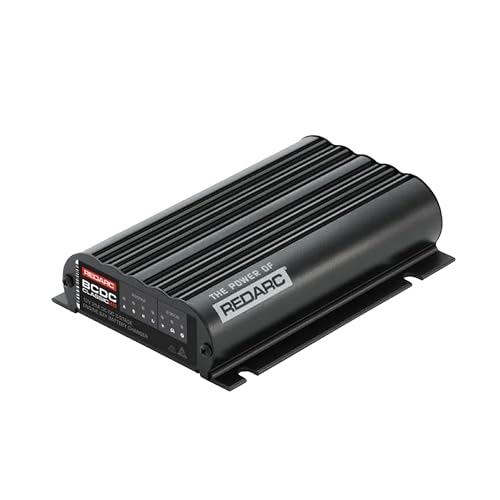
REDARC BCDC1225D 25A Charger
A charger that sets its own profile for the second battery.

Victron SmartShunt 300A Monitor
Shows whether your relay or charger is really refilling the bank.
Two Ways to Feed a Second Battery
A voltage sensing relay, the most common isolator today, watches the start battery. When the alternator pushes that battery above a set point, the relay closes and the two batteries sit side by side on the same charging circuit. When the engine stops and voltage falls, the relay opens so your lights, fridge or inverter can only pull from the auxiliary battery.
That simplicity is the appeal and the limit. With the relay closed, the second battery gets whatever voltage the alternator happens to make, minus what the cable loses on the way. It has no say in how that battery is charged, so a battery that wants a higher absorption voltage, or a lithium pack with its own profile, may never reach a full charge.
A DC-DC charger takes power from the start battery side and converts it. It can raise a low input voltage to the level the auxiliary battery needs, run a multi-stage charge profile for AGM, gel or LiFePO4, and cap its output current so the alternator is not asked for more than it can comfortably give. Most also disconnect the auxiliary side when the engine is off, so they do the isolating job too.
REDARC, which makes both kinds of product, sums up the split in its guide to choosing a dual battery charger. It points older vehicles with fixed-voltage alternators, generally built before about 2015, toward isolators, and newer vehicles with variable-voltage alternators toward DC-DC chargers. It also notes that its BCDC chargers have a smart isolator built in, so you would not buy both.
Battery Isolator or DC to DC Charger? Five Questions to Settle It
Work through these in order. If any answer lands in the DC-DC column, the cheaper relay is likely to leave the second battery undercharged.
| Question | Points to an isolator | Points to a DC-DC charger |
|---|---|---|
| What does your alternator do at cruise? | Holds a steady charging voltage | Drops voltage to save fuel (smart or variable alternator) |
| What is the second battery? | Flooded or AGM, similar to the start battery | LiFePO4, or a type that needs its own profile |
| How long is the cable run? | A few feet, same engine bay | Truck bed, canopy, camper or trailer |
| Will you add solar? | No | Yes, and you want one unit to manage both |
| How hard do you use it? | Weekend lights and a phone charger | Multi-day fridge, inverter or work loads |
Not sure what your alternator does? Your owner’s manual or service information will say whether the vehicle uses a battery monitoring sensor, which is usually a small module clipped to the negative terminal. A voltmeter on the start battery at highway speed tells the same story: a reading that wanders well down toward resting voltage means a relay set to close at a fixed point may drop out often.
Battery chemistry deserves its own note. Many lithium makers ask for a current-limited charger with a LiFePO4 profile instead of a direct relay link to the alternator, and our article on alternators and lithium auxiliary batteries explains why heat at idle is the concern. A flooded or AGM second battery is more forgiving, and our roundup of car battery brands covers lead-acid options that pair well with a simple relay.
Battery Isolator vs DC to DC Charger: Three Parts Up Close
Below are one relay-style isolator, one DC-DC charger and a battery monitor that works with either. Specs come from each Amazon listing, so check the voltage, current and battery types against your own setup before ordering.
VEVOR Split Charge Relay Kit: 12V 140A Voltage Sensitive Relay with 6m Cable
- Cuts in at 13.3V and out at 12.8V, per the listing
- 140A voltage sensitive relay for 12V systems
- Kit includes accessories and a 6m cable
- IP65 rated, shockproof and dustproof housing
This VEVOR kit is a voltage sensitive relay, the isolator type most dual battery setups use today. It watches the start battery and closes when the alternator lifts it to 13.3 volts, then opens again when voltage falls to 12.8 volts, so both batteries charge together while the engine runs and stand apart once it stops. The listing rates the relay at 140 amps for 12-volt systems.
The package is a full kit rather than a bare relay, with the accessories and a 6-meter cable VEVOR says you need to start the install, plus written instructions. The housing is plastic, rated IP65 against dust and water, and described as shockproof for vibration. At 2.66 by 2.11 by 2.66 inches it fits in most engine bays near the start battery, which keeps the cable short.
It is a sensible match for an older truck or SUV with a fixed-voltage alternator and a flooded or AGM second battery that runs lights, a winch or a small fridge. The listing does not mention smart alternator or lithium settings, so it is the wrong part for a newer vehicle that drops voltage at cruise or for a LiFePO4 bank. Add fuses near both batteries, sized to the wire.
View VEVOR 140A Split Charge Relay Kit on Amazon

REDARC BCDC1225D: 25A Dual Input In-Vehicle DC to DC Charger with MPPT Solar
- 25A output from alternator and solar at once
- Built-in MPPT regulator with Green Power Priority
- Profiles for AGM, gel, lead acid, calcium and LiFePO4
- Sealed unit rated for heat up to 176F
The REDARC BCDC1225D is an in-vehicle DC to DC charger, the more controlled answer to the same problem a relay solves. Instead of tying the batteries together, it draws from the start battery side and charges the auxiliary battery at up to 25 amps with a multi-stage profile. REDARC’s own product page says it works with standard and variable, or smart, alternators and with 12- or 24-volt vehicle systems.
Its second input takes solar. A built-in MPPT regulator handles the panels, and Green Power Priority uses solar first, which lightens the load on the alternator when both are available. The listing covers AGM, gel, standard lead acid, calcium and LiFePO4 batteries and says it suits banks of about 75 to 200 amp-hours in most setups. The electronics are sealed against dust and water crossings and rated for heat up to 176F, with a 2-year limited warranty.
This unit fits a newer truck or van, a lithium house battery, or a battery placed in the bed, canopy or camper where a long cable run loses voltage. Because it isolates the batteries itself, you do not add a separate relay. For a very large bank, 25 amps may take more than one drive to refill.
View REDARC BCDC1225D 25A Charger on Amazon
Victron Energy SmartShunt: 300A Bluetooth Battery Monitor with App Readout
- Shows state of charge, voltage, current and time left
- Bluetooth readout in the VictronConnect app
- Aux input for a second battery, midpoint or temperature
- Logs charge cycles, deepest discharge and voltage extremes
The SmartShunt is not a charger or an isolator. It is a battery monitor that measures every amp going into and out of the auxiliary battery, which makes it the easiest way to tell whether a relay or a DC-DC charger is doing its job. Victron’s listing rates this version at 300 amps, and the readings appear in the VictronConnect app on your phone over Bluetooth.
The shunt calculates state of charge, time remaining, voltage, current and amp-hours used, and it keeps a history of charge cycles, deepest discharge and the highest and lowest voltages. Alarm notifications flag urgent conditions. An auxiliary connection can watch a second battery, check a bank’s midpoint, or take an optional temperature sensor, and the unit can share data with other Victron chargers through VE.Smart networking.
It pays off most for owners who keep finding a flat second battery and cannot tell why. After a drive you can see how many amp-hours actually went in, which separates a smart alternator problem from a wiring or fuse fault. It goes on the negative side of the auxiliary battery, so every load and charge source must run through it, and it does not replace the relay or charger itself.
View Victron SmartShunt 300A Monitor on Amazon

How the Relay and the Charger Compare on Paper
The two charging parts solve the same problem from opposite ends. The table sets out what each listing states, with the monitor alongside, since it is the part that shows whether either one is doing its job.
| Point | VEVOR 140A relay | REDARC 25A charger | Victron SmartShunt |
|---|---|---|---|
| Job | Joins and splits the batteries | Charges the second battery with its own profile | Measures what goes in and out |
| Rated current | 140A relay | 25A output | 300A shunt |
| Battery types | Not stated beyond 12V | AGM, gel, lead acid, calcium, LiFePO4 | Monitors the bank it is wired to |
| Solar input | No | Yes, MPPT | Not a charger |
A higher amp figure on the relay does not mean faster charging. The relay rating is how much current it can pass without damage, while the actual flow depends on the alternator, the cable and how empty the second battery is. The DC-DC charger’s 25A is a controlled output, which is slower for a deeply drained bank but easier on the alternator over a long drive.

If you are still choosing the hardware family, our longer lists of battery isolators and dual battery kits include relays and complete kits beyond the three parts reviewed here. They are a good next stop if your truck needs a kit with cables and a tray.
Short Trips, Frozen Mornings and Second Batteries in West Michigan
Winter in Grand Rapids is hard on any charging setup. A ten-minute run to work on a cold morning gives the alternator little time to refill the start battery, let alone a second one, and a cold battery accepts charge more slowly. With a relay, the second battery may barely see a charge on days like that, while a DC-DC charger at least delivers a steady current whenever the engine runs.
Lithium needs extra care in a Michigan winter. Many LiFePO4 batteries must not be charged below freezing unless they have built-in low-temperature protection or heating, so read the battery maker’s limits before an ice fishing weekend. Mounting the auxiliary battery inside the cab or camper rather than in an open truck bed helps keep it in its charging range.

Road salt goes after every connection in the circuit. Lugs, fuse holders and the relay’s terminals near the front of the truck collect slush spray, and a corroded joint adds resistance that looks like a charging fault. A coat of dielectric grease on cleaned terminals and a check of the run each spring keep small losses from adding up.
Wiring, Fuses and When to Bring It In
Whichever part you choose, the cable between the batteries needs a fuse or breaker close to each battery, sized to the wire, because a short anywhere along that run is fed from both ends. If a fuse in the new circuit keeps letting go, stop and find the cause; our guide to why a car fuse keeps blowing walks through the usual suspects. Disconnect the negative terminals before you start, wear eye protection around batteries, and follow the wire gauge the maker gives for your cable length.
A way to cut power completely is worth adding for storage or for working on the system. A battery disconnect switch on the auxiliary side lets you park a camper for the season without slow drains, and it gives you a clear off position before you touch the wiring.

Newer vehicles are where a home install can go wrong. A battery monitoring sensor on the negative post, a start-stop system or a body control module that manages charging can react badly when extra loads are tied in at the wrong point. If your dash shows a charging warning, the start battery keeps going flat, or the alternator seems weak, our car electrical repair team in Grand Rapids can test the charging system before you add a second battery. Hendrick Hoffman, our owner and head mechanic, is ASE and State of Michigan certified in electrical work.
More Buying Guides
Frequently Asked Questions
Will a battery isolator work with a smart alternator?
Often not well. A smart alternator lowers its output voltage at cruise, so a relay that closes at a fixed voltage may drop out or never engage, and the second battery stays undercharged. REDARC recommends a DC-DC charger for vehicles with variable-voltage alternators.
Can an isolator charge a lithium auxiliary battery?
A relay can connect one, but it cannot give it a lithium charge profile or limit the current it draws from the alternator. Many LiFePO4 makers ask for a DC-DC charger with a lithium setting instead, so check your battery maker’s charging instructions first.
Do I need an isolator if I install a DC-DC charger?
Usually not. Most DC-DC chargers, including REDARC’s BCDC range, separate the auxiliary battery from the start battery when the engine is off. Check the manual for your charger, since some models use an ignition wire to know when to switch on.
Why is my second battery still low after a long drive?
Common causes are a smart alternator holding voltage below the relay’s cut-in point, voltage lost over a long or thin cable, a corroded connection or a blown fuse in the run. A battery monitor shows whether charge is reaching the battery at all.
Planning a second battery and want the charging system checked first? Ring our Creston shop at 616-279-3832 between 8am and 5pm on weekdays, or set up an electrical appointment through our contact page.
Busy until evening? Park at 456 Carrier St NE, Grand Rapids, after we close and leave the keys with our after-hours drop-off so the truck is ready for us in the morning.