
As an Amazon Associate, 456 AutoFix earns from qualifying purchases. Product links below go to Amazon, where you can confirm the right part for your vehicle.
Adding a LiFePO4 house battery to a van, camper or work truck raises a quick question: what is the best alternator for lithium battery charging on the road? In most builds the answer is not a new alternator at all. It is a device that sits between the alternator and the lithium bank and controls how much current the bank can pull.
This guide explains why lithium is hard on a stock charging system, how to size the gear, and six products that makers design for this job. Choosing an alternator for the vehicle itself? See our guide to the best alternator brand.
Quick answer
How do I charge a lithium battery from my alternator safely?
Put a DC-DC charger between the starter battery and the lithium bank. It caps the current the alternator has to supply and applies a proper lithium charge profile. Pick a size your alternator can sustain, such as a Victron Orion-Tr Smart or Renogy 40A, and add a protection device or larger alternator for big banks.
Our Quick Picks
Three quick picks for the most common lithium setups: a mid-size van or truck, a bigger bank, and a rig with solar on the roof. All six products are reviewed below.

Victron Orion-Tr Smart 12/12-30
Configurable three-stage charger that limits what the bank draws.

Renogy 40A DC-DC Charger
Second-generation Renogy charger ready for smart alternators.
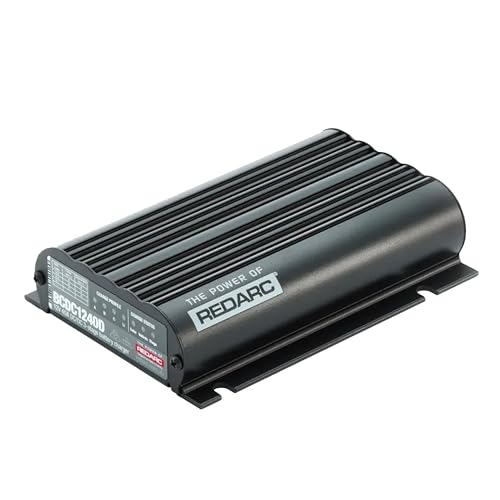
REDARC Dual Input 40A
Takes solar first, easing the load on the alternator.
Why a Lithium Bank Works an Alternator Harder
A lead-acid battery slows its own charging as it fills, because its internal resistance climbs. A LiFePO4 battery behaves differently. It keeps accepting a high current for most of the charge, so a big lithium bank wired straight to the alternator can ask for full output for a long time.
Most vehicle alternators are built for short bursts, like refilling the starter battery after a cold start. Long periods near maximum output make heat, and heat is worst at idle, when the fan and pulley turn slowly and airflow is low. That is how owners end up with a cooked regulator or burnt windings after a lithium conversion.
There is a second risk. A lithium battery’s management system (BMS) can disconnect the battery suddenly, and if the alternator is charging hard at that moment, the voltage can spike and harm its diodes or regulator. We make no claim that a stock alternator is fine on its own with a lithium bank, and neither do the makers below.
Matching the Charging Setup to Your Alternator
Three types of product show up in a sensible charging system for lithium.
- DC-DC charger: draws a set current from the starter battery side and charges the lithium bank with its own multi-stage profile. This is the core of most builds.
- Alternator protection device: a small part wired at the alternator that absorbs a voltage spike if the load disappears suddenly.
- High-output alternator: a larger replacement for vehicles where the stock unit can’t feed a big charger plus the vehicle’s own loads. These are specific to each engine.
Also check whether your vehicle has a “smart” alternator that lowers its voltage once the starter battery is full; the charger then needs a matching setting or an ignition signal. If you want to see whether your current alternator is healthy first, read our list of bad alternator symptoms.
Best Alternator for Lithium Battery Charging: The Picks in Detail
Five chargers and one protection device. Check your alternator’s rated output and your battery’s charge limits before choosing.
1. Victron Orion-Tr Smart 12/12-30: 30A Isolated DC-DC Charger with Bluetooth
- 30 A, 360 W isolated 12V to 12V charger
- Adaptive three-stage charging
- Lead-acid and lithium profiles
- Bluetooth setup in the VictronConnect app
The Orion-Tr Smart 12/12-30 is a DC-DC charger built for dual battery systems, where the alternator and starter battery feed a separate service battery. Victron describes it as an adaptive three-stage charger, moving through bulk, absorption and float, and rates this version at 30 A and 360 W. It is an isolated model, so the input and output can have separate grounds.
Setup happens through the VictronConnect app over Bluetooth. You choose a lead-acid or lithium profile, adjust voltages to match your battery maker’s figures, and watch the charger’s status from your phone. Victron also lists engine running detection and a remote on/off input, which helps on vehicles with a smart alternator. If you later need more current, the maker says identical units can run in parallel.
For a lithium build, the main benefit is control. The charger draws a fixed amount from the starting side, so the alternator never sees the full appetite of a large LiFePO4 bank. Victron rates full output up to 40C and operation up to 55C, so mount it somewhere with airflow rather than buried under carpet. It suits a van or pickup with a mid-size alternator that needs a steady, configurable charge.
View Victron Orion-Tr Smart 12/12-30 on Amazon
2. Renogy 40A DC-DC Charger: 12V Multi-Stage Charger with LiFePO4 Activation
- 40 A, 12V multi-stage charging
- Built-in alternator detection
- LiFePO4 activation you can switch on or off
- Overload, short, heat and over-voltage protection
This is Renogy’s second-generation 40A DC-DC charger for 12V systems, made to charge a house battery from the vehicle’s alternator. The listing covers LiFePO4, AGM, gel and flooded batteries, uses a three-stage charging strategy, and describes the unit as ready for smart alternators. Its wall-mount case keeps the input and output terminals well apart, which Renogy says helps prevent short circuits during installation.
A built-in alternator detection feature means the charger only runs while the engine is running, so it doesn’t drain the starter battery when you park. Renogy also includes a LiFePO4 activation function, which can wake a lithium battery whose management system has shut it off, and you can turn it on or off with one button. Protection covers overload, short circuit, over-temperature and over-voltage.
Bluetooth monitoring needs the separate Renogy BT-2 module. With it, the DC Home app or a Renogy One Core display shows settings and up to 365 days of charging data. At 40 A, this charger asks more of the alternator than the smaller units here, so it fits a vehicle with a larger alternator and a bigger lithium bank. On a small alternator, choose a lower-current charger instead.
View Renogy 40A DC-DC Charger on Amazon

3. REDARC Dual Input 40A: In-Vehicle DC-DC Charger with MPPT Solar Regulator
- 40 A charging from alternator and solar
- Built-in MPPT solar regulator
- Green Power Priority uses solar first
- Sealed for dust, water and heat to 176F
REDARC’s Dual Input 40A charger keeps a second battery charged while you drive, and it accepts both the vehicle’s alternator and solar panels at the same time. A built-in MPPT regulator handles the solar side, so there is no separate solar controller to wire. The listing says it works in 12V and 24V vehicles and charges AGM, gel, standard lead-acid, calcium and LiFePO4 batteries.
The feature that matters most for alternator health is Green Power Priority. REDARC says the charger picks solar first and only tops up from the alternator when the panels can’t keep up, which reduces how hard the alternator works on a sunny day. The multi-stage profile is aimed at battery banks of about 200 Ah and up in common setups.
The case is fully sealed, and the maker rates it for heat up to 176F, dust, vibration and deep water crossings. That makes it a candidate for mounting closer to the engine than most chargers, though you should still follow REDARC’s installation guide for location and cable size. It comes with a 2-year limited warranty. It suits overland trucks and campers that already carry roof solar and want one box to manage both sources.
View REDARC Dual Input 40A on Amazon
4. Schumacher SDC371: 40A 12V DC-DC Charger with Solar Priority Button

- 40 A, 12V output for auxiliary batteries
- Charges from the alternator or solar panels
- IP66 weatherproof housing
- Standard, gel, AGM, calcium and lithium
Schumacher is better known for plug-in garage chargers, and the SDC371 is its permanently installed answer for auxiliary batteries. It is a 40 A, 12V DC-DC charger that takes power from either the vehicle’s alternator or a set of solar panels. A solar priority button lets you switch which source it favors.
Charging runs through three stages: boost, absorption and float. Schumacher designed it to be mounted in the engine compartment, on a chassis rail or inside the cabin, and the housing carries an IP66 weatherproof rating. The listing says it can still deliver its full 40 A at temperatures up to 176F, which matters if it ends up near a hot engine. It works with 12V standard, gel, AGM, calcium and lithium batteries.
In the box you get the charger and its user manual, so cables, fuses and terminals are bought separately to suit your run length. Because it draws up to 40 A from the starting side, it suits a truck or van with a larger alternator. It is a practical choice for a work truck that runs lights, a fridge or tools from a second battery and spends its days outdoors in the weather.
View Schumacher SDC371 on Amazon
5. Victron Orion-Tr Smart 12/12-18: 18A Isolated DC-DC Charger for Smaller Alternators

- 18 A, 220 W isolated 12V to 12V charger
- Three-stage charging for lithium or lead-acid
- Bluetooth monitoring and settings
- Units can be paired in parallel later
The 12/12-18 is the smaller sibling of the Orion-Tr Smart 30A reviewed above, rated at 18 A and 220 W. It shares the same design: an isolated DC-DC charger for systems where the starter battery and alternator charge a separate service battery, using an adaptive three-stage cycle. Victron rates it for both lead-acid and lithium batteries.
The lower output is the point. A compact SUV, small pickup or older vehicle with a modest alternator has less spare capacity once headlights, the blower and wipers are on, especially on a winter evening. Capping the draw at 18 A keeps the extra load modest, while still putting a useful charge into a small LiFePO4 battery during a day of driving.
You get the same VictronConnect Bluetooth app for setting the lithium profile and checking status, plus engine running detection and a remote on/off input listed on Victron’s page. If your needs grow, the maker says you can add a second unit in parallel rather than replacing the first. It suits a weekend camping setup, a small fridge battery, or anyone unsure how much their alternator can spare. Check your battery maker’s settings before the first drive.
View Victron Orion-Tr Smart 12/12-18 on Amazon
6. Sterling Power APD12: 12V Alternator Protection Device for Voltage Spikes

- Activates above 16.5V back voltage
- Applies a small resistive load at 0 A
- Sacrificial protection for the regulator
- Made for 12V alternator systems
The APD12 is not a charger. It is a small alternator protection device from Sterling Power, designed for 12V systems, and it addresses the voltage spike risk that comes with lithium batteries. If a battery management system disconnects the bank while the alternator is charging hard, the sudden loss of load can send voltage climbing fast.
Sterling says the APD12 activates when back voltage exceeds 16.5V. It then applies a small resistive load to keep the voltage from rising further when the current drops to zero. The maker describes it as a sacrificial part, meaning it is meant to take the hit so the more costly alternator and regulator don’t.
This device works alongside a charging system rather than replacing one. It makes the most sense on setups where the alternator feeds a lithium bank more directly, such as boats and vehicles with a battery isolator or relay instead of a DC-DC charger, though Sterling markets it for vehicle systems in general. Installation is at the alternator output, so follow the maker’s wiring instructions or have a technician fit it. It does not limit charging current, so pair it with proper current control when the bank is large.
View Sterling Power APD12 on Amazon
Charger Size Versus Alternator Size
A common rule of thumb from installers is to keep the charger’s draw well below what the alternator can sustain, after allowing for headlights, blower, wipers and the engine’s own electronics. The table below is a starting point, not a substitute for the alternator’s label and the charger maker’s manual.
| Alternator rating | Charger size to consider | Example from this list |
|---|---|---|
| Small, under about 100 A | Around 15 to 20 A | Victron Orion-Tr Smart 12/12-18 |
| Mid-size, about 100 to 150 A | Around 25 to 30 A | Victron Orion-Tr Smart 12/12-30 |
| Large, about 150 A and up | Around 40 A | Renogy 40A, REDARC 40A, Schumacher SDC371 |
| Any size with a big bank | Add spike protection | Sterling Power APD12 |
Victron says on its Orion-Tr Smart charger page that several units can run in parallel for more output, which lets you grow the system in steps instead of buying one oversized charger. Heavy cable and a fuse at each end matter as much as the charger.

If the numbers don’t work, the best alternator for lithium battery charging may be a higher-output unit for your engine. Those are vehicle-specific, so confirm the year, model and engine on the listing before buying.
Lithium Charging Through a West Michigan Winter
Most LiFePO4 battery makers set a low-temperature limit for charging, often around freezing, and some batteries carry built-in heaters for that reason. A camper parked through a Grand Rapids January can sit below that limit for weeks. Read your battery’s charge temperature range and set the charger to match.
Short winter trips leave the lithium bank little charge. When the vehicle sits for the season, a plug-in maintainer with a lithium mode is often the simpler answer, and our best car battery charger for winter guide lists models that handle LiFePO4.

When to Have the Charging System Checked
Get the system tested before a lithium install if the battery light flickers, the headlights dim at idle, or the alternator whines. A struggling alternator fails faster under a new load. A quick voltage check with one of the meters in our automotive multimeter buying guide tells you a lot: around 13.8 to 14.7 volts with the engine running is typical for many vehicles, but your service manual has the exact range.

High-current wiring, fusing and smart alternator settings are easy to get wrong, and a mistake can melt cables or kill the alternator. Our car electrical repair in Grand Rapids covers charging system tests and tracing electrical faults, so you know the alternator is sound before you add a lithium bank.
More Buying Guides
Frequently Asked Questions
Can a stock alternator charge a lithium battery directly?
It can push current into one, but a large LiFePO4 bank may hold the alternator near full output for a long time, which builds heat, and a sudden BMS disconnect can cause a voltage spike. Charger makers such as Victron and Renogy design DC-DC chargers to limit that current.
What size DC-DC charger should I get for my alternator?
Choose a charger whose draw stays well under what your alternator can sustain after the vehicle’s own loads. Small alternators suit chargers around 15 to 20 A, while larger ones can handle 30 to 40 A. Check the alternator label and the charger manual.
Do I need a new alternator for a lithium house battery?
Not always. The best alternator for lithium battery charging is often the one you already have, paired with a correctly sized DC-DC charger. A high-output alternator makes sense when the stock unit can’t cover a large charger plus the vehicle’s normal loads.
What does an alternator protection device do?
Sterling Power says its APD12 switches on when voltage climbs above 16.5V and applies a small resistive load, acting as a sacrificial part that shields the alternator and regulator if the load drops away suddenly.
Planning a lithium setup and want to know your alternator can take it? Reach our shop at 616-279-3832 on weekdays between 8am and 5pm, or set up a charging system check on our contact page.
Daytime hours don’t suit you? Leave the vehicle with our after-hours drop-off at 456 Carrier St NE in Grand Rapids.