
As an Amazon Associate, 456 AutoFix earns from qualifying purchases. Product links below go to Amazon, where you can confirm the right part for your vehicle.
Coding a module or flashing new software keeps the ignition on and every system awake for a long time. If battery voltage sags halfway through, the update can stop and leave a module that won’t respond. The best battery charger for programming isn’t really a charger at all while you work: it’s a power supply that holds system voltage steady until the job is done.
Below we explain supply mode, how many amps different jobs need and what to look for, then review six units whose listings name a power supply or programming mode. For everyday charging and winter storage, start with our guide to the best car battery charger for winter.
Quick answer
Which battery charger is best for programming a car?
Pick a unit with a dedicated power supply or flash mode that holds a fixed voltage with clean output. For full module flashes, a 100A supply like the Clore PL6100 is the safe choice. For app coding and long diagnostic sessions at home, a 20 to 25A unit with supply mode, like the NOCO GENIUSPRO25, usually does the job.
Our Quick Picks
Three quick picks for full module flashes, home coding and lighter key-on work. All six units are reviewed below.

Clore PRO-LOGIX PL6100
Dedicated flash supply with adjustable voltage and clean output.

NOCO GENIUSPRO25
Versatile charger with a clean power supply mode.

Clore PRO-LOGIX PL2320
Compact smart charger that also holds system voltage.
Why Voltage Matters When You Program a Module
When a scan tool or laptop writes new software to a control module, the car sits with the ignition on, modules awake and often the cooling fans, lights and blower running. That load can pull a healthy battery down fast. Many flashes take several minutes and some take far longer, and the module expects steady voltage the whole time.
If voltage drops too far, the module can stop accepting data, and an interrupted flash can leave it unresponsive until the update is completed. Even simple coding and long diagnostic sessions can trip low-voltage warnings that confuse the results. A support unit prevents that by feeding the electrical system directly, so the battery isn’t doing the work.
An ordinary smart charger isn’t built for this. It charges in stages, tapers its current as the battery fills and may pause to test the battery. A unit in supply mode instead holds one set voltage and raises its output as the load rises, which is exactly what a flash needs.
What to Look For: Supply Mode, Amps and Clean Output
- A named power supply mode: look for “power supply”, “supply mode”, “flash reprogram” or “programming mode” in the listing, not just “maintainer”.
- Enough amps: the unit has to keep up with everything that’s switched on. A 20 to 25A supply suits coding and diagnostics; full flashes and ADAS calibrations on larger cars are where 70 to 100A units earn their keep.
- Adjustable voltage: vehicle makers often state the voltage they want during programming. Units that let you dial it in make it easy to follow those instructions.
- Clean DC output: low ripple, fast load response and no spikes protect the modules you’re programming.
- Practical details: cable length and gauge, clamp style and whether the unit needs a dedicated 20A outlet.
| Mode | What it does | Use it for |
|---|---|---|
| Charge mode | Charges in stages and tapers current as the battery fills | Recharging a low battery before you start |
| Maintain or float mode | Holds a full battery at rest with small top-ups | Storage, not programming |
| Power supply or flash mode | Holds a fixed voltage and raises output as the load rises | Coding, flashing, long diagnostics, ADAS calibration |
Best Battery Charger for Programming: The Picks in Detail
Every unit below names a power supply, supply or flash reprogram mode in its listing. They run from home-garage 20A units to 100A shop supplies.
1. Clore PRO-LOGIX PL6100: 100A Flash Reprogramming Power Supply with 60A Charger
- 0-100A on-demand power supply mode
- Adjustable 13.1-14.9V to match OE specs
- Ripple under 100mV with Rapid Load Response
- 60/40/10A charging for lead-acid batteries
The Clore PRO-LOGIX PL6100 is built first as a programming power supply and second as a shop charger. In power supply mode it holds the vehicle’s electrical system at a preset voltage and raises its output on demand, up to 100 amps, as the load climbs. Clore says it is meant to support module reprogramming and ADAS calibration on today’s vehicles, which carry many control modules.
Output voltage is adjustable from 13.1 to 14.9 volts in 0.1-volt steps, so you can set exactly what the vehicle maker’s procedure calls for. Clore’s PL6100 product page lists ripple under 100mV and Rapid Load Response technology for quick recovery when demand jumps. In charge mode it offers 60, 40 and 10 amp rates for flooded, AGM, spiral wound, deep cycle and marine batteries, with a forced start mode for totally dead batteries.
Practical touches include 13-foot #2 AWG cables and PowerJaw clamps that let the hood close on most vehicles during calibration work. It has no lithium charging mode, weighs about 25 pounds and needs a 20-amp circuit, so check your garage wiring first. It suits someone doing full flashes on several cars rather than an occasional coding change.
View Clore PRO-LOGIX PL6100 on Amazon
2. Schumacher INC100: 100A Battery Charger and Power Supply with Flash Reprogram Mode
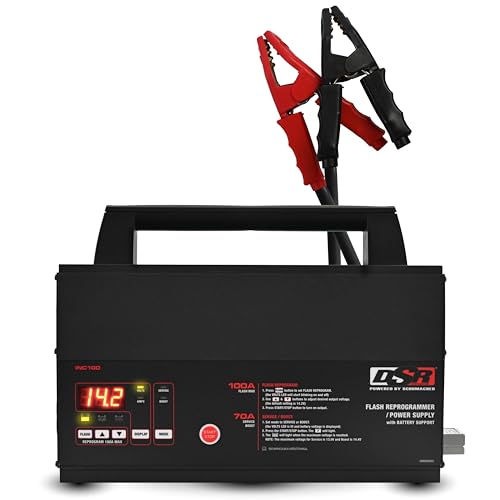
- Flash Reprogram Mode delivers 70-100A
- Service Mode holds up to 13.5V
- Selectable 13.0-14.8V DC output
- Anderson plug and 10 ft 4-gauge cables
The Schumacher INC100 is a professional-grade 12-volt charger and power supply from Schumacher’s DSR Pro line. Its listing focuses on holding stable voltage through every job, so vehicle memory, settings and programming stay intact while you work. It comes with quick-connect battery clamps, four mounting brackets and a user manual.
Three modes cover different tasks. Service Mode holds up to 13.5 volts for general work with the ignition on, Flash Reprogram Mode delivers 70 to 100 amps for ECU updates, and Boost Mode pushes up to 14.4 volts to bring a discharged battery back. The DC output is selectable from 13.0 to 14.8 volts, which helps you match the voltage a programming procedure asks for.
The output side uses an Anderson plug for a secure high-current connection, with 4-gauge, 10-foot booster cables and a 9-foot power cord for positioning in a bay. The brackets let you mount it on a wall or cart. The listing doesn’t name a lithium mode, so it suits lead-acid vehicles, and it is sized for a shop or a serious home garage rather than casual use. Check the manual for setup and mode selection before the first job.
View Schumacher INC100 on Amazon
3. PowerMax PMBC-100-SE: 100A 12V Power Supply and Charger with Adjustable 13-16V Output
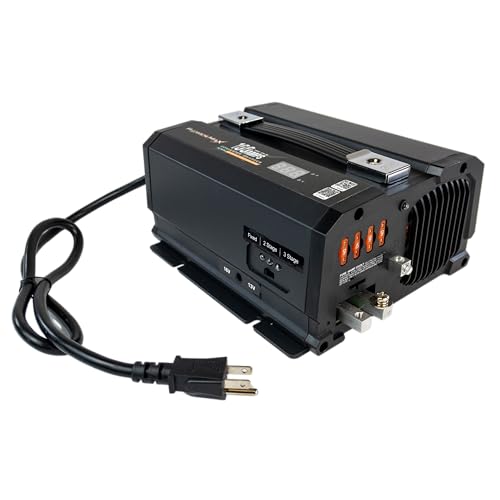
- Up to 100A regulated DC, 1,440W max
- Fixed 13-16V output with under 100mV ripple
- LCD shows output volts and amps
- 15 ft 4 AWG cables and clamps
The PowerMax PMBC-100-SE is a 120-volt AC unit that works as both a 100-amp power supply and a battery charger. The listing says it delivers up to 100 amps of regulated DC output with a rated maximum of 1,440 watts, and names ECU coding, module flashing, diagnostics, ADAS calibration and extended service procedures as its jobs. It is sized for work that runs well past a quick code read.
In Fixed Voltage mode you set the output anywhere from 13 to 16 volts to match the vehicle maker’s requirements, and the listing quotes AC ripple under 100mV. Two charging modes cover 12-volt lead-acid batteries: a 2-stage boost and float, and a smart 3-stage profile with 14.4-volt boost, 13.6-volt normal and 13.2-volt storage settings. An LCD shows output voltage and current in real time, which helps you see how hard the car is pulling.
It ships with 15-foot 4 AWG cables and clamps. Protection covers short circuits, reverse polarity, overload, current limiting and over-temperature, and a temperature-controlled fan handles heat during long sessions. The listing describes compatible lead-acid batteries only, so it isn’t the pick for a lithium battery, and it suits showrooms, service bays and dedicated home setups.
View PowerMax PMBC-100-SE on Amazon
4. NOCO GENIUSPRO25: 25A 6/12/24V Charger with Power Supply Mode and Lithium Charging
- 12V 25A and 24V 12.5A power supply
- Clean output for ECU flashing and diagnostics
- AGM, Gel and LiFePO4 charging
- Thermal sensor and Force Mode
The NOCO GENIUSPRO25 is a professional charger that NOCO describes as a more powerful evolution of its G15000. It charges 6-volt and 12-volt batteries at 25 amps and 24-volt batteries at 12.5 amps, covering lead-acid types such as AGM, Gel, SLA and VRLA as well as lithium LiFePO4 batteries, including deep-cycle and marine types.
Its power supply mode runs at 12 volts and 25 amps or 24 volts and 12.5 amps. The listing says it provides clean, consistent power with no ripple, noise or voltage spikes during ECU flashing, reprogramming and diagnostic testing. That makes it a sensible size for app-based coding, service resets and long key-on diagnostic sessions, though a full flash on a large vehicle may call for a bigger supply.
An integrated thermal sensor adjusts charging to the ambient temperature, which matters in an unheated garage. It charges batteries from as low as 1 volt, and Force Mode handles completely dead batteries. The silicone cables are rated to -40 degrees Celsius, and the box includes a 10-foot extension cable and a storage case. It suits a home mechanic who wants one unit for charging, maintaining and supporting voltage.
View NOCO GENIUSPRO25 on Amazon

5. CTEK PRO25SE: 25A Professional Charger and Power Supply with Lithium Mode

- 25A charger and supply mode
- Dedicated 12V LiFePO4 mode
- 19.6 ft cables with lift bracket
- No need to disconnect the battery
The CTEK PRO25SE is a 25-amp battery charger and power supply designed around the needs of automotive professionals and the electronics in modern cars. Its supply mode supports the battery during diagnostic or fault-finding work so the car keeps its important electronic settings. The listing says there’s no need to disconnect the battery, since the unit is designed not to damage electronic systems.
Charging covers lead-acid batteries, with a reconditioning program and a desulphation function, and there is a dedicated mode for 12-volt LiFePO4 lithium batteries. An automatic temperature sensor adjusts the charge, which helps in a cold garage. CTEK says the voltage and current delivery is clean, with no surges or spikes. That matters when the modules you’re coding are sensitive to unstable voltage.
The 19.6-foot cables, wall hanger and bracket are meant for mounting on a car lift, so you can work under the car without a cable across the floor. The unit is splash and dustproof, non-sparking, reverse polarity protected and short-circuit proof. Like other 25-amp supplies, it suits coding, resets and long diagnostic sessions better than a full flash on a large vehicle. CTEK backs it with a 2-year warranty.
6. Clore PRO-LOGIX PL2320: 20A 6/12V Smart Charger with Stable Power Supply Mode
- 2/10/20A charge rates
- Power supply mode for stable system voltage
- Charges AGM and LiFePO4 batteries
- Forced start and recondition modes
The Clore PRO-LOGIX PL2320 is a 20-amp intelligent charger and maintainer for 6-volt and 12-volt batteries. It offers 2, 10 and 20 amp charge rates and a fully automatic, multi-phase charging process. The listing adds a power supply mode that provides stable power to maintain system voltage in a wide variety of applications.
Clore says the PL2320 delivers power in a very tight voltage window, which is what the car wants when a charger supports battery voltage during on-vehicle repair or electrical diagnosis. The maker also names it for maintaining system voltage during key-on ADAS recalibrations. At 20 amps it suits light coding, service resets and diagnostic sessions rather than a full module flash on a large vehicle.
As a charger it handles flooded, AGM, spiral wound, marine and deep cycle lead-acid batteries as well as LiFePO4 lithium batteries, according to Clore. A forced start mode charges totally dead batteries, and a recondition mode helps batteries with sulfation. It also works as a trickle charger for a stored vehicle. It’s an entry-level choice for an owner who wants a charger first, with voltage support for occasional coding.
View Clore PRO-LOGIX PL2320 on Amazon
How Many Amps for Which Job?
There’s no single number, because the draw depends on the car and what’s switched on. A short coding change through a phone app pulls far less than a full software update on a large luxury SUV with the blower and lights running. Your scan tool’s or the vehicle maker’s instructions are the final word.
| Job | Typical unit | Examples below |
|---|---|---|
| App coding, resets, short diagnostics | 20 to 25A with supply mode | Clore PL2320, NOCO GENIUSPRO25, CTEK PRO25SE |
| Long diagnostic sessions, key-on work | 25A or more with supply mode | NOCO GENIUSPRO25, CTEK PRO25SE |
| Full module flash, ADAS calibration | 70 to 100A flash supply | Clore PL6100, Schumacher INC100, PowerMax PMBC-100-SE |
If you’re unsure, size up rather than down. A bigger supply only delivers the current the car asks for, while an undersized one can let voltage fall at exactly the wrong moment. Also check your outlet: 100A units like the PL6100 need a 20A circuit.
A Safe Programming Session, Step by Step
- Start with a charged, healthy battery: a supply supports the system, it doesn’t hide a failing battery. In a cold West Michigan garage, charge first, since a winter-weak battery sags sooner.
- Connect the supply before you start: clamp on, select supply or flash mode and set the voltage the instructions call for.
- Cut the extra load: lights off, doors closed, blower and accessories off unless the procedure says otherwise.
- Keep the laptop or tablet powered: a dead tool mid-flash is as bad as a dead battery.
- Don’t disconnect anything until the tool says it’s finished: then clear any codes the update set and confirm the module works.

Using an app-based tool on a European car? Our guide to the best scan tool for BMW covers battery registration and coding, and our guide to OBD2 scanners for DIY mechanics explains what different tools can do.
When Programming Is a Shop Job
Phone-app coding and service resets are within reach of a careful DIY owner. Dealer-level flashing is different: it often needs the maker’s own software, a paid subscription and a stable internet connection, and a failed attempt can mean a module has to be recovered or replaced. A good power supply lowers the risk but doesn’t remove it.

If your battery keeps going flat between sessions, the problem may be a drain rather than the charger; our guide to why a car battery dies overnight explains the usual causes. For electrical faults, module problems and charging issues, our car electrical repair in Grand Rapids covers body and engine electronics, and foreign and European car repair handles model-specific steps.
More Buying Guides
Frequently Asked Questions
Can I use a regular battery tender while programming?
Not for a real flash. A tender or maintainer delivers a few amps and tapers its output, so it can’t keep up with a car that has every module awake. Use a unit with a named power supply or flash mode instead.
How many amps do I need for ECU programming?
It depends on the car and the job. A 20 to 25A supply mode suits app coding and diagnostics, while full module flashes and ADAS calibrations on larger vehicles are what 70 to 100A flash supplies are built for. Follow the vehicle maker’s or tool maker’s instructions.
Can I use a jump starter to support voltage while coding?
No. A jump starter is built for short bursts to crank an engine, not for steady output over a long session. Use a supply that plugs into the wall and holds a fixed voltage.
What is the best battery charger for programming at home?
For most home garages, a 20 to 25A unit with supply mode, such as the NOCO GENIUSPRO25, CTEK PRO25SE or Clore PL2320, covers coding and long diagnostic sessions and doubles as a charger. Full dealer-level flashes are better left to a shop with a 100A supply.
Need help with a module, coding or electrical fault in Grand Rapids? Call 456 AutoFix at 616-279-3832, Monday to Friday 8am to 5pm, or book an electrical check through our contact page.
Can’t make it during the day? Use our after-hours drop-off. We’re at 456 Carrier St NE in Creston.