As an Amazon Associate, 456 AutoFix earns from qualifying purchases. Product links below go to Amazon, where you can confirm the right part for your vehicle.
Plenty of Fiestas still commute around Grand Rapids, even though Ford stopped selling the car in the US after the 2019 model year. Picking the best brake fluid for Ford Fiesta models comes down to one detail many owners miss: Ford changed the fluid grade partway through the car’s US run.
Below you’ll find the spec by model year, what the “LV” on later bottles means and five fluids that suit the car. If you want a wider look at the grade, our hub on standard, LV and racing DOT 4 brake fluid compares many more bottles.
Quick answer
Which brake fluid does a Ford Fiesta use?
Owner’s manuals for the 2011 to 2013 Fiesta list Motorcraft PM-1-C DOT 3. From the 2014 model year, Ford calls for DOT 4 LV, Motorcraft PM-20 or a fluid meeting ISO 4925 Class 6. Ford says PM-20 also services cars specified for its DOT 3 fluid, so it covers every year. Check the reservoir cap first.
Our Quick Picks
Three quick picks: the two Motorcraft fluids the Fiesta manuals name, plus a gallon jug for home shops. All five are reviewed below.
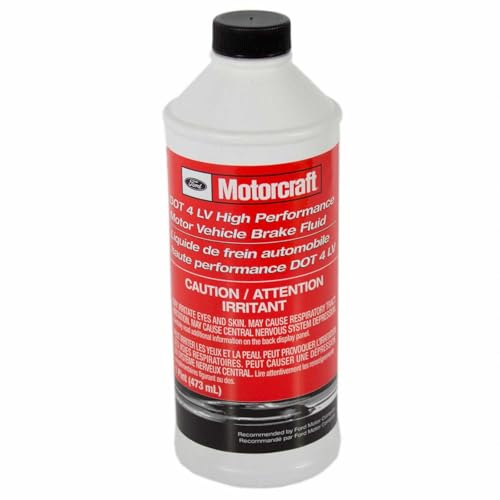
Motorcraft PM-20 DOT 4 LV
The fluid named in 2014 to 2019 Fiesta manuals, and Ford lists it for the earlier DOT 3 spec too.
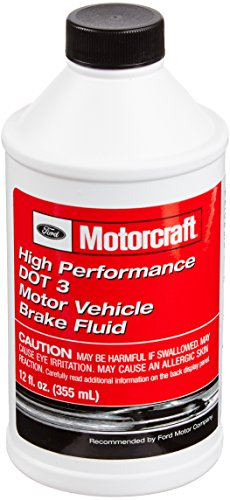
Motorcraft PM-1-C DOT 3
The amber DOT 3 fluid listed in the early Fiesta owner's manuals.

MAG 1 DOT 4 Gallon
A bulk jug for repeated flushes on DOT 3 and DOT 4 cars.
Reading the Fiesta Spec Year by Year
The US Fiesta arrived for 2011 as a sedan and hatchback, and the ST joined for 2014. The capacities table in the 2011 and 2013 owner’s manuals lists “Brake/Clutch fluid” as Motorcraft High Performance DOT 3, part PM-1-C, to Ford specification WSS-M6C62-A or WSS-M6C65-A1.
The 2014 manual switches to Motorcraft or Ford DOT 4 LV High Performance Brake Fluid, specification WSS-M6C65-A2 or ISO 4925 Class 6. Later manuals keep that wording through the end of US sales. Any Fiesta you buy used could fall on either side of that line, so the cap and the manual for your exact year are the final word.
- 2011 to 2013 Fiesta: DOT 3, PM-1-C, WSS-M6C65-A1. Ford’s chemicals catalog says its DOT 4 LV High Performance brake fluid can also service these cars.
- 2014 to 2019 Fiesta and Fiesta ST: DOT 4 LV, PM-20, WSS-M6C65-A2 or ISO 4925 Class 6.
- Manual gearbox cars: the manual lists the item as brake and clutch fluid, because the hydraulic clutch draws from the same reservoir.
What “LV” Means and Why Mixing Rules Matter
LV stands for low viscosity. Ford’s page for PM-20 gives a maximum of 750 mm²/s at -40°F (-40°C), which is the Class 6 limit, and says the thinner fluid gives a faster response at low temperature. That helps the ABS and stability control pump move fluid quickly on a frozen morning.
Every bottle in this guide is glycol based, so DOT 3, DOT 4 and DOT 4 LV blend safely if you top up with a different one. Silicone DOT 5 is a different chemistry and never goes into a Fiesta. Ford also warns against using its DOT 4 LV fluid in vehicles that specify its DOT 5.1 or Super DOT 4 fluid, which does not apply to the Fiesta but matters if you share bottles across a Ford household.
The catch is viscosity. A standard DOT 4 meets the federal boiling point minimums, but none of the non-Ford bottles below claims the Class 6 limit. For a full flush on a 2014 or later car, the factory fluid or another fluid labeled ISO 4925 Class 6 is the safer match.
Best Brake Fluid for Ford Fiesta: Five Bottles Compared
All five fluids are listed on Amazon US and are glycol based. The two Motorcraft bottles come first because they are the fluids named in the manuals, followed by three retail fluids for top-ups, older cars and home shops.
1. Ford Motorcraft PM-20: DOT 4 LV Brake Fluid, ISO 4925 Class 6, 16 oz
- DOT 4 low viscosity formula
- Meets ISO 4925 Class 6
- Made for ABS with stability control
- 16 oz bottle
This is the genuine Ford bottle sold under the Motorcraft name, and it is the fluid the 2014 and later Fiesta manuals call for. The listing describes a low viscosity DOT 4 formula that meets both the federal DOT 4 standard and ISO 4925 Class 6, which is the exact wording in the Fiesta capacities table. The listing adds that it became required for certain vehicles from the 2012 and 2013 model years.
The thinner fluid is the point. Ford says the low viscosity gives a faster response at low temperatures, and the listing recommends it for ABS systems with stability control. On Ford’s own chemicals catalog, the fluid is also approved to service cars that specify the WSS-M6C65-A1 DOT 3 fluid, so one bottle covers early and late Fiestas alike. The catalog lists minimum boiling points of 500°F dry and 338°F wet.
The 16 oz bottle is enough for a top-up and for many flushes, but a car that also needs its clutch line bled may use more, so buying two is sensible. Its yellow color makes old fluid easy to spot at the bleeder. It is not meant for vehicles that call for DOT 5.1 or Ford’s Super DOT 4, so check the cap on any other Ford before sharing it.
View Motorcraft PM-20 DOT 4 LV on Amazon
2. Ford Motorcraft PM-1-C: High Performance DOT 3 Brake Fluid for Disc, Drum and ABS, 12 oz
- High performance DOT 3
- Factory-fill formulation
- For disc, drum and ABS systems
- 12 oz bottle
PM-1-C is the Motorcraft DOT 3 fluid listed in the 2011 to 2013 Fiesta owner’s manuals, under the Ford specifications WSS-M6C62-A or WSS-M6C65-A1. The listing calls it a factory-fill formulation for disc, drum and ABS brakes. If your early Fiesta still has its original cap and manual, this is the bottle they describe, word for word.
Ford’s chemicals catalog says the fluid meets SAE J1703 and the federal DOT 3 standard, with minimum boiling points of 500°F dry and 293°F wet. Those figures sit well above the federal DOT 3 floor, which gives some margin as the fluid absorbs moisture over the years. The fluid is amber, so it looks different from the yellow PM-20 in the reservoir, which helps if you are unsure what a previous owner used.
The limits are clear. Ford says to use PM-1-C only in vehicles that specify WSS-M6C65-A1, so it is not the right fluid for a 2014 or later Fiesta, which calls for the low viscosity DOT 4. The 12 oz size suits a top-up, but a full flush usually needs more than one bottle. Owners who keep both an early and a late Fiesta may find PM-20 simpler, since Ford lists it for both specs.
View Motorcraft PM-1-C DOT 3 on Amazon
3. MAG 1 DOT 4 Brake Fluid: 1 Gallon, High-Temperature Formula for Brake and Clutch Systems
- FMVSS No. 116 DOT 4 performance
- For brake and hydraulic clutch systems
- FMX friction and protection technology
- 1 gallon jug
MAG 1 sells this DOT 4 fluid in a one gallon jug, a size that makes sense for someone who services several cars or flushes brakes and clutches regularly. The listing states FMVSS No. 116 DOT 4 performance and says it is formulated for both hydraulic brake and clutch systems, which fits a manual Fiesta where the clutch shares the brake reservoir.
The listing highlights a high-temperature formula that is designed to hold up in daily and demanding driving, plus protection against wear, corrosion and moisture damage on brake components. MAG 1 also mentions its FMX technology, a name it uses across its fluids for friction management and protection. As a glycol DOT 4 it mixes with DOT 3 and DOT 4 fluids already in a system, and it meets the DOT 3 minimums that the early Fiesta was built around.
What it does not claim is the ISO 4925 Class 6 low viscosity rating that Ford specifies for 2014 and later Fiestas, so for a full flush on those cars the Motorcraft PM-20 is the closer match. Gallon jugs also need care. Once opened, the fluid starts taking on moisture from the air, so keep the cap tight, store it somewhere dry and do not use a jug that has sat half full for years.
View MAG 1 DOT 4 Gallon on Amazon
4. TRIAX DOT 3 and 4 Brake Fluid: Full Synthetic, High Temperature, 1 Quart

- Full synthetic DOT 3 and DOT 4 fluid
- Meets SAE J1703 and J1704
- Exceeds FMVSS No. 116 DOT 3 and 4
- 1 quart bottle
TRIAX markets this as a full synthetic fluid that covers both DOT 3 and DOT 4 systems in one bottle. The listing says it meets SAE J1703 and J1704 and exceeds the federal FMVSS No. 116 requirements for DOT 3 and DOT 4, which lines up with the grades found across Fiesta model years. The quart size gives more fluid than either Motorcraft bottle.
The listing stresses resistance to brake fade and vapor lock, a high boiling point and compatibility with modern ABS, traction and stability systems. TRIAX also describes it as race ready for high heat loads, although the listing does not publish boiling point figures. It lists passenger cars, SUVs, pickups and heavy-duty uses, so one bottle can serve a mixed driveway of vehicles that take DOT 3 or DOT 4.
For a Fiesta, this works well as a top-up fluid or for a flush on a 2011 to 2013 car that specifies DOT 3. It does not state the ISO 4925 Class 6 low viscosity rating, so it is not a like-for-like match for the factory fill on 2014 and later cars. As with any glycol fluid, it mixes with what is already in the system, but never with silicone DOT 5.
5. Wagner DOT 4 ABS Blend Brake Fluid: Top-Up Size for ABS, Disc and Drum Systems, 12 oz

- DOT 4 grade
- ABS blend formula
- Aimed at smooth pedal travel
- 12 oz (355 ml) bottle
Wagner is a long-standing brake parts name, and this small bottle is its DOT 4 fluid blended for cars with anti-lock brakes. At 12 oz it is sized for topping up rather than a full flush, which is how most Fiesta owners will use it: a spare on the garage shelf for the day the level sits near the MIN line.
The listing keeps its claims modest. Wagner says the fluid maintains proper movement for safe stopping, helps deliver a quieter brake system and gives smoother pedal travel, along with longer brake life. It does not list boiling point figures or an ISO class. As a glycol DOT 4 it mixes with the DOT 3 and DOT 4 LV fluids the Fiesta has used from the factory, so a small top-up will not upset the system.
It is not the bottle for a full flush on a 2014 or later Fiesta, since it does not claim the Class 6 low viscosity rating Ford asks for. Use it to bring the level back up, then find out why it dropped. A slowly falling level usually tracks pad wear, while a fast drop or a damp spot near a wheel calls for a closer look before the car goes far.
View Wagner DOT 4 ABS Blend on Amazon
Matching a Bottle to Your Fiesta
Model year and the size of the job decide most of this. The table sorts the five bottles by the work they suit.
| Your Fiesta and job | Fluid that fits | Why | Watch for |
|---|---|---|---|
| 2014 to 2019, full flush | Motorcraft PM-20 | The DOT 4 LV, Class 6 fluid the manual names | A flush with a clutch bleed may need two bottles |
| 2011 to 2013, full flush | Motorcraft PM-1-C or PM-20 | Both are Ford fluids for the WSS-M6C65-A1 spec | Do not move PM-1-C to a later car |
| Any year, small top-up | Wagner DOT 4 ABS Blend, TRIAX DOT 3&4 | Glycol fluids that mix with the factory fill | A low level usually has a cause |
| Several cars or a home shop | MAG 1 DOT 4 gallon | Bulk size for repeated jobs on DOT 3 or DOT 4 cars | Keep the jug tightly capped |
For most owners, the best brake fluid for Ford Fiesta service is simply PM-20, since Ford lists it for both specs the car has used. The retail bottles earn their place for a quick top-up, for an older DOT 3 car or when you look after more than one vehicle. If you also drive a Focus, Fusion or F-150, read each cap before you share a bottle between them.
Fluid Changes, the Clutch and West Michigan Winters
Glycol fluid absorbs water from the air over time, and that moisture lowers its boiling point and feeds corrosion inside the calipers and ABS unit. Ford’s product pages for both Motorcraft fluids give a recommended change-out of every three years. Our article on how often to change brake fluid explains why the calendar matters as much as the odometer.
Grand Rapids puts a Fiesta through humid summers and salted winters, and short trips never warm the fluid enough to drive moisture off. A brake fluid tester pen gives a rough moisture reading at the reservoir between services. On a manual car, a soft or sticky clutch pedal can also point to tired fluid, since the clutch shares it.
A slowly falling level is normal as pads wear, because the caliper pistons sit further out. Check the pads before you add fluid, and replace them before you top up to the MAX line. Our roundup of brake pads for daily driving suits a commuter car like the Fiesta.
Bleeding a Fiesta and When to Book a Shop
A two-person bleed works on the Fiesta, and a one-person kit makes it easier. Our comparison of the brake bleeder kit types for home use explains vacuum, pressure and bottle styles. Manual cars need the clutch line bled too, or old fluid stays in that circuit.
Air trapped in the ABS unit is harder to clear, and some procedures need a scan tool to cycle the pump. Our guide to scan tools for Ford owners covers tools that reach the ABS module. If the ABS warning stays on after a bleed, stop and have it checked.
A pedal that feels soft after a home flush, or that sinks under steady pressure, means the car should not be driven until it is fixed. Our brake repair service in Grand Rapids handles fluid flushes, bleeding, calipers and lines on foreign and domestic cars, the Fiesta included.
More Buying Guides
Frequently Asked Questions
Can I put regular DOT 4 in a 2014 or later Fiesta?
It mixes safely with the factory fill, so a small top-up will not harm the system. Ford still specifies DOT 4 LV that meets ISO 4925 Class 6, so use PM-20 or another Class 6 fluid for a full flush.
Is PM-20 safe in a 2011 to 2013 Fiesta?
Ford’s catalog says PM-20 can service vehicles that specify its WSS-M6C65-A1 DOT 3 fluid, which the early Fiesta manuals list. The reverse does not hold, so keep PM-1-C out of later cars.
What is the best brake fluid for Ford Fiesta ST track days?
For street driving, PM-20 is the listed fluid. Owners who run track days often move to a racing DOT 4 with a higher boiling point and change it more often, which our guide to brake fluid for performance driving covers.
Where is the brake fluid spec on a Fiesta?
It is printed on the reservoir cap and listed in the capacities and specifications section of the owner’s manual. If the two disagree on a used car, the cap may have been swapped, so trust the manual for that model year.
Time for a fresh fluid flush on your Fiesta in Grand Rapids? Call 456 AutoFix at 616-279-3832, Monday to Friday 8am to 5pm, or request a brake appointment on our contact page.
Tied up at work until five? Park the Fiesta at our Carrier St NE shop in Creston, number 456, and leave the keys in the after-hours drop-off.