
As an Amazon Associate, 456 AutoFix earns from qualifying purchases. Product links below go to Amazon, where you can confirm the right part for your vehicle.
A coolant reservoir that keeps dropping with no puddle under the car is one of the more frustrating problems to chase. The best cooling system pressure tester for that job is the one that seals to your filler neck, holds the system at its rated pressure and lets you watch the gauge while you hunt for the drip.
Below: what a pressure test shows, how to choose a connection style, and six testers. If the engine also misfires, pair the test with our compression tester guide, because the two results together point toward or away from a head gasket.
Quick answer
Which coolant pressure tester should a home mechanic buy?
For most domestic and Asian cars, a hand pump kit with cap adapters such as the Mityvac MV4560 covers leak and cap tests. Plastic European expansion tanks need a wider adapter set like the OMT 19-piece kit. If you also refill after repairs, a 33-piece vacuum refill kit saves bleeding time.
Our Quick Picks
Three starting points: an all-round hand pump kit with cap adapters, a universal tester that needs no adapters and a master kit that also refills the system. All six testers are reviewed below.

Mityvac MV4560
Tests the system and the cap with one compact, well-organized kit.

OTC 7991
One tester that seals to many filler necks without a box of adapters.
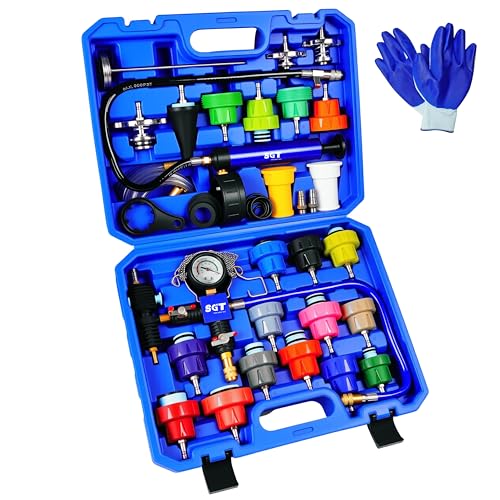
SGT 33-Piece Kit
Pressure tests the system, then pulls a vacuum and refills it without air pockets.
What a Cooling System Pressure Tester Actually Finds
A warm engine pressurizes its coolant, and the cap holds that pressure. A tester recreates it with the engine off and cold: pump to the pressure stamped on the cap, then watch whether the needle holds.
- External leaks: a weeping water pump, a cracked radiator tank, a loose clamp or a pinhole in a hose will drip or mist under pressure, even when it stays dry at idle.
- Internal leaks: if the needle falls and nothing drips, coolant may be going into a cylinder or the oil, which points toward a head gasket, a cracked head or an oil cooler.
- Cap faults: with a cap adapter, you can check whether the cap itself holds its rating and releases where it should.
How to Choose a Cooling System Pressure Tester Kit
Four choices decide whether the best cooling system pressure tester for your garage gets used for years or sits in a drawer.
- Connection style: threaded or bayonet adapters seal to a specific filler neck. A universal cone presses into the neck instead, which saves hunting for the right adapter but does not suit every design.
- Adapter coverage: domestic and Asian radiators share a few common necks, while European cars often use threaded plastic expansion tanks. Count the adapters and check the maker’s fit notes for your vehicle before you buy.
- Gauge and relief valve: a gauge that reads comfortably past your cap rating, plus a relief valve, lets you bleed off pressure before you remove the tester.
- Cap test and refill extras: cap adapters test the cap itself. A vacuum purge and refill tool pulls a vacuum on the system and draws fresh coolant in without air pockets.
Shop air testers swap the hand pump for a regulator and need a compressor.
The Best Cooling System Pressure Tester Options, Reviewed
Features below come from each maker’s Amazon listing or product page. Adapter fit varies by vehicle, so confirm your year, model and engine on the listing before you order.
1. Mityvac MV4560: Hand Pump Cooling System Test Kit with Cap Adapters
- Hand pressure pump with gauge
- 4 cooling system adapters
- 2 dual-function cap test adapters
- Custom-molded storage case
The Mityvac MV4560 is a hand-operated pressure test kit built around the job most home mechanics need done: pressurizing a cold cooling system and watching whether it holds. Mityvac lists it for Asian, European and US cars and light duty trucks. The kit pairs a hand pressure pump and gauge with four cooling system adapters that connect to common radiator and coolant bottle necks.
What sets it apart from a basic pump is the pair of dual-function cap adapters. They let you put the radiator cap or expansion tank cap on the pump and check whether it holds pressure, which matters because a weak cap can mimic a leak or let the engine run hot. The listing describes using the kit to find external leaks at clamps, hoses, connectors, water pumps and radiators, and to point toward internal problems such as a blown head gasket or damaged block.
Everything packs into a custom-molded case, so the adapters stay together between uses. The kit suits someone who maintains one or two family vehicles and wants to test both system and cap without buying extra pieces. If your car uses an unusual threaded expansion tank, check that one of the included adapters matches before you order.
2. OTC 7991: Universal Fit Cooling System Pressure Tester with Case
- Universal fit, no adapter set needed
- Cars, light trucks and SUVs
- Motorcycle, ATV, snowmobile and marine use
- Blow-molded storage case
The OTC 7991 takes a different approach from adapter kits. Instead of a separate threaded or bayonet adapter for each filler neck, OTC uses a universal fit design that the maker says removes the need for multiple adapters. That makes it quick to grab when you want to check a car, a pickup or a small engine without sorting through a tray of fittings first.
OTC lists the tester for most cars, light trucks and SUVs, and also for motorcycles, ATVs, snowmobiles and many marine applications. That range suits someone with a garage full of different machines who would otherwise need several kits. The tester stores in a durable blow-molded case that keeps the pieces together and clean between jobs.
There is one clear limit, and both the Amazon listing and OTC’s product page state it: the tester will not work on Saturns, Kias or Jeeps with a plastic coolant reservoir. Many newer vehicles use pressurized plastic expansion tanks, so check where your cap sits before buying. If your car is on that list or uses a threaded tank, an adapter kit is the better fit.

3. Orion Motor Tech 19-Piece Coolant Pressure Tester Kit: 15 Adapters and 35 psi Gauge

- 15 color-coded radiator adapters
- 2.5 in. gauge, up to 35 psi
- Manual vacuum pump and probe thermometer
- Aluminum, nylon, rubber and brass build
Orion Motor Tech’s 19-piece kit is aimed at people who work on more than one make. It includes 15 radiator adapters, a manual vacuum pump, a probe thermometer, a wrench and spare O-rings, and the listing names compatibility with makes such as BMW, Ford, Fiat, VW, Porsche, Mercedes-Benz, Nissan, Peugeot and Chrysler. That spread covers many of the threaded plastic expansion tanks that simple kits miss.
The pressure gauge is 2.5 inches across with a protective rubber coating, and OMT rates it for testing pressurized cooling systems up to 35 psi. The adapters are color coated with molded size markings, so finding the right one is quicker than reading part numbers. The probe thermometer is a practical extra, because it lets you confirm the coolant has cooled before you open the system.
Parts are made from aluminum alloy, nylon, rubber and brass, and they store in a custom molded case. This kit suits a home mechanic who looks after a mix of domestic and European vehicles. It is a leak and pressure tester first; the manual vacuum pump is not the same as the purge and refill tool in larger master kits.
View OMT 19-Piece Kit on Amazon
4. SGT 33-Piece Coolant Pressure Tester and Vacuum Refill Kit: 23 Adapters
- 23 radiator adapters including a universal
- Vacuum purge and refill tool
- 0-35 psi pressure, 0-30 inHg vacuum gauges
- Probe thermometer and molded case
Super Garage Tools’ 33-piece kit combines a pressure tester with a vacuum purge and refill tool, which answers the search for a cooling system pressure tester and filler in one box. It includes 22 adapters plus a universal adapter, a vacuum pump, the purge and refill tool, a probe thermometer, a wrench, O-rings, hoses and air inlet connectors for EU, US and Japanese fittings.
The listing gives a pressure gauge range of 0 to 35 psi and a vacuum range of 0 to 30 inHg. In practice, you pressure test to find the leak, fix it, then use shop air through the refill tool to pull the system into vacuum and draw new coolant in. That helps avoid trapped air, which can cause overheating and weak heater output after a repair. SGT lists a wide range of makes, from GM, Jeep and Toyota to Volvo, Audi and Mini Cooper.
Adapters are color coded, the refill tool uses a metal valve, and everything stores in a custom-molded case. This kit suits a DIYer who replaces hoses, water pumps or radiators and wants one set for testing and refilling. The refill tool needs an air compressor to run, so factor that in before choosing it.
View SGT 33-Piece Kit on Amazon

5. OEMTOOLS 27069: Steel Cooling System Pressure Test Pump, 4-30 psi

- 4 to 30 psi test range
- Steel pump construction
- Lever-style pressure relief valve
- Works with most cooling system adapters
The OEMTOOLS 27069 is a pressure test pump on its own, without an adapter set. OEMTOOLS says it works with most cooling system adapters and with almost any coolant pressure tester adapter kit, and sells adapters separately. That makes it a good fit for someone whose old pump has worn out, or who already owns the right adapter for their car.
The listing gives a test range of 4 to 30 psi, which covers the cap ratings of most passenger cars and light trucks. The pump body is steel, and the lever-style relief valve lets you release pressure in a controlled way before removing the adapter. That matters because popping an adapter off a pressurized system can spray coolant. OEMTOOLS states the pump suits most domestic and import vehicles.
A blow-molded case comes with the pump and has room for adapters you buy later. Because nothing connects to a filler neck out of the box, this is not the right first purchase for someone starting from scratch. It suits a returning DIYer, or a small shop building its own adapter collection, who wants a durable pump with a clear relief valve.
6. Astro Pneumatic 7856: Air-Powered Cooling System Pressure Tester, 30 psi Max

- Regulates shop air for testing
- Regulator maxes at 30 psi
- Quick connector fits most cap adapters
- Tests systems and radiator caps
The Astro Pneumatic 7856 replaces the hand pump with a regulator that runs on shop air. You connect it to a compressor line, and it regulates that air down to test the cooling system or a radiator cap for leaks. Astro says it fills even large cooling systems almost instantly, which saves time on trucks and vans with big radiators.
The gauge shows the common pressure levels for different cooling systems, and the regulator tops out at 30 psi to help prevent damage. Because the tool keeps a constant pressure on the system, a leak keeps seeping or hissing while you trace it, rather than fading as a hand-pumped system slowly bleeds down. You still need to set the pressure to your cap’s rating, not to the regulator’s maximum.
Its quick connector works with nearly all brands of cooling system test caps and adapters, but the tester itself does not include them, so you pair it with an adapter kit you own. This suits a home garage or small shop that already runs a compressor and tests cooling systems often. Without shop air it does nothing, so a hand pump kit makes more sense for occasional use.
Matching the Tester to the Job
Pick the row that matches your car and how often you will use the kit.
| Tester | Connection | Extras | Suits |
|---|---|---|---|
| Mityvac MV4560 | Hand pump, 4 neck adapters | 2 cap test adapters | Domestic, Asian and European cars, light trucks |
| OTC 7991 | Universal fit, no adapters | Storage case | Quick checks on many cars, bikes and marine engines |
| OMT 19-piece | Hand pump, 15 adapters | Manual vacuum pump, thermometer | Mixed fleets with European expansion tanks |
| SGT 33-piece | Hand pump, 23 adapters | Vacuum purge and refill tool | Test, flush and refill in one kit |
| OEMTOOLS 27069 | Pump only, adapters separate | Lever relief valve | Owners who already have adapters |
| Astro 7856 | Shop air, regulated | Works with most cap adapters | Garages with a compressor |
If you only own one car and it has a common radiator neck, the best cooling system pressure tester is usually the simplest kit that fits it. A larger adapter set only pays off when you work on several makes.

Already own the Mishimoto 28-piece kit people search for? It is covered in our guide to coolant testers, next to hydrometers and test strips.
Running the Test Safely, Step by Step
Start cold: a hot cap can spray scalding coolant. Wear safety glasses and gloves.
- Top up the coolant and fit the correct adapter, wetting its seal with a little coolant.
- Pump to the pressure printed on your cap, never past it. Overpressure can split an aging radiator tank or hose.
- Watch the gauge for 10 to 15 minutes while you look and listen around the hoses, water pump, radiator seams and heater hoses at the firewall.
- Use the relief valve to release pressure before removing the tester, then test the cap with its adapter.

A slow drop with no visible leak is your cue to dig further. A scanner for DIY mechanics can show the coolant temperature reading and any misfire codes, and a multimeter for automotive use helps rule out a bad temperature sensor or fan circuit. OTC’s product page for the 7991 tester lists the vehicles its universal design does not fit.
Grand Rapids Winters, Heater Trouble and When to Book Us
West Michigan winters are hard on cooling systems. Freeze-thaw cycles work old hoses loose, road salt corrodes clamps, and a weak coolant mix can crack parts when the temperature drops overnight.
Lukewarm heater air on a cold morning often means low coolant or trapped air. If a top-up and pressure test do not fix it, our car heater repair in Grand Rapids covers the heating side of the system.

Hoses, coolant condition and the cap all get a look during factory scheduled maintenance in Grand Rapids, which catches a seep before it becomes overheating. If your test points to an internal leak, book a diagnosis before pouring in a sealer.
More Buying Guides
Frequently Asked Questions
How much pressure should I use when testing a cooling system?
Use the pressure rating printed on your radiator or expansion tank cap, which is often in the mid-teens of psi on passenger cars. Going past that rating can damage an older radiator or hose, so the cap number is the ceiling, not the gauge’s maximum.
Can a cooling system pressure tester find a blown head gasket?
It can point toward one. If the gauge drops steadily with no outside leak, coolant may be escaping into a cylinder or the oil. Confirm with a combustion leak test, a compression test or a leak-down test before deciding on repairs.
Do I need a cooling system pressure tester and vacuum refill kit together?
Not for leak testing alone. A vacuum purge and refill tool is worth adding if you replace hoses, water pumps or radiators yourself, because it fills the system without air pockets that cause overheating and poor heater output.
How long should a cooling system hold pressure?
A healthy system should hold its test pressure with little or no drop for about 10 to 15 minutes. A fast drop usually means an obvious external leak, while a slow drop with dry hoses calls for a closer look at internal causes.
Pressure test done and still not sure what the gauge is telling you? Phone 456 AutoFix at 616-279-3832 between 8am and 5pm, Monday to Friday, or send us a note from the contact page to set up a visit.
If your workday clashes with our hours, the after-hours drop-off lets you leave the car and the keys with us. Bring the cooling system leak to 456 Carrier St NE, Grand Rapids, MI 49505, with your pressure test numbers if you have them.