
As an Amazon Associate, 456 AutoFix earns from qualifying purchases. Product links below go to Amazon, where you can confirm the right part for your vehicle.
Coolant keeps dropping, the temperature gauge creeps up on long climbs, and there is a sweet smell after every drive. When a head gasket starts to leak, the best head gasket sealer is a pour-in product that matches your leak, your coolant and your engine size, and it buys time rather than replacing the gasket.
Below: what these bottles can do, how to confirm the gasket is the problem, and six sealers. If the cooling system is dirty or full of old coolant, our radiator flush guide explains the cleaning step some labels ask for first.
Quick answer
Which head gasket sealer should I try first?
For a small leak in an engine that can still idle without overheating, Bar’s Leaks HG-1 is a strong first choice because it mixes with existing antifreeze. K-Seal ST3501 suits minor seeps, and BlueDevil 38386 is a particle-free option. Treat any of them as a stopgap until the gasket is properly diagnosed.
Our Quick Picks
Three starting points: an antifreeze-compatible formula, a quick fix for small seeps and a particle-free sealer. All six bottles are reviewed below.

Bar's Leaks HG-1 Head Seal
An antifreeze-compatible sealer that goes straight into the existing coolant.

K-Seal ST3501 Pour & Go
A one-step formula aimed at small head, gasket and block leaks.

BlueDevil 38386 Head Gasket Sealer
A liquid sealer with no particles, made to avoid clogging narrow passages.
What a Pour-In Head Gasket Repair Sealer Can and Can’t Do
A head gasket keeps combustion pressure, coolant and oil apart between the cylinder head and block. When it fails, coolant can leak outside, burn in the cylinders or seep into the oil. A pour-in sealer travels with the coolant, finds the gap where heat and pressure are highest, and hardens there.
Some formulas rely on sodium silicate that cures with combustion heat, others add carbon or ceramic fibers to bridge a wider gap, and a few skip particles entirely to avoid clogging narrow passages.
Even the best head gasket sealer works only on a slow coolant loss or a small crack. It is a long shot on a badly warped head, and no help at all when overheating comes from a stuck thermostat or a dead water pump.
Confirm It Is the Gasket Before You Pour
Overheating and coolant loss have plenty of causes besides the head gasket, including a leaking hose, a cracked radiator tank or a weak radiator cap. K-Seal’s own guide to fixing a blown head gasket lists a compression test, a cooling system pressure test and exhaust gas analysis as the way to confirm the diagnosis. It also notes that most blown gaskets end up needing a replacement part.
Classic signs include sweet-smelling vapor from the tailpipe, bubbles in the coolant reservoir with the engine running, and a creamy film inside the oil filler cap. Our guides to white smoke from the exhaust and a milky substance under the oil cap explain which causes are harmless and which point to a gasket.
Best Head Gasket Sealer Options: Six Bottles Reviewed
The list runs from antifreeze-compatible formulas to heavier block sealers and a cylinder-specific bottle. Claims come from each Amazon listing or maker page.
1. Bar’s Leaks HG-1 Head Seal: Carbon Fiber Blown Head Gasket Repair, 33.8 oz
- Mixes with all 50-50 coolant types
- No draining or thermostat removal
- Carbon fiber reinforced formula
- Gasoline and diesel engines
Bar’s Leaks HG-1 is the brand’s professional-grade blown head gasket repair, sold in a 33.8 fl oz bottle. The maker’s product page says one bottle treats cooling systems holding roughly 2.5 to 5 gallons. Its formula combines a sodium silicate sealing liquid with gasket sealing particles reinforced with carbon fiber, which flow to a gap and harden into what Bar’s Leaks calls a ceramic-type seal.
The practical draw is the prep. The listing says it mixes with all common 50-50 coolants, including yellow, orange, pink, red, blue and green, silicate and non-silicate (OAT and HOAT) antifreeze, so you do not have to drain the system or pull the thermostat. It is listed for gasoline and diesel engines, along with intake gasket leaks and warped or cracked heads and blocks.
Bar’s Leaks also gives a simple screening test. Your engine is a good candidate if it can idle for 15 minutes without overheating or needing more coolant. An engine that boils over sooner has damage beyond what most pour-in products can bridge. Think of HG-1 as a stopgap for a small, early leak, then keep watching the coolant level and the oil cap over the following weeks.
View Bar's Leaks HG-1 Head Seal on Amazon
2. K-Seal ST3501 Pour & Go: Head Gasket Sealer with Ceramic Micro-Fibres, 16 oz
- Seals holes and cracks up to 0.64 mm
- Ceramic micro-fibre formula
- Works with all coolant types
- One-step pour-in treatment
K-Seal ST3501 is a 16 oz pour-in head gasket sealer from the K-Seal range, listed for blown head gaskets, cracked heads and porous engine blocks. The listing says the formula has 33% more sealing power than regular K-Seal. It is built around ceramic micro-fibres that lodge in a crack or hole and bind together as the coolant circulates.
Its stated limit is useful to know before you buy: K-Seal says it seals leaks up to 0.64 mm. That fits a slow seep or a hairline crack, not a gasket that has failed badly between two cylinders. The listing says it works with all types of coolant, so there is no draining, and the one-step approach suits owners who want to treat the problem without tools.
One detail in the listing deserves attention. If you see bubbles coming from the radiator or reservoir, or the product is not sealing, K-Seal says the system may be over-pressurized, which often points to combustion gas being forced into the coolant. That symptom calls for a proper test rather than a second bottle. K-Seal’s technical notes on the listing explain the extra steps it recommends in that case.
View K-Seal ST3501 Pour & Go on Amazon

3. BlueDevil 38386 Head Gasket Sealer: Particle-Free Formula for Gas and Diesel, 1 Quart
- Contains no solid or particulate matter
- Bonds to aluminum, cast iron, alloy and plastic
- Gasoline and diesel engines
- Also listed for heater cores and freeze plugs
BlueDevil 38386 is a one-quart head gasket sealer that takes a different route from fiber-reinforced products. The listing says it contains no solid or particulate matter and will not clog or harm the engine. Instead, the liquid is designed to bond to metal, aluminum, cast iron, alloy and plastic once it reaches a leak, which is why many owners pick it when a heater core or a narrow radiator is a concern.
According to the listing, it repairs and seals leaks in blown head gaskets, warped or cracked heads, heater cores and freeze plugs. It is listed as compatible with gasoline and diesel engines, so the same bottle can cover a family sedan or a diesel pickup. BlueDevil describes the seal as permanent, though as with any sealer, results depend on how damaged the gasket already is.
Prep matters more with this product than with the add-to-coolant options above, so read the instructions on the bottle before you start and follow every step about flushing, fill and idle time. Skipping them is a common reason for a failed treatment. If your engine overheats within a few minutes of starting, a quart of sealer is unlikely to hold, and a pressure test is the next step.
View BlueDevil 38386 Head Gasket Sealer on Amazon
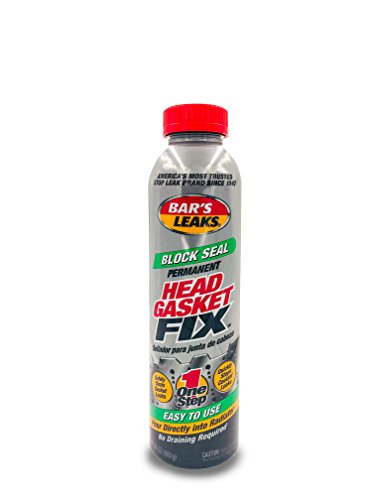
4. Bar’s Leaks Block Seal Head Gasket Fix: Heavy-Duty Sealer for Aluminum and Cast Iron
- Sodium silicate plus sealing particles
- Aluminum and cast iron heads and blocks
- Traditional or extended life coolant
- One step, no draining required
Bar’s Leaks Block Seal is the brand’s heavy-duty head gasket fix, and it reaches a little further than a standard stop leak. The listing describes a one-step mix of antifreeze-compatible sodium silicate sealing liquid and sealing particles in several sizes. These penetrate gaps and cracks, then harden with combustion heat to stop the leak.
The listing names a wide range of repairs: head gaskets, cylinder heads, intake gaskets, cracked blocks and freeze plugs, on both aluminum and cast iron engines. It works with traditional and extended life coolants, including silicate and non-silicate OAT and HOAT types mixed 50-50, so there is no draining. That makes it a natural next step if you are searching for a block sealer rather than a gasket-only product.
The suitability test is slightly more generous than HG-1’s. Bar’s Leaks says an engine is a good candidate if it can idle for 20 minutes without overheating or needing coolant. If yours cannot manage that, the damage is probably too large for a pour-in treatment. Block Seal is made in the USA, and it pairs well with a careful cooling system inspection afterward.
View Bar's Leaks Block Seal on Amazon

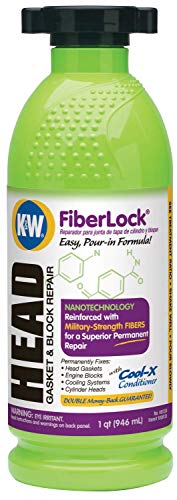
5. K&W 401224 FiberLock: Head Gasket and Block Repair with Reinforcing Fibers, 32 oz
- Fibers build a layered, web-like seal
- Pour-in, no draining needed
- Rated to seal larger holes
- 32 fl oz bottle from CRC Industries
K&W FiberLock 401224 is a 32 fl oz head gasket and block repair from CRC Industries, the company behind the K&W line. Its formula uses what the listing calls military strength fibers, which build a multi-layer repair over a crack with a web-like weave. A second ingredient described as nanotechnology is meant to fill the smallest cracks and crevices that fibers alone would miss.
The listing says FiberLock seals larger holes with less fluid loss than competing products and repairs leaks in 30 minutes or less. It is a pour-in formula, so you do not have to drain the cooling system first. K&W also states that it lowers operating temperature as it circulates, which may help an engine that has been running slightly warm because of the leak.
Because it relies on fibers, this is a better match for a stubborn crack or a gasket leak that a lighter liquid has not stopped. That same feature means you should follow the bottle’s directions on dose and idle time closely. On a car with a small heater core, keep an eye on cabin heat after treatment, and use it as a short-term fix while you plan the real repair.
View K&W FiberLock 401224 on Amazon
6. Steel Seal Blown Head Gasket Fix: Pour-In Sealer Sized for 8 Cylinder Engines

- Dosed for 8 cylinder engines
- Do-it-yourself pour-in treatment
- Heat-activated formula
- 4 cylinder version sold separately
Steel Seal sells its blown head gasket fix by engine size, and this bottle is the version for 8 cylinder engines. That matters on a V8 truck or SUV, where the cooling system holds more coolant than a compact car and a small bottle would be diluted. A separate 4 cylinder version is listed for smaller engines, so check which one matches your vehicle before ordering.
The maker describes Steel Seal as a thermochemical formula, a blend of compounds that react under heat and pressure to form a hardened seal in the damaged part of a head gasket or block. Steel Seal says it contains no fibrous particles or fillers, which sets it apart from the fiber-reinforced products above. The listing presents it as a do-it-yourself pour-in fix that it says is used by repair shops nationwide.
Steel Seal is also unusually frank on its own website. The company says it always insists on a mechanical repair and that the most reliable way back on the road is a head gasket replaced by a trained professional. Read that as a fair summary of every product here: a bottle can buy time on a leaking V8, but plan for a diagnosis.
View Steel Seal 8 Cylinder on Amazon
Matching a Sealer to Your Leak
The best head gasket sealer for your engine comes down to how much prep you will do and how bad the leak is. This table sums up each listing.
| Sealer | Coolant handling (per listing) | Good starting point for |
|---|---|---|
| Bar’s Leaks HG-1 | Mixes with all 50-50 coolant types, no draining | Small leaks where the engine idles 15 minutes without overheating |
| K-Seal ST3501 | Works with all coolant types | Seeps and cracks up to 0.64 mm |
| BlueDevil 38386 | Check the label’s prep steps | Owners who want a formula with no solid particles |
| Bar’s Leaks Block Seal | Traditional or extended life coolant, no draining | Heads, blocks and freeze plugs; 20-minute idle test |
| K&W FiberLock | No draining needed | Larger holes and cracks in the cooling system |
| Steel Seal 8 Cylinder | Pour-in, sized by cylinder count | V8 engines; a 4-cylinder version is sold separately |

A sealer works more predictably in clean coolant of the right type, and our coolant brand guide covers which formulas match which makers. Rough running with no coolant loss at all is more often a fuel or ignition issue, which our fuel system cleaner picks touch on.
Using a Sealer Without Making Things Worse
Skipping the label’s steps is a common reason a treatment fails. The general pattern:
- Start cold: never open a hot radiator cap.
- Fix easy leaks first: a split hose will keep leaking whatever is in the coolant.
- Follow the label on prep: some formulas go into the old coolant, others want a flush first.
- Let it cure: idle or drive exactly as the instructions say.
- Watch afterward: check the coolant level cold for a few days.

West Michigan winters add one step. If a label calls for draining the antifreeze, refill with the correct coolant mix right after treatment, because plain water left in the engine during a January cold snap can freeze and crack the block.
When the Bottle Is Not the Answer
A sealer is a stopgap, not a repair. If the engine overheats within minutes, coolant is pouring into the oil, or the leak returns after one treatment, keep driving to a minimum. Running hot can warp the head further and turn a gasket job into a much bigger one.

When the heater has gone cold along with the coolant loss, our car heater repair service can look at that side of the system, and a check engine light diagnostic reads the misfire codes a leaking gasket often sets. Booking an oil change in Creston is also an easy way to get a second pair of eyes on milky oil.
More Buying Guides
Frequently Asked Questions
What is the best head gasket sealer brand?
No single brand suits every engine. Bar’s Leaks, K-Seal, BlueDevil, K&W and Steel Seal all sell established formulas, and the right one depends on whether you can leave the antifreeze in, how large the leak is, and what your engine’s coolant type is. Read the label against your owner’s manual.
Is a head gasket sealer spray the same as a pour-in sealer?
No. Spray-on gasket coatings, such as copper sprays, are applied to a new gasket during installation with the engine apart. A pour-in sealer goes into the cooling system of an assembled engine and tries to plug a leak that already exists.
Does a head gasket sealer permanently fix a blown gasket?
Several makers describe their seal as permanent, but results depend on how damaged the gasket and head are. A small, early leak has the most realistic chance. Even Steel Seal’s maker says it insists on a mechanical repair, so plan for a proper diagnosis and possibly a new gasket.
Do I have to drain the antifreeze before adding a sealer?
It depends on the product. Bar’s Leaks HG-1 and Block Seal list no draining, and K-Seal says it works with all coolant types. Other formulas ask for a flush or a water-only fill first, so follow the bottle’s instructions exactly.
Losing coolant with no puddle in the driveway, or watching the gauge climb in traffic? Phone 456 AutoFix at 616-279-3832 on any weekday from 8am to 5pm, or request a visit through our contact form, and we can check what is behind it before a bottle goes in.
Evenings and weekends work too: park at 456 Carrier St NE in Grand Rapids, use the after-hours drop-off, and we will call you once we have looked it over.