
As an Amazon Associate, 456 AutoFix earns from qualifying purchases. Product links below go to Amazon, where you can confirm the right part for your vehicle.
Bare studs, a thin steel door and a concrete slab that stays frozen until April: that is the garage a lot of West Michigan home mechanics work in. The best garage heater for uninsulated garage use is not simply the biggest one you can afford. It is the one that puts heat where you are standing instead of pouring it out through every gap.
This guide explains why leaky garages behave differently, then reviews five heaters chosen for that problem, from vented gas radiant tubes to a plug-in infrared panel. If you want the wider field start with our main garage heater buying guide.
Quick answer
What heats a garage with no insulation most effectively?
Radiant heat. A vented gas tube heater such as the SunStar SIR45-15-L warms the floor, the car and you directly, so the warmth survives drafts and door openings. Without gas, a 10,000W 240V Dr. Infrared DR-910F can carry a bay, and a Heat Storm infrared panel covers one workbench.
Our Quick Picks
Three ways to beat the drafts: a vented gas radiant tube for the whole bay, a 10,000-watt 240V heater when gas is not an option, and a plug-in infrared panel for bench work. All five heaters are reviewed below.

SunStar SIR45-15-L Tube Heater
A vented radiant tube that warms the slab, the car and you instead of the leaking air.

Dr. Infrared DR-910F
Enough electric output to keep up with a drafty bay when gas is not an option.

Heat Storm Tradesman
Point it at the bench and feel it without warming the whole garage.
Why Uninsulated Garages Swallow Heat
Warm air rises, finds the uninsulated roof deck and leaks out around the overhead door, the window frames and the sill plate. A fan-forced heater keeps reheating that air, so in a drafty building it can run for hours while the floor and your tools stay cold.
Radiant and infrared heaters work the way sunshine does. They warm solid things, such as the slab, the car body, the bench top and your shoulders, and those surfaces hold the heat and give it back slowly. When someone opens the big door for a minute, you lose some air but not the warmth soaked into the concrete.
Whole-Bay Heat or Just Heat at the Bench?
Decide how you actually use the space before you compare models. If you spend Saturday afternoons doing brake jobs and want the whole bay comfortable, you need a permanent heater with real output and a proper fuel or electrical supply. If you mostly stand at one bench sorting parts for an hour, a radiant panel aimed at that spot costs far less to buy and run.
Then match the heater to the building. Gas radiant heaters list a minimum mounting height and large clearances to anything that can burn, and some are meant for ceilings taller than a typical home garage. A 240V heater needs a breaker, wire gauge and in some cases a receptacle that your panel may not have yet.
Best Garage Heater for Uninsulated Garage: Five Picks Reviewed
The five heaters below fall into three groups: two vented gas units for whole-bay heat, a heavy 240V fan heater for homes without gas, and two electric infrared panels for spot work. Match each listing’s fuel, voltage and mounting height to your own garage before you order.
1. SunStar SIR45-15-L: 45,000 BTU LP Infrared Tube Heater with Vacuum Combustion
- 45,000 BTU, liquid propane (LP) version
- Efficiency listed up to 84.5%
- Mounts as low as 8 ft above the floor
- CSA design certified, 110 in overall length
The SunStar SIR45-15-L is a gas-fired infrared tube heater, the type that hangs from the ceiling and runs a long steel tube along the bay. A reflector above the tube sends radiant heat down onto the floor, the car and anyone working below. Because it warms surfaces rather than air, it suits a garage where the walls and door leak heat faster than a fan heater can replace it.
This listing is the liquid propane version rated at 45,000 BTU, with efficiency listed up to 84.5%. The overall length is 110 inches, and the listing allows mounting as low as 8 feet above the floor, which brings it within reach of many home garages that cannot fit taller commercial radiant units. SunStar describes a vacuum system that pulls combustion products through the chamber so they do not leak into the heated space, and the heater is CSA design certified.
A tube heater is a permanent install. It needs a propane supply line and venting, so a licensed gas installer should size the line, set the clearances from the car and any storage, and commission it. It is not a heater you move or take down in spring, and a natural gas house needs the matching NG model instead.
View SunStar SIR45-15-L Tube Heater on Amazon
2. Modine Hot Dawg HD45AS0111: 45,000 BTU Natural Gas Garage Heater with Power Exhaust
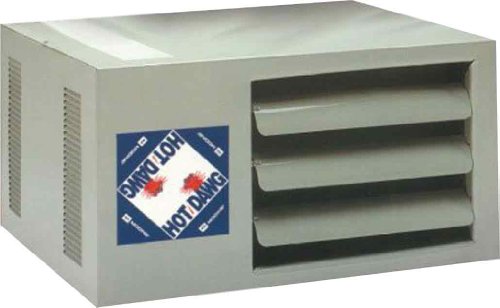
- 45,000 BTU natural gas unit heater
- 80% efficiency listed
- Power exhaust for side-wall or roof venting
- Low-profile body, certified for residential use
The Modine Hot Dawg HD45AS0111 is a natural gas unit heater, a boxy fan-forced heater that hangs in a corner near the ceiling and blows warm air down across the bay. It is one of the most common gas heaters fitted to home garages, and Modine lists it as certified for residential, commercial and industrial use. This model is rated at 45,000 BTU with 80% efficiency.
Its main advantage in an uninsulated garage is simple output. A fan heater loses warm air through gaps, but a gas unit at this rating can keep replacing it far better than a household electric circuit could. The standard power exhaust lets the installer vent through a side wall or the roof with small-diameter vent pipe, and the listing points to knockouts and field wiring connections that make running gas and power to the unit more straightforward. Modine also describes the operation as quiet and the body as low profile with a neutral color.
It is still forced air, so expect the garage to cool quickly after the door opens and plan on sealing the worst drafts. The install needs a gas line, a vent and a power supply, which is work for a licensed gas installer. It is the wrong pick for a propane-only property unless you buy the propane version.
View Modine Hot Dawg HD45 on Amazon

3. Dr. Infrared DR-910F: 10,000-Watt 240V Hardwired Garage Heater with Remote Thermostat
- 10,000W, 240V single phase
- Hardwired with 6 AWG copper, no cord
- Remote thermostat, 50 to 85 degrees
- 5 louvers, timer, UL/cUL listed
The Dr. Infrared DR-910F is a heavy-duty fan-forced electric heater rated at 10,000 watts on a 240-volt single-phase supply. Despite the brand name, this one heats air with a fan rather than radiating heat, but its output is the point. A smaller 5,000-watt heater can struggle to keep up with an uninsulated door and bare walls, while a unit of this size has more headroom on the coldest nights.
It mounts on a wall or ceiling, keeping it clear of the floor, and five adjustable louvers let you direct airflow toward the area where you actually work. A remote-controlled thermostat covers a range of 50 to 85 degrees, so you can hold a lower background temperature and raise it before a job. The listing also mentions a timer, a fully enclosed heavy-duty motor and UL/cUL listing.
The trade-off is the electrical work. The heater is hardwired with no power cord, and the listing calls for 6 AWG copper wire, which points to a large dedicated circuit that a licensed electrician should size and install to local code. If your panel has no room for that, a gas heater or a smaller infrared panel may be more realistic.
View Dr. Infrared DR-910F on Amazon
4. Dr. Infrared DR-239: 3000W Carbon Infrared Heater, IP55 Wall or Ceiling Mount

- 3000W, listed at 10,260 BTU
- 220-240V with NEMA 6-15P plug and cord
- IP55 weatherproof, wall or ceiling brackets
- Remote, overheat protection, ETL listed
The Dr. Infrared DR-239 is a 3000-watt carbon infrared heater that the listing sells for patios, garages and workshops alike. Instead of moving air, it radiates heat onto the people and objects in front of it, and the listing describes the warmth as instant with no warm-up period. That makes it a strong fit for a drafty garage where you want to feel warm at one spot without heating the whole volume.
Output is listed at 10,260 BTU on a 220 to 240-volt supply. Unlike the hardwired heaters here, it comes with a power cord and a NEMA 6-15P plug, so it needs a matching 240-volt receptacle rather than wiring into the panel. Brackets for wall and ceiling mounting are included, and an IP55 weatherproof rating means cold, damp air and the occasional wet car will not worry it. The remote switches between power levels and standby.
The listing adds overheat protection with automatic shut-off and ETL listing, and describes it as odorless and silent with no open flame. It will not warm a whole two-car bay, and if you do not have a 6-15 receptacle, budget for an electrician to install one to local code before you plug it in.
View Dr. Infrared DR-239 on Amazon

5. Heat Storm Tradesman: 1500-Watt Infrared Heater with Tripod, Wall and Ceiling Mounts
- 1500W carbon fiber infrared element
- Tripod, wall and ceiling mount included
- IPX4 weatherproof build, remote control
- 8 ft cord, tip-over safety shutoff
The Heat Storm Tradesman is a 1500-watt infrared heater with a carbon fiber element, built for spaces such as garages, workshops and sheds. At this wattage it plugs into a standard household outlet, which makes it the simplest heater in this guide to start using. It sends focused radiant heat toward whatever it faces, so you feel the warmth even when the air around you stays cold.
Its strongest feature is flexibility. The kit includes a tripod, a wall mount and ceiling or pole hardware, so you can stand it beside a fender for one evening and bolt it above the bench the next weekend. Molded end caps let you angle the heater, an 8-foot cord gives some room to position it, and the listing calls the build IPX4 weatherproof. A remote is included, and the carbon fiber element runs silently with no fan.
Think of it as personal heat rather than garage heat. It will not raise the temperature of an uninsulated two-car bay, but it makes an hour of bench work far more comfortable. Plug it directly into a wall outlet rather than a light extension cord, and rely on the built-in tip-over shutoff only as a backup to keeping it clear of rags and fuel.
View Heat Storm Tradesman on Amazon
Radiant, Forced Air or Infrared: How the Picks Compare
Use this table to narrow the list by the supply you already have and the kind of heat a drafty garage needs from you.
| Heater type | Supply needed | Holds up in a drafty bay? | Picks in this guide |
|---|---|---|---|
| Vented radiant tube | LP line, vent, installer | Yes, warms the slab and car directly | SunStar SIR45-15-L |
| Power-vented unit heater | Natural gas line, vent pipe, power | Yes, if output matches the space | Modine Hot Dawg HD45 |
| 240V hardwired fan heater | Dedicated circuit, 6 AWG copper | Partly, oversize it for heat loss | Dr. Infrared DR-910F |
| Electric infrared panel | 240V 6-15 outlet or 120V outlet | Yes, for the spot it faces | Dr. Infrared DR-239, Heat Storm Tradesman |
Whichever row fits, lighting matters as much as heat on short winter days. Our mechanic work light picks pair well with a radiant panel at the bench, and the electric garage heater guide goes deeper on 240V options if gas is off the table.

Cheap Fixes That Help Any Heater in a Leaky Garage
Even the best garage heater for uninsulated garage conditions works harder than it should if wind is blowing under the door. A few weekend fixes cut that loss without a full insulation job:
- Replace the bottom door seal: a cracked rubber seal lets snow and wind straight in along the slab.
- Weatherstrip the door stops: the gap between the overhead door and its frame is often the biggest leak.
- Insulate the overhead door panels: foam panel kits are a small job compared with insulating the walls.
- Close off the attic hatch or open rafters above the work area: even a tarp overhead keeps rising heat closer to you.
Lake-effect snow makes a West Michigan garage colder in a particular way, because every car you pull in drags slush onto the slab. A squeegee by the door keeps that meltwater from soaking up heat the slab just stored. Plan your organization around the heat, too: a rolling tool chest lets you move the sockets and wrenches into the warm zone instead of walking back to a cold wall.
Carbon Monoxide, Clearances and Who Installs What
A garage holds gasoline, brake cleaner and a car that may drip fuel, so heater safety is not optional. The EPA’s indoor carbon monoxide page lists unvented kerosene and gas space heaters among the main sources of CO indoors, which matters most in a closed winter garage.
- Gas lines and vents: tube heaters and unit heaters need a licensed gas installer for the fuel connection, venting and combustion check.
- 240V circuits: a hardwired heater or a new 6-15 receptacle should be installed by a licensed electrician to local code.
- Unvented propane: follow the maker’s fresh-air requirements, fit a CO alarm and never run it with an engine idling inside.
- Clearance: keep every heater the listed distance from the car, shelving, fuel cans and rags, and wear eye protection when you work overhead to mount one.
If propane is your only fuel option, our propane garage heater guide covers portable units in more detail.

When the Car Needs More Than a Warm Garage
A heated bay makes winter jobs like swapping wiper blades, checking tire pressure or changing a cabin filter far easier, and a solid mechanic tool set handles most of them. Bigger items such as a mileage service with a full inspection are easier on a lift, and our factory scheduled maintenance in Grand Rapids follows your maker’s schedule.
If the car’s own cabin stays cold however warm the garage gets, that points to the vehicle, not the building. Our car heater repair service can find out why.
More Buying Guides
Frequently Asked Questions
Will a garage heater work in an uninsulated garage?
Yes, but it has to be the right type and size. Radiant and infrared heaters hold up best because they warm surfaces rather than air, while a fan heater needs far more output than its square-foot rating suggests to keep up with drafts.
Is radiant or forced air heat better for an uninsulated garage?
Radiant usually wins in a leaky space. It warms the floor, the car and the person working, so the heat stays when the door opens. Forced air suits larger garages only when the heater has enough output to replace the air it loses.
Can I run a propane heater in a closed garage?
Only a heater the maker approves for indoor use, with the fresh air its manual calls for and a working CO alarm. Vented propane heaters send exhaust outside, while unvented ones release combustion gases and moisture into the space, so they suit shorter sessions.
Should I insulate the garage before buying a heater?
Sealing the overhead door and weatherstripping the frame are worth doing first because they are cheap and help any heater. Full wall insulation is a bigger project, and a radiant heater can make an uninsulated garage usable in the meantime.
Spent the winter wrenching in a cold bay and found a job that needs a lift? Give Hendrick’s team a call at 616-279-3832 on a weekday between 8am and 5pm, and tell us what you found under the hood.
If a frozen morning is no time to sit in a waiting room, park the car at 456 Carrier St NE, Grand Rapids after we close and leave the keys in our after-hours drop-off with a short list of what it needs. You can also book ahead through our contact page.