
As an Amazon Associate, 456 AutoFix earns from qualifying purchases. Product links below go to Amazon, where you can confirm the right part for your vehicle.
Propane makes sense in a garage that has no spare breaker space or sits too far from the house for a new circuit. The best propane garage heater for your space comes down to one question: will it run off a portable cylinder, a fixed supply line with no flue, or a vented ceiling unit?
Below we sort propane heaters into those three groups, size them to the bay, then review five models from a carry-around radiant to a vented ceiling unit. If you are still deciding between fuels, our broader garage heater guide compares electric, gas and propane side by side.
Quick answer
Which propane heater suits a home garage?
For weekend jobs, a portable Big Buddy covers up to 450 square feet. A one- or two-car garage with a propane line suits a vent-free wall heater like the 30,000 BTU Blue Flame. Large or detached garages call for a vented ceiling unit, such as the 80,000 BTU model rated up to 2,667 square feet.
Our Quick Picks
Three picks that cover the main propane setups: a carry-around radiant, a wall heater on a supply line and a vented ceiling unit for big garages. The other two are reviewed below.

Mr. Heater Big Buddy Midnight
Carry-around radiant heat with a fan and three output settings.

Mr. Heater 30,000 BTU Blue Flame
Thermostat-controlled convection heat from a fixed propane line.
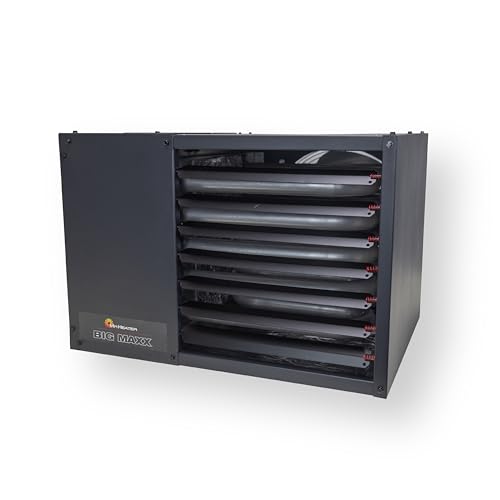
Mr. Heater 80,000 BTU Unit Heater
Ceiling-mount forced-air unit heater for big bays.
Portable, Vent-Free or Vented: Three Ways to Burn Propane in a Garage
Every heater here burns the same fuel, but each one gets it and handles the exhaust differently. That decides the install work and how you live with the best propane garage heater day to day.
- Portable cylinder heaters: carry-around radiant units that run on 1 lb cylinders or a hose to a bigger tank. No install, but they cover a modest area and need fresh air.
- Vent-free wall heaters: blue flame or infrared panels that bolt to a wall and connect to a fixed propane line. All the combustion products stay in the room, so ventilation and a CO alarm are not optional.
- Vented ceiling heaters: forced-air unit heaters and infrared tube heaters that hang overhead and send exhaust outside through a flue. They suit big spaces and long sessions but are a real installation project.
Tank-top and torpedo heaters show up in a lot of propane searches too. Most are built for job sites, patios or other well-ventilated areas, so read the indoor-use wording on any listing before it goes near an enclosed garage.
Matching BTUs to the Bay You Have
Makers quote coverage in square feet, which assumes a reasonably tight room. A typical two-car garage runs somewhere around 400 to 600 square feet, so multiply your own length by width and compare it against the listing rather than going by the number of stalls.
Then adjust for how the space holds heat. An uninsulated overhead door or bare block walls push you toward the top of a heater’s range, or the next model up. Ceiling height matters too, because the hanging heaters below list a minimum mounting height.
Finally, think about fuel supply. A 1 lb cylinder lasts a few hours at most, which is fine for a quick brake job but tiresome for a long Saturday, while wall and ceiling units need a regulated line from a larger tank that a licensed gas installer should run to local code.
Best Propane Garage Heater Picks, Reviewed One by One
The five heaters below run from portable to permanent, so the best propane garage heater for your hookup and floor size should be among them.
1. Mr. Heater Big Buddy Midnight Series: 18,000 BTU Portable Propane Heater with Fan
- 4,000, 9,000 and 18,000 BTU settings
- Heats up to 450 sq ft
- Built-in fan and push-button ignition
- Low-oxygen and tip-over shutoff
The Big Buddy Midnight Series is the larger member of Mr. Heater’s portable radiant family. It offers three output levels, 4,000, 9,000 and 18,000 BTU, and the listing rates it for spaces up to 450 square feet, which lines up with a typical one-car garage or one side of a two-car bay.
A built-in fan pushes the warm air past the front of the heater instead of leaving it all in a narrow radiant beam, and electronic ignition lights it with a button. It runs on two 1 lb cylinders, or on a 20 lb tank through an optional Buddy hose and fuel filter, and the listing quotes up to 96 hours on low from that larger tank. The Life Safety System includes a low-oxygen shutoff, a tip-over shutdown and flame-retardant materials.
Because it needs no wiring or gas line, it suits renters and anyone who only works in the garage now and then. It does put all its exhaust and moisture into the room, so crack a door and keep a CO alarm nearby. The listing notes indoor use is not approved in Canada or Massachusetts, and it will not keep a large drafty space warm.
View Mr. Heater Big Buddy Midnight on Amazon
2. Mr. Heater 30,000 BTU Blue Flame: Vent-Free Propane Wall Heater with Thermostat
- 30,000 BTU blue flame convection
- Heats up to 750 sq ft
- Built-in thermostat, no electricity needed
- Oxygen depletion sensor shutoff
This Mr. Heater unit is a vent-free blue flame heater that connects to a liquid propane supply line. Its 30,000 BTU tube burner warms the air by natural convection, and the listing rates it for spaces up to 750 square feet, a common size for an attached two-car garage.
It needs no electricity and no outdoor vent, so it keeps working through a power outage. An on-board thermostat cycles the burner to hold a set temperature, electronic ignition starts it, and a factory-installed oxygen depletion sensor shuts it off if room oxygen drops too low. It can hang on the wall with the included hardware or stand on the included legs, and Mr. Heater sells an optional blower kit to move the heat further.
Convection heat evens out the room rather than warming one spot, which suits people who spend long stretches in the garage. Being vent-free, it adds water vapor and combustion products to the space, so plan on fresh air and a CO alarm. The listing describes the setup as a do-it-yourself job, but many owners still have a licensed gas installer run and test the propane line, and local codes may limit vent-free heaters.
View Mr. Heater 30,000 BTU Blue Flame on Amazon

3. Dyna-Glo IR30PMDG-1: 30,000 BTU Vent-Free Infrared Propane Wall Heater

- 6,000 to 30,000 BTU variable output
- Heats up to 1,000 sq ft
- Infrared radiant heat
- No electricity required
The Dyna-Glo IR30PMDG-1 is a vent-free infrared wall heater built for liquid propane only, and the listing notes that fuel conversion is not permitted. Output runs from 6,000 to 30,000 BTU per hour, with coverage listed at up to 1,000 square feet.
Infrared heat works differently from the blue flame style above. Instead of warming the air first, it radiates heat to the objects in front of it, much like sunlight, so you, the car and the workbench feel warm quickly even while the air is still cool. The variable control knob gives low, medium and high settings at roughly 6,000, 18,000 and 30,000 BTU, and the heater needs no electricity, which makes it useful as backup heat during an outage.
That direct warmth suits a garage where you work in one area, such as a bench along a wall or the space in front of one stall. It warms corners and far walls less evenly than a convection unit. As with any vent-free heater, run it with fresh air and a CO alarm, keep clearances from the manual, and have the gas line run by a qualified installer.
View Dyna-Glo IR30PMDG-1 on Amazon
4. Mr. Heater 80,000 BTU Unit Heater: Ceiling-Mount Forced Air for Propane or Natural Gas
- 80,000 BTU forced-air output
- Heats up to 2,667 sq ft
- Works with 24V or Wi-Fi thermostats
- High-temperature and flame-sensor shutoffs
The Mr. Heater 80,000 BTU unit is a ceiling-mounted forced-air heater sold for propane or natural gas, built to turn garages, barns and workshops into heated work spaces. The listing rates it for up to 2,667 square feet, which puts it in range of a large three- or four-stall garage or a detached shop building.
A blower moves heated air across the room, and the unit connects to a standard 24-volt thermostat or a newer Wi-Fi model, sold separately, so it can hold a steady temperature all winter. Its low-profile body needs a minimum 10 foot ceiling and 8 feet of clearance from the bottom of the heater to the floor. Safety features include a high-temperature shutoff switch and a gas safety shutoff with a flame sensor.
This is the heater for someone who wants the garage kept warm rather than heated up for an hour. It is a permanent installation with a gas supply, a flue and thermostat wiring, which belongs with a licensed HVAC or gas installer and a permit where your town requires one. It is far more output than a small attached garage needs.
View Mr. Heater 80,000 BTU Unit Heater on Amazon

5. Reznor UDXC-60: 60,000 BTU Propane Unit Heater with LP Conversion Kit

- 60,000 BTU input rating
- 83% thermal efficiency
- LP kit included for propane operation
- Ceiling or wall mount at four suspension points
Reznor sells its UDXC line for commercial, industrial and residential spaces such as workshops, and the UDXC-60 is the size that suits many home garages. The listing rates it at 60,000 BTU with 83 percent thermal efficiency, and it ships with an LP kit that converts the heater from natural gas to liquid propane operation.
The cabinet has threaded-nut retainers at four suspension points, so it can hang from the ceiling or mount on a wall, depending on the bracket you buy, since mounting hardware is sold separately. It is compatible with vertical Category I double-wall B-vent or horizontal Category III single-wall vent pipe, which gives an installer some choice in how the flue leaves the building. Inside, Reznor uses a TCORE2 titanium-stabilized aluminized steel heat exchanger, a single-burner design and a circuit board with a display and status LED.
It sits between the 30,000 BTU wall heaters and the larger 80,000 BTU Mr. Heater, which suits a two- or three-car garage that stays heated through the season. Like any vented unit heater, it needs a gas line, a flue, electrical power and thermostat wiring, so treat it as a job for a licensed HVAC installer working to local code and permit rules.
Five Propane Heaters Side by Side
Narrow the field by the install you are willing to take on, then go back to the full review for the details.
| Heater | Type | Listed output and coverage | Suits |
|---|---|---|---|
| Mr. Heater Big Buddy Midnight | Portable radiant | Up to 18,000 BTU, 450 sq ft | Short jobs, renters, no install |
| Mr. Heater 30,000 BTU Blue Flame | Vent-free convection | 30,000 BTU, 750 sq ft | Attached one- or two-car garages |
| Dyna-Glo IR30PMDG-1 | Vent-free infrared | 6,000 to 30,000 BTU, 1,000 sq ft | Spot warmth at a bench or bay |
| Mr. Heater 80,000 BTU Unit Heater | Vented forced air | 80,000 BTU, 2,667 sq ft | Large or detached garages |
| Reznor UDXC-60 | Vented forced air | 60,000 BTU, 83% thermal efficiency | Shops wanting a commercial-grade unit |
Whichever row you land on, a bright mechanic work light makes winter evenings in the bay far easier on the eyes than a single overhead bulb.

Best Propane Garage Heater for Large Garage Spaces
Once a garage passes three stalls, or has a tall door for a truck or camper, portable and wall units stop keeping up. That is where the ceiling-hung options earn their install cost, because they move heat across the whole floor and keep the exhaust out of the room.
Both vented picks here are forced-air unit heaters that warm the air quickly and run from a wall thermostat, which suits a shop kept at a steady temperature. For the best propane garage heater in a big building, compare the listed coverage with your floor area and leave headroom for a door that opens often. If drafty walls are the bigger problem, the guide to heating an uninsulated garage covers what they do to any heater.
Fumes, Moisture and the CO Alarm You Need
Burning propane makes carbon monoxide and water vapor. The NFPA’s carbon monoxide safety page points to fuel-burning heating equipment as a CO source, recommends alarms on every level and testing them monthly, and warns against running a vehicle or other fueled engine indoors even with the garage door open.
- Alarm first: mount a listed CO alarm in the garage and near the door into the house before the heater’s first run.
- Crack a window or door: portable and vent-free heaters rely on room air, so follow each manual’s fresh-air guidance.
- Clear the snow: after a lake-effect storm, check that a vented heater’s flue is not buried.
- Keep the space clean: store gasoline, solvents and brake cleaner well away from any flame, and never run the car indoors to warm it up.
Vent-free heaters also leave moisture behind, which can show up as condensation on cold tools. Storing sockets and wrenches in a closed rolling tool chest keeps that damp off the steel.
A Heated Bay for Winter Jobs, and When to Hand Them Off
With the chill gone, it gets easier to swap wiper blades, refill washer fluid or recheck tire pressure after a cold snap. A dependable mechanic tool set handles most of that kind of upkeep.
Bigger mileage services are another matter. Our factory scheduled maintenance in Grand Rapids follows the maker’s intervals, and if the garage is toasty but the car’s own cabin stays cold, our article on a car heater blowing cold air walks through the usual causes.

More Buying Guides
Frequently Asked Questions
Is it safe to run a propane heater in a garage?
It can be, if the heater is approved for indoor use, sized to the space and run with the fresh air its manual calls for. Add a working CO alarm, keep fuel and solvents away from the flame, and switch portable units off when you leave.
Do propane garage heaters need to be vented?
It depends on the design. Portable radiant and vent-free wall heaters release exhaust into the room and use oxygen sensors as a backstop, while unit heaters and tube heaters send it outside through a flue. Local code can restrict vent-free heaters, so check before you buy.
What is the best garage heater propane owners can use without any install?
A portable radiant model such as the Mr. Heater Big Buddy needs no wiring or gas line. It runs on 1 lb cylinders or, with the optional hose and fuel filter, a 20 lb tank, and it suits garages up to about 450 square feet.
Is propane cheaper to run than an electric garage heater?
That depends on your local propane and electric rates, the heater’s efficiency and how many hours you run it. Propane does skip the cost of a new 240V circuit, which can tip the math for a detached garage far from the panel.
Spending winter evenings in the garage but would rather not tackle a brake or suspension job on the cold floor? Talk it through with our team at 616-279-3832, open 8am to 5pm on weekdays, or tell us about the car on our contact page.
If the weekday hours never line up with yours, roll the car over to 456 Carrier St NE after we close and leave it with the after-hours drop-off, with a short note on the seat about what you noticed.